
- Catalogs
- The MathWorks
- C and Fortran API Reference

- Products
- Catalogs
- News & Trends
- Exhibitions
C and Fortran API Reference

C and Fortran API Reference
- Engine Session Management: Functions like
engOpen,engClose, andengOpenSingleUseare used to start and terminate MATLAB engine sessions.engOpenstarts a MATLAB process and returns an engine handle, whileengCloseterminates the session.engOpenSingleUseis specific to Windows and allows for single, nonshared use. - Expression Evaluation: The
engEvalStringfunction evaluates expressions within the MATLAB engine session. It communicates with MATLAB using pipes on UNIX systems and COM interfaces on Windows. - Variable Management: Functions like
engPutVariableandengGetVariablemanage variables in the MATLAB workspace.engPutVariablewrites an mxArray to the engine, whileengGetVariableretrieves it. - Visibility Control:
engSetVisibleandengGetVisiblemanage the visibility of the MATLAB engine session on Windows, allowing user interaction to be enabled or disabled. - Output Buffering:
engOutputBufferspecifies a buffer for MATLAB output, allowing the capture of output that would typically appear on the screen.
engdemo.c and engwindemo.c for C, and fengdemo.F for Fortran, which illustrate the use of these functions on different operating systems.This function is used to close a MAT-file associated with a given pointer. It returns EOF in C (-1 in Fortran) for a write error, and 0 if successful. Examples can be found in the eng_mat subdirectory.
This function deletes a named mxArray from a MAT-file. It returns 0 if successful, and nonzero otherwise. Examples are available in the eng_mat subdirectory.
This is a handle to a MAT-file object used for reading and writing MAT-files. The header file is
#include "mat.h". Examples are provided in the eng_mat directory.This function retrieves the directory of mxArrays in a MAT-file. It returns a pointer to an internal array containing pointers to the names of the mxArrays. If it fails, it returns NULL in C (0 in Fortran).
This function obtains a C file handle to a MAT-file, useful for using standard C library routines to investigate error situations.
This function reads the next mxArray from a MAT-file. It returns a pointer to a newly allocated mxArray structure. The order of variables returned is not guaranteed to be the same as the order in which they were written.
This function loads only the array header information for the next mxArray from a MAT-file. It should not be passed back to the MATLAB workspace or saved to MAT-files.
This function copies an mxArray out of a MAT-file. It returns a pointer to a newly allocated mxArray structure.
This function loads only the array header information for a specified mxArray from a MAT-file.
This function opens a MAT-file for reading and writing. It supports various modes such as reading, updating, writing, and creating files in different formats.
This function writes an mxArray to a MAT-file. If the mxArray does not exist, it is appended; if it exists, it is replaced.
This function is similar to matPutVariable but places the array into the global workspace when loaded by MATLAB.
This function registers a function to be called just before a MEX-function is cleared or MATLAB software is terminated, allowing for tasks such as freeing memory and closing files.
Each MEX-function can register one active exit function using
mexAtExit. If called multiple times, the most recent function is used. Locked MEX-files cannot be cleared, and their exit functions are not called.This function allows calling MATLAB functions or MEX-files from within a MEX-file. It requires specifying the number of input and output arguments and the function name. It returns 0 on success and a nonzero value on failure.
mexErrMsgIdAndTxt: Issues an error message with an identifier and returns control to MATLAB. It automatically frees allocated memory.mexErrMsgTxt: Similar to the previous function but without an identifier.
Executes a MATLAB command in the caller's workspace. It does not return values to the MEX-file, unlike
mexCallMATLAB.The entry point for C MEX-files. It handles input and output arguments and is mandatory for every MEX-file.
Returns the name of the current MEX-function.
mexGet: Retrieves the value of a specified Handle Graphics property.mexSet: Sets a graphics property value.
mexGetVariable: Copies a variable from a specified workspace.mexGetVariablePtr: Provides a read-only pointer to a variable in another workspace.
Determines if an
mxArray has global scope.mexIsLocked: Checks if a MEX-file is locked.mexLock: Prevents a MEX-file from being cleared from memory.
Makes an
mxArray persist after the MEX-file completes, preventing automatic memory deallocation.mexMakeArrayPersistent, mexPrintf, mexPutVariable, and others, along with their syntax, arguments, and usage examples.mexMakeArrayPersistent and mexMakeMemoryPersistent are used to make memory allocated by MATLAB persist after a MEX-function completes. Users are responsible for freeing persistent memory using mxDestroyArray or mxFree to prevent memory leaks.mexSetTrapFlag allow users to control MATLAB's response to errors in mexCallMATLAB. By setting a trap flag, users can decide whether MATLAB should terminate the MEX-file or return control to the MEX-file for error handling.mxArray and related functions. mxArrayToString converts an array to a C-style string, while mxAddField adds fields to structure arrays. These functions facilitate data exchange between MATLAB and MEX-files.mexPrintf is used for displaying messages, similar to the C printf function, while mexWarnMsgIdAndTxt and mexWarnMsgTxt issue warning messages without terminating the MEX-file.- mxAssert: Used for checking assertion values during debugging. It prints an error message if the assertion fails and is disabled in optimized MEX-files.
- mxAssertS: Similar to mxAssert but does not print the assertion text, only the error message.
- mxCalloc: Allocates dynamic memory using MATLAB's memory manager. It initializes memory to zero and registers it with the memory manager. In MEX-files, it automatically deallocates memory when the MEX-file ends unless made persistent.
- mxCalcSingleSubscript: Calculates the offset from the first element to a desired element in an mxArray. It uses zero-based indexing in C and one-based in Fortran.
- mxCopyCharacterToPtr: Copies character values from a Fortran array to a pointer array in MATLAB.
- mxCopyComplex16ToPtr and mxCopyComplex8ToPtr: Copy complex values from Fortran arrays to MATLAB pointer arrays, essential for compilers that do not support certain constructs.
- mxChar: Represents string mxArray data elements as mxChar instead of char.
- mxClassID: Enumerates the class of an mxArray, identifying how data is represented (e.g., mxDOUBLE_CLASS, mxINT8_CLASS).
- mxComplexity: Specifies whether an mxArray has imaginary components, using flags mxREAL or mxCOMPLEX.
- mxCopyInteger1ToPtr and mxCopyInteger2ToPtr: Copy integer values from Fortran arrays to MATLAB pointer arrays, facilitating data transfer between Fortran and MATLAB.
- Data Copying Subroutines: The document describes several subroutines for copying different data types between Fortran and MATLAB arrays. These include:
- mxCopyInteger2ToPtr and mxCopyPtrToInteger2: For copying INTEGER*2 values.
- mxCopyInteger4ToPtr and mxCopyPtrToInteger4: For copying INTEGER*4 values.
- mxCopyPtrToCharacter: For copying character values.
- mxCopyPtrToComplex16 and mxCopyPtrToComplex8: For copying complex numbers of different precisions.
- mxCopyPtrToReal4 and mxCopyPtrToReal8: For copying real numbers of different precisions.
- Array Creation Functions: Functions like mxCreateCellArray and mxCreateCellMatrix are used to create unpopulated cell arrays in MATLAB. These functions specify the dimensions and initialize the arrays.
- String Handling: Functions such as mxCreateCharArray and mxCreateCharMatrixFromStrings are used for creating string arrays in MATLAB, either unpopulated or populated with strings.
- These subroutines are crucial for setting up standard Fortran arrays for passing as arguments to the computation routine of a MEX-file.
- Examples are provided in the document to illustrate the usage of these subroutines in Fortran programs.
- Common issues such as insufficient heap space are noted as potential causes for failure when creating arrays.
- Purpose: Returns the address of the first element of the real data in an mxArray.
- Returns NULL if there is no real data.
- Usage: Similar to mxGetPr but returns a void pointer in C.
- Example: Refer to phonebook.c in the examples directory.
- Purpose: Retrieves a pointer to the dimensions array of an mxArray.
- Returns the number of elements in each dimension.
- Example: See mxcalcsinglesubscript.c in the examples directory.
- Purpose: Determines the number of bytes required to store each data element in an mxArray.
- Returns 0 on failure, typically due to an unrecognized class.
- Example: Refer to doubleelement.c in the examples directory.
- Purpose: Returns the value of the MATLAB eps variable, indicating floating-point accuracy.
- Example: See mxgeteps.c in the examples directory.
- Purpose: Retrieves the value of a specified field in a structure mxArray.
- Returns NULL if the field is invalid or unassigned.
- Example: Refer to phonebook.c in the examples directory.
- Purpose: Similar to mxGetField but uses a field number instead of a field name.
- Example: See phonebook.c in the examples directory.
- Purpose: Retrieves the field name given a field number in a structure mxArray.
- Returns NULL if the field number is invalid.
- Example: Refer to phonebook.c in the examples directory.
- Purpose: Returns the field number for a given field name in a structure mxArray.
- Returns -1 if the field name is invalid.
- Example: See mxcreatestructarray.c in the examples directory.
- Purpose: Retrieves a pointer to the imaginary data of an mxArray.
- Returns NULL if there is no imaginary data.
- Example: See mxisfinite.c in the examples directory.
- Purpose: Returns the value of infinity as represented in MATLAB.
- Example: Not explicitly provided.
- Handling Infinity and NaN: Operations like division by zero or overflow result in infinity. The document references functions like
mxGetInfandmxGetNaNto handle these cases. - mxGetIr and mxGetJc: These functions are used to retrieve the row and column indices of non-zero elements in a sparse matrix. They return pointers to the first elements of the respective arrays.
- mxGetLogicals: This function retrieves the starting address of logical elements in an mxArray, allowing access to logical data.
- mxGetM and mxGetN: These functions return the number of rows and columns in an mxArray, respectively. They are crucial for understanding the dimensions of the data structure.
- mxGetNumberOfDimensions and mxGetNumberOfElements: These functions provide the number of dimensions and total elements in an mxArray, aiding in the manipulation of multi-dimensional arrays.
- mxGetNzmax: This function returns the maximum number of non-zero elements that can be stored in a sparse mxArray, which is important for memory allocation and optimization.
- mxGetPr and mxGetPi: These functions retrieve the real and imaginary parts of the data in an mxArray, respectively, allowing for complex number manipulations.
- mxGetProperty: This function is used to get the value of a property from a MATLAB class object, providing access to object-oriented data.
- mxGetScalar: This function retrieves the first real element of an mxArray, often used when dealing with scalar values.
mxgetinf.c, fulltosparse.c, and explore.c, which are located in various subdirectories of the examples directory. These examples illustrate the practical application of the functions described.- Purpose: Copies a string mxArray to a C-style string.
- C Syntax:
#include "matrix.h" int mxGetString(const mxArray *pm, char *str, mwSize strlen); - Fortran Syntax:
integer*4 mxGetString(pm, str, strlen) - Arguments:
- pm: Pointer to a string mxArray.
- str: Starting location for the string.
- strlen: Maximum number of characters to read.
- Returns: 0 on success, 1 on failure.
- Description: Copies character data into a C-style string or Fortran character array, terminating with a NULL character in C.
- Purpose: Determines if input is a cell mxArray.
- C Syntax:
#include "matrix.h" bool mxIsCell(const mxArray *pm); - Returns: Logical 1 (true) if the array is a cell array, 0 (false) otherwise.
- Description: Checks if the specified array is a cell array.
- Purpose: Determines if input is a string mxArray.
- C Syntax:
#include "matrix.h" bool mxIsChar(const mxArray *pm); - Returns: Logical 1 (true) if the array is a string mxArray, 0 (false) otherwise.
- Description: Checks if the specified array is a string mxArray.
- Purpose: Determines if mxArray is a member of a specified class.
- C Syntax:
#include "matrix.h" bool mxIsClass(const mxArray *pm, const char *classname); - Arguments:
- pm: Pointer to an mxArray.
- classname: The class name to test against.
- Returns: Logical 1 (true) if the array is of the specified class, 0 (false) otherwise.
- Description: Checks if the mxArray is of a specified type.
- Purpose: Determines if data is complex.
- C Syntax:
#include "matrix.h" bool mxIsComplex(const mxArray *pm); - Returns: Logical 1 (true) if the array contains complex data, 0 (false) otherwise.
- Description: Checks if an imaginary part is allocated for an mxArray.
- Purpose: Determines if mxArray represents data as double-precision, floating-point numbers.
- C Syntax:
#include "matrix.h" bool mxIsDouble(const mxArray *pm); - Returns: Logical 1 (true) if the array stores data as double-precision, 0 (false) otherwise.
- Description: Checks if the mxArray represents data as double-precision numbers.
- Purpose: Determines if mxArray is empty.
- C Syntax:
#include "matrix.h" bool mxIsEmpty(const mxArray *pm); - Returns: Logical 1 (true) if the array is empty, 0 (false) otherwise.
- Description: Checks if an mxArray contains no data.
- Purpose: Determines if input is finite.
- C Syntax:
#include "matrix.h" bool mxIsFinite(double value); - Returns: Logical 1 (true) if the value is finite, 0 (false) otherwise.
- Description: Checks if a number is finite.
- Purpose: Determines if mxArray was copied from MATLAB global workspace.
- C Syntax:
#include "matrix.h" bool mxIsFromGlobalWS(const mxArray *pm); - Returns: Logical 1 (true) if the array was copied from the global workspace, 0 (false) otherwise.
- Description: Useful for standalone MAT programs to check if an array is from the global workspace.
- Purpose: Determines if input is infinite.
- C Syntax:
#include "matrix.h" bool mxIsInf(double value); - Returns: Logical 1 (true) if the value is infinite, 0 (false) otherwise.
- Description: Checks if a number is equal to infinity or minus infinity.
- Purpose: Determines if mxArray represents data as signed 16-bit integers.
- C Syntax:
#include "matrix.h" bool mxIsInt16(const mxArray *pm); - Returns: Logical 1 (true) if the array stores data as signed 16-bit integers, 0 (false) otherwise.
- Description: Checks if the mxArray represents data as 16-bit signed integers.
- Purpose: Determines if mxArray represents data as signed 32-bit integers.
- C Syntax:
#include "matrix.h" bool mxIsInt32(const mxArray *pm); - Returns: Logical 1 (true) if the array stores data as signed 32-bit integers, 0 (false) otherwise.
- Description: Checks if the mxArray represents data as 32-bit signed integers.
- Purpose: Determines if mxArray represents data as signed 64-bit integers.
- C Syntax:
#include "matrix.h" bool mxIsInt64(const mxArray *pm); - Returns: Logical 1 (true) if the array stores data as signed 64-bit integers, 0 (false) otherwise.
- Description: Checks if the mxArray represents data as 64-bit signed integers.
- Purpose: Determines if mxArray represents data as signed 8-bit integers.
- C Syntax:
#include "matrix.h" bool mxIsInt8(const mxArray *pm); - Returns: Logical 1 (true) if the array stores data as signed 8-bit integers, 0 (false) otherwise.
- Description: Checks if the mxArray represents data as 8-bit signed integers.
- Purpose: Determines if mxArray is of type mxLogical.
- C Syntax:
#include "matrix.h" bool mxIsLogical(const mxArray *pm); - Returns: Logical 1 (true) if the array is logical, 0 (false) otherwise.
- Description: Checks if MATLAB treats the data in the mxArray as Boolean.
- Purpose: Determines if scalar mxArray is of type mxLogical.
- C Syntax:
#include "matrix.h" bool mxIsLogicalScalar(const mxArray *array_ptr); - Returns: Logical 1 (true) if the mxArray is logical and has 1-by-1 dimensions, 0 (false) otherwise.
- Description: Checks if the scalar data in the mxArray is treated as logical or numerical.
- mxIsLogicalScalarTrue: Determines if a scalar mxArray of type mxLogical is true. Equivalent to checking if the array is logical, has one element, and the logical value is true.
- mxIsNaN: Checks if a double value is NaN (Not-a-Number), which represents undefined operations like 0.0/0.0.
- mxIsNumeric: Checks if an mxArray can contain numeric data, covering various numeric classes like mxDOUBLE_CLASS and mxINT32_CLASS.
- mxIsSingle: Determines if an mxArray stores data as single-precision floating-point numbers.
- mxIsUint16, mxIsUint32, mxIsUint64, mxIsUint8: Check if an mxArray represents data as unsigned integers of various bit sizes.
- mxMalloc: Allocates dynamic memory using MATLAB's memory manager, ensuring memory is managed and freed appropriately.
- mxRealloc: Reallocates memory for an existing block, allowing for resizing while maintaining data integrity.
- mxIsSparse: Determines if an mxArray is sparse, which is important for certain matrix operations.
- mxIsStruct: Checks if an mxArray is a structure, which is necessary for functions that manipulate structure fields.
- mxRemoveField: Removes a field from a structure array without destroying the field values.
- mxSetCell: Sets the value of a specific cell in a cell mxArray, allowing for complex data structures within cells.
- Purpose: Assigns a value to a specific cell in a cell array.
- Important Note: Does not free memory for displaced data. Use mxDestroyArray to free memory before calling mxSetCell.
- Examples: Refer to phonebook.c and mxcreatecellmatrix.c in the examples directory.
- Purpose: Converts a structure array to a MATLAB® object array.
- Returns: 0 if successful, nonzero otherwise.
- Important Note: If the class is undefined, the object reverts to a structure array upon loading.
- Purpose: Sets a pointer to data in an mxArray.
- Important Note: Does not free memory for displaced data. Use mxFree to free memory before calling mxSetData.
- Purpose: Modifies the number of dimensions and size of each dimension in an mxArray.
- Important Note: Does not allocate or deallocate space for data arrays. Adjust pr and pi arrays if the number of elements changes.
- Purpose: Sets a field in a structure array given the field name and index.
- Important Note: Does not free memory for displaced data. Use mxDestroyArray to free memory before calling mxSetField.
- Purpose: Similar to mxSetField but uses field number instead of field name.
- Important Note: Does not free memory for displaced data. Use mxDestroyArray to free memory before calling mxSetFieldByNumber.
- Purpose: Sets the imaginary data pointer for an mxArray.
- Important Note: Does not free memory for displaced data. Use mxFree to free memory before calling mxSetImagData.
- Purpose: Sets the ir array of a sparse mxArray.
- Important Note: The ir array must be sorted in column-major order. Does not free memory for displaced data. Use mxFree to free memory before calling mxSetIr.
- Purpose: Sets the jc array of a sparse mxArray.
- Important Note: The jc array defines the column indices for nonzero elements. Does not free memory for displaced data. Use mxFree to free memory before calling mxSetJc.
- Memory Management: Functions like
mxSetM,mxSetN, andmxSetNzmaxare used to set dimensions and manage storage space for nonzero elements in mxArray. These functions do not automatically allocate or deallocate memory, requiring manual adjustments usingmxReallocif the number of elements changes. - Data Manipulation: Functions such as
mxSetPiandmxSetPrare used to set imaginary and real data for mxArray. These functions replace existing data without freeing memory, necessitating the use ofmxFreeto prevent memory leaks. - Property Management: The
mxSetPropertyfunction assigns values to properties of MATLAB class objects, making a copy of the value before assignment, which can impact memory usage. - Examples and References: The document references example files like
mxsetdimensions.candmxsetnzmax.cfor practical implementation guidance.
- Memory management functions do not automatically handle memory allocation, requiring explicit calls to
mxReallocandmxFree. - Changing the shape of an mxArray with
mxSetMormxSetNrequires careful management of associated arrays (pr,pi,ir,jc). - Setting properties with
mxSetPropertyinvolves copying values, which can be memory-intensive.
Catalog excerpts
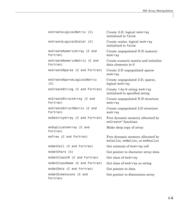
MXArrayManipulation mxCreateLogicalMatrix(C) Create2-D,logical > mxArray initializedto > falsemxCreateLogicalScalar(C) Createscalar,logical > mxArray initializedto > falsemxCreateNumericArray(CandFortran) CreateunpopulatedN-Dnumeric > mxArraymxCreateNumericMatrix(CandFortran) Createnumericmatrixandinitializedataelementsto0 > mxCreateSparse(CandFortran) Create2-Dunpopulatedsparse > mxArraymxCreateSparseLogicalMatrix(C) Createunpopulated2-D,sparse,logical > mxArraymxCreateString(CandFortran) Create > 1 -by- > N string > mxArray initializedtospecifiedstring > mxCreateStructArray(CandFortran) CreateunpopulatedN-Dstructure...
Open the catalog to page 11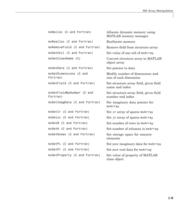
MXArrayManipulation mxMalloc(CandFortran) AllocatedynamicmemoryusingMATLABmemorymanager > mxRealloc(CandFortran) Reallocatememory > mxRemoveField(CandFortran) Removefieldfromstructurearray > mxSetCell(CandFortran) Setvalueofonecellof > mxArraymxSetClassName(C) ConvertstructurearraytoMATLABobjectarray > mxSetData(CandFortran) Setpointertodata > mxSetDimensions(CandFortran) Modifynumberofdimensionsandsizeofeachdimension > mxSetField(CandFortran) Setstructurearrayfield,givenfield nameandindex > mxSetFieldByNumber(CandFortran) Setstructurearrayfield,givenfieldnumberandindex > mxSetImagData(CandFortran)...
Open the catalog to page 15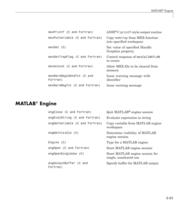
MATLAB Engine mexPrintf(CandFortran) ANSI > ή C > printf -styleoutputroutine > mexPutVariable(CandFortran) Copy > mxArray fromMEX-functionintospecifiedworkspace > mexSet(C) SetvalueofspecifiedHandle Graphicsproperty > mexSetTrapFlag(CandFortran) Controlresponseof > mexCallMATLAB toerrors > mexUnlock(CandFortran) AllowMEX-filetobeclearedfrom memory > mexWarnMsgIdAndTxt(CandFortran) Issuewarningmessagewithidentifier > mexWarnMsgTxt(CandFortran) Issuewarningmessage > engClose(CandFortran) QuitMATLAB > ή enginesession > engEvalString(CandFortran) Evaluateexpressioninstring > engGetVariable(CandFortran)...
Open the catalog to page 17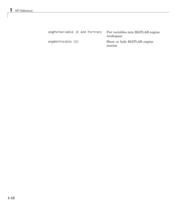
APIReference engPutVariable(CandFortran) PutvariablesintoMATLABengineworkspace > engSetVisible(C) ShoworhideMATLABengine session >
Open the catalog to page 18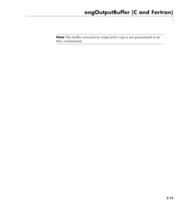
Note Thebufferreturnedby > engEvalString isnotguaranteedtobe > NULL terminated. >
Open the catalog to page 33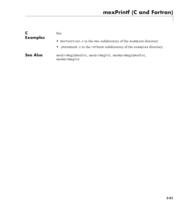
See > mexfunction.c inthe > mex subdirectoryofthe > examples directory Օ > phonebook.c inthe > refbook subdirectoryofthe > examples directory. > mexErrMsgIdAndTxt , > mexErrMsgTxt , > mexWarnMsgIdAndTxt , > mexWarnMsgTxt
Open the catalog to page 79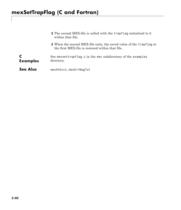
2 ThesecondMEX-fileiscalledwiththe > trapflag initializedto > withinthatfile. > 3 WhenthesecondMEX-fileexits,thesavedvalueofthe > trapflag inthefirstMEX-fileisrestoredwithinthatfile. > See > mexsettrapflag.c inthe > mex subdirectoryofthe > examples directory. >
Open the catalog to page 84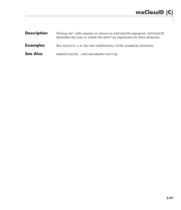
Various > mx* callsrequireorreturnan > mxClassID argument. > mxClassID identifiesthewayinwhichthe > mxArray representsitsdataelements. > See > explore.c inthe > mex subdirectoryofthe > examples directory. >
Open the catalog to page 105
> mxgeteps.c and > mxisfinite.c inthe > mx subdirectoryofthe > examples directory >
Open the catalog to page 164
> mxsetdimensions.c and > mxsetnzmax.c inthe > mx subdirectoryofthe > examples directory > mxGetJc , > mxGetNzmax , > mxSetIr , > mxSetJc , > mxSetNzmax
Open the catalog to page 180
Itismostefficienttousethe > mxIsDouble form. > See > mxisclass.c inthe > mx subdirectoryofthe > examples directory. > mxClassID , > mxGetClassID , > mxIsEmpty , > mxGetClassName
Open the catalog to page 203
> mexget.c , > mexlock.c , > mexsettrapflag.c ,and > yprime.c inthe > mex subdirectoryofthe > examples directory Օ > mxcalcsinglesubscript.c , > mxgeteps.c , > mxgetinf.c ,and > mxisfinite.c inthe > mx subdirectoryofthe > examples directory >
Open the catalog to page 206All The MathWorks catalogs and technical brochures
 MATLAB Production Server
6 Pages
 Database Toolbox
4 Pages
 MATLAB Report Generator
4 Pages
 Stateflow
8 Pages
 SimEvents
7 Pages
 SimDriveline
7 Pages
 SimHydraulics
7 Pages
 SimPowerSystems
8 Pages
 Simulink Control Design
5 Pages
 Aerospace Blockset
5 Pages
 SimRF
SimRF6 Pages
 Simulink Coder
6 Pages
 Embedded Coder
8 Pages
 Simulink PLC Coder
4 Pages
 Fixed-Point Designer
9 Pages
 MATLAB Coder
5 Pages
 Simulink 3D Animation
10 Pages
 Gauges Blockset
2 Pages
 Simulink Report Generator
3 Pages
 Polyspace Bug Finder
6 Pages
 global-optimization-toolbox
10 Pages
 Phased Array System Toolbox
9 Pages
 OPC Toolbox
5 Pages
 Simulink Design Verifier
7 Pages
 Simulink Design Optimization
10 Pages
 Filter Design HDL Coder
5 Pages
 Bioinformatics Toolbox
9 Pages
 SimBiology
6 Pages
 Computer Vision System Toolbox
10 Pages
 DSP System Toolbox
11 Pages
 Fuzzy Logic Toolbox
5 Pages
 Polyspace Client for C/C++
5 Pages
 xPC Target
5 Pages
 SimMechanics
7 Pages
 Simscape
7 Pages
 Simulink
6 Pages
 Data Acquisition Toolbox
8 Pages
 Image Processing Toolbox
7 Pages
 Signal Processing Toolbox
10 Pages
 Control System Toolbox
6 Pages
 Symbolic Math Toolbox?
6 Pages
 Parallel Computing Toolbox?
7 Pages
 MATLAB®
6 Pages
 Mapping Toolbox 3.2
7 Pages
 Instrument Control Toolbox
7 Pages
 Optimization Toolbox 6.0
14 Pages



Archived catalogs
 MATLAB Release Notes
505 Pages
 External Interfaces
649 Pages
 Function Reference: Volume 3 (P-Z)
1696 Pages
 Function Reference: Volume 2 (F-O)
1568 Pages
 Function Reference: Volume 1 (A-E)
1298 Pages
 Creating Graphical User Interfaces
520 Pages
 3-D Visualization
212 Pages
 Graphics
667 Pages
 MATLAB Programming Tips
66 Pages
 Programming Fundamentals
840 Pages
 Data Analysis
220 Pages
 Mathematics
316 Pages
 MATLAB® Getting Started Guide
250 Pages


- Automation software solution
- Management software solution
- Analysis software solution
- Process software
- Real-time software
- Windows software
- Computer-aided design software
- Cloud-based software
- Control software
- Design software solution
- 3D software solution
- Measurement software
- Visualization software solution
- Simulation software solution
- Programming software solution
- Automated software
- Network software
- Reporting software
- Engineering software
- Machine software