
- Catalogs
- Masterwatt Srl
- Electric duct heaters

Electric duct heaters

Electric duct heaters
The electric duct heaters are engineered for controlling the temperature of air or gas flows in industrial settings. They can be integrated into ventilation ducts, tubes, ovens, or autoclaves. The heaters feature finned elements for enhanced heat exchange, with smooth elements used when the fluid contains particles. The design process includes determining specific power, pressure drops, maximum sheath temperature, materials, dimensions, and thermodynamic behavior.
There are two primary types: 'Through Duct Heaters' and 'Plug-in Duct Heaters', both utilizing threaded bushings for easy maintenance.
For high operating temperatures, a 'cold head' construction is employed to distance the electric contact box, using threaded bushings or distancing tubes for maximum tightness, particularly in explosion-proof heaters.
Each heater is equipped with a safety device to limit sheath temperature during unforeseen events, safeguarding both the heater and the plant.
Applications include air conditioning, pre-heating ovens, heating in autoclaves, and specialized uses like heating gases in explosive atmospheres and drying in silos.
Designing an electric duct heater necessitates thermodynamic data, duct or flange dimensions, electrical data, and ATEX certification if applicable. Key data includes fluid type, flow rate, pressure drop, temperatures, and electrical specifications.
MAXIMA duct heaters are designed for less complex heating needs, offering powers from 2.5 to 315 kW and suitable for air velocities of 2.5 to 5 m/s. They can increase air temperature by up to 40°C and operate at temperatures up to 100°C.
The power supply is typically 400 V tri-phase, with options for 1, 2, or 3 power supply stages. Safety sensors include adjustable thermostats and thermocouples.
Selection involves matching duct section, flow rate, and temperature increase requirements, including verifying effective temperature increase using specific coefficients.
An example is provided for selecting a MAXIMA duct heater based on flow rate, duct section, and required temperature increase, demonstrating the selection and verification process.
- Modules: The document lists multiple modules (A, B, C) with varying base, height, and depth dimensions, further divided into subcategories based on power output and other parameters.
- Dimensions: Modules are specified with base (B), height (H), and depth (P) in millimeters.
- Power Output: Power is measured in kilowatts (kW) and varies across different module configurations.
- Minimum Flow Rate: The minimum flow rate (Qmin) is provided in cubic meters per hour (m3/h) for each module.
- Temperature Increase: The temperature increase (dt°) is specified in degrees Celsius (°C).
- Temperature Coefficient: The temperature coefficient (Coeff_T°) is also provided, indicating the efficiency of temperature increase per flow rate.
- Modules are available in different configurations, with base dimensions ranging from 350 mm to 1175 mm.
- Power output ranges from 3.0 kW to 315.0 kW depending on the module and configuration.
- Minimum flow rates vary significantly, from 788 m3/h to 20093 m3/h.
- Temperature increases range from 11.15°C to 45.89°C, with corresponding temperature coefficients provided.
The heaters are designed for the heating of air and gases, suitable for various industrial applications.
The document provides comprehensive data on electric duct heaters, allowing for selection based on specific heating requirements and installation constraints.
Catalog excerpts
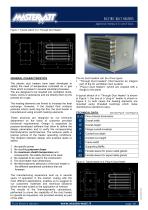
ELECTRIC DUCT HEATERS Ap plicat ion: Heat ing of a i r a nd of Ga se s Figure 1: Typical sketch of a “Through Duct Heater” GENERAL CHARACTERISTICS The electric duct heaters have been developed to satisfy the need of temperature controlled air or gas flows which is present in several industrial processes. The are designed to be inserted into ventilation ducts, tubes, ovens or autoclaves and are directly flown by the process air or gas. The heating elements are finned to increase the heat exchange. However, if the heated fluid contains particles which could clog the fins, the duct heater is manufactured using smooth heating elements. These products are designed by our technical department on the basis of customer provided functional requirements. Design is supported by purpose-developed software that allow to define the design parameters and to verify the corresponding thermodynamic performances. The analysis yields a precise picture of the heater operating conditions. The iteration between design and analysis leads to define: 1. the specific power 2. the resulting pressure drops 3. the maximum sheath temperature and, consequently, the safety devices to be used 4. the materials to be used in the construction 5. The duct heater main dimensions 6. the thermodynamic behaviour of the duct heater in the different operational conditions that are foreseen The air duct heaters can be of two types: “Through Duct heaters” (that become an integral part of the for ventilation duct system) “Plug-in Duct heaters” (which are coupled with a flange to the plant) A typical sketch of a “Through Duct Heater” is shown in Figure 1, the one of a “plug-in” heater Is shown in Figure 2. In both cases the heating elements are mounted using threaded bushings which make maintenance operations easy. TECHNICAL DATA (see also Figure 1 and Figure 2) B x H Flow channel dimensions Overall width Overall height Flange overall envelope Contact box depth Contact box height Frame width Supporting Baffle Female sleeve for power cable glands Female sleeve for signal cable glands Figure 2: Typical sketch of a “Plug-In Duct Heater” Fluid Electric Heaters The manufacturing experience built up in several years of operation in the market, coping with the most different applications, enables us to suggest to our customers materials and technical solutions which are best suited to the application of interest. The results of the thermodynamic calculations, performed to prove the capability of the duct heater to operate as requested, are provided already as part of the offer. p a g e 1/8
Open the catalog to page 1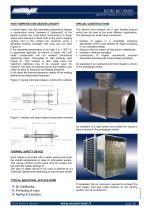
ELECTRIC DUCT HEATERS Ap plicat ion: Heat ing of a i r a nd of Ga se s HIGH TEMPERATURE DESIGN CONCEPT SPECIAL CONSTRUCTIONS In some cases, the high operating temperature impose a construction which foresees a “distancing” of the electric contact box (“cold head” construction). In these cases each element is fixed both to the plant coupling surface and to the contact box structure using a threaded bushing complete with seal and nut (see Figure 3) If the operating temperature is too high (i.e. > 300 °C) to guarantee tightness by means of seals, the “cold head” construction can be realised introducing...
Open the catalog to page 2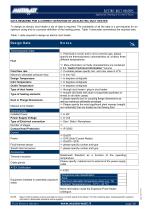
ELECTRIC DUCT HEATERS Ap plicat ion: Heat ing of a i r a nd of Ga se s DATA REQUIRED FOR A CORRECT DEFINITION OF AN ELECTRIC DUCT HEATER To design an electric duct heater a set of data is required. The availability of all the data is a pre-requisite for an optimum sizing and for a precise definition of the heating power. Table 1 hereunder summarises the required data. Table 1: data required to design an electric duct heater Design Data Thermodynamic Data If the fluid is not air and is not a common gas, please specify the thermodynamic characteristics at, at least, three different temperatures...
Open the catalog to page 3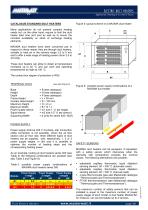
ELECTRIC DUCT HEATERS Ap plicat ion: Heat ing of a i r a nd of Ga se s Figure 5: typical scheme of a MAXIMA duct heater CATALOGUE STANDARD DUCT HEATERS Many applications do not present complex heating needs but, on the other hand, require to limit the duct heater lead time and cost as well as to insure the constant availability on stock of exchange heating elements. MAXIMA duct heaters have been conceived just to respond to these needs: they are through duct heaters, suitable to heat air in the velocity range 2.5 to 5 m/s and to offer a wide range of heating powers (from 2.5 to 315 kW). These...
Open the catalog to page 4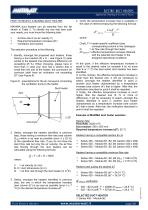
ELECTRIC DUCT HEATERS Ap plicat ion: Heat ing of a i r a nd of Ga se s 4. Verify the temperature increase that is available in the case of interest employing the following formula: HOW TO SELECT A MAXIMA DUCT HEATER MAXIMA duct heaters can be selected from the list shown in Table 2. To identify the one that best suits your needs, you must know the following data: Air flow rate Q (or air velocity V) Required temperature increase (∆T) Ventilation duct section The selection procedure is the following: 1. identify, amongst the proposed duct heaters, those having a duct section (B x H – see Figure...
Open the catalog to page 5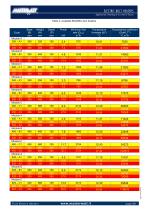
ELECTRIC DUCT HEATERS Ap plicat ion: Heat ing of a i r a nd of Ga se s Table 2: available MAXIMA duct heaters Fluid Electric Heaters Minimum flow rate (Qmin) m3/h Temperature coefficient (Coeff_T°) °C m3/h
Open the catalog to page 6
ELECTRIC DUCT HEATERS Ap plicat ion: Heat ing of a i r a nd of Ga se s Table 2: available MAXIMA duct heaters (continued) Fluid Electric Heaters Minimum flow rate (Qmin) m3/h Temperature coefficient (Coeff_T°) °C m3/h
Open the catalog to page 7
ELECTRIC DUCT HEATERS Ap plicat ion: Heat ing of a i r a nd of Ga se s Table 2: available MAXIMA duct heaters (continued) Minimum flow rate (Qmin) m3/h Temperature coefficient (Coeff_T°) °C m3/h Fluid Electric Heaters
Open the catalog to page 8All Masterwatt Srl catalogs and technical brochures
 UNIT HEATERS Series MW-UH-Ex
4 Pages
 Seal gas heater
1 Page
 ISOTEX
2 Pages
 INFRARED
8 Pages
 SPIRFLEX
2 Pages
 Electric Heat Exchangers
4 Pages
 PIROWATT Cartridge heaters
8 Pages
 PIROSLIM thin nozzle heaters
2 Pages
 Plate heat
1 Page
 ATEX explosion proof heaters
14 Pages
 Finned armoured heaters
4 Pages


- Heat exchanger unit
- Liquid/liquid heat exchanger
- Tubular heat exchanger
- Stainless steel heat exchanger
- Infrared heater
- Air heater
- Compact heat exchanger
- Electric power radiant heater
- Gas heater
- Cartridge heater
- Tubular electric heater
- Heating radiant heater
- Liquid heater
- Industrial electric heater
- Pressure heat exchanger
- Stainless steel heater
- Custom-made heat exchanger