
- Catalogs
- Master Magnetics
- Permanent Magnetic Materials

Permanent Magnetic Materials

Permanent Magnetic Materials
Catalog excerpts
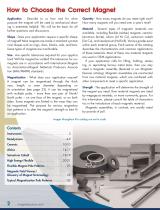
Application - Describe to us how and for what purpose the magnet will be used (a mechanical drawing is extremely helpful). This will be the basis for all further questions and discussions. Shape - Does your application require a specific shape of magnet? Most magnets are made in standard symmetrical shapes such as rings, discs, blocks, rods, and bars. Some types of magnets are machinable. Size - Are specific tolerances required for your application? Will the magnet be visible? The tolerances for our magnets are in accordance with International Magnetics Association/Magnet Materials Producers...
Open the catalog to page 2
Reference magnet, batteries, AC power adaptor, transverse probe and durable carrying case included. A. Part No. GM-2 - The DC Gaussmeter is a very accurate instrument useful in measuring the DC magnetic field intensity of magnets, magnetic devices and assemblies, as well as relays, electromagnets, motors, generators, loudspeakers, actuators, ferrite content in non-ferrous materials and more. Typical applications include magnet classification, analysis of magnetic circuitry and components, air shipment inspection, measurements of the earth’s field vectors, mapping and recording field perturbations,...
Open the catalog to page 3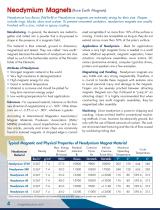
(Rare Earth Magnets) Neodymium Iron Boron (Nd-Fe-B) or Neodymium magnets are extremely strong for their size. Shapes include rings, blocks, discs and custom. To prevent unwanted oxidation, neodymium magnets are usually finished with a zinc, nickel or epoxy coating. Manufacturing - In general, the elements are melted together and milled into a powder that is dry-pressed to shape in the presence of a magnetic field. ered acceptable if no more than 10% of the surface is missing. Cracks are acceptable as long as they do not extend across more than 50% of the pole’s surface. The material is then sintered,...
Open the catalog to page 4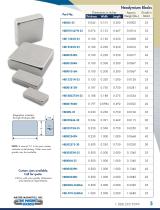
Neodymium Blocks Part No. Dimensions in Inches Thickness Width Length Approx. Grade in Weight (lbs.) MGO Call us with your grade, dimension and tolerance requirements. Custom sizes available, Call for quote. NOTE: A second “N” in the part number indicates nickel plating. Other sizes and grades may be available. Magnetism oriented through thickness (M)
Open the catalog to page 5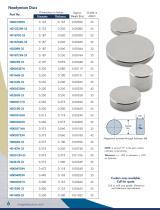
Neodymium Discs Part No. Dimensions in Inches Diameter Approx. Grade in Weight (Lbs.) MGO NOTE: A second “N” in the part number indicates nickel plating. Tolerances: +/– .005 on diameter, + .005 on thickness. Custom sizes available, Call for quote. Call us with your grade, dimension and tolerance requirements. Magnetism oriented through thickness
Open the catalog to page 6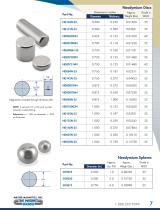
Neodymium Discs Dimensions in Inches Diameter NOTE: A second “N” in the part number indicates nickel plating. Tolerances: +/– .005 on diameter, + .005 on thickness. Magnetism oriented through thickness (M) Neodymium Spheres Diameter (in.)
Open the catalog to page 7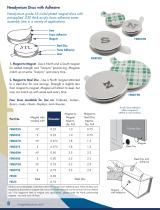
Neodymium Discs with Adhesive Neodymium grade 35 nickel plated magnet discs with pre-applied .030 thick acrylic foam adhesive saves assembly time in a variety of applications. Liner Foam Adhesive Magnet Steel Disc Foam Adhesive Liner FSND50S 1. Magnet to Magnet - Use a North and a South magnet for added strength and “Snap-to” positioning. Magnets match up at same “Snap-to” spot every time. 2. Magnet to Steel Disc - Use a North magnet attracted to a steel disc for cost savings. Strength is slightly less than magnet to magnet. Magnet will attract to steel, but may not match up with same spot every...
Open the catalog to page 8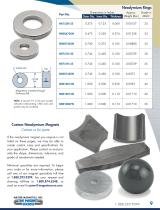
Neodymium Rings Part No. Dimensions in Inches Approx. Grade in Weight (lbs.) MGO Outer Dia. Inner Dia. Thickness Magnetism oriented through thickness (M) NOTE: A second “N” in the part number indicates nickel plating. Other sizes and grades may be available. Custom Neodymium Magnets Contact us for quote If the neodymium magnet you require is not listed on these pages, we may be able to create custom sizes and specifications for your application. Please contact us and provide the shape, dimensions, tolerance, and grade of neodymium needed. Minimum quantities are required. To begin your order or...
Open the catalog to page 9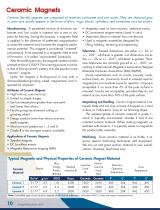
Ceramic (ferrite) magnets are composed of strontium carbonate and iron oxide. They are charcoal gray in color and usually appear in the forms of discs, rings, blocks, cylinders, and sometimes arcs for motors. Manufacturing - A powdered mixture of strontium carbonate and iron oxide is injected into a wet or dry press for forming. During this process, a magnetic field is applied in the direction of preferred magnetization to orient the material and increase the magnet’s performance potential. This magnet is considered “oriented” (anisotropic). If not exposed to a magnetic field at time of formation,...
Open the catalog to page 10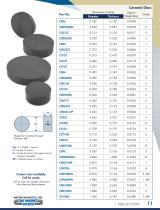
Ceramic Discs Dimensions in Inches Diameter Magnetism oriented through thickness (M) Key: 1 = Grade 1 ceramic 5 = Grade 5 ceramic 8 = Grade 8 ceramic (strongest ceramic material available) MP = Multiple poles on surface. Custom sizes available, Call for quote. Call us with your grade, dimension and tolerance requirements.
Open the catalog to page 11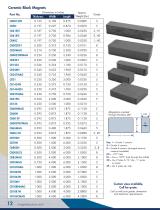
Ceramic Block Magnets Dimensions in Inches Thickness Magnetism oriented through thickness (M) L Key: 1 = Grade 1 ceramic 5 = Grade 5 ceramic 8 = Grade 8 ceramic (strongest ceramic material available) H0 = .197” hole H1 = has a .1875” hole through the middle 2H = has 2 holes 3/16” dia., 1” center to center. 2P = has 2 poles per side Custom sizes available, Call for quote. Call us with your grade, dimension and tolerance requirem
Open the catalog to page 12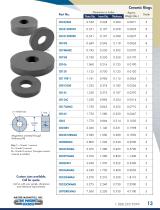
Ceramic Rings Dimensions in Inches Outer Dia. Magnetism oriented through thickness (M) Key: 1 = Grade 1 ceramic 5 = Grade 5 ceramic 8 = Grade 8 ceramic (strongest ceramic material available) Custom sizes available, Call for quote. Call us with your grade, dimension and tolerance requirements.
Open the catalog to page 13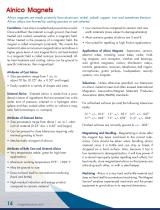
Alnico magnets are made primarily from aluminum, nickel, cobalt, copper, iron and sometimes titanium. Alnico alloys are formed by casting process or are sintered. Cast Alnico - Cast alnico is melted and poured into a mold. Once solidified, the material is rough ground, then heattreated and cooled, sometimes within a magnetic field. When treated in the presence of a magnetic field, the magnet is called anisotropic (oriented). This orients the material to take on maximum magnetization and allows a higher gauss level. A cast magnet that is not heat-treated in a magnetic field is called isotropic...
Open the catalog to page 14All Master Magnetics catalogs and technical brochures
 Basics About Magnets
4 Pages
 WATER TREATMENT MAGNETS
2 Pages
 Plate magnets
4 Pages
 Magnetic Sweepers
8 Pages
 Automotive Aftermarket
12 Pages
 craft & hobby
16 Pages
 Magnetic Products
32 Pages
 INDUSTRIAL MAGNETIC SOLUTIONS
36 Pages
 bulk craft & hobby
6 Pages


- Eddy current separator
- Metal stand
- Lifting magnet
- Metal latch
- Neodymium magnet
- Cylindrical magnet
- Magnetic chuck
- Steel bracket
- Fixing clip
- Coated magnet
- Motor magnet
- Magnetic gripper
- Permanent lifting magnet
- Plastic sheet
- Plastic clip
- Rectangular magnet
- Cable clip
- Adhesive foil
- Manually switched permanent lifting magnet
- Holding magnet