
- Catalogs
- Master Bond
- UV16: Utilized in Bonding Applications for Microring Resonators, Optical Waveguides and Confocal Microscopes


- Company
- Products
- Catalogs
- News & Trends
- Exhibitions
UV16: Utilized in Bonding Applications for Microring Resonators, Optical Waveguides and Confocal Microscopes
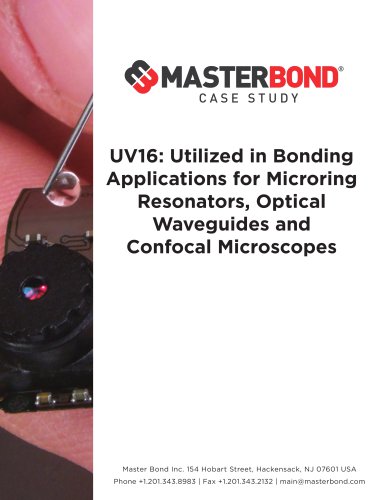
UV16: Utilized in Bonding Applications for Microring Resonators, Optical Waveguides and Confocal Microscopes
UV16 is a versatile polymer used in bonding applications for microring resonators, optical waveguides, and confocal microscopes. It offers advantages such as low viscosity, low shrinkage, and a low refractive index, making it suitable for high-performance and handling applications. UV16 is a one-component system that cures rapidly under UV light and provides high tensile strength and electrical insulation.
- Microring Resonators: UV16 is used to create high-integrity bonds between substrates and solutions in microring resonators, which are essential for optical modulators. It supports the fabrication of resonators with high resonance extinction ratios by maintaining robust bonds during electron beam writing.
- Optical Waveguides: The polymer is employed in creating polarization-independent optical waveguides. It helps mitigate polarization effects that can degrade performance in fiber optic communications by enabling the design of waveguides that are polarization-selective.
- Confocal Microscopes: UV16 is used in assembling miniature endoscopic confocal microscopes, providing a thin adhesive layer for attaching diffractive optical elements to lenses. Its properties, such as low viscosity and resistance to solvents, make it ideal for precise assembly and cleaning processes.
- For microring resonators, UV16 enables high resonance extinction ratios by providing a stable bond during electron beam bleaching.
- In optical waveguides, UV16 supports the creation of polarization-independent components with high extinction ratios, crucial for high-speed electro-optic modulators.
- In confocal microscopes, UV16 ensures robust adhesion and precise alignment of optical components, contributing to successful in-situ imaging capabilities.
UV16's properties make it an excellent choice for applications requiring high-performance bonding and minimal interference with optical properties. Its use in microring resonators, optical waveguides, and confocal microscopes demonstrates its versatility and effectiveness in advanced optical and biomedical engineering applications.
Catalog excerpts
<8> M ASTERBOND CASE STUDY UV16: Utilized in Bonding Applications for Microring Resonators, Optical Waveguides and Confocal Microscopes Master Bond Inc. 154 Hobart Street, Hackensack, NJ 07601 USA Phone +1.201.343.8983 | Fax +1.201.343.2132 | [email protected]
Open the catalog to page 1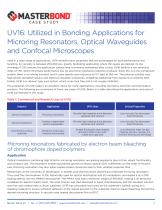
<$> MASTER BOND CASE STUDY Used in a wide range of applications, UV16 exhibits many properties that are advantaged for both performance and handling. Its viscosity is between 250-500 cps, greatly facilitating application where thin layers are desired. Its low shrinkage (1-2%) ensures the application surface area is primarily maintained after curing. UV16 exhibits a low refractive index of 1.511, which minimizes performance loss for electronic resonance reduction products. Since this is a one component system, there is no mixing involved, and it cures rapidly upon exposure to UV light at 365 nm....
Open the catalog to page 2
Key Parameters and Requirements The objective of the microring is to dissipate resonance; so, the target metric is the maximum-achievable resonance extinction ratio, which defines optimal resonator characteristics for the application. The researchers used two applications, transverse electric (TE) and transverse magnetic (TM) polarization, to determine the resonator specifications. The highest resonance mode present in both spectra defined the target extinction ratio. The UV16 polymer enables electron beam writing of the microring by maintaining a robust and high-integrity bond between the substrate...
Open the catalog to page 3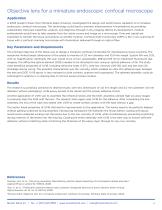
Objective lens for a miniature endoscopic confocal microscope Application A 2005 master’s thesis from Montana State University investigated the design and performance validation of a miniature endoscopic confocal microscope. This technology could lead to dramatic advancements in biomedicine by providing substantially improved inspection, analysis, and diagnosis through in-situ imaging. Before its development, medical professionals would have to take samples from the native source and image on a microscope. Time and capital are expended to transfer the tissue and analysis at another location....
Open the catalog to page 4All Master Bond catalogs and technical brochures
 Understanding low outgassing
5 Pages


- MasterBond single-component adhesive
- MasterBond metal adhesive
- MasterBond industrial adhesive
- MasterBond plastic adhesive
- MasterBond glass adhesive
- MasterBond dispersion adhesive
- MasterBond epoxy adhesive
- MasterBond bonding adhesive
- MasterBond two-component adhesive
- MasterBond electronic adhesive
- MasterBond ceramic adhesive
- MasterBond sealing adhesive
- MasterBond fast curing adhesive
- MasterBond viscosity adhesive
- MasterBond conductivity adhesive
- Curing system
- MasterBond epoxy resin
- MasterBond rubber adhesive
- Automotive adhesive
- MasterBond composite material adhesive