
- Catalogs
- Master Bond
- High Temperature Resistant Adhesives Beat the Heat


- Company
- Products
- Catalogs
- News & Trends
- Exhibitions
High Temperature Resistant Adhesives Beat the Heat

High Temperature Resistant Adhesives Beat the Heat
High temperature resistant adhesives are crucial for applications in aerospace, oil-and-gas, industrial, and electronics sectors where materials must withstand extreme temperatures, both high and low. This document explores the types of adhesives suitable for such conditions, focusing on their properties and selection criteria.
Adhesives like epoxies, silicones, and bismaleimides are highlighted for their ability to endure temperatures exceeding 300°C. Epoxies are noted for their broad temperature spectrum, while bismaleimides offer superior high-temperature resistance. The glass transition temperature (Tg) is a critical factor, indicating the temperature at which adhesives transition from a rigid to a pliable state.
Choosing the right adhesive involves more than just checking data sheets for temperature resistance values. Engineers must consider the adhesive's Tg relative to the application's continuous use temperature to avoid failure. Proper curing methods are essential to maintain the adhesive's properties.
Adhesives with high Tg values generally offer better heat resistance. However, some silicones and B-stage epoxies can provide decent heat resistance with lower Tg values. For cold applications, epoxies maintain their properties even at cryogenic temperatures, making them suitable for such environments.
Overestimating temperature requirements can lead to selecting adhesives that are unnecessarily difficult to handle and cure. It's important to realistically assess the duration and extent of temperature exposure to choose the appropriate adhesive.
Tables in the document list various Master Bond adhesive products, detailing their viscosity, color, storage stability, cure schedule, and service temperature range. These products are designed for specific applications, such as cryogenic service, thermal cycling, and high-temperature resistance.
Temperature resistant adhesives are essential for extreme environments, offering a balance of properties for structural bonding, encapsulation, and sealing. While they require careful handling and curing, their benefits in demanding applications are significant.
Catalog excerpts

TECH SPOTLIGHT High Temperature Resistant Adhesives Beat the Heat Master Bond Inc. 154 Hobart Street, Hackensack, NJ 07601 USA Phone +1.201.343.8983 | Fax +1.201.343.2132 | [email protected]
Open the catalog to page 1
High Temperature Resistant Adhesives Beat the Heat Too hot, too cold or just right? It’s not just a question for Goldilocks. Engineers have to be even better judges of temperature when they select a materials system for the job at hand. And those jobs increasingly involve temperature conditions that are best described as “extreme.” It’s no longer uncommon for aerospace, oil-and-gas, industrial and some electronics applications to require materials systems that withstand temperatures of 300°C or greater. Other applications have to contend with extreme cold, even down to cryogenic temperatures...
Open the catalog to page 2
With a couple of important exceptions, adhesives with the best heat resistance tend to have high Tg values, making them rigid across their operating temperature range. Epoxies used to be unmatched in this regard with some grades offering Tg of 230°C and service temperatures up to 315°C. Master Bond’s newly developed bismaleimide adhesive (see sidebar) ups the ante on heat resistance substantially with a Tg of 300°C and predicted service temperatures in excess of 340°C. The exception to this relationship between heat resistance and a high Tg involves some silicones and “B-stage epoxies”. The unique...
Open the catalog to page 3
This ability to work in environments that mix extreme heat and cold is particularly important in aerospace applications. Adhesives with a low Tg that function just fine in a purely cryogenic environment tend to exhibit large CTEs as they heat up–with all the thermal stress problems that large CTEs can imply. High Tg adhesives tend to have smaller, manageable CTEs across their entire operating temperature range, and may be more suitable for these mixed extreme environments. Managing Minor Trade-offs The good news about temperature resistant adhesives is that they offer a balance of properties...
Open the catalog to page 4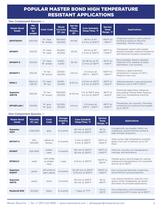
POPULAR MASTER BOND HIGH TEMPERATURE RESISTANT APPLICATIONS Two Component Epoxies — Mix Ratio by weight Color Code Mixed Viscosity RT, cps Set-Up Time Minutes, RT Cure Schedule Temp/Time, °F Service Temp Range, °F 100/100 “A” clear “B” amber 100,000120,000 60-90 48 hrs @ RT 2-3 hrs @ 200°F -100°F to +350°F Toughened system is well suited for bonding & sealing of dissimilar substrates. Thermal cycling. EP30HT 100/25 “A” clear “B” clear 35,00045,000 25-35 24 hrs @ RT 1-2 hrs @ 200°F -60°F to +400°F Transparent system with superb physical strength, chemical resistance, and electrical insulation...
Open the catalog to page 5
MEASURING GLASS TRANSITION TEMPERATURE THERMO MECHANICAL ANALYSIS CTE “Vitreous” “Rubbery” Tg Temperature DIFFERENTIAL SCANNING CALORIMETRY Heat Capacity “Vitreous” “Rubbery” Tg Thermoset adhesives, such as epoxies, do not melt before degrading in the way that thermoplastic materials do. Instead, these adhesives undergo a state change as they heat to a point known as the glass transition temperature (Tg). Above the Tg, the adhesive remains in a rubbery, more ductile state. Below the Tg, the adhesive becomes increasingly strong yet more brittle. The graphs here show how lab methods can determine...
Open the catalog to page 6All Master Bond catalogs and technical brochures
 Understanding low outgassing
5 Pages


- MasterBond single-component adhesive
- MasterBond metal adhesive
- MasterBond industrial adhesive
- MasterBond plastic adhesive
- MasterBond glass adhesive
- MasterBond dispersion adhesive
- MasterBond epoxy adhesive
- MasterBond bonding adhesive
- MasterBond two-component adhesive
- MasterBond electronic adhesive
- MasterBond ceramic adhesive
- MasterBond sealing adhesive
- MasterBond fast curing adhesive
- MasterBond viscosity adhesive
- MasterBond conductivity adhesive
- MasterBond epoxy resin
- MasterBond rubber adhesive
- Curing system
- Automotive adhesive
- MasterBond composite material adhesive