
- Catalogs
- Master Bond
- Biocompatible Epoxies for Medical Device Manufacturing


- Company
- Products
- Catalogs
- News & Trends
- Exhibitions
Biocompatible Epoxies for Medical Device Manufacturing
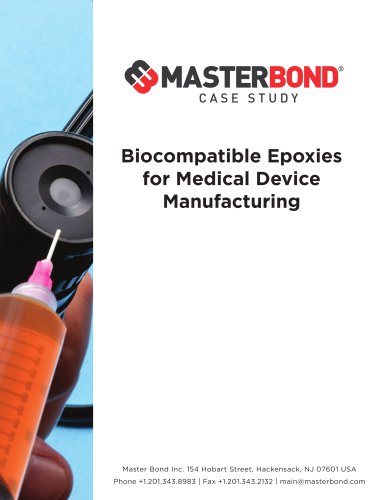
Biocompatible Epoxies for Medical Device Manufacturing
Biocompatible epoxies are crucial in the manufacturing of medical devices, particularly in microelectronics where they serve as adhesive encapsulants. These encapsulants protect sensitive electrical components, assist in thermal management, and provide mechanical support.
Encapsulants in Microelectronics
Encapsulants are used in chip-on-board assemblies to protect electrical connections. They help mitigate thermal mismatch by distributing stresses across the assembly. The coefficient of thermal expansion (CTE) is a critical factor, with different materials having varying CTEs that can lead to stress accumulation and device failure.
Wire-Bonding vs. Flip-Chip Assemblies
Wire-bonding and flip-chip are two predominant methods for forming electrical connections. Flip-chip offers advantages such as higher interconnect density and speed improvements. Encapsulants used in these assemblies must have optimized viscosity and modulus to prevent strain and cracking.
Material Properties and Optimization
Unfilled epoxies have high CTEs, which can be reduced by adding fillers like aluminum oxide or silica. These fillers enhance thermal conductivity and modulus, with aluminum oxide preferred for higher thermal conductivity and silica for higher modulus at reduced filler loading.
Master Bond EP42HT-4AOMed Black
This product is a two-component ceramic-filled epoxy designed for medical device applications. It offers improved thermal and chemical resistance, maintaining compliance with ISO 10993-5 and USP Class VI. It features a wide service temperature range and excellent bonding capabilities.
Application Example
An implantable neural probe used Master Bond EP42HT-2Med to seal bond wires, demonstrating the epoxy's biocompatibility and effectiveness in protecting sensitive components.
Conclusion
Master Bond's biocompatible epoxy systems provide essential protection and support for microelectronic assemblies in medical devices, ensuring long-term reliability and performance.
Catalog excerpts
<8> M ASTERBOND CASE STUDY Master Bond Inc. 154 Hobart Street, Hackensack, NJ 07601 USA Phone +1.201.343.8983 | Fax +1.201.343.2132 | [email protected]
Open the catalog to page 1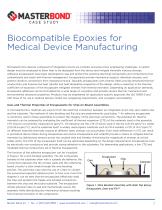
CASE STUDY Biocompatible Epoxies for Medical Device Manufacturing Microelectronics devices composed of integrated circuits are complex and pose many engineering challenges. A careful design must be employed to allow heat to be dissipated from the device and mitigate thermally induced stresses. Adhesive encapsulants have been developed to seal and protect the sensitive electrical components and connections from contaminants and assist with thermal management. Encapsulants provide mechanical support, distribute stresses, and protect sensitive connections from mechanical shock. Typically, encapsulants...
Open the catalog to page 2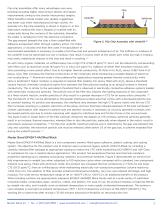
Flip-chip assemblies offer many advantages over wirebonding including higher interconnect density and speed improvements owing to the shorter interconnect lengths. Other benefits include smaller size, greater ruggedness, and lower cost when manufactured at high volume. An example of a flip-chip assembly is shown in Figure 2—in this fabrication method the chip is flipped or inverted with its solder balls facing the contacts of the substrate; thereafter, the solder is remelted to form the electrical connection. The gap present beneath the chip is then underfilled with Figure 2. Flip Chip Assembly...
Open the catalog to page 3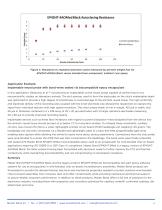
Figure 3. Resistance to repeated autoclave cycles measured by percent weight loss for EP42HT-4OMed Black versus standard two-component, ambient cure epoxy. Application Example: Implantable neural probe with bond-wires sealed via biocompatible epoxy encapsulant In this application, Raducanu et al.(8) constructed an implantable, active neural probe capable of performing in-vivo neuroscientific studies on laboratory animals. The etch process used to form the electrodes on the chip’s implantable shank was optimized to provide a high degree of smoothness to avoid damage to the animal’s neural tissue....
Open the catalog to page 4
1 “Enhancing reliability of flip-chip assemblies with underfill encapsulants.” Master Bond. White paper. 2 “Glob top epoxies.” Master Bond. URL: https://www.masterbond.com/industries/glob-top-epoxies. Accessed: August 2020 3 LeGall, C. A., Qu, J. and McDowell, D. “Some mechanics issues related to the thermomechanical reliability of flip chip DCA with underfill encapsulation.” Trans. ASME, vol. EEP-222, pp. 85-95, 1997. 4 Agrawal, A., Satapathy, A. “Experimental investigation of micro-sized aluminum oxide reinforced epoxy composites for microelectronic applications.” Procedia Materials Science,...
Open the catalog to page 5All Master Bond catalogs and technical brochures
 Understanding low outgassing
5 Pages


- MasterBond single-component adhesive
- MasterBond metal adhesive
- MasterBond industrial adhesive
- MasterBond plastic adhesive
- MasterBond glass adhesive
- MasterBond dispersion adhesive
- MasterBond epoxy adhesive
- MasterBond bonding adhesive
- MasterBond two-component adhesive
- MasterBond electronic adhesive
- MasterBond ceramic adhesive
- MasterBond sealing adhesive
- MasterBond fast curing adhesive
- MasterBond viscosity adhesive
- MasterBond conductivity adhesive
- Curing system
- MasterBond epoxy resin
- MasterBond rubber adhesive
- Automotive adhesive
- MasterBond composite material adhesive