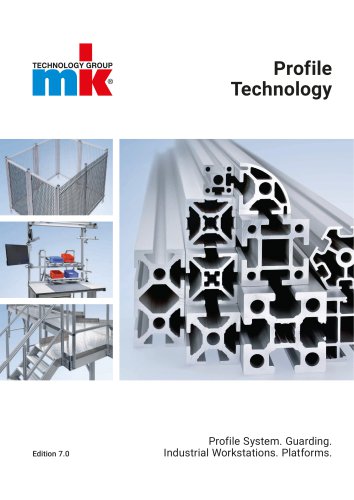
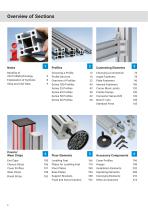
Overview: The document is a comprehensive guide to mk Technology Group's
Profile Technology, focusing on components, modules, and systems for factory automation. It highlights the versatility and reliability of the mk profile system, used for constructing workstations, guarding, machine frames, and platforms.
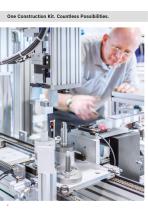
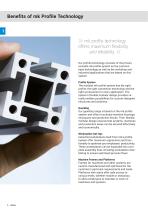
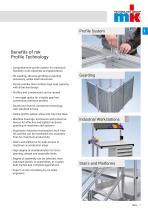
Profile Technology: The mk profile system is modular, offering flexibility for custom-designed structures. It includes a range of profiles and connection technologies suitable for various applications, ensuring high load capacity and attractive design. Profiles are made from high-quality aluminum alloy with a durable anodized coating.
Guarding: Guarding solutions based on the mk profile system provide functional machine housings, enclosures, and protective fences, designed to secure systems, machines, and production areas effectively and economically.
Industrial Workstations: Workstations constructed from mk profiles offer ergonomic and functional setups to enhance productivity. They can be expanded into complete assembly lines for optimized process flows.
Machine Frames and Platforms: Custom-manufactured frames and platforms are optimized for specific customer requirements, providing safe access to various levels for maintenance or operation of machines and systems.
Benefits of mk Profile Technology: The system offers maximum flexibility, no need for welding or painting, high load capacity, reusable components, and a high degree of standardization for efficient planning and assembly. It also includes an online shop with CAD data for easy access and planning.
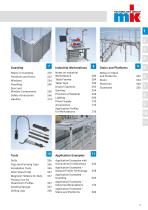
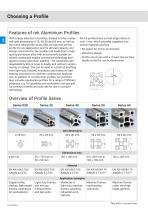
Profile Selection: The document details the selection process for profiles, including features of mk aluminum profiles, deflection calculations, and standards. Profiles are available in various series with different grid dimensions and are suitable for a wide range of applications.
Connecting Elements and Accessories: A variety of connecting elements and accessories are available, including angle fasteners, plate fasteners, internal fasteners, and profile clamps. These components ensure sturdy and diverse connection technology.
Additional Components: The document also covers floor elements, covers, wear strips, and accessory components like hinges and installation elements, which enhance the functionality and safety of the profile systems.
Application Examples: Various application examples are provided, demonstrating the use of profile technology in general applications, guarding, industrial workstations, and stairs and platforms.
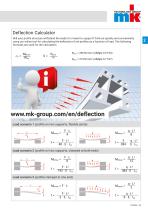
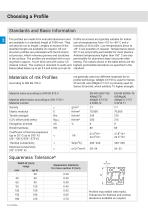
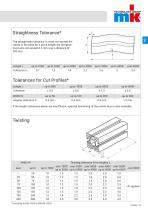
Specifications: The document outlines various tolerances for cut profiles, including straightness, length, width, and angular tolerances. The straightness tolerance must not exceed specified values based on length, with a maximum deviation of 0.3 mm over 300 mm. Length tolerances range from ±0.5 mm to ±2.0 mm depending on the length category. Width and twisting tolerances are also specified for different profile widths and lengths.
Profile Services: End services for profiles include machining for positive-locked connections, such as drilling bores for tension plugs or mitre cuts. Various end service options are available, and customers can select and order these through an online shop or CAD library. Specific instructions for lateral bores and threading are provided, with recommended screw depths and thread types.
Machining Tools: The document lists taps and installation tools required for end services, including threaded inserts and HELICOILs. These tools are designed for hand use, and specifications for each series and bore channel diameter are provided.
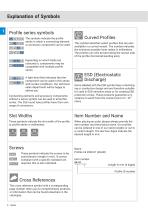
Curved Profiles: Certain profiles can be bent to a specified radius, with a minimum inner radius indicated. Non-square profiles can only be bent along the narrow side, and bending may slightly deform cross sections.
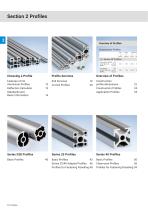
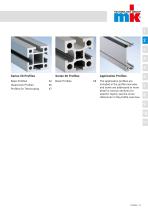
Profile Overview: The document provides a comprehensive overview of construction profiles, including dimensions, area, mass, moments of inertia, and section moduli for various series (25, 40, 50, 60). Each profile is identified by a unique ID number, and detailed specifications are provided for each.
Application Profiles: Additional profiles for specific applications, such as cover profiles and closure strips, are listed with their respective dimensions and mass.
Specifications: The document provides detailed technical specifications and procedures for machining and assembling profiles, particularly focusing on cleanroom and Series 40, 50, and 60 profiles. It includes information on materials, tools, and connection elements used in the assembly process.
Specifications: The profiles are made from anodised aluminium, offering various dimensions and weights suitable for different applications. Series 40 profiles are designed for fastening panelling, while Series 50 and 60 profiles are used for heavy-duty and large gantry applications, respectively.
Machining Procedures: Profiles can be manually opened using a parting tool, and drilling jigs are available for precise bore placement. A sanding sponge is recommended for deburring during assembly.
Connection Elements: The document outlines various connection options, including angle fasteners, internal fasteners, and corner blocks. It emphasizes the flexibility of the mk profile system, allowing connections at any angle using standard screws.
Load Specifications: The document provides load specifications for screw connections, including pretension, tightening torque, and maximum static operating force. Safety factors are recommended based on the type of load (static, dynamic, etc.).
Recommendations: For optimal performance, it is recommended to use the appropriate nuts and screws for each profile type. The document also suggests using ribbed washers for dynamic loads and provides guidelines for screw depth and load capacity.
Specifications: The document details various connecting elements and fasteners designed for aluminum profiles, specifically Series 40 and Series 50. The materials used include tumbled and anodized aluminum, as well as galvanized steel, ensuring durability and compatibility with high-load applications.
Connecting Elements: The document lists multiple types of connecting elements such as connection plates, plate fasteners, tension plugs, anchor fasteners, clamping jaws, bolt fasteners, and corner blocks. Each type is designed for specific applications, ensuring secure and stable connections without obstructing profile slots.
Fastening Procedures: Fastening examples are provided for each type of connector, illustrating the assembly process. The document includes references to assembly videos for visual guidance. Tools and end services required for installation are mentioned, with specific pages indicated for further details.
Norms and Standards: The document adheres to DIN standards for screws and other components, ensuring compatibility and reliability in industrial applications. The use of standardized parts allows for seamless integration into existing structures.
Recommendations: The document suggests using tension plugs and anchor fasteners for hidden connections and unobstructed slots, ideal for cleanroom environments and aesthetic applications. It also highlights the versatility of clamping jaws and bolt fasteners for various profile configurations.
Key Data from Tables and Diagrams: The document includes dimensional sketches and specifications for each connector type, detailing bore sizes, distances, and compatible profile series. This information is crucial for selecting the appropriate connector for specific structural requirements.
Specifications: The document lists various types of screws and connecting elements, specifying their dimensions, material, and standards. It includes:
- DIN EN ISO 10642 screws in galvanised steel and A2-70 stainless steel.
- DIN EN ISO 7380-2 flanged button-head screws in 10.9 black, galvanised steel, and A2 stainless steel.
- DIN EN ISO 4017 hexagon head screws in 8.8 galvanised steel and A2-70 stainless steel.
- Threaded inserts and helicoils in galvanised steel and A2 stainless steel.
- DIN EN ISO 4027 threaded pins in 45H galvanised steel and A1 stainless steel.
- DIN EN ISO 4032 hexagon nuts in galvanised steel and A2-70 stainless steel.
Procedures and Recommendations: The document provides guidelines for using various components, such as:
- End caps for profiles, made from high-quality plastic, providing closure and protection against sharp surfaces.
- Closure strips to prevent dirt accumulation and enhance appearance, available in various colors and materials.
- Wear strips for reducing friction and protecting surfaces, available in different materials and designs for specific applications.
- Brush strips for sealing and guiding in conveyor technology, made from PA6 plastic.
Norms and Standards: The document references several DIN EN ISO standards for screws and connecting elements, ensuring compliance with international norms for quality and performance.
Key Data from Tables and Diagrams: The document includes dimensional sketches and specifications for various components, such as end caps and wear strips, highlighting their dimensions, materials, and application examples.
Critical Information: Important details include:
- Material specifications for each component, such as galvanised steel, stainless steel, and various plastics.
- Load capacities and adjustment ranges for levelling feet, ensuring stability and compensation for uneven surfaces.
- Recommendations for specific applications, such as using anti-slip plates with levelling feet for added stability.
Specifications: The document details various types of levelling feet and floor elements, primarily made from stainless steel, suitable for cleanrooms and FDA-compliant environments. The levelling feet have different spindle lengths and adjustment ranges, with load capacities ranging from 10,000 N to 24,000 N. Some models include anti-slip, damping, and sealing effects due to a vulcanised rubber base.
Procedures: Levelling feet can be anchored to the floor and adjusted for height differences and uneven surfaces. Holders for levelling feet are available for horizontal profiles, allowing for secure attachment and additional stability without profile machining.
Norms and Standards: The document references DIN ISO 1302 and DIN ISO 2768-K standards for manufacturing tolerances. It also mentions FDA requirements for certain applications.
Recommendations: Levelling feet with stainless steel construction are recommended for environments requiring high hygiene standards. The document suggests using holders and plates for additional stability and ease of installation.
Key Data from Tables: - Levelling foot ø 39 M16: Spindle length 100 mm, adjustment range 70 mm, 14,500 N load capacity.
- Levelling foot ø 110 M16: Spindle length 50 mm, adjustment range 16 mm, 10,000 N load capacity.
- Fixed and swivel casters: Load capacities range from 400 N to 900 N, with wheel diameters from 50 mm to 125 mm.
Critical Information: - Material: Stainless steel for levelling feet, tumbled aluminium for holders and plates.
- Load capacities and adjustment ranges are crucial for selecting the appropriate levelling foot.
- The document emphasizes the importance of using the correct fastening accessories for stability and safety.
Specifications: The document provides detailed specifications for various components such as casters, hinges, cable ducts, and pneumatic components. Swivel casters are equipped with a total locking device and have a high load capacity of 7000 N. Hinges are available in different models with varying angles of rotation and load capacities, up to 300 kg.
Procedures: Installation elements like cable ducts and clips are designed for easy attachment to profiles without additional fasteners. Pneumatic components allow profiles to be used as compressed air lines, with a maximum pressure of 6 bar.
Standards and Recommendations: The document emphasizes the use of anodised aluminium for cover profiles and tumbled aluminium for hinges, ensuring durability and aesthetic appeal. It also highlights the importance of using appropriate fasteners and seals for pneumatic connections.
Accessory Components: Various accessory components are detailed, including bumpers for shock absorption, eye bolts for lifting, and handwheels for adjustments. Each component is specified with material, dimensions, and load capacities.
Installation and Usage: The document provides examples of fastening methods for different components, ensuring proper installation and functionality. It also includes guidelines for using components like mini-rollers and track rollers for manual transfer applications.
Guarding and Safety: The document outlines components for guarding systems, including doors, windows, and safety interlocks. It provides options for designing and configuring guarding systems with standardised components to reduce costs and design time.
Overview: The document provides detailed information on the design and installation of guarding systems, which are used to protect machinery and production areas. These systems are modular and flexible, allowing for effective and economical protection. The document outlines various components and methods for assembling these systems, ensuring compliance with safety standards such as DIN EN ISO 13857:2008-06.
Specifications: The guarding systems are based on the mk profile system and include machine housings, enclosures, and protective fences. They are designed to be modular and compatible, with standard frame heights of 1400/2000 mm and custom heights available upon request. The systems can be connected pneumatically, hydraulically, or electrically to machine control systems.
Safety Standards: The document emphasizes compliance with safety standards, specifying safety distances to prevent access to hazard zones. Closed panelling requires a safety distance of 0 mm, while open panelling requires 200 mm. The systems are designed to meet the safety standards applicable in different countries.
System Selection: Three main methods are outlined: the Partition Method, Pillar-Panel Solution, and ECO Solution. The Partition Method is the standard and preferred method due to its ease of installation and sturdiness. The Pillar-Panel Solution allows for easy removal of partitions, while the ECO Solution is cost-effective but requires more installation work.
Components and Installation: The document details various components such as partitions, doors (swing, sliding, lifting, and scissor doors), and windows. Each component is described with its specifications, installation instructions, and ordering information. The document also includes information on the captive fastening system, which allows for quick installation and removal of partitions.
Ordering Information: For each component, specific information is required for ordering, such as dimensions, panelling type, and lock type. The document provides part numbers and assembly instructions for each component.
Specifications and Dimensions: - Maximum clear dimension (LM) for panelling is 1200 mm, and maximum clear height (LH) is 1800 mm. Assemblies without panelling include mk 2040.31 (40x40) profile, connecting elements, handle, end caps, hinges, and lock.
Sliding Windows: Sliding windows can be designed with two or three panes using mk 2240 or mk 2241 profiles as tracks. These profiles are compatible with Series 40 and Series 50 profiles. Sliding elements can be installed or removed when the window is not fully closed and can be locked with a bolt lock.
Folding Windows: Folding windows require less swivel range than casement windows, making them a space-saving alternative. Paneling is sold separately.
Panelling Information: Panelling can be used in partitions, frames, doors, and windows. Fastening accessories for mounting panelling in a profile frame are available. Order information includes whole sheet panelling material item number and cut panelling item number with width, height, and color specifications.
Materials and Fastening Methods: - Polycarbonate: Available in clear or tinted grey, known for impact resistance.
- PETG: Offers higher impact resistance and better optical properties than acrylic glass.
- Acrylic Glass: Known for high strength and transparency.
- Alucobond®: Consists of silver-anodised aluminium sheets with a plastic core.
- Galvanised or Painted Steel: Available in various thicknesses and requires RAL color specification for painted steel.
- Stainless Steel: Suitable for food production applications.
- Duet Chequer Sheet: Used for slip-resistant surfaces.
Fastening Accessories: - Holder: Available in various designs for fastening panelling.
- Panel Clamp: Used for fastening unmachined panelling from 5 to 8 mm in thickness.
- Angle: Used for attaching steel panelling.
- Clamping Profile: Used to fasten wire mesh in a T-slot.
- Fence Clip: Used to fasten welded grids.
- Sealing Strip: Used to fix panelling in the T-slot and suitable for cleanroom conditions.
Ordering Information: For ordering, specify item numbers, dimensions, and any additional requirements such as color or specific fastening methods.
Material Specifications: TPE-V rubber, Alucobond® (silver anodised), polycarbonate (clear or tinted grey), and acrylic glass (clear) are specified for various thicknesses and applications. Fastening examples and sealing strips are provided for panelling.
Fastening and Panelling: Sealing strips suitable for 4-6 mm panelling are detailed, including material specifications and installation instructions. Profiles and sealing strips are specified for seamless transitions.
Door and Window Components: Various hinges are described for different series profiles, including material specifications and installation examples. Hinges are available for both right-hand and left-hand connections, with options for frequent opening under high loads.
Locks and Latches: Details on ball latches, external and internal locks, tower bolts, and roller units are provided. Specifications include material, installation instructions, and compatibility with different door gaps.
Safety Interlocks: Hinged safety interlocks, magnetic safety interlocks, and solenoid latches are described with properties, installation instructions, and safety performance levels. These components ensure operational safety and are suitable for various guarding applications.
Handles: Bracket handles and strip handles are detailed for use in opening and closing doors, windows, and other components. Material specifications and ergonomic features are highlighted.
Summary: This document provides comprehensive specifications and installation instructions for various materials, fastening systems, door and window components, locks, latches, safety interlocks, and handles. Emphasis is placed on material properties, compatibility, and safety standards.
Specifications: Anodised aluminium profiles are used for constructing industrial workstations, offering flexibility and adaptability. The profiles, such as mk 2244, weigh 0.87 kg/m and can be cut to any length.
Industrial Workstations: These workstations are designed for ergonomic and functional efficiency, enhancing productivity and employee health. They are customizable with adjustable table frames, gantries, shelving systems, and electrical and pneumatic supply options. The workstations can be expanded into complete assembly lines and tailored to specific processes like lean production and ESD protection.
Ergonomics: Ergonomically designed workstations improve productivity and employee health by allowing adjustments to meet individual needs. Features include height adjustment mechanisms and optimal positioning of tools and materials. Lighting systems are also adjustable to suit specific tasks.
Standards and ESD Protection: Workstations comply with standards like DIN EN ISO 6385 for ergonomics and DIN VDE 0100-410 for electrical safety. Conductive components are interconnected to ensure protection against electric shock.
Table Frames: Various table frames are available, including fixed, manual, manual-hydraulic, and electrical height adjustments. These frames are made from Series 40 profiles and can support different load capacities. Custom dimensions and heavy-duty designs are available.
Table Tops: Table tops are available in materials like beechwood multiplex and laminated particleboard, with options for ESD compatibility. Fasteners and holders are provided for secure mounting.
Drawer Cabinets: Drawer cabinets offer organized storage without encroaching on workspace. They are made of reinforced sheet steel and can support up to 200 kg.
Gantries and Rack Systems: Gantries provide ergonomic configurations for attaching tools and accessories. Rack systems hold bins and tools, with adjustable shelves for optimal positioning.
Swivel Arms and Kanban Components: Swivel arms create additional workspace and can hold shelves or monitors. Kanban components like
roller conveyors facilitate efficient material flow.
Conveyor Systems: The conveyor systems are available with or without ESD protection and come in various models with different roll diameters (ø20, ø40, ø50). For detailed specifications, refer to the conveyor technology catalogue.
Roller Strips: Used in carton flow racks, roller strips facilitate the smooth movement of boxes. They are available in lengths up to 4500 mm with roller spacing of 33 mm or 49.5 mm. For heavy loads, additional support is recommended. Materials include galvanized steel U-rails and yellow plastic rollers.
Bin Mounts and Shelves: Bins can be mounted using holders or racks, with options for swivel arm connections. Shelves, both angled and straight, can be attached to swivel arms for ergonomic positioning.
Monitor Mounts: These mounts offer flexibility with five axes and height adjustment, suitable for VESA-compatible monitors. Made from die-cast aluminum, they support loads between 2-10 kg.
Tool Hangers: Standard and custom tool hangers are available to improve organization and safety. They feature adjustable spring tension systems to reduce user strain.
Lighting: LED system lamps provide glare-free lighting with a color temperature of 5000K. They are available in various power ratings and can be mounted rigidly or with a swivel feature.
Pneumatic and Electrical Supply: Pneumatic units distribute compressed air with flexibility in connection positioning. Electrical supply systems offer stability and customization, tested according to DIN VDE 0100-410 standards.
Accessories: Footrests and floor mats are designed for ergonomic support and safety. Footrests are adjustable, and floor mats are anti-slip and oil-resistant.
Stairs and Platforms: Custom solutions for accessing work areas include platforms and footbridges, designed to meet specific site conditions and requirements.
Overview: The document provides detailed specifications and guidelines for designing and constructing stairs and platforms using modular aluminum profiles. It emphasizes safety, ergonomics, flexibility, and high-quality materials.
Specifications: The document outlines the use of high-quality aluminum profiles for constructing stairs and platforms, ensuring safety and ergonomic design. It highlights the modular design for easy assembly and disassembly, compatibility for modifications, and the availability of mobile designs with casters or air cushions.
Stairs and Platforms: The document specifies the pitch angles for stairs and stepladders, recommending a comfortable pitch between 30° and 38°. It provides technical data on materials, dimensions, and compliance with DIN EN ISO 14122-3 standards. The document includes detailed measurements for stair height, length, and width, along with specific profiles and connection technologies used.
Technical Data: The document includes technical data for constructing stairs and platforms, such as the use of mk 2040.68, mk 2040.69, and mk 2040.06 profiles with slip-reducing surfaces. It specifies the incline angle, number of steps, and dimensions for going and rise, adhering to international standards.
Connection Details: Various connection methods are detailed, including base plate and angle bracket connections, ensuring stability and safety. The document describes the use of screws, washers, and nuts for secure assembly.
Guardrails: Specifications for guardrails include minimum height requirements, post spacing, and the inclusion of knee braces for additional safety. The document emphasizes compliance with legal regulations for guardrail heights on stairs and platforms.
Tools: A section on tools provides information on drilling jigs, taps, forming taps, and other installation tools necessary for constructing and assembling the profiles. It includes order numbers and specifications for each tool.
Application Examples: The document provides examples of applications with instructions for mounting, including tension plugs, hinges, and protective device guards with lifting doors. It illustrates the practical use of the profiles and accessories in various configurations.
Specifications and Components: The document describes various components and their applications in industrial settings. Key components include a plastic handle for easy operation of lifting doors, an angle for Eco partition solutions, and a monitor mount with five-axis flexibility suitable for VESA-compatible monitors. Additionally, it mentions stainless steel levelling feet ideal for cleanroom environments and a safety interlock system meeting high safety standards.
Application Examples: Several application examples are provided, illustrating the use of components in different setups. These include workbenches with roller conveyors for material handling, protective device guards for cleanrooms and measuring stations, and custom solutions like kanban shelves and supply trolleys. Each example highlights the integration of components to enhance functionality and safety.
Procedures and Installation: The document includes detailed instructions for mounting and installing various components. It covers the use of parallel connectors for gap-free connections, the installation of cylinder locks in profiles, and the use of captive fasteners for retrofitting panelling. The procedures ensure secure and efficient assembly of structures.
Standards and Recommendations: Components and systems are designed to meet specific industry standards, such as ESD protection and cleanroom requirements. Recommendations for using specific materials, like scratch-resistant Makrolon for panelling, are provided to ensure compliance with sanitary regulations.
Custom Solutions: Custom applications are highlighted, such as a stair crossover for transport routes and a mobile support frame for assembly workstations. These solutions demonstrate the adaptability of the components to meet unique customer needs and enhance operational efficiency.
Overview: The document provides detailed information on custom guarding solutions, industrial workstations, and stairs and platforms, focusing on customer-specific applications. It includes various examples and specifications for each category, highlighting the versatility and adaptability of the solutions offered.
Custom Guarding Solutions: This section outlines various guarding solutions tailored for specific applications. Examples include extendible guarding elements, protective laser enclosures, and custom protective device guards. Key features include manual and pneumatic operation, use of materials like Alucobond® and polycarbonate, and integration of safety interlocks and controllers.
Industrial Workstations: The document describes a range of industrial workstations designed for ergonomic efficiency and adaptability. Examples include height-adjustable workstations, ESD-compliant assembly lines, and workstations with integrated electrical supply. Features such as hydraulic height adjustment, integrated document holders, and custom monitor mounts are highlighted.
Stairs and Platforms: This section covers custom stairs and platforms designed for industrial use. Examples include mobile assembly platforms for helicopters, free-standing bridges, and platforms with retractable welded grid frames. Emphasis is placed on safety features, such as high-load stairs and anti-slip coverings, as well as the use of Series 40 profiles for structural integrity.
Application Examples: Throughout the document, numerous application examples are provided to illustrate the practical implementation of the described solutions. These examples demonstrate the adaptability of the products to various industrial needs, including material provision stations, assembly trolleys, and soundproof enclosures.
Technical Specifications: The document includes detailed technical specifications for various components, such as profiles, fasteners, and accessories. It provides guidance on choosing the right profiles and connection technology, ensuring compatibility and optimal performance in different applications.
Overview: This document appears to be a technical catalog or index for various components used in manufacturing or assembly processes. It includes profiles, nuts, bolts, plates, and other hardware items, each identified by a unique ID number and associated specifications.
Sections:
- Profiles: The document lists various profiles identified by 'mk' numbers, with dimensions provided in parentheses. These profiles are likely structural components used in assembly or construction.
- Items by Item Number: This section includes a detailed list of items such as bolts, nuts, shims, sensor holders, and wear strips. Each item is associated with a specific page number, indicating where more detailed information can be found.
- Wear Strips: A subsection dedicated to wear strips, which are components used to reduce friction between moving parts. Each strip is identified by a unique number.
- Hardware Components: Includes various nuts, bolts, and plates, each with specific dimensions and material specifications (e.g., ESD, VA).
- Connection and Support Components: Lists various connection plates, angle brackets, and support brackets, which are essential for assembling and supporting structures.
- Foot Plates and Base Plates: Details different types of foot and base plates used for stabilizing structures, with specifications for different sizes and materials.
- Lighting and Electrical Components: Includes LED lamps, power strips, and electrical supply units, indicating the document also covers electrical components for workstations or assembly lines.
- Furniture and Accessories: Lists items like table frames, footrests, shelves, and drawer cabinets, suggesting the document also includes components for setting up workstations or assembly areas.
Key Information:
- Specifications: Each item is listed with specific dimensions and material types, crucial for ensuring compatibility and functionality in assembly processes.
- Page References: The document provides page numbers for each item, facilitating quick access to detailed information.
- Applications: The variety of components suggests applications in conveyor technology, workstation setup, and general manufacturing processes.



 mk Conveyor Technology
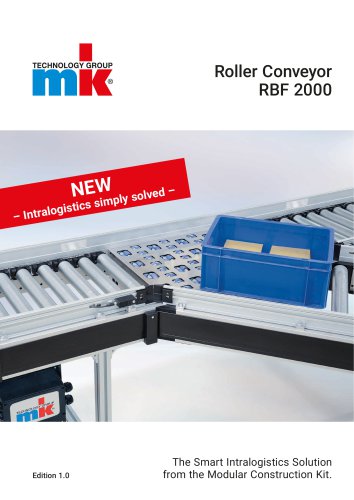 Roller conveyor RBF 2000
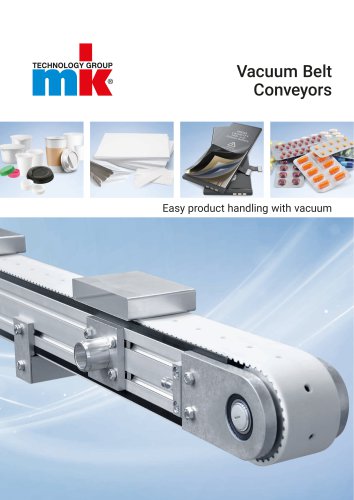 Vacuum belt conveyor
 Pallet Handling Systems
 D28 Round Tube System


