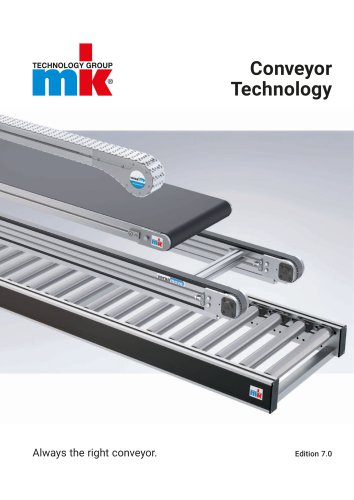
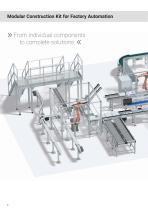
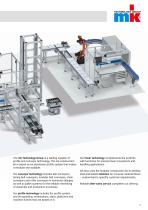
Overview: The document provides a comprehensive guide on mk Technology Group's modular construction kit for factory automation, focusing on
conveyor technology. It highlights the versatility and scalability of their aluminium
profile system, which supports various conveyor types and configurations.
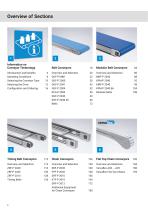
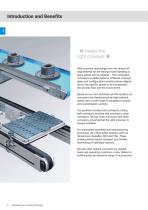
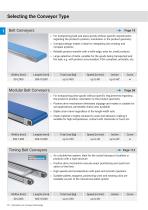
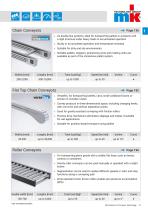
Conveyor Types: The document details several conveyor types, including belt conveyors, timing belt conveyors, modular belt conveyors, chain conveyors, flat top chain conveyors, and roller conveyors. Each type is designed to meet specific transport and handling requirements, ensuring precise adaptation to goods, process flow, and environment.
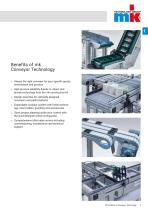
Key Features: mk's conveyors are characterized by high material quality, a wide range of equipment variants, and customization options. The system supports automated assembly and manufacturing processes with pallet systems like Versamove and Versaflex, enabling position-based transport and reliable interlinking of stations.
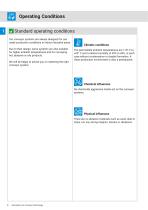
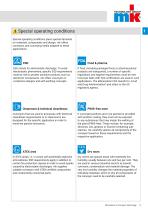
Operating Conditions: The conveyors are designed for indoor industrial use, withstanding higher ambient temperatures and conveying hot, abrasive, or oily products. Special operating conditions such as dry rooms, PWIS-free zones, ATEX areas, and cleanrooms are addressed with tailored solutions.
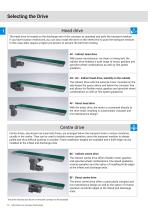
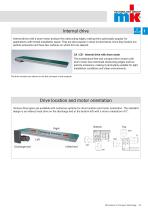
Drive Selection: Various drive options are available, including head drives, centre drives, and internal drives with drum motors. The document explains the benefits of each drive type and provides guidance on motor selection, speeds, and operational modes.
Additional Equipment: The document also covers additional equipment for chain conveyors, roller conveyors, and pallet systems, including stands, side rails, frequency inverters, and end stops.
Practical Examples: Examples from practice are provided for each conveyor type, illustrating their application in real-world scenarios.
Conclusion: mk Technology Group offers a robust and flexible conveyor technology solution, supported by comprehensive after-sales service, ensuring the right conveyor is always available for specific goods, environments, and processes.
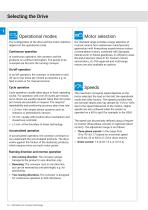
Conveyor Operation Modes: The document describes different operation modes such as one running direction, reversing, and two running directions, designed for continuous operation in both directions.
Motor Selection and Load Considerations: A diagram is provided to determine motor power based on load and speed, considering a kinetic friction value of μ=0.3. It highlights the need for higher speeds in cycling operations compared to continuous operations and discusses the impact of changing friction coefficients on permissible load and speed.
Conveyor Technology Information: The "QuickDesigner" online configurator allows users to create custom belt conveyors without software installation. It checks entries for plausibility and offers CAD models and quotes. Users can subscribe to a newsletter for updates.
Request/Order Information: Details required for ordering include conveyor system name, dimensions, load, length, width, drive version, speed, mode, belt type, and additional accessories. Assistance is available via various communication methods.
Belt Conveyor Overview and Selection: Technical data for various belt conveyor models (GUF-P MINI, GUF-P 2000, etc.) are provided, including width, length, load capacity, speed, and operational modes. Factors affecting total load include belt pull strength, power transmission, motor selection, mechanical stability, operational mode, and environmental conditions.
Speed and Conveyor Dimensions: The maximum speed depends on motor selection, load, and operational mode. Timing belts are recommended for speeds over 30 m/min. Conveyor width and length are defined with specific tolerances and adjustments for tracking and tensioning.
GUF-P MINI Conveyor Details: The GUF-P MINI is designed for small, lightweight products with a low height for easy integration. It offers various drive options and belt designs, with technical data provided for different configurations.
GUF-P 2000 Conveyor Details: The GUF-P 2000 is versatile with a wide selection of components and is UR+ approved for use with cobots. It features a robust design with technical data for various configurations.
Specifications: Detailed specifications for the GUF-P 2000 and GUF-P 2041 belt conveyors are provided, highlighting their design, drive options, and operational capabilities.
Operational Modes: Continuous, cycle, accumulated, and reverse operations are supported.
Benefits: High load-bearing capacity, compact design, options for straight lines and inclines, and reliable transfer of small products with knife edge options.
Technical Data: Speeds up to 80 m/min for GUF-P 2000 and up to 60 m/min for GUF-P 2041, depending on the drive version.
Tails: Different tail designs are available, including crowned rollers and knife edges, with specific configurations for product transfer lengths.
Conclusion: The GUF-P 2000 and GUF-P 2041 belt conveyors offer versatile and robust solutions for handling a wide range of products, with customizable options to suit specific operational needs.
Overview: The document provides detailed specifications and technical data for various types of belt conveyors, including the GUF-P 2004, KFG-P 2000, and KGF-P 2040 models. These conveyors are designed for different applications, such as handling bulky and heavy products, incline conveying of small parts, and transporting goods around curves.
1. GUF-P 2004 Belt Conveyor: Designed for high loads with a torsion-resistant frame. Available in lengths from 720 to 10,000 mm and widths from 1,000 to 2,000 mm. Supports speeds up to 60 m/min and total loads up to 500 kg.
2. KFG-P 2000 Incline Conveyor: Suitable for incline conveying of small parts with lengths from 1,400 to 4,000 mm and widths from 300 to 700 mm. Supports speeds up to 16 m/min and total loads up to 40 kg.
3. KGF-P 2040 Curved Belt Conveyor: Designed for horizontal transport around curves with outer radii of 600 and 900 mm for 90° and 180° curves. Supports speeds up to 30 m/min and total loads up to 30 kg.
4. KGF-P 2040.02 Enhanced Curved Belt Conveyor: Offers higher load capacity and speed, with outer radii of 1,000 and 1,500 mm for 90° curves. Supports speeds up to 60 m/min and total loads up to 50 kg.
5. Special Requirements: ESD-safe belts, ATEX-compliant belts, cleanroom belts, and food/pharmaceutical belts are available for specific applications.
Conveyor Belt Specifications and Types: FDA certified belts, PWIS-free belts, electrically insulating belts, and metal-free belts are detailed for various applications.
Standard and Antistatic Belts: Standard belts are typically antistatic to prevent electrostatic charge buildup, ensuring safe transport of products.
Belt Properties and Applications: Belts are available in materials like PET, PVC, PU, and NBR, each with specific temperature ranges and surface properties.
Modular Belt Conveyors: Modular belts can be combined with straight, curved, and incline conveyors, allowing for complex track layouts.
Cleats and Side Walls: Cleats must match the belt material, with options for segmented and combined cleats.
MBF-P 2040 Modular Belt Conveyor: Offers conveyor lengths from 475 to 10,000 mm and widths from 200 to 1,000 mm. It supports a total load of up to 250 kg and speeds up to 30 m/min.
KFM-P 2040 Incline Conveyor: Designed for inclined conveying of small parts, with lengths up to 10,000 mm and widths from 200 to 1,000 mm. Supports up to 100 kg load.
KMF-P 2040 Curved Modular Belt Conveyor: Offers flexible track layouts with L, S, and U curves, and angles of 45° or 90°. Supports up to 150 kg load.
General Benefits: All models feature modular belts that are wear and abrasion-resistant, suitable for food, and resistant to heat and chemicals.
Modular Belt Conveyors: Conveyors are designed for transporting medium to heavy goods with options for different belt inclines (15° to 60°) and load capacities (up to 150 kg total load, 50 kg/m distributed load).
Timing Belt Conveyors: Designed for high-speed, high-acceleration transport of piece goods and pallets, with options for single-line and double-line systems.
Technical Specifications: Material options include POM and steel, with temperature resistance from -45°C to +90°C.
Applications and Benefits: Modular belt conveyors are suitable for industrial applications involving containers, bottles, and boxes.
Timing Belt Conveyors: ZRF-P 2045 and ZRF-P 2010 models are discussed with various configurations such as single-line, head drive, and integration with pallet systems.
Chain Conveyors: SRF-P 2045 and SRF-P 2010 models are discussed with various configurations such as single-line, head drive, and integration with pallet systems.
Additional Features: Wear strips made from PE-UHMW ensure low friction and are available in antistatic versions.
Applications: These conveyor systems are versatile and modular, suitable for various industrial applications, including transporting and buffering pallets with moderate loads.
Specifications: Conveyor Length ranges from 600 to 10,000 mm depending on the model.
Design and Integration: The compact design allows for easy integration into existing systems, with flexible drive positioning.
Operational Features: Capable of continuous, cycle, and accumulated operations.
Additional Components: Wear strips made from PE-UHMW ensure low friction and are available in antistatic versions.
Applications: Ideal for use in environments with moderate to heavy loads and moderate speeds.
Overview: The document provides detailed technical specifications and options for various
chain conveyor systems, including KTF-P 2010 and SRF-P 2012 models, as well as the Versaflex flat top chain conveyors.
KTF-P 2010 Chain Conveyors: AC – Indirect Head Drive utilizes a drive chain as a reduction gear, suitable for low-speed operations.
SRF-P 2012 Accumulating Roller Chain Conveyor: Designed for heavy load applications, part of the Versamove ultra workpiece pallet system.
Versaflex Flat Top Chain Conveyors: Modular system allowing complex track layouts in three-dimensional space.
Additional Features: Wear strips made from PE-UHMW ensure low friction and are available in antistatic versions.
Overview: The document provides detailed technical specifications and configurations for Flat Top Chain Conveyors and Roller Conveyors, focusing on their adaptability, efficiency, and application across various industries such as food and beverage, pharmaceuticals, cosmetics, chemicals, and consumer goods.
Flat Top Chain Conveyors: Designed for complex track designs with easy configuration and commissioning.
Roller Conveyors: RBF 2000 system offers modular, decentralised solutions for intralogistics, including motor-driven rollers, gear motors, and gravity options.
Key Benefits: Energy and space-saving designs with a large selection of conveyor widths and chains.
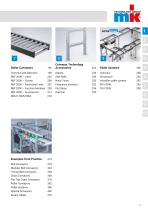
Roller Conveyors Overview: The document provides detailed specifications and configurations for various types of roller conveyors, including alignment roller conveyors, 45° infeed/outfeed conveyors, multi-transfer modules, and 90° transfer modules.
Specifications: Usable Width: Available in 400, 500, and 700 mm, with custom sizes on request.
Alignment Roller Conveyor: This conveyor uses motor-driven rollers to move products both in the conveying direction and perpendicular to it for alignment purposes.
45° Infeed/Outfeed Conveyor: Designed for merging or branching product flows, this conveyor uses staggered rollers to facilitate the process.
Multi-Transfer Module: Features omni-directional rollers for discharging products at 45° or 90° angles.
90° Transfer Module: Used for right-angle infeed or outfeed of products, changing their orientation.
Stands and Accessories: Stand RBF 2000 provides stability with levelling feet, available for straight lines and curves.
Gravity Roller Conveyor RBS-P 2065/2066: These conveyors are designed for non-powered transport of smaller products.
Technical Data: Conveyor Length: Up to 5,000 mm, unlimited by connecting segments.
Conveyor Technology Accessories: The document also details various accessories for conveyor technology, including side rails, stands, foot options, and fastening elements.
Overview: The document provides detailed specifications and descriptions of various conveyor technology accessories, focusing on stands, side rails, frequency inverters, and other components used in conveyor systems.
Stands: The document outlines different types of stands for conveyor systems, including lightweight and medium-weight height-adjustable stands.
Side Rails: Fixed and adjustable side rails are described, with specifications for height and width adjustments.
Frequency Inverters: Frequency inverters are used to adjust the conveying speed of three-phase motors.
Other Accessories: Additional accessories include end stops for stopping products on conveyors and drip pans for collecting liquids.
Pallet Systems Overview: The document provides a comprehensive overview of modular pallet systems, specifically focusing on the Versamove series, which includes standard, plus, and ultra versions.
Specifications: The Versamove systems are categorized by weight and size, with the standard version supporting up to 40 kg, the plus version up to 100 kg, and the ultra version up to 300 kg.
Function Modules: Function modules available include lift and transfer units, rotating units, and lift and locate units.
System Configuration and Production: The document outlines the process for achieving an optimal pallet system, including layout design, power supply options, and conveyor types.
Maintenance and Service: mk offers comprehensive service, including planning, project management, commissioning, and quality assurance.
Technical Data: The document provides detailed technical data for various conveyor types, including timing belt conveyors, accumulating roller chain conveyors, and flat top chain conveyors.
Industry Applications: The pallet systems are applicable in industries such as automotive, consumer goods, packaging, electrical engineering, and logistics.
Conclusion: The document emphasizes the versatility and adaptability of the Versamove pallet systems, highlighting their suitability for a wide range of industrial applications and their ability to integrate seamlessly into existing systems.
Overview: The document provides detailed technical specifications and functionalities of various pallet systems and conveyor components used in industrial settings.
Maintenance Access: The WTZ 2010 is a timing belt conveyor with maintenance access, allowing safe and easy interior access for maintenance.
Short Stroke Lift: The KHL 2045 and KHL 2010 short stroke lifts provide precise access to different transport heights using pneumatic raising and lowering.
Stoppers: Stoppers are used to stop or separate pallets. Options include undamped (SU) and damped (SD) stoppers.
Pallet Systems: The document describes various pallet systems, including the Versaflex and SPU 2040 systems.
Technical Data: Detailed specifications are provided for each component, including dimensions, load capacities, and operational speeds.
Applications: These systems are applicable in industries such as automotive, machine construction, electrical engineering, and logistics.
Overview: The document provides detailed technical specifications and descriptions of various pallet and conveyor systems, focusing on the SPU 2040 and TKU 2040 models.
SPU 2040 Pallet Systems: The SPU 2040 system is designed for cost-effective and compact interlinking of two machining stations.
TKU 2040 Chain Conveyor System: The TKU 2040 is ideal for cycled, position-oriented supply and removal, and interlinking machining centers.
Additional Features and Accessories: Protective Device Guards, Lubrication Station, and Drip Pan are available.
Conclusion: The document provides comprehensive information on the SPU 2040 and TKU 2040 systems, highlighting their versatility, robust design, and suitability for various industrial applications.
Overview: This document provides practical examples of various conveyor systems, highlighting their applications and configurations.
Key Sections: Belt Conveyor GUF-P MINI, Belt Conveyor GUF-P 2000, Belt Conveyor GUF-P 2041, Belt Conveyor GUF-P 2004, Incline Conveyor Belt KFG-P 2000, Curved Belt Conveyor KGF-P 2040, Modular Belt Conveyor MBF-P 2040, Incline Conveyor Modular Belt KFM-P 2040, Curved Modular Belt Conveyor KMF-P 2040, Timing Belt Conveyors ZRF-P 2040 and ZRF-P 2045, Timing Belt Conveyors ZRF-P 2010.
Conclusion: The document showcases the versatility and customization options available for different conveyor systems, emphasizing the company's ability to provide tailored solutions for various industrial applications.
Overview: The document provides detailed examples and specifications of various conveyor systems and components used in industrial applications.
1. Accumulating Roller Chain Conveyors: SRF-P 2045 and SRF-P 2010 models are discussed with various configurations such as single-line, head drive, and integration with pallet systems.
2. Flat Top Chain Conveyors: FPF-P 2045 models are highlighted with features like pneumatic lift units, 90° and 180° curves, and integration with Versamove pallet systems.
3. Chain Conveyors: KTF-P 2010 models are used for lift-and-transfer units and include custom side rails and head drives.
4. Versaflex Systems: Versaflex A04 to A29 models are described with features like rolling curves, magnetic chains, and adjustable side rails for vertical and horizontal transport.
5. Roller Conveyors: RBF 2000 and RBS-P 2065/2066 models are used for aligning products, with features like photoelectric sensors and gravity discharge systems.
6. Pallet Systems: Versamove standard and plus systems are detailed with timing belt conveyors, lift and transfer units, and custom pallets for multi-level transport.
7. Special Conveyors: Includes vacuum belt conveyors for high-speed packaging, telescopic conveyors for adjustable infeed, and cleanroom conveyors for technical cleanliness.
8. Rotary Tables: DT-P 2040 models are used for part separation and buffering, with features like roller bridges and adjustable direction guides.
Conclusion: The document provides comprehensive examples and configurations of conveyor systems, highlighting their versatility and adaptability in various industrial applications. Key features such as automation, customisation, and integration with pallet systems are emphasized.


 mk Profile Technology
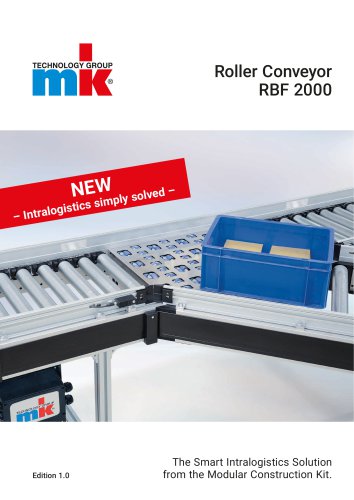 Roller conveyor RBF 2000
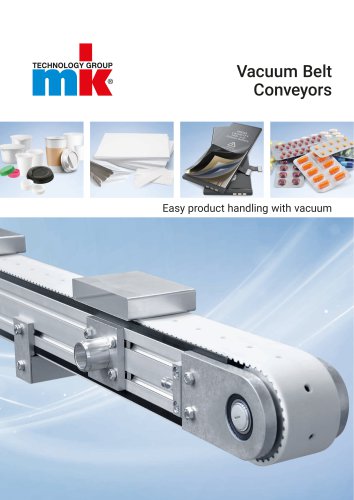 Vacuum belt conveyor
 Pallet Handling Systems
 D28 Round Tube System


