
- Catalogs
- MARQUARDT France
- Standard switches and sensors


Standard switches and sensors

Standard switches and sensors
Switches and systems are essential for connecting users with technology. Key factors influencing switch requirements include safety, design, logic, comfort, installation, durability, reliability, and cost. Marquardt has been a leader in this field since 1925, setting standards with numerous innovations.
Marquardt is an independent family business with over 85 years of experience, investing 10% of its turnover annually in R&D. The company has advanced development tools, extensive testing facilities, and 11 global production and sales locations, ensuring a strong presence in key markets across Europe, America, and Asia.
Marquardt operates through two main business units: Automotive and Switches, Sensors & Controls, setting benchmarks for diverse applications.
Marquardt is known for its consistency and pioneering spirit in the switching world, offering a wide range of products including sensors, switches for household appliances, and systems for various technologies. The focus is on customizing standard products and developing innovative solutions.
Marquardt excels in developing and designing switches and systems for large-scale production, integrating electronics and mechanics, and producing customized solutions. Their production capabilities include injection molding, laser processing, and high-speed punching technology.
This unit provides intelligent solutions with a wide base, offering products like sensors, micro-signal switches, snap-action switches, and more.
Marquardt offers a variety of products including switches, sensors, locks, lightings, and control systems for electric power tools and automobiles.
The catalog provides an overview of Marquardt's standard switches, with technical data and specifications. Customized variants and special products are available on request. Marquardt's products are known for their high quality and long life, certified under ISO TS 16949: 2002.
Marquardt adheres to a code of conduct emphasizing ethical and legal behavior. Their switches are tested according to EN 61058-1 or IEC 61058-1 standards and carry various approval marks for Europe, the USA, and Canada.
Marquardt complies with the RoHS directive, ensuring no hazardous substances are used in their products. They also adhere to REACH regulations for chemical safety.
Some switches conform to this standard, identified by a "G" in specifications, ensuring compliance with glow-wire-flammability and ignition-temperature requirements.
Marquardt specifies electrical ratings for AC and DC voltages, with recommendations for testing DC loads. The life endurance of switches is defined by mechanical and electrical cycles.
Gold-plated contacts are recommended for low-power applications. Most switches are rated for 50,000 cycles, with some approved for 10,000 cycles.
Many switches have a contact distance suitable for full disconnection from the mains. Proof tracking values indicate the voltage at which the test is passed.
Marquardt provides values for capacitive inrush currents, crucial for devices with power supply units.
- Rated for up to 4 A at 250 V AC.
- Features include quick-connect terminals and solder terminals.
- Protection cap available for dust and water protection.
- Rated for up to 10 A at 250 V AC.
- Mechanical life endurance of 10E4 cycles.
- Operating force of 5 N and inrush current capacity of 100 A.
- Protection type IP 40 and flammability rating UL 94 V-0.
- Rated for up to 12 A at 250 V AC.
- High dust protection with IP 50 rating.
- Mechanical life endurance of 1E5 cycles.
- Suitable for appliances of protection class II.
- Rated for up to 16 A at 250 V AC.
- Mechanical life endurance of 5E4 cycles.
- Features include illuminated windows and mechanical forced opening.
- Conformity with IEC 60065 chap. 14.6.
- Rated for up to 20 A at 250 V AC.
- Mechanical life endurance up to 1 million cycles.
- Variants available with IP 67 or dust protection insert.
- Approval for 400 V (product-dependent).
- All switches are suitable for appliances of protection class II.
- Various terminal types and configurations are available, including quick-connect, solder, and PCB terminals.
- Options for different colors, printing variants, and cable assemblies are available on request.
- Rated for up to 16 A at 250 V AC.
- Available in both illuminated and non-illuminated versions.
- Features quick-connect terminals (4.8 x 0.8 mm).
- Includes models with IP 65/IP 67 protection for enhanced durability.
- Designed for low voltage applications with a mechanical life endurance of 100,000 cycles.
- Operating force is 6.0 ± 1.0 N.
- Ambient temperature range from -25 °C to +70 °C.
- Features include compact design and customizable actuators.
- Rated for up to 7 A at 250 V AC.
- Mechanical life endurance of 100,000 cycles.
- Actuator material is PA glass fiber-reinforced.
- Options for fastening strips and interference suppression capacitors.
- Designed for at least 200,000 mechanical switching cycles.
- Protection type IP 40, with variants offering IP 54 protection.
- Flammability rating of UL 94 V-2.
- Available with different actuator colors and printing options.
- Rated for up to 2 A at 250 V AC.
- Mechanical life endurance of 500,000 cycles.
- Protection type IP 40 with options for dust and water protection.
- Features include small, compact design and various terminal types.
- Rated for up to 6 A at 250 V AC.
- Mechanical life endurance of 100,000 cycles.
- Features a proven switching principle and excellent actuating characteristics.
- Available with different terminal types and cable assembly options.
- All switches are suitable for appliances of protection class II.
- Various models offer additional features such as snap-on actuators, protection caps, and customizable options.
- Electrical Rating: Up to 21 A at 250 V AC.
- Mechanical Life: 5E6 cycles for versions with lever or contact spacing > 3 mm, 10E6 for standard versions.
- Contact Resistance: < 100 mOhm (new condition).
- Insulation Resistance: > 100 MOhm.
- Ambient Temperature: -40°C to +100°C, extendable to +125°C on request.
- Flammability: UL 94 V-0 for housing, V-2 for actuator.
- Materials: Actuator made of PA, housing of duroplast type 182, terminals are silver plated.
- Features: High inrush currents, friction contact system, operating forces from 0.2 to 4.2 N.
- Electrical Rating: Up to 4 A at 250 V AC.
- Mechanical Life: 5E6 cycles.
- Contact Resistance: < 100 mOhm (new condition).
- Insulation Resistance: > 100 MOhm.
- Protection Type: IP 40 on actuator side, IP 00 on terminal side.
- Ambient Temperature: -35°C to +85°C.
- Materials: Actuator made of PA glass fiber-reinforced, terminals are silver plated.
- Features: Low switching torques, adaptable spring steel auxiliary actuators.
- Electrical Rating: Up to 6 A at 250 V AC.
- Contact Resistance: < 100 mOhm (new condition).
- Insulation Resistance: > 100 MOhm.
- Protection Type: IP 00.
- Ambient Temperature: -20°C to +85°C, up to +120°C for brief periods.
- Materials: Actuator made of spring steel, housing of PA glass fiber-reinforced.
- Features: High switching reliability, short bounce time, vibration-resistant contact system.
- Various terminal types including quick-connect, solder, and screw terminals.
- Different actuator types such as roller, spring, and lever actuators.
- Options for extended overtravel and special base forms.
- Compliance with protection class II for appliances under specific installation conditions.
Catalog excerpts
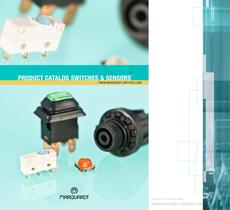
PRODUCT CATALOG SWITCHES
Open the catalog to page 1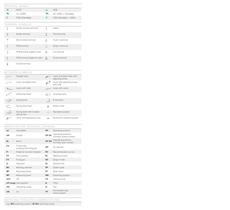
APPROVAL MARKS ENEC VDE UL (USA) CUS UL (USA + Canada) CSA (Canada) CUS CSA (Canada + USA) TERMINAL SYMBOLS Quick-connect terminal Cable Solder terminal Terminal strip Short solder terminal Push-in terminal PCB terminal Snap-in terminal PCB terminal angled to left Cut terminal PCB terminal angled to right Screw terminal Socket terminal ACTUATOR SYMBOLS Straight lever Lever simulated roller with adjusting screw Lever simulated roller Lever with adjusting screw and roller Lever with roller Lever with cams Differential lever Housing cams Spring lever Pushbutton Spring lever bent Rotary shaft Spring...
Open the catalog to page 2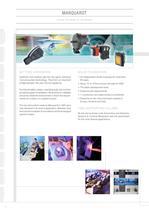
| 2 SENSORS MICRO-SIGNAL SWITCHES SNAP-ACTION SWITCHES TACT AND KEY SWITCHES FOOT SWITCHES ROTARY SWITCHES SLIDE SWITCHES TOGGLE SWITCHES PUSHBUTTON SWITCHES ROCKER SWITCHES MARQUARDT SETTING STANDARDS Switches and systems get into the game wherever man encounters technology. They form an important bridge between the user and the appliance. Functional safety, shape, operating logic and comfort as well as eayse of installation, life endurance, reliability and price create the environment in which the requirements for a switch or a system evolve. The very fi rst switch made by Marquardt in 1925...
Open the catalog to page 4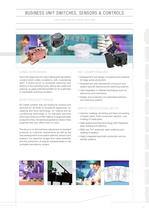
3 | SENSORS MICRO-SIGNAL SWITCHES SNAP-ACTION SWITCHES TACT AND KEY SWITCHES FOOT SWITCHES ROTARY SWITCHES SLIDE SWITCHES TOGGLE SWITCHES PUSHBUTTON SWITCHES ROCKER SWITCHES LONG EXPERIENCE Since the beginning the name Marquardt represents a brand which unites consistency with a pioneering spirit. A brand which is constantly exploring new territory in the switching world, taking new roads and opening up great potential benefi ts for its customers in marketable switching solutions. WIDE PRODUCT RANGE No matter whether they are looking for sensors and switches for all kinds of household appliances,...
Open the catalog to page 5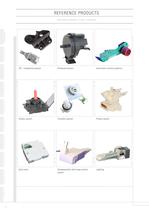
| 4 SENSORS MICRO-SIGNAL SWITCHES SNAP-ACTION SWITCHES TACT AND KEY SWITCHES FOOT SWITCHES ROTARY SWITCHES SLIDE SWITCHES TOGGLE SWITCHES PUSHBUTTON SWITCHES ROCKER SWITCHES REFERENCE PRODUCTS SWITCHES, SENSORS, LOCKS, LIGHTINGS 3D - imbalance sensor Pressure sensor Rotary switch Turbidity sensor Power switch Door lock Subassembly with snap-action switch Lighting Automatic control systems
Open the catalog to page 6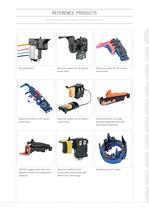
5 | SENSORS MICRO-SIGNAL SWITCHES SNAP-ACTION SWITCHES TACT AND KEY SWITCHES FOOT SWITCHES ROTARY SWITCHES SLIDE SWITCHES TOGGLE SWITCHES PUSHBUTTON SWITCHES ROCKER SWITCHES REFERENCE PRODUCTS EC-electronics Electronic switch for AC electric power tools Electronic switch for AC electric power tools Electronic switch for DC electric power tools Electronic switch for angle grinders (integrated soft start and restart protection) ON/OFF trigger switch with timedelayed contact and suppression capacitor Electronic switch for DC accumulator power tools with lithium ionic technology Brushring with DT...
Open the catalog to page 7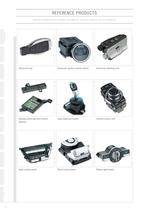
| 6 SENSORS MICRO-SIGNAL SWITCHES SNAP-ACTION SWITCHES TACT AND KEY SWITCHES FOOT SWITCHES ROTARY SWITCHES SLIDE SWITCHES TOGGLE SWITCHES PUSHBUTTON SWITCHES ROCKER SWITCHES REFERENCE PRODUCTS DRIVER AUTHORIZATION SYSTEMS, ASSEMBLIES, CONTROL PANELS FOR AUTOMOBILES Electronic key Electronic ignition starter switch Electronic steering lock Keyless antennas and control devices Gear selection switch Central control unit Seat control panel Roof control panel Rotary light switch
Open the catalog to page 8
7 | SENSORS MICRO-SIGNAL SWITCHES SNAP-ACTION SWITCHES TACT AND KEY SWITCHES FOOT SWITCHES ROTARY SWITCHES SLIDE SWITCHES TOGGLE SWITCHES PUSHBUTTON SWITCHES ROCKER SWITCHES GENERAL TECHNICAL INFORMATION ABOUT THE CATALOG This catalog provides you with an overview of the wide range of Marquardt standard switches. The portfolio includes rocker switches, pushbutton switches, toggle switches, slide switches, rotary switches, foot switches, power tool switches, keys, snap-action switches, micro-signal switches and sensors. Basic types are distinguished within a series to group products with identical...
Open the catalog to page 9
| 8 SENSORS MICRO-SIGNAL SWITCHES SNAP-ACTION SWITCHES TACT AND KEY SWITCHES FOOT SWITCHES ROTARY SWITCHES SLIDE SWITCHES TOGGLE SWITCHES PUSHBUTTON SWITCHES ROCKER SWITCHES GENERAL TECHNICAL INFORMATION ROHS (RESTRICTION OF THE USE OF CERTAIN HAZARDOUS SUBSTANCES) From July 1, 2006 no more new electrical and electronic products may be offered in the EU which do not comply with the RoHS directive. The use of lead, mercury, hexavalent chromium, cadmium and the fl ame inhibitors containing bromide PBB and PBDE is prohibited for the protection of man and the environment. Compliance with the legal...
Open the catalog to page 10
9 | SENSORS MICRO-SIGNAL SWITCHES SNAP-ACTION SWITCHES TACT AND KEY SWITCHES FOOT SWITCHES ROTARY SWITCHES SLIDE SWITCHES TOGGLE SWITCHES PUSHBUTTON SWITCHES ROCKER SWITCHES GENERAL TECHNICAL INFORMATION GOLD-PLATED CONTACTS For applications with a rating of 300 mW or 12 V we recommend switches with gold-plated contacts, also for applications with rare actuation or in a sulfurous atmosphere or other corrosive environments. Minimum currents are not especially defi ned, but can be assumed in a range down to 1 mA. SWITCHING FREQUENCY For switches which are expected to be actuated more than 2 000...
Open the catalog to page 11
| 10 SENSORS MICRO-SIGNAL SWITCHES SNAP-ACTION SWITCHES TACT AND KEY SWITCHES FOOT SWITCHES ROTARY SWITCHES SLIDE SWITCHES TOGGLE SWITCHES PUSHBUTTON SWITCHES ROCKER SWITCHES GENERAL TECHNICAL INFORMATION ISOLATION CHARACTERISTICS Devices has to be developped and constructed in a way that they work assured for conventional use. To work in an assured way it is needed to have an adequate isolation. They have to protect against the danger of current. The measurements of this insulating based on a protection target, which also has an adequate protect against electric shocks even if there is an facile...
Open the catalog to page 12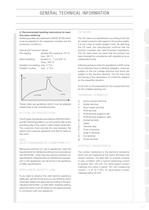
11 | SENSORS MICRO-SIGNAL SWITCHES SNAP-ACTION SWITCHES TACT AND KEY SWITCHES FOOT SWITCHES ROTARY SWITCHES SLIDE SWITCHES TOGGLE SWITCHES PUSHBUTTON SWITCHES ROCKER SWITCHES GENERAL TECHNICAL INFORMATION 2. Recommended handling instructions for leadfree wave soldering Soldering profi les are published in DIN IEC 61760 which must be adapted to the respective modules and the production conditions. Typical and maximum values: Pre-heating duration 80 s typical at 110 °C, max. 125 °C Wave soldering duration 2 - 7 s at 235 °C, Tmax. 245 °C Gradient pre-heating max. 2 °C/s Gradient cooling max. -4...
Open the catalog to page 13All MARQUARDT France catalogs and technical brochures
 LAWN AND GARDEN APPLIANCES
6 Pages
 3250 SERIE IP 66/68
11 Pages
 3006 SERIE
5 Pages
 STANDARD SWITCHES
6 Pages
 CLEANING TECHNOLOGY
6 Pages
 HEATING TECHNOLOGY
6 Pages
 POWER TOOLS
6 Pages
 HOUSE HOLD APPLIANCE
6 Pages
 PRODUCT CATALOG SWITCHES AND SENSORS
264 Pages
- Single-pole switch
- Push-button switch
- Technology switch
- Multipole switch
- Electromechanical switch
- IP67 switch
- Action push-button switch
- Form push-button switch
- Hermetic switch
- Bipolar switch
- Technology push-button switch
- IP65 switch
- Electromechanical push-button switch
- Lever switch
- Spring push-button switch
- Sealed push-button switch
- Standard push-button switch