
- Catalogs
- Malvern Panalytical
- Zetasizer Nano Series

- Company
- Products
- Catalogs
- News & Trends
- Exhibitions
Zetasizer Nano Series

Zetasizer Nano Series
The Zetasizer Nano Series is a compact and versatile tool for characterizing nanoparticles, proteins, and macromolecules. It integrates multiple technologies to ensure high sensitivity and accuracy, featuring disposable zeta potential cuvettes and advanced temperature control.
- Compact unit with versatile technology options.
- Easy operation with minimal training required.
- High sensitivity for precise measurements.
- Automated trend measurement capabilities.
- Dynamic Light Scattering (DLS)
- Non-Invasive Back-Scatter (NIBS)
- Static Light Scattering (SLS)
- Electrophoretic Light Scattering (ELS)
- Microrheology
- Development of colloid and emulsion formulations.
- Assessment of protein formulation stability.
- Investigation of protein aggregation.
DLS measures the size of colloids and nanoparticles, offering faster confirmation of oligomeric states than size exclusion chromatography. The Zetasizer Nano series provides high-quality data through optimized components and patented NIBS optics.
Zeta potential is vital for understanding dispersion stability and shelf life, measured using laser Doppler electrophoresis and phase analysis light scattering (PALS). The Zetasizer Nano automates this process for accurate and repeatable results.
Measured using an accessory cell, surface zeta potential provides insights into surface interactions in applications like contact lens development and water filtration.
Using Static Light Scattering (SLS), the Zetasizer Nano measures molecular weight with small sample volumes, offering insights into solubility and stability.
DLS-based microrheology assesses the viscoelastic properties of materials using tracer particles, suitable for small sample volumes and providing high-frequency dynamics for dilute samples.
The series offers various accessories and options to enhance functionality, including a chromatography accessory kit, MPT-2 Autotitrator, and surface zeta potential accessory. Additional options include high-temperature capability, narrow band filter for fluorescent samples, and ER/ES compliance software.
Available cell types include disposable folded capillary cells, dip cells for aqueous and non-aqueous applications, high concentration cells, surface zeta potential cells, and low volume polystyrene cells.
The Zetasizer Nano measures particle and macromolecule size, zeta potential, protein charge, molecular weight, and properties like the second virial coefficient and protein aggregation.
Patented technologies like NIBS and M3-PALS enhance sensitivity and zeta potential sensitivity. Disposable cells reduce cross-contamination, and precision temperature control ensures accurate results.
Used in nanoparticle production, formulation stability, product shelf life improvement, and water treatment optimization, as well as protein formulation and aggregation studies.
Offers high sensitivity for small and dilute samples, minimal sample volume requirements, and capability to measure in high salt and non-aqueous media. Automation features like the autotitrator improve productivity, and disposable cells enhance accuracy.
Designed for ease of use with automation to minimize training, extensive functionality, and data quality reports. Optional packages support ER/ES compliance and advanced protein studies.
The Zetasizer APS and μV systems are designed for protein size measurement, offering automation and integration with SEC systems for real-time protein size and molecular weight analysis.
Various models offer different specifications, including temperature control, laser power, and measurement angles. Accessories like the MPT-2 Autotitrator and high concentration cells enhance functionality.
Measurement angles include 13° and 90° for general purpose NNLS with multiple narrow modes, particularly for protein analysis.
Zeta potential sensitivity exceeds +/-500mV, with a mobility range greater than +/- 20 μ.cm/V.s.
Maximum sample concentration is 40% w/v, with a minimum sample volume of 20μL using a diffusion barrier. Maximum sample conductivity is 200mS/cm.
Utilizes M3-PALS for signal processing. Molecular weight range is estimated from DLS as <1000Da to 2 x 10⁷Da, and from Debye plot as <10,000Da to 2 x 10⁷Da.
Includes MPT-2 Autotitrator and degasser, dip cell, high concentration cell, surface zeta potential cell, SV-10 viscometer, high power laser, high temperature range, narrow band fluorescence filter, and chromatography option. Software options include 21 CFR part 11 software and research software.
Device dimensions are 600 x 320 x 260 mm with a weight of 19kg.
Sample dependent specifications and optional accessories are available for purchase separately.
Malvern Instruments Limited, part of Spectris plc, provides advanced technology solutions. Contact: Grovewood Road, Malvern, Worcestershire, UK, WR14 1XZ, Tel +44 1684 892456, Fax +44 1684 892789, www.malvern.com.
Includes patents for Non-Invasive Back Scatter (NIBS), High and Low Frequency Electrophoreses (M3), Light Scattering Measurements, and Surface Potential Determination in a Dip Cell.
Catalog excerpts

Material relationships PARTICLE SIZE MOLECULAR SIZE MOLECULAR WEIGHT ZETA POTENTIAL - PROTEIN CHARGE RHEOLOGICAL PROPERTIES ZETASIZER NANO Series PERFORMANCE, SIMPLICITY, VERSATILITY
Open the catalog to page 1
Performance, Simplicity, Versatility ZETASIZER NANO SERIES Research Performance, Operational Simplicity, Application Versatility The Zetasizer Nano series has been designed with you and your requirements in mind. You need a reliable system that gives consistently good performance, that is easy to use, and covers your range of applications. For colloid, nanoparticle and macromolecule characterization, our customers tell us that the Zetasizer Nano instruments are the most user-friendly systems available. As well as this ease of use, the performance and condence in the results is validated by the...
Open the catalog to page 2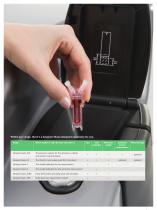
Within our range, there’s a Zetasizer Nano designed especially for you Model Which system is right for your laboratory? Zeta potential Molecular weight Advanced protein measurement The premium system for the ultimate in colloid and protein characterization The World’s most widely used DLS instrument The model dedicated to size measurement The model dedicated to zeta potential measurement Entry-level system providing value and versatility Entry-level size measurement system
Open the catalog to page 3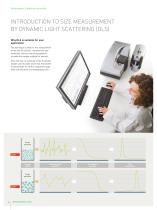
Performance, Simplicity, Versatility INTRODUCTION TO SIZE MEASUREMENT BY DYNAMIC LIGHT SCATTERING (DLS) The technique is ideal for the measurement of the size of colloids, nanoparticles and molecules, without requiring agitation to make the sample suitable for analysis. From the size, an estimate of the molecular weight can be made, which has the benefit of being faster to confirm oligomeric state than size exclusion chromatography (SEC). Scattered light
Open the catalog to page 4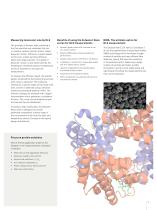
Measuring molecular size by DLS To measure the diffusion speed, the speckle pattern produced by illuminating the particles with a laser is observed. The scattering intensity at a specic angle will uctuate with time, and this is detected using a sensitive avalanche photodiode detector (APD). The intensity changes are analysed with a digital autocorrelator which generates a correlation function. This curve can be analysed to give the size and the size distribution. NIBS: The ultimate optics for DLS measurement Research grade results with the ease of use of a routine system Patented NIBS optics...
Open the catalog to page 5
Performance, Simplicity, Versatility INTRODUCTION TO ZETA POTENTIAL AND PROTEIN CHARGE The importance of zeta potential and protein charge Electrical double layer How do you approach the development of a stable dispersion or assess product shelf life? Stern Layer Diffuse layer Do you run time consuming shelf tests? If so, there may be a better way to optimize sample stability and shelf life. The charge acquired by a particle or molecule in a given medium is its zeta potential and arises from the surface charge and the concentration and types of ions in the solution. Since particles of similar...
Open the catalog to page 6
Why measure zeta potential? The choices of materials used in a formulation may be restricted by regulations and also have an impact on cost. Knowledge of the zeta potential of particles in a formulation can be used to make logical choices about the chemistry of a formulation in order to select the most appropriate materials to provide stability and improve shelf life. Zeta potential can also be used to study the effect of formulation components on other bulk properties such as viscosity, in order to achieve lower viscosity at higher concentrations for example. Why measurement of protein charge...
Open the catalog to page 7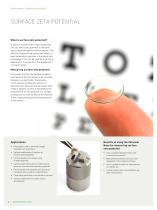
Performance, Simplicity, Versatility SURFACE ZETA POTENTIAL What is surface zeta potential? Surfaces in contact with a liquid containing ions can have a zeta potential in the same way as dispersed particles and molecules. This effective charge on the surface will attract or repel molecules or particles in the liquid, and knowledge of this can be used for a variety of applications, for example in the development of contact lenses. Measuring surface zeta potential An accessory cell for the Zetasizer enables a small piece of the at sample to be mounted between two electrodes. The presence of the...
Open the catalog to page 8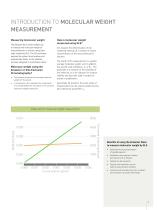
INTRODUCTION TO MOLECULAR WEIGHT MEASUREMENT Measuring molecular weight The Zetasizer Nano series enables you to measure the molecular weight of macromolecules in solution using Static Light Scattering (SLS). The SLS technique requires the system to be sensitive and exceptionally stable, so the Zetasizer has been designed to meet these criteria. Molecular weight using the Zetasizer or Size Exclusion Chromatography? • The Zetasizer measures the average molecular weight of the sample In comparison, SEC separates the components of a sample before the calculation of an accurate molecular weight distribution....
Open the catalog to page 9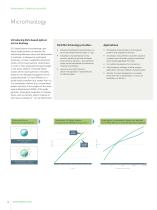
Performance, Simplicity, Versatility Microrheology Introducing DLS-based optical microrheology DLS-based optical microrheology uses tracer probe particles to measure the relationship between stress and deformation in materials. Analogous to mechanical rheometry, a stress is applied by Brownian motion of the tracer particle. Deformation or strain is then measured through changes in the tracer position. Thermally-driven motion of the tracer particle is intimately linked to the rheological properties of the suspending uid. It is very different in a purely viscous medium (e.g. water) than it is in...
Open the catalog to page 10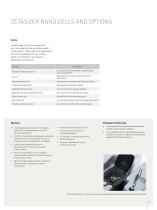
ZETASIZER NANO CELLS AND OPTIONS Cells A wide range of cells are available for size, zeta potential and molecular weight measurement. These extend the applications that can be addressed to low volumes, higher concentration, non-aqueous dispersants and solvents. Cell type Disposable folded capillary cell Size, zeta potential and protein charge avoiding cross contamination Zeta potential for aqueous and non-aqueous applications High concentration cell Zeta potential of samples with little or no dilution Surface zeta potential cell Zeta potential of material surfaces Disposable polystyrene cell...
Open the catalog to page 11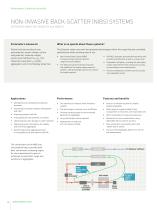
Performance, Simplicity, Versatility NON-INVASIVE BACK-SCATTER (NIBS) SYSTEMS ZETASIZER NANO ZSP, NANO ZS and NANO S Parameters measured What is so special about these systems? Particle and macromolecule size, zeta potential, protein charge, surface zeta potential, molecular weight, second virial coefcient A 2, B22, DLS interaction parameter kD, protein aggregation and microrheology properties. The Zetasizer series uses novel and patented technologies within the range that give unrivalled performance whilst retaining ease of use. • The diffusion barrier technique improves the stability of the...
Open the catalog to page 12All Malvern Panalytical catalogs and technical brochures
 Mastersizer 3000+
13 Pages
 CNA3 Copper
5 Pages
 CNA3 Iron
5 Pages
 CNA Cross-belt Analyzer
9 Pages
 Water treatment solutions
8 Pages
 Zetasizer Advance
5 Pages
 MicroCal ITC Systems
16 Pages
 Insitec Dry
16 Pages
 CubiX3
4 Pages
 MicroCal PEAQ-DSC Automated
7 Pages
 Zetasizer Pro and Ultra
20 Pages
 Hydro LV
20 Pages
 Hydro EV
20 Pages
 Hydro SM
11 Pages
 Mastersizer Chocosizer
2 Pages
 Aeris Cement Edition
8 Pages
 2830 ZT
12 Pages
 Axios Fast
8 Pages
 X'Pert3 powder
12 Pages
 Cement Solution
16 Pages
 AERO M
2 Pages
 Drug Development Solutions
20 Pages


Archived catalogs
 VISCOTEK UV Detector
2 Pages
 Viscotek UV-PDA Detector
2 Pages
 The Viscotek SEC-MALS 20
4 Pages
 NanoSight Range
12 Pages
 MASTERSIZER_3000
13 Pages


- Malvern Panalytical gas analyzer
- Concentration analyzer
- Monitoring analyzer
- Liquids analyzer
- Malvern Panalytical automatic analyzer
- Benchtop analyser
- Malvern Panalytical solids analyzer
- Malvern Panalytical spectrometer
- Process analyzer
- Portable analyzer
- Continuous analyzer
- Water analyzer
- Real-time analyzer
- Oxygen analyzer
- Malvern Panalytical laboratory analyzer
- Compact analyzer
- Infrared analyser
- Calibration analyzer
- Temperature analyzer
- Laboratory spectrometer