
- Catalogs
- Malvern Panalytical
- MicroCal ITC Systems

- Company
- Products
- Catalogs
- News & Trends
- Exhibitions
MicroCal ITC Systems

MicroCal ITC Systems
Isothermal titration microcalorimetry (ITC) is a technique for measuring the binding affinity and thermodynamics of biomolecular interactions. It provides a comprehensive thermodynamic profile by measuring parameters such as affinity (KD), stoichiometry (n), enthalpy (ΔH), and entropy (ΔS) in a single experiment, offering insights into molecular function and mechanism.
Malvern MicroCal ITC systems are tailored for life sciences, particularly in drug discovery and protein interaction studies. They measure heat changes during biomolecular binding, offering label-free, direct measurements of binding affinity and thermodynamics. Key features include high sensitivity, a wide affinity range, reduced sample consumption, and automation options.
- MicroCal PEAQ-ITC: Provides high sensitivity and data quality with minimal sample use, featuring user-friendly workflows.
- MicroCal PEAQ-ITC Automated: Combines sensitivity with automation for enhanced productivity in research labs.
- MicroCal iTC200: Offers ease-of-use with semi-automated functions for cell filling, injection, and cleaning.
- MicroCal VP-ITC: Delivers fast, accurate analysis with high data sensitivity for academic and research settings.
MicroCal ITC systems are extensively used in life sciences and drug discovery for confirming binding and activity, determining stoichiometry and thermodynamic parameters, and studying structure-activity relationships. They are crucial in drug discovery for hit validation, lead optimization, and understanding mechanisms of action, offering label-free measurement and broad dynamic range.
ITC is versatile and widely cited in scientific studies for measuring binding affinity and thermodynamic properties, providing insights into structure-function relationships and binding mechanisms. Applications include optimizing enzyme kinetics, fragment-based drug discovery, and understanding protein-protein interactions.
Catalog excerpts

LABEL-FREE BINDING ANALYSIS MICROCALORIMETRY LABEL-FREE BINDING ANALYSIS MICROCALORIMETRY MICROCAL ITC SYSTEMS UNDERSTANDING BIOMOLECULAR INTERACTIONS
Open the catalog to page 1
Understanding biomolecular interactions MEASURE MULTIPLE BINDING PARAMETERS IN A SINGLE EXPERIMENT Isothermal titration microcalorimetry (ITC) is an essential tool in drug discovery and the study and regulation of protein interactions. Having been developed specifically to meet the needs of life scientists working in these fields, Malvern MicroCal ITC calorimeters deliver the exceptional performance and outstanding quality data needed in these application areas. MicroCal ITC systems directly measure the heat released or absorbed during a biomolecular binding event. The result is a direct, label-free...
Open the catalog to page 2
Understanding biomolecular interactions Applications Used widely in the life sciences and drug discovery with key applications in: Characterizing biomolecular interactions, to: • Confirm binding and activity • Determine stoichiometry and thermodynamic parameters • Study structure activity relationships Studying the interaction of any two biomolecules including: • Proteins, nucleic acids, lipids, drugs and inhibitors Drug discovery for: • Hit validation and characterization • Lead optimization • Mechanism of action Sample volume Sample cell size MicroCal PEAQ-ITC Automated Fully automated MicroCal...
Open the catalog to page 3
Understanding biomolecular interactions INTRODUCTION TO ISOTHERMAL TITRATION MICROCALORIMETRY Isothermal titration microcalorimetry (ITC) measures the binding affinity and thermodynamics of biomolecular interactions, helping to understand why interactions occur. The technique is based on the measurement of heat evolved or absorbed when complexes are formed between molecules. It has the advantage of measuring all binding parameters in a single label-free, in-solution experiment, including binding affinity (K D), reaction stoichiometry (n), enthalpy (ΔH), and entropy (ΔS). This reveals thermodynamic...
Open the catalog to page 4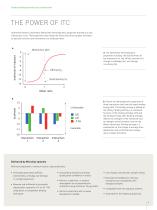
Understanding biomolecular interactions THE POWER OF ITC Isothermal titration calorimetry determines thermodynamic properties that tell you why interactions occur. Thermodynamic data reveal the forces that drive complex formation to describe function and mechanism at a molecular level. A. ITC determines thermodynamic properties including: the stoichiometry of Unfavorable the interaction (n), the affinity constant (K D), change in enthalpy (ΔH), and change in entropy (ΔS). G B. Shown are thermodynamic signatures of three interactions that have the same binding energy (ΔG). The binding energy is...
Open the catalog to page 5
Understanding biomolecular interactions ITC IN ACTION – PROVEN VERSATILITY Theory into practice Thousands of citations in reference databases illustrate the diverse applications of MicroCal ITC systems. They are used to measure the binding affinity and thermodynamic properties of any biomolecular change that can influence recognition between binding partners. When combined with structural information, ITC data provide deeper insights into structure-function relationships and the mechanisms of binding. While the following examples provide a snapshot, you can find a wealth of detailed applications...
Open the catalog to page 6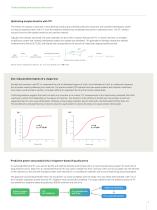
Understanding biomolecular interactions Optimizing enzyme kinetics with ITC The kinetics of xylanase is important in bio-bleaching wood pulp and biofuel production. Baumann and coworkers developed a system to measure xylanase kinetics with ITC since the traditional method was complicated and prone to systematic errors. The ITC method was also found to offer greater sensitivity and used less material. Typically, heat changes associated with xylan hydrolysis are too small to measure directly with ITC. To boost heat flow, an enthalpy amplification system that involved carbohydrate oxidase and catalase...
Open the catalog to page 7
Understanding biomolecular interactions MICROCAL ITC RANGE AT A GLANCE MicroCal PEAQ-ITC Automated Combining exceptional performance of the MicroCal PEAQ-ITC with full automation and unattended operation, the MicroCal PEAQ-ITC Automated is a valuable asset for any busy research laboratory. User-friendly software ensures efficient experimental design while automated data analysis delivers fast, reliable results. The automation and throughput it offers make it a particularly good choice for drug discovery applications such as hit validation where productivity is crucial. FEATURES: • Fully automated...
Open the catalog to page 8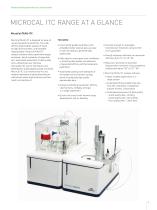
Understanding biomolecular interactions MICROCAL ITC RANGE AT A GLANCE MicroCal PEAQ-ITC MicroCal PEAQ-ITC is designed for ease-ofuse and exceptional sensitivity. The wide affinity range enables analysis of weak to high affinity binders, with excellent reproducibility. MicroCal PEAQ-ITC analysis software offers experiment design simulation, batch evaluation of large data sets, automated assessment of data quality and a streamlined user interface that guides the user to final figures and presentation quality graphs quickly and easily. MicroCal ITC is an essential tool for any research laboratory...
Open the catalog to page 9
Understanding biomolecular interactions MICROCAL ITC RANGE AT A GLANCE MicroCal iTC200 The MicroCal iTC200 is designed for ease of use and exceptional sensitivity. Its wide affinity range enables analysis of weak to high affinity binders with excellent reproducibility. Syringe and cell cleaning functions are semi-automated and require minimal operator involvement. User-friendly software guides all operations for fast accurate analysis. MicroCal iTC200 is an essential tool for any research laboratory studying biomolecular interactions where high sensitivity and rapid results are paramount. FEATURES:...
Open the catalog to page 10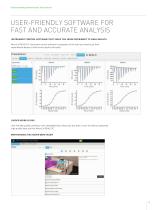
Understanding biomolecular interactions FAST AND ACCURATE ANALYSIS INSTRUMENT CONTROL SOFTWARE THAT TAKES YOU FROM EXPERIMENT TO FINAL RESULTS: MicroCal PEAQ-ITC instrument control software incorporates all the tools you need to go from experimental design to final results quickly and easily. Molar Ratio Molar Ratio Molar Raw GUIDED WORK-FLOWS User-friendly guided workflows with embedded help videos give any level of user the ability to generate high quality data with the MicroCal PEAQ-ITC. MAINTENANCE HAS NEVER BEEN EASIER
Open the catalog to page 11All Malvern Panalytical catalogs and technical brochures
 Mastersizer 3000+
13 Pages
 CNA3 Copper
5 Pages
 CNA3 Iron
5 Pages
 CNA Cross-belt Analyzer
9 Pages
 Water treatment solutions
8 Pages
 Zetasizer Advance
5 Pages
 Insitec Dry
16 Pages
 CubiX3
4 Pages
 MicroCal PEAQ-DSC Automated
7 Pages
 Zetasizer Pro and Ultra
20 Pages
 Hydro LV
20 Pages
 Hydro EV
20 Pages
 Hydro SM
11 Pages
 Mastersizer Chocosizer
2 Pages
 Aeris Cement Edition
8 Pages
 2830 ZT
12 Pages
 Axios Fast
8 Pages
 X'Pert3 powder
12 Pages
 Cement Solution
16 Pages
 AERO M
2 Pages
 Drug Development Solutions
20 Pages


Archived catalogs
 VISCOTEK UV Detector
2 Pages
 Viscotek UV-PDA Detector
2 Pages
 The Viscotek SEC-MALS 20
4 Pages
 Zetasizer Nano Series
20 Pages
 NanoSight Range
12 Pages
 MASTERSIZER_3000
13 Pages


- Malvern Panalytical gas analyzer
- Concentration analyzer
- Monitoring analyzer
- Liquids analyzer
- Malvern Panalytical automatic analyzer
- Benchtop analyser
- Malvern Panalytical solids analyzer
- Malvern Panalytical spectrometer
- Process analyzer
- Portable analyzer
- Continuous analyzer
- Water analyzer
- Real-time analyzer
- Oxygen analyzer
- Malvern Panalytical laboratory analyzer
- Compact analyzer
- Infrared analyser
- Calibration analyzer
- Temperature analyzer
- Laboratory spectrometer