
- Catalogs
- Magnetrol - AMETEK
- TRACKING NATURAL GAS WITH FLOWMETERS

TRACKING NATURAL GAS WITH FLOWMETERS

TRACKING NATURAL GAS WITH FLOWMETERS
Industries are increasingly focusing on strategic energy management, particularly in monitoring natural gas consumption. While total gas consumption is tracked by custody-transfer flowmeters, individual combustion sources often remain unmonitored. Accurate measurement of natural gas flow can enhance combustion performance, identify efficient units, and ensure compliance with emission regulations, leading to cost savings.
Natural gas flow to combustion sources typically involves pipe sizes from 1 to 6 inches, with ambient temperature conditions. Pressure generally ranges from 5 to 10 psig, and flowmeters are installed downstream of pressure regulators.
- Orifice Plate: Traditional method requiring additional instrumentation for accurate mass flow measurement, making it costly.
- Vortex Flowmeters: Require pressure and temperature adjustments for mass flow conversion.
- Turbine Flowmeters: High accuracy but require clean gas and pressure/temperature corrections.
- Ultrasonic Flowmeters: Accurate but costly and less suitable for low-velocity applications.
- Coriolis Mass Flowmeters: Provide direct mass flow measurement but are expensive.
- Thermal Mass Flowmeters: Offer advantages like lower flow sensitivity, higher turndown capabilities, simplified installation, and minimal pressure drop.
Thermal mass flowmeters provide mass flow measurement without additional devices for pressure and temperature correction. They offer lower flow sensitivity, higher turndown capabilities, simplified installation, and minimal pressure drop, making them beneficial in low-pressure applications.
Thermal mass flowmeters are advantageous for measuring natural gas flow to individual combustion units due to their accuracy, ease of installation, and ability to handle a wide range of flow rates without significant pressure drop.
The electronics maintain a desired temperature difference between the pins. At no flow, minimal energy is needed. As flow increases, heat is transferred to the gas stream, requiring more power to maintain the temperature difference. This relationship is used to measure flow rates.
Calibration involves using a test bench to flow known gas amounts past the sensor, measuring signals at different flow rates. At least ten calibration points are recommended for accuracy. Post-calibration, the flowmeter provides a linear output signal over its range.
Proper installation requires a straight run of pipe to ensure a fully developed flow profile. Insertion probes must be correctly positioned, and pipe dimensions accurately entered into the transmitter to avoid measurement errors.
Similar to natural gas, biogas measurement with thermal mass flowmeters accounts for its composition, typically methane and carbon dioxide. These flowmeters are suitable for low-pressure, low-flow conditions and can handle wet and dirty gases.
Thermal mass flowmeters offer benefits such as high sensitivity at low flow rates, low pressure drop, and ease of installation. They provide economical solutions compared to other technologies requiring pressure and temperature compensation.
Thermal mass flowmeters are effective for measuring gas flows due to their sensitivity, turndown capabilities, and adaptability to varying gas compositions. They are particularly advantageous in applications with low flow rates and challenging gas conditions.
The document discusses various types of level measurement instruments used in industrial applications, highlighting their features and applications.
Catalog excerpts

TRACKING NATURAL GAS WITH FLOWMETERS
Open the catalog to page 1
www.che.com Feature Report ENERGY EFFICIENCY: Tracking Natural Gas With Flowmeters Thermal mass flowmeters provide advantages over other options for metering the consumption of natural gas by individual combustion units throughout the facility Wayne Shannon, Magnetrol International ith today’s increased emphasis on strategic energy management, many throughout the chemical process industries (CPI) and elsewhere are attempting to obtain better information on the natural gas consumption in their facilities. While custody-transfer flowmeters are typically in place at the property line (to track total...
Open the catalog to page 2
Pressure drop FIGURE 2. In this thermal mass flowmeter, the sensors are an integral part of the body construction. This design can be used in pipe sizes from 0.5 to 4 in., and may be used with an optional, built-in flow-conditioning element FIGURE 3. Shown here is a typical curve showing the square root relationship between pressure drop and flow for differential-pressure-type flowmeters. At very low flowrates, there is little signal, which limits the ability to accurately measure low flowrates. Similarly, pressure drop increases with the square of the flowrate, and this may limit the turndown...
Open the catalog to page 3
Feature Report counted using an external pickup that provides a series of electronic pulses with each pulse equivalent to one rotation. The pulses are then sent to the transmitter. The manufacturer provides a K factor to relate each rotation to a given gas volume. The number of pulses that are counted over a given time period provide both the flowrate and the totalized flow. Turbine meters have relatively high turndown capabilities with corresponding high measurement accuracy. Like the previously mentioned flowmeter types, the turbine flowmeter is a volumetric device that measures the actual...
Open the catalog to page 4
FIGURE 7 (bottom right). This figure shows a fully developed flow profile in a pipe. It also shows the use of a compression fitting for positioning the probe in the pipe. This installation provides considerable flexibility and easy installation Flowrate, scfh FIGURE 6 (top left). This curve shows the relationship between the power and the mass flowrate for a thermal mass flowmeter in a 4-in. pipe. Such a curve is developed during the calibration of the instrument contact with the natural gas, the user should ensure that the temperature rise of the sensor is less than the autoignition temperature...
Open the catalog to page 5
the relative change in heat transfer is comparatively less than the change in gas density, which is directly used by other flowmeters. Installation considerations Nearly all flowmeters require some straight run of pipe ahead of the flow sensor. Thermal mass flowmeters follow the same basic ' guidelines. The flow calculations used with an insertion-type flowmeter assume the presence of this fully developed flow profile and the placement of the sensor on the centerline of the pipe as shown in Figure 7. Theoretically the velocity at the wall is zero and the velocity on the centerline of the pipe...
Open the catalog to page 6
Special Application Series Guided Wave Radar Eclipse® and Horizon™ transmitters are two-wire, loop-powered, 24 VDC level transmitters based on Guided Wave Radar (GWR) technology. Available in coaxial, twin rod and single rod probes, these leading-edge transmitters provide measurement performance well beyond that of many traditional technologies. Available with HART®, Foundation fieldbus™ and PROFIBUS® outputs. Thru-Air Radar Pulsar® Pulse Burst Radar level transmitters are the latest generation of loop-powered, 24 VDC, liquid level transmitters. They offer lower power consumption, faster response...
Open the catalog to page 8All Magnetrol - AMETEK catalogs and technical brochures
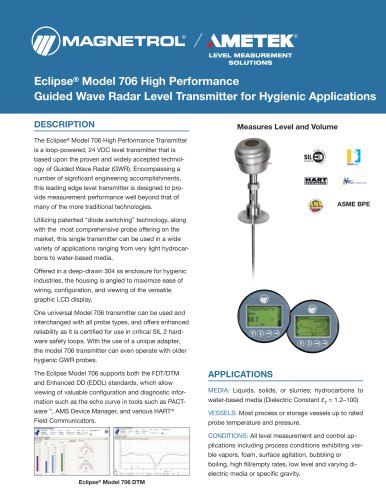 Eclipse® 706 Hygienic
12 Pages
 TUFFY® II
12 Pages
 E4 Modulevel®
12 Pages
 Thermatel® TD1/TD2
16 Pages
 Crude Oil Processing
8 Pages
 Natural Gas Processing
12 Pages
 Interface In The Field
14 Pages
 Emulsion In The Field
9 Pages
 PRODUCT LINE CATALOGUE
106 Pages
 Aurora® Magnetic Level Indicator
28 Pages
 Atlas™ Magnetic Level Indicator
24 Pages
 Echotel® 355
4 Pages
 STEAM DRUM LEVEL MATTERS
1 Page
 INTERFACE IN THE FIELD
1 Page
 Power Generation
16 Pages
 Petroleum Refining
16 Pages
 Seal Pots
4 Pages
 Mass Flow Measurement
12 Pages
 Heat Rate Awareness
8 Pages
 Ethylene Applications
8 Pages
 GEMINI™
32 Pages
 Pneumatic Tuffy®
12 Pages
 Models T5x & T6x
8 Pages
 Models T20/T21
12 Pages
 Series B73 and Series 75
12 Pages
 Series 3
24 Pages
 Model J52
2 Pages
 Model B40
4 Pages
 Floating Roof Detection
16 Pages
 Displacer Switches
20 Pages
 APM Pneumatic Modulevel®
12 Pages
 Flue Gas Desulferization
8 Pages
 Energy Management
4 Pages
 API 2350 Overfill Prevention
8 Pages
 PULSAR ® R96
1 Page
 Water & Wastewater
12 Pages
 Displacer Transmitters
4 Pages
 Guided Wave Radar
12 Pages
 Magnetic Level Indicators
12 Pages
 Thermal Dispersion
12 Pages
 Ultrasonic Contact
4 Pages
 R Series High Temp Switch
12 Pages
 Series K Pneumatic Switch
8 Pages
 J Series Pneumatic Switch
8 Pages
 Liquid Displacer Level Switches
16 Pages
 Crude Oil Processing
8 Pages
 Product Line Quick Reference
8 Pages





- MAGNETROL liquid level switch
- Level probe
- Liquid level sensor
- Measurement software
- Interface software
- MAGNETROL float level switch
- Analog level sensor
- MAGNETROL stainless steel level switch
- Digital output level sensor
- MAGNETROL threaded level switch
- Vessel level sensor
- MAGNETROL analog level transmitter
- Liquids level gauge
- MAGNETROL tank level switch
- MAGNETROL magnetic float level switch
- Flow switch