
- Catalogs
- Magnetrol - AMETEK
- Pulsar Model R96 - 6 GHz Pulse Burst Radar Level transmitter

Pulsar Model R96 - 6 GHz Pulse Burst Radar Level transmitter
Pulsar Model R96 - 6 GHz Pulse Burst Radar Level transmitter
- Multivariable two-wire, 24 VDC loop-powered transmitter for level or volume measurement.
- Unaffected by changes in specific gravity and dielectric.
- Operates at 6 GHz, suitable for challenging conditions like turbulence, foam, and heavy vapors.
- Simple Echo Rejection setup.
- Antennas withstand temperatures up to +400°F (+200°C) and pressures from -14.7 to 750 psig (-1.0 to 51.7 bar).
- Measurement range up to 130 feet (40 meters).
- Low power output at antenna, less than a cell phone.
- Equipped with a 4-button keypad and graphic LCD display for configuration and diagnostics.
- Compatible with SIL 2 Loops and available with HART® or FOUNDATION fieldbus™ digital output.
The Pulsar® R96 Radar transmitter is a non-contact radar transmitter designed for enhanced performance and ease of use in level measurement applications, complementing the MAGNETROL Eclipse® Model 706 Guided Wave Radar transmitter.
TechnologyUses pulse burst radar technology, emitting short bursts of 6 GHz microwave energy. Distance is calculated using the transit time of the reflected signal, determining liquid level by factoring in tank height.
Applications- Suitable for liquids and slurries, including hydrocarbons and water-based media.
- Applicable in metal and concrete vessels, pits, sumps, and glass-lined tanks.
- Effective in conditions with varying specific gravity, dielectric, visible vapors, high fill/empty rates, turbulence, foam, and buildup.
Available with three antenna configurations: TFE Dielectric Rod, 4" Horn, and 6" Horn. Proper installation and orientation are crucial to minimize false target reflections and ensure accurate measurements.
Agency Approvals- Complies with RED-directive 2014/53/EU, PED-directive 2014/68/EU, and ATEX directive 2014/34/EU.
- Explosion Proof, Flame Proof, Non-Incendive, Non-Sparking, and Intrinsically Safe certifications for various regions and conditions.
- Measurement principle: Pulse burst radar at 6 GHz.
- Span: 0.5 to 130 feet (0.2 to 40 meters).
- Output: 4 to 20 mA with HART, FOUNDATION fieldbus™.
- Resolution: Analog .003 mA, Digital Display 1 mm.
- User interface includes a 4-button keypad and graphic LCD display.
- Menu languages available in multiple languages including English, French, German, Spanish, Russian, and Chinese.
The document outlines specifications for FOUNDATION fieldbus Host Systems and HART systems, detailing power requirements, housing materials, and dimensions. HART systems require a minimum of 11 VDC, while FOUNDATION fieldbus systems require 9 to 17.5 VDC. Housing options include die-cast aluminum and stainless steel, with IP67 rating for weatherproofing.
Environmental Conditions
Operating temperature range is -40° to +175° F, with storage temperatures from -50° to +185° F. Designed to handle humidity levels from 0–99% non-condensing and meets CE and NAMUR NE 21 electromagnetic compatibility standards.
Performance
Offers a response time of less than 2 seconds and an initialization time of under 30 seconds. Maintains high accuracy with a linearity and measured error of ±0.3 inch or 0.1% of tank height. Maximum rate of change is 180 inches per minute.
Antenna Specifications
Details on antenna types, including PTFE Rod & Horn and Dielectric Rod models, with maximum process temperatures and pressures specified. Constructed from materials like 316 SS and Hastelloy C, with various process connection options.
Functional/Physical Specifications
Includes detailed dimensional specifications for different models and configurations, including antenna extensions and process connections.
Quality Assurance and Warranty
Magnetrol's quality assurance system is ISO 9001 certified, ensuring high-quality products and services. Warranty covers defects in materials or workmanship for eighteen months from the date of shipment.
Additional Information
References additional resources such as the Instruction Manual 58-602 and lists relevant U.S. Patent numbers for the PULSAR Pulse Burst Radar transmitters.
Catalog excerpts

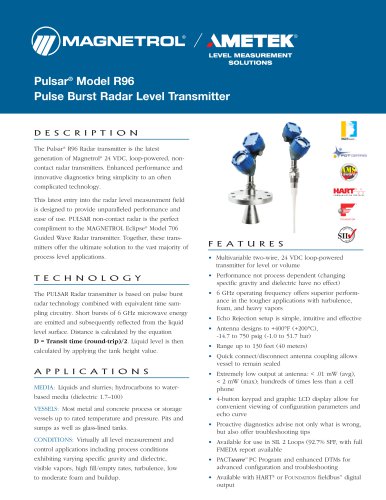
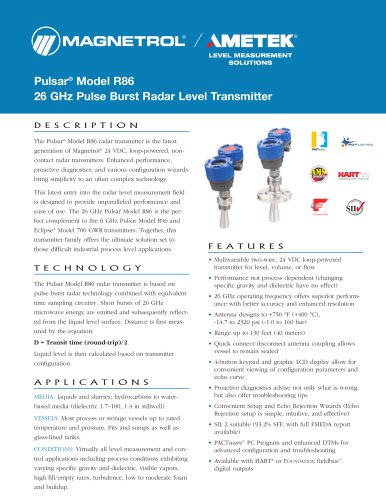
Pulsar® Model R96 Pulse Burst Radar Level Transmitter D E S C R I P T I O N The Pulsar® R96 Radar transmitter is the latest generation of Magnetrol® 24 VDC, loop-powered, noncontact radar transmitters. Enhanced performance and innovative diagnostics bring simplicity to an often complicated technology. This latest entry into the radar level measurement field is designed to provide unparalleled performance and ease of use. PULSAR non-contact radar is the perfect compliment to the MAGNETROL Eclipse® Model 706 Guided Wave Radar transmitter. Together, these transmitters offer the ultimate solution to the vast majority of process level applications. F E A T U R E S • Multivariable two-wire, 24 VDC loop-powered transmitter for level or volume • Performance not process dependent (changing specific gravity and dielectric have no effect) The PULSAR Radar transmitter is based on pulse burst radar technology combined with equivalent time sampling circuitry. Short bursts of 6 GHz microwave energy are emitted and subsequently reflected from the liquid level surface. Distance is calculated by the equation D = Transit time (round-trip)/2. Liquid level is then calculated by applying the tank height value. • 6 GHz operating frequency offers superior performance in the tougher applications with turbulence, foam, and heavy vapors • Echo Rejection setup is simple, intuitive and effective • Antenna designs to +400°F (+200°C), -14.7 to 750 psig (-1.0 to 51.7 bar) • Range up to 130 feet (40 meters) • Quick connect/disconnect antenna coupling allows vessel to remain sealed A P P L I C A T I O N S MEDIA: Liquids and slurries; hydrocarbons to waterbased media (dielectric 1.7–100) VESSELS: Most metal and concrete process or storage vessels up to rated temperature and pressure. Pits and sumps as well as glass-lined tanks. CONDITIONS: Virtually all level measurement and control applications including process conditions exhibiting varying specific gravity and dielectric, visible vapors, high fill/empty rates, turbulence, low to moderate foam and buildup. • Extremely low output at antenna: < .01 mW (avg), < 2 mW (max); hundreds of times less than a cell phone • 4-button keypad and graphic LCD display allow for convenient viewing of configuration parameters and echo curve • Proactive diagnostics advise not only what is wrong, but also offer troubleshooting tips • Available for use in SIL 2 Loops (92.7% SFF, with full FMEDA report available • PACTware™ PC Program and enhanced DTMs for advanced configuration and troubleshooting • Available with HART® or F
Open the catalog to page 1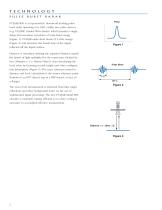
PULSAR R96 is a top-mounted, downward-looking pulse burst radar operating at 6 GHz. Unlike true pulse devices (e.g. ECLIPSE Guided Wave Radar) which transmit a single, sharp (fast rise-time) waveform of wide-band energy (Figure 1), PULSAR emits short bursts of 6 GHz energy (Figure 2) and measures the transit time of the signal reflected off the liquid surface. Distance is calculated utilizing the equation Distance equals the Speed of light multiplied by the transit time divided by two (Distance = C × Transit Time/2), then developing the level value by factoring in tank height and other configuration...
Open the catalog to page 2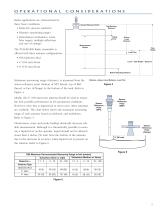
Radar applications are characterized by three basic conditions: • Dielectric (process medium) Sensor Reference Point • Distance (measuring range) • Disturbances (turbulence, foam, false targets, multiple reflections and rate of change) Safety Zone Sensor Level Distance Measurement Region Tank Height The PULSAR R96 Radar transmitter is offered with three antenna configurations: Level Trim • TFE Dielectric Rod Level = Tank Height – Distance Bottom Blocking Distance Maximum measuring range (distance) is measured from the sensor reference point (bottom of NPT thread, top of BSP thread, or face of...
Open the catalog to page 3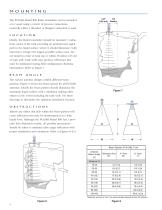
The PULSAR Model R96 Radar transmitter can be mounted on a vessel using a variety of process connections. Generally either a threaded or flanged connection is used. L O C A T I O N Ideally, the Radar transmitter should be mounted 1⁄2 radius from center of the tank providing an unobstructed signal path to the liquid surface where it should illuminate (with microwave energy) the largest possible surface area. Do not install in center of tank top or within 18 inches (45 cm) of tank wall. Tank walls may produce reflections that must be minimized during field configuration (Antenna Orientation). Refer...
Open the catalog to page 4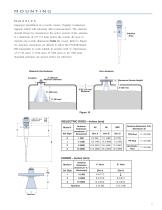
Improper installation in a nozzle creates “ringing” (undesired signals) which will adversely affect measurement. The antenna should always be mounted so the active section of the antenna is a minimum of 0.5" (12 mm) below the nozzle. Be sure to include any nozzle dimension inside the vessel. Refer to Figure 10. Antenna extensions are offered to allow the PULSAR Model R96 transmitter to work reliably in nozzles with “L” dimensions of 1" (25 mm), 4" (100 mm), 8" (200 mm) or 12" (300 mm). Standard antennas are shown below for reference. Dielectric Rod Antenna Coupling Inactive Area Horn Antenna...
Open the catalog to page 5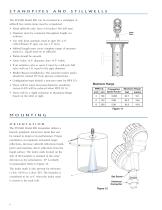
The PULSAR Model R96 can be mounted in a standpipe or stillwell but certain items must be considered: • Metal stillwells only: Sizes 4–8 inches (100–200 mm). Index Mark • Diameter must be consistent throughout length; no reducers. • Use only horn antennas sized to pipe ID; 4–6" (100–150mm); 8" pipe can use a 6" horn. • Stillwell length must cover complete range of measurement (i.e., liquid must be in stillwell). • Welds should be smooth. • Vents: holes <0.5" diameter, slots <0.5" width. • If an isolation valve is used, it must be a full port ball valve with an I.D. equal to the pipe diameter....
Open the catalog to page 6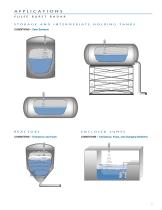
CONDITIONS – Calm Surfaces CONDITIONS – Turbulence and Foam CONDITIONS – Turbulence, Foam, and Changing Dielectric
Open the catalog to page 7All Magnetrol - AMETEK catalogs and technical brochures
 Eclipse® 706 Hygienic
12 Pages
 TUFFY® II
12 Pages
 E4 Modulevel®
12 Pages
 Thermatel® TD1/TD2
16 Pages
 Crude Oil Processing
8 Pages
 Natural Gas Processing
12 Pages
 Interface In The Field
14 Pages
 Emulsion In The Field
9 Pages
 PRODUCT LINE CATALOGUE
106 Pages
 Aurora® Magnetic Level Indicator
28 Pages
 Atlas™ Magnetic Level Indicator
24 Pages
 Echotel® 355
4 Pages
 STEAM DRUM LEVEL MATTERS
1 Page
 INTERFACE IN THE FIELD
1 Page
 Power Generation
16 Pages
 Petroleum Refining
16 Pages
 Seal Pots
4 Pages
 Mass Flow Measurement
12 Pages
 Heat Rate Awareness
8 Pages
 Ethylene Applications
8 Pages
 GEMINI™
32 Pages
 Pneumatic Tuffy®
12 Pages
 Models T5x & T6x
8 Pages
 Models T20/T21
12 Pages
 Series B73 and Series 75
12 Pages
 Series 3
24 Pages
 Model J52
2 Pages
 Model B40
4 Pages
 Floating Roof Detection
16 Pages
 Displacer Switches
20 Pages
 APM Pneumatic Modulevel®
12 Pages
 Flue Gas Desulferization
8 Pages
 Energy Management
4 Pages
 API 2350 Overfill Prevention
8 Pages
 PULSAR ® R96
1 Page
 Water & Wastewater
12 Pages
 Displacer Transmitters
4 Pages
 Guided Wave Radar
12 Pages
 Magnetic Level Indicators
12 Pages
 Thermal Dispersion
12 Pages
 Ultrasonic Contact
4 Pages
 R Series High Temp Switch
12 Pages
 Series K Pneumatic Switch
8 Pages
 J Series Pneumatic Switch
8 Pages
 Liquid Displacer Level Switches
16 Pages
 Crude Oil Processing
8 Pages
 Product Line Quick Reference
8 Pages








- MAGNETROL level switch
- MAGNETROL liquid level switch
- Level probe
- Liquid level sensor
- Measurement software
- Interface software
- MAGNETROL float level switch
- Analog level sensor
- MAGNETROL stainless steel level switch
- MAGNETROL liquid level transmitter
- Digital output level sensor
- MAGNETROL threaded level switch
- Vessel level sensor
- MAGNETROL analog level transmitter
- Liquids level gauge
- MAGNETROL tank level switch
- Flow sensor
- MAGNETROL magnetic float level switch
- Flow switch