
- Catalogs
- Magnetrol - AMETEK
- Pulp & Paper Mills - A Guide to Level Instrumentation for Pulp and Paper Mills

Pulp & Paper Mills - A Guide to Level Instrumentation for Pulp and Paper Mills

Pulp & Paper Mills - A Guide to Level Instrumentation for Pulp and Paper Mills
Catalog excerpts

I N D U S T R Y A P P L I C A T I O N S S E R I E S A Guide to Level Instrumentation for Pulp and Paper Mills
Open the catalog to page 1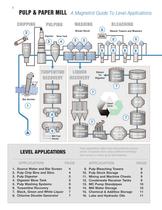
2 LEVEL APPLICATIONS APPLICATION PAGE 1. Source Water and Bar Screen 4 2. Pulp Chip Bins and Silos 4 3. Pulp Digester 5 4. Digester Blow Tank 5 5. Pulp Washing Systems 6 6. Turpentine Recovery 6 7. Black, Green and White Liquor 7 8. Chlorine Dioxide Generator 7 These applications utilize level instruments for process control. A separate alarm using a different technology often serves as a back-up for spill detection. APPLICATION PAGE 9. Pulp Bleaching Towers 8 10. Pulp Stock Storage 8 11. Mixing and Machine Chests 9 12. Condensate Receiver Tanks 9 13. MC Pump Standpipes 10 14. Mill Water Storage...
Open the catalog to page 2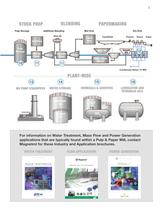
3 For information on Water Treatment, Mass Flow and Power Generation applications that are typically found within a Pulp & Paper Mill, contact Magnetrol for these Industry and Application brochures. WATER TREATMENT FLOW APPLICATIONS POWER GENERATION
Open the catalog to page 3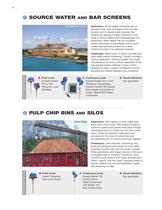
4 Application: As the largest industrial user of process water, pulp and paper mills are often located next to natural water sources. Bar screens are placed in intake channels or wet wells to remove debris that could damage mill equipment. When debris has accumulated, screen cleaning is accomplished with an automated rake typically actuated by a level control mounted in an upstream channel. Challenges: Water levels of intake channels and plant wells require monitoring. Though normally a routine application, freezing weather can cause complications for level controls, especially those that actuate...
Open the catalog to page 4
5 Application: The kraft process is the most prevalent pulping method. Here, heat and chemicals (sodium hydroxide and sodium sulphide, or White Liquor) combine in a large pressurized cooker, or digester, to transform wood chips into pulp by dissolving the wood’s lignin binder. The waste lignin and spent chemicals, or Black Liquor, is routed to a recovery boiler. Challenges: Digester level monitoring maintains operational stability, increases throughput and reduces kappa variation (the measure of lignin remaining in the pulp). Process conditions of up to +355° F (+180° C), steam, high pressure,...
Open the catalog to page 5
6 Application: Pulp is washed at two junctures in the chemical pulping process. Brown Stock (pulp with residual lignin) is washed following the digester; and Bleached Stock is washed in the multi-stage bleaching unit. In each case, pulp moves through a series of washers and screens to remove residual chemicals and chips. Level controls usually monitor mass tanks and filtrate tanks in the washing units. Challenges: Precise level control of the two pulp washing lines ensures a consistent supply of wash water; maintains level stability; ensures correct dilution levels for the wash line; keeps filtrate...
Open the catalog to page 6
7 Application: Black Liquor is the digester waste mixture of spent chemicals and lignin extracted from wood chips. When burned in a recovery boiler Black Liquor produces heat for steam and also releases digester chemicals called “smelt.” Mixed with water, smelt becomes Green Liquor. This is treated with lime in the causticizers to produce White Liquor, the digester’s cooking chemical. Challenges: Stored in varying concentrations, liquors are corrosive solutions with high levels of organic compounds. Liquors can cause chemical burns or damage the lungs if inhaled. Level sensors contend with the...
Open the catalog to page 7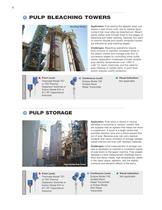
8 Application: Pulp leaving the digester wash unit retains a dark brown color due to residual lignin content that must often be bleached out. Bleach plants whiten pulp through three to five stages of bleaching and water washing. Typically, two pairs of chlorine dioxide and caustic extraction towers are followed by pulp washing stages. Challenges: Bleaching operations require level controls to maintain consistent levels in the bleach towers and manage pulp flow to successive stages by controlling tower outlet valves. Application challenges include variable pulp density, temperatures over +200°...
Open the catalog to page 8
9 Application: The mixing chest is a large, agitated tank used for mixing various types of pulp, fillers, and additives together in a specified formula for the paper machine. The mixed stock is fed to the machine chest where it is pumped to the headbox and dispensed evenly onto the moving wire of the papermaking machine. When the stock is de-watered and dried, the result is finished paper. Challenges: Level controls ensure that the chests never overflow and that the level never sinks below a safe level with respect to the agitation zone. Level monitoring must contend with pulp thickness, high...
Open the catalog to page 9
10 Application: Designed to move thick fluids, MC (Medium Consistency) pumps are ideal for transporting pulp in a mill. Pulp is often pumped from a standpipe, a vertical feed pipe integral to the pump. Pumps with standpipes typically pump to and from washers and thickeners, O2 and CLO2 mixers, extraction towers, bleach storage towers, and high-density pulp storage towers. Challenges: It is important that the proper level of pulp be maintained in a standpipe. A level control in the standpipe does this by actuating a valve downstream of the pump. A malfunctioning level control could result in standpipe...
Open the catalog to page 10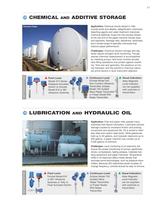
11 Application: Chemical stocks stored in mills include acids and alkalies, delignification chemicals, bleaching agents and water treatment chemicals. Chemical additives mixed into the process stream at the wet end of the paper machine include dyes and pigments, drainage aids, defoamers, slimicides, and a broad range of specialty chemicals that improve paper performance. Challenges: Chemical solution storage and day tanks require stringent level monitoring. Though precise chemical measurement is accomplished by metering pumps, tank level controls actuate tank-filling operations and protect against...
Open the catalog to page 11
AN INDUSTRY GUIDE TO LEVEL MEASUREMENT AND CONTROL FROM MAGNETROL Other industry and special application brochures from Magnetrol include: CORPORATE HEADQUARTERS 5300 Belmont Road • Downers Grove, Illinois 60515-4499 USA Phone: 630-969-4000 • Fax: 630-969-9489 magnetrol.com • [email protected] EUROPEAN HEADQUARTERS Heikensstraat 6 • 9240 Zele, Belgium Phone: 052 45.11.11 • Fax: 052 45.09.93 BRAZIL: Av. Dr. Mauro Lindemberg Monteiro • 185-Jd. Santa Fé, Osasco • São Paulo CEP 06278-010 CANADA: 145 Jardin Drive, Units 1 & 2 • Concord, Ontario L4K 1X7 CHINA: Plant 6, No. 191, Huajin Road • Minhang...
Open the catalog to page 12All Magnetrol - AMETEK catalogs and technical brochures
 Eclipse® 706 Hygienic
12 Pages
 TUFFY® II
12 Pages
 E4 Modulevel®
12 Pages
 Thermatel® TD1/TD2
16 Pages
 Crude Oil Processing
8 Pages
 Natural Gas Processing
12 Pages
 Interface In The Field
14 Pages
 Emulsion In The Field
9 Pages
 PRODUCT LINE CATALOGUE
106 Pages
 Aurora® Magnetic Level Indicator
28 Pages
 Atlas™ Magnetic Level Indicator
24 Pages
 Echotel® 355
4 Pages
 STEAM DRUM LEVEL MATTERS
1 Page
 INTERFACE IN THE FIELD
1 Page
 Power Generation
16 Pages
 Petroleum Refining
16 Pages
 Seal Pots
4 Pages
 Mass Flow Measurement
12 Pages
 Heat Rate Awareness
8 Pages
 Ethylene Applications
8 Pages
 GEMINI™
32 Pages
 Pneumatic Tuffy®
12 Pages
 Models T5x & T6x
8 Pages
 Models T20/T21
12 Pages
 Series B73 and Series 75
12 Pages
 Series 3
24 Pages
 Model J52
2 Pages
 Model B40
4 Pages
 Floating Roof Detection
16 Pages
 Displacer Switches
20 Pages
 APM Pneumatic Modulevel®
12 Pages
 Flue Gas Desulferization
8 Pages
 Energy Management
4 Pages
 API 2350 Overfill Prevention
8 Pages
 PULSAR ® R96
1 Page
 Water & Wastewater
12 Pages
 Displacer Transmitters
4 Pages
 Guided Wave Radar
12 Pages
 Magnetic Level Indicators
12 Pages
 Thermal Dispersion
12 Pages
 Ultrasonic Contact
4 Pages
 R Series High Temp Switch
12 Pages
 Series K Pneumatic Switch
8 Pages
 J Series Pneumatic Switch
8 Pages
 Liquid Displacer Level Switches
16 Pages
 Crude Oil Processing
8 Pages
 Product Line Quick Reference
8 Pages







- MAGNETROL liquid level switch
- Liquid level sensor
- Measurement software
- Interface software
- MAGNETROL float level switch
- Analog level sensor
- MAGNETROL stainless steel level switch
- MAGNETROL level transmitter
- MAGNETROL liquid level transmitter
- Digital output level sensor
- MAGNETROL threaded level switch
- Vessel level sensor
- MAGNETROL analog level transmitter
- Liquids level gauge
- MAGNETROL tank level switch
- Flow sensor
- MAGNETROL magnetic float level switch
- Flow switch