
- Catalogs
- Magnetrol - AMETEK
- Petroleum Refining

Petroleum Refining

Petroleum Refining
- Crude Storage and Dewatering: Utilizes radar level measurement to manage water separation and prevent overflows. Interface detection is crucial for separating water from crude oil.
- Crude Desalting: Removes contaminants using chemical or electrostatic methods. Accurate interface measurement is essential to avoid errors from probe coating and electrostatic interference.
- Preflash Drum and Distillation Column: Require precise level control to prevent issues like foaming and carryover, enhancing separation efficiency.
- Reflux Accumulator and Column Reboiler: Accurate level monitoring prevents excessive reflux and ensures proper heat transfer.
- Solvent Extraction: Critical for managing high temperatures and pressures during deasphalting of petroleum resids.
- Catalytic Cracker and Stripper: Level control is vital for managing fluidized solids and preventing hazards.
- Hydrocracking: Requires robust level controls to withstand high pressure and corrosive conditions.
- Acid Settling Tanks and Alkylation: Accurate level control prevents cross-contamination and hazards.
- Catalytic Reformer and Isomerization: Essential for managing fouling and ensuring product quality.
- Coking Operations: Focus on converting heavy products into lighter gases and gasoline blends.
- Hydrodesulfurization and Chemical Storage: Emphasizes sulfur removal and safe chemical storage management.
- Blending Units: Accurate level control is crucial for maintaining quality standards in product mixing.
Catalog excerpts

INDUSTRY APPLICATIONS
Open the catalog to page 1
COOLER ACCUMULATOR 20 Leading Petroleum Refinery Level Control Applications APPLICATION PAGE 2. Crude Dewatering 4 3. Crude Desalting 5 4. Preflash Drum 5 5. Distillation Column 6 6. Reflux Accumulator 6 7. Column Reboiler 7 8. Solvent Extraction 7 Conversion 9. Catalytic Cracker 8 10. Catalytic Stripper 8 11. Hydrocracking 9 12. Acid Settling Tanks 9 13. Alkylation Tanks 10 14. Catalytic Reformer 10 15. Coking Operations 11 16. Isomerization 11 Treatment 17. Hydrodesulfurization 12 18. Chemical Storage 12 Blending 19. Blending Unit 13 20. Finished Products 13 See page 14 for information...
Open the catalog to page 2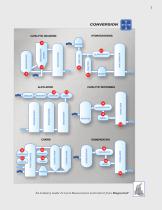
CATALYTIC CRACKING CONVERSION HYDROCRACKING CATALYTIC REFORMING An Industry Guide To Level Measurement and Control from Magnetrol®
Open the catalog to page 3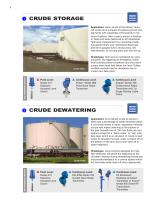
CRUDE STORAGE Application: Upon arrival at the refinery terminal, crude oil is pumped into above-ground storage tanks with capacities of thousands to millions of gallons. Raw crude is stored in floatingor fixed-roof tanks field-built to API standards. Tank level measurement by noncontact radar has gained share over mechanical float type and servo gauges due to its accuracy, low maintenance, no moving parts and fast set-up. Crude Tanks s Point Level: Model A15 DisplacerActuated Level Switch Challenges: Tank level is maintained by valve actuation. By triggering an emergency cutoff, level controls...
Open the catalog to page 4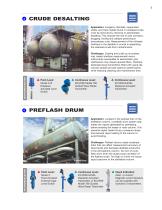
CRUDE DESALTING Application: Inorganic chlorides, suspended solids, and trace metals found in untreated crude must be removed by chemical or electrostatic desalting. This reduces the risk of acid corrosion, plugging, fouling and catalyst poisoning in downstream units. Measurement of the oil/water interface in the desalter is crucial in separating the cleansed crude from contaminants. Desalting Tanks s Point Level: Model A15 DisplacerActuated Level Switch Challenges: Coating and build-up on probes may create interface measurement errors. Instruments susceptible to electrostatic grid interference...
Open the catalog to page 5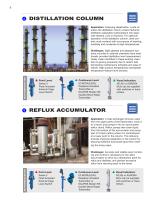
DISTILLATION COLUMN Application: Following desalination, crude oil enters the distillation column where fractional distillation separates hydrocarbons into separate streams, cuts or fractions. For optimum operation of the distillation column, level controls must contend with occurances of foaming, bubbling and moderate-to-high temperatures. Fractional Distillation s Point Level: Series 3 Float-Actuated External Cage Level Switch Challenges: Sight glasses and displacer systems mounted in external chambers have traditionally provided distillation level measurement. Today, radar retrofitted in these...
Open the catalog to page 6
COLUMN REBOILER Application: A heat exchanger positioned near the bottom of the distillation column re-heats and vaporizes liquid and reintroduces the vapor several trays higher. This improves separation by introducing more heat into the column. For effective functioning of the reboiling process, level monitoring of the reboiler is required. s Point Level: Series 3 FloatActuated External Cage Level Switch or Tuffy® II FloatActuated Switch Challenges: In some steam reboilers, the level must be controlled so that only a percentage of tubes are covered. This allows a control scheme to regulate the...
Open the catalog to page 7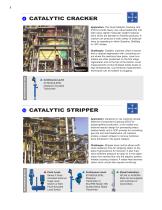
CATALYTIC CRACKER Application: The Fluid Catalytic Cracking Unit (FCCU) cracks heavy, low-value feedstocks into high-value, lighter molecular weight hydrocarbons which are blended to finished products. A cracker can produce a wide variety of yield patterns by operating in either Gasoline, Distillate or LPG modes. Challenges: Catalytic crackers utilize a reactor and a catalyst regenerator with connecting risers where the reactions take place. Level controllers are often positioned on the first stage regenerator and at the top of the reactor. Level measurements involve fluidized solids levels at...
Open the catalog to page 8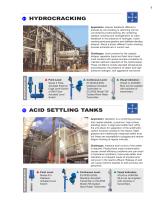
HYDROCRACKING Application: Heavier feedstock difficult to process by cat cracking or reforming can be converted by hydrocracking. By combining catalytic cracking and hydrogenation to crack feedstock in the presence of hydrogen, hydrocracking produces gasoline and distillate blending streams. About a dozen different hydro-cracking process schemes are in current use. Hydrocracking Unit Challenges: Level controls for the catalyst stripper, separator liquid and flash drum liquid must contend with severe process conditions to maintain optimum operation of the hydrocracker. These conditions include...
Open the catalog to page 9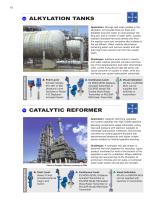
ALKYLATION TANKS Application: Storage and wash vessels in the alkylation unit include those for fresh and depleted acid and water, an acid analyzer settling pot, and a number of wash tanks. Caustic washes neutralize free acid carried over from the reaction zone and neutralize alkyl sulfates in the net effluent. Water washes decompose remaining esters and remove caustic and salt that might have carried over from the caustic wash. Wash Tanks Challenges: Interface level control in caustic and water washes prevents corrosion and fouling of the deisobutanizer and other downstream units. Levels rising...
Open the catalog to page 10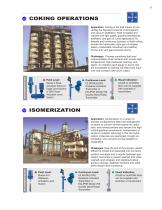
T5 COKING OPERATIONS Application: Coking is the final means of converting the heaviest products of atmospheric and vacuum distillation. Feed is heated and cracked into light gases, gasoline blendstocks, distillates, and gas oil. Level applications for delayed and continuous (contact or fluid) coking include the fractionator, light gas oil stripper, steam, condensate, blowdown and settling drums, and vent gas knockout drums. Challenges: Process conditions that level instrumentation must contend with include high temperatures, high pressures, foaming, and steam. An interface level gauge in drums...
Open the catalog to page 11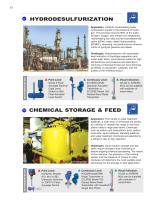
[7 HYDRODESULFURIZATION Application: Catalytic Hydrotreating treats hydrocarbon liquids in the presence of hydrogen. This process removes 90% of the sulfur, nitrogen, oxygen, and metals from feedstocks. Hydrotreating can also provide hydrodearomatization (HDAr), heavy diesel hydrocracking (HDHDC), dewaxing, and performance enhancements of pyrolysis gasoline and diesel. Challenges: Hydrotreatment will necessitate level indication of liquid/gas separators and water wash tanks. Level devices suited for high temperatures and pressures are essential in removing contaminants that can have detrimental...
Open the catalog to page 12All Magnetrol - AMETEK catalogs and technical brochures
 Eclipse® 706 Hygienic
12 Pages
 TUFFY® II
12 Pages
 E4 Modulevel®
12 Pages
 Thermatel® TD1/TD2
16 Pages
 Crude Oil Processing
8 Pages
 Natural Gas Processing
12 Pages
 Interface In The Field
14 Pages
 Emulsion In The Field
9 Pages
 PRODUCT LINE CATALOGUE
106 Pages
 Aurora® Magnetic Level Indicator
28 Pages
 Atlas™ Magnetic Level Indicator
24 Pages
 Echotel® 355
4 Pages
 STEAM DRUM LEVEL MATTERS
1 Page
 INTERFACE IN THE FIELD
1 Page
 Power Generation
16 Pages
 Seal Pots
4 Pages
 Mass Flow Measurement
12 Pages
 Heat Rate Awareness
8 Pages
 Ethylene Applications
8 Pages
 GEMINI™
32 Pages
 Pneumatic Tuffy®
12 Pages
 Models T5x & T6x
8 Pages
 Models T20/T21
12 Pages
 Series B73 and Series 75
12 Pages
 Series 3
24 Pages
 Model J52
2 Pages
 Model B40
4 Pages
 Floating Roof Detection
16 Pages
 Displacer Switches
20 Pages
 APM Pneumatic Modulevel®
12 Pages
 Flue Gas Desulferization
8 Pages
 Energy Management
4 Pages
 API 2350 Overfill Prevention
8 Pages
 PULSAR ® R96
1 Page
 Water & Wastewater
12 Pages
 Displacer Transmitters
4 Pages
 Guided Wave Radar
12 Pages
 Magnetic Level Indicators
12 Pages
 Thermal Dispersion
12 Pages
 Ultrasonic Contact
4 Pages
 R Series High Temp Switch
12 Pages
 Series K Pneumatic Switch
8 Pages
 J Series Pneumatic Switch
8 Pages
 Liquid Displacer Level Switches
16 Pages
 Crude Oil Processing
8 Pages
 Product Line Quick Reference
8 Pages





- MAGNETROL liquid level switch
- Level probe
- Liquid level sensor
- Measurement software
- Interface software
- MAGNETROL float level switch
- Analog level sensor
- MAGNETROL stainless steel level switch
- MAGNETROL level transmitter
- MAGNETROL liquid level transmitter
- Digital output level sensor
- MAGNETROL threaded level switch
- Vessel level sensor
- MAGNETROL analog level transmitter
- Liquids level gauge
- MAGNETROL tank level switch
- Flow sensor
- MAGNETROL magnetic float level switch
- Flow switch