
- Catalogs
- Magnetrol - AMETEK
- Mass Flow Measurement

Mass Flow Measurement

Mass Flow Measurement
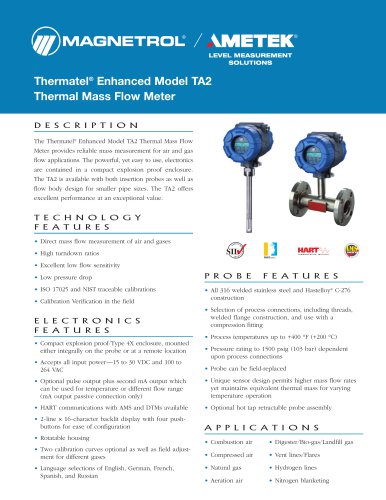
Thermal flow meters provide accurate mass flow measurements in units like SCFM or NM3/hr, crucial for industries reliant on precise chemical reactions and combustion processes.
Thermatel TA2 transmitters use heat transfer principles with RTDs to measure mass flow, offering direct measurement without needing pressure or temperature inputs for density correction. They feature excellent low flow sensitivity and a high turndown rate.
Advantages include negligible pipe blockage, low maintenance, easy installation, and competitive costs. They are approved for combustible gases and available in insertion or inline styles.
The TA2 features a compact, explosion-proof enclosure, optional display, and electronic features like HART communication and real-time temperature compensation. It is factory calibrated for specific applications.
The TA2 uses Constant Temperature Difference Technology for accurate mass flow measurement, with factory calibration and field verification methods.
- Mass Flow of Air: Used in cooling, combustion, and ventilation.
- Compressed Air Flow: Essential for pneumatic tools and materials handling.
- Nitrogen Gas Flow: Used for tank blanketing and purging.
- Natural Gas Flow: Monitored for efficiency in power generation and refining.
Each flow meter is calibrated to customer requirements, allowing easy field configuration and maintenance.
The document covers industrial applications of gases like Hydrogen, Argon, Oxygen, Carbon Dioxide, and exhaust gases, highlighting the advantages of TA2 Mass Flow Meters.
Used in chemical processing, metal production, petroleum refining, and automotive fuel cell technology.
Valued for inertness and low cost, used in metal fabrication, electronics, and thermal glass manufacturing.
Crucial in steelmaking, metal processing, and chemical industries for combustion and oxidation.
Used in fertilizers, beverage carbonation, and as a coolant, involved in oil extraction and food/pharmaceutical blanketing.
Managed through flaring and venting, with applications in waste-to-energy conversion and environmental monitoring.
Magnetrol's proprietary method ensures accuracy across varying temperatures.
Bio-gas is used as a fuel source, with TA2 meters effective due to low flow sensitivity.
The document emphasizes the versatility and industrial importance of these gases and the effectiveness of TA2 Mass Flow Meters.
Catalog excerpts

THERMATEL® MASS FLOW MEASUREMENT
Open the catalog to page 1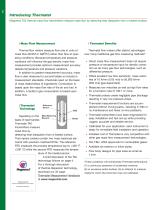
Magnetrol TA2 thermal mass flow transmitters measure mass flow by detecting heat dissipation from a heated surface. Thermal flow meters measure flow rate in units of mass flow (SCFM or NM1 2 3 4/hr) rather than flow at operating conditions. Because temperature and pressure variations will influence the gas density, mass flow measurement provides optimum measurement accuracy despite temperature and pressure variations. In addition to greater measurement accuracy, mass flow is also measured to accommodate an industry's measurement standards. Chemicals react on the basis of mass relationships of...
Open the catalog to page 2
TA2 SPECIFICATIONSSupply Voltage: Flow Range: Flow Accuracy: 100 - 264 VAC, 50 - 60 Hz Temperature Accuracy: 11.6-30 VDC Repeatability: 10-50,000 SFPM (0.05-250 Nm/s) (gas dependent) Sensor Range: -50° to +400° F (-45° to +200° C) ±1 % of reading plus 0.5% of calibration range Turn Down: Insertion (left) or In-Line style (above) Integral or Remote: All electronics are housed in a compact, explosion-proof enclosure mounted on the probe or at a remote location. Display: Optional two-line, 16 digits/line, alphanumeric backlit display module with four-button keypad for easy configuration. Displays...
Open the catalog to page 3
Principle of Operation TA2 thermal mass flow transmitter technology for measuring mass flow. The TA2 uses the proven Constant Temperature Difference Technology for mass flow measurement. There are two elements in the sensor as shown on page 2. The RTD in the reference pin measures the process temperature of the gas where the sensor is located; a variable amount of power is applied to the heater in the second pin to maintain a specified temperature difference. The amount of the temperature difference is set during the calibration to optimize the performance for the particular application. At low...
Open the catalog to page 4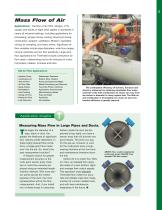
Mass Flow of Air Applications: The flow of air (78% nitrogen, 21% oxygen and traces of eight other gases) is monitored in nearly all industrial settings, including applications for processing; air/gas mixing; cooling; blowing & drying; combustion; aeration; ventilation; filtration; ingredient mixing; air sampling, and many others. Significant airflow variables include pipe diameters, wide flow ranges, varying velocities and low flow sensitivity. Large-duct flow applications for Thermatel include combustion air flow used in determining fuel-to-air mixtures for industrial boilers, heaters, furnaces...
Open the catalog to page 5
Compressed Air Flow Applications: Air that is compressed and contained at a pressure greater than atmosphere has become industry’s universal power source. Seventy percent of all manufacturers operate compressed air (CA). Process operations dependent upon CA include pneumatic tools; materials handling; painting; oxidation; fractionation; cryogenics; refrigeration; dehydration; filtration and aeration. Flow meters help ensure efficient operation at rated SCFM output and are also used to detect leaks. A Flow Meter with a Totalizer provides an accurate measurement of CA consumption. TA2 Compressed...
Open the catalog to page 6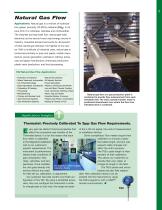
Natural Gas Flow Applications: Natural gas is a mixture of hydrocarbon gases, primarily (70-90%) methane (CH4). In its pure form it is colorless, odorless and combustible. The cleanest burning fossil fuel, natural gas trails electricity as the second most used energy source in industry. Industrial demand accounts for 40 percent of total natural gas demand, the highest of any sector. With a multitude of industrial uses, natural gas is consumed primarily in pulp and paper; metals manufacture; power generation; petroleum refining; stone, clay and glass manufacture; chemicals production; plastic...
Open the catalog to page 7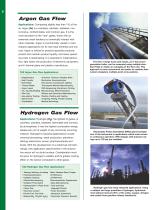
Degasification Heat Transfer Bulb Media Thermal Media Argon Lasers Arc, Tig, Mig Welding Filler Gas Gas-plasma Treating Spectrometry Cryoablation • Treating, Welding, Annealing • Hydrodesulfurization • Catalytic Cracking • Vitamin Manufacturing • Oxidation Preventative • Hydrogenation of Fatty Acids • Carrier Gas • Generator Coolant • Rocket Fuel, Fuel Cells • Making NH3, CH3OH, H2O2 Argon Gas Flow Applications: Composing slightly less than 1% of the air, Argon (Ar) is a colorless, odorless, tasteless, noncorrosive, nonflammable, and nontoxic gas. It is the most abundant of the “rare” gases,...
Open the catalog to page 8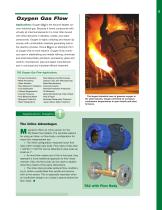
Oxygen Gas Flow Applications: Oxygen (O2) is the second-largest volume industrial gas. Because it forms compounds with virtually all chemical elements it is most often bound with other elements in silicates, oxides, and water compounds. Oxygen is highly oxidizing and reacts vigorously with combustible materials generating heat in the reaction process. Ozone (O3) is an allotropic form of oxygen that is more reactive. Oxygen finds numerous uses in steelmaking and metals refining; chemicals and pharmaceuticals; petroleum processing; glass and ceramic manufacture; pulp and paper manufacture; and...
Open the catalog to page 9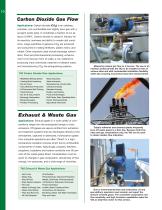
• MIG/MAG Welding Shield • Casting Mold Hardening • Dry-Ice Feed • Urea, Methanol Production • Oil Extraction Well Priming • Flash Removal • Dry Ice & CO2 Coolant • Beverage Carbonation • Blanketing Agent • Fertilizer Processing Vent Lines Waste CO2 SO2 Off-Gas Flare Stacks, Headers Flue Gas Waste-to-Energy Gas Waste Flow Mixing Flare Gas Recovery NC Gas Disposal Carbon Dioxide Gas Flow Applications: Carbon dioxide (CO2) is an odorless, colorless, non-combustible and slightly toxic gas with a pungent acidic taste. It constitutes a fraction of our air, about 0.036%. Carbon dioxide is valued in...
Open the catalog to page 10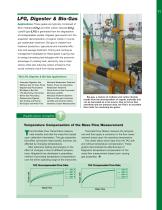
LFG, Digester & Bio-Gas Applications: These gases are typically composed of 65% methane (CH4) and 35% carbon dioxide (CO2). Landfill gas (LFG) is generated from the degradation of biodegradable wastes. Digester gas results from the anaerobic decomposition of organic matter in municipal wastewater treatment. Bio-gas is created from livestock production, agricultural and industrial effluents and sewage treatment. Flaring and venting as management strategies for these gases is giving way to energy harvesting technologies with the economic advantage of creating heat, electricity, fuel or feedstocks...
Open the catalog to page 11All Magnetrol - AMETEK catalogs and technical brochures
 Eclipse® 706 Hygienic
12 Pages
 TUFFY® II
12 Pages
 E4 Modulevel®
12 Pages
 Thermatel® TD1/TD2
16 Pages
 Crude Oil Processing
8 Pages
 Natural Gas Processing
12 Pages
 Interface In The Field
14 Pages
 Emulsion In The Field
9 Pages
 PRODUCT LINE CATALOGUE
106 Pages
 Aurora® Magnetic Level Indicator
28 Pages
 Atlas™ Magnetic Level Indicator
24 Pages
 Echotel® 355
4 Pages
 STEAM DRUM LEVEL MATTERS
1 Page
 INTERFACE IN THE FIELD
1 Page
 Power Generation
16 Pages
 Petroleum Refining
16 Pages
 Seal Pots
4 Pages
 Heat Rate Awareness
8 Pages
 Ethylene Applications
8 Pages
 GEMINI™
32 Pages
 Pneumatic Tuffy®
12 Pages
 Models T5x & T6x
8 Pages
 Models T20/T21
12 Pages
 Series B73 and Series 75
12 Pages
 Series 3
24 Pages
 Model J52
2 Pages
 Model B40
4 Pages
 Floating Roof Detection
16 Pages
 Displacer Switches
20 Pages
 APM Pneumatic Modulevel®
12 Pages
 Flue Gas Desulferization
8 Pages
 Energy Management
4 Pages
 API 2350 Overfill Prevention
8 Pages
 PULSAR ® R96
1 Page
 Water & Wastewater
12 Pages
 Displacer Transmitters
4 Pages
 Guided Wave Radar
12 Pages
 Magnetic Level Indicators
12 Pages
 Thermal Dispersion
12 Pages
 Ultrasonic Contact
4 Pages
 R Series High Temp Switch
12 Pages
 Series K Pneumatic Switch
8 Pages
 J Series Pneumatic Switch
8 Pages
 Liquid Displacer Level Switches
16 Pages
 Crude Oil Processing
8 Pages
 Product Line Quick Reference
8 Pages





- MAGNETROL level switch
- MAGNETROL liquid level switch
- Level probe
- Liquid level sensor
- Measurement software
- Interface software
- MAGNETROL float level switch
- Analog level sensor
- MAGNETROL stainless steel level switch
- MAGNETROL level transmitter
- MAGNETROL liquid level transmitter
- Digital output level sensor
- MAGNETROL threaded level switch
- Vessel level sensor
- MAGNETROL analog level transmitter
- Liquids level gauge
- MAGNETROL tank level switch
- Flow sensor
- MAGNETROL magnetic float level switch
- Flow switch