
- Catalogs
- Magnetrol - AMETEK
- Level Instruments for Tank Overfill Prevention

Level Instruments for Tank Overfill Prevention

1 / 8 PagesView full catalog
Level Instruments for Tank Overfill Prevention
Product catalog summary
Overview: This document provides recommendations for tank overfill prevention in petroleum storage facilities, referencing the American Petroleum Institute's (API) Recommended Practice (RP) 2350. It emphasizes the importance of level instrumentation as part of an Overfill Prevention System (OPS) to prevent incidents like the Buncefield Oil Depot overflow.
Applicability: The guidelines apply to above-ground storage tanks (ASTs) with capacities of 1320 gallons (5000 L) or more, storing Class I, II, or III flammable or combustible liquids.
Equipment: An Automated Overfill Prevention System (AOPS) should include alarm signal systems, shutdown or diversion valves, sensors, and logic solvers, all supported by an uninterruptible power supply.
Management System: API RP 2350 recommends a formal Overfill Prevention Process (OPP) involving training, procedures, risk assessment, inspections, testing, and maintenance.
Proof Testing: OPS equipment must be tested annually, with high-high (HH) sensors/alarm tested semi-annually. Testing methods include moving the tank level, manual proofer devices, wet probe tests, or self-diagnostics.
Independence and Redundancy: Sensors and alarms for HH levels must be independent from routine operations. Redundancy with disparate technologies is recommended to avoid failures.
Tank Categories: Tanks are categorized based on personnel attendance during operations:
- Category I: Fully attended, manual termination.
- Category II: Semi-attended, requires Automatic Tank Gauge System (ATGS).
- Category III: Unattended, requires ATGS with independent HH sensor.
Levels of Concern (LOCs): LOCs are calculated product levels that determine alarm and alert positions and response times. Critical levels include Critical High, AOPS Activation, High-High, and Maximum Working Level.
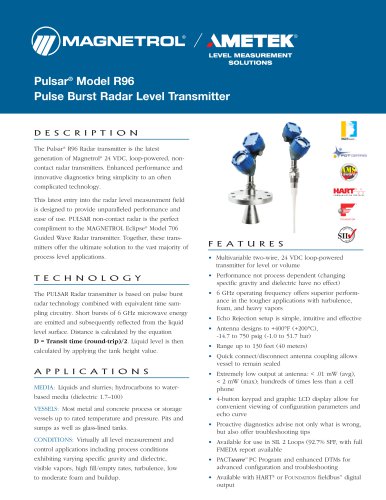
Recommended Equipment: Various sensors and transmitters are recommended based on tank and roof types, including Eclipse® Guided Wave Radar, Pulsar® Radar, and Jupiter® Magnetostrictive Transmitters.
Conclusion: The document emphasizes the need for tailored solutions based on specific applications and encourages consultation of API RP 2350 for comprehensive guidance.
See more
All Magnetrol - AMETEK catalogs and technical brochures
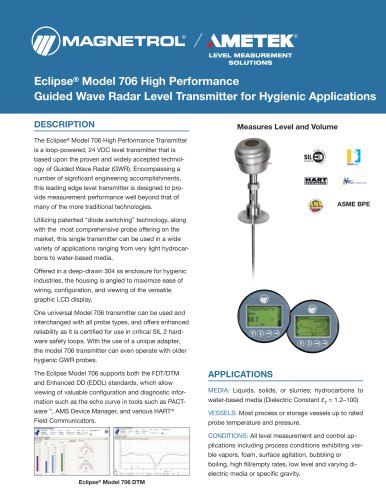 Eclipse® 706 Hygienic
12 Pages
 TUFFY® II
12 Pages
 E4 Modulevel®
12 Pages
 Thermatel® TD1/TD2
16 Pages
 Crude Oil Processing
8 Pages
 Natural Gas Processing
12 Pages
 Interface In The Field
14 Pages
 Emulsion In The Field
9 Pages
 PRODUCT LINE CATALOGUE
106 Pages
 Aurora® Magnetic Level Indicator
28 Pages
 Atlas™ Magnetic Level Indicator
24 Pages
 Echotel® 355
4 Pages
 STEAM DRUM LEVEL MATTERS
1 Page
 INTERFACE IN THE FIELD
1 Page
 Power Generation
16 Pages
 Petroleum Refining
16 Pages
 Seal Pots
4 Pages
 Mass Flow Measurement
12 Pages
 Heat Rate Awareness
8 Pages
 Ethylene Applications
8 Pages
 GEMINI™
32 Pages
 Pneumatic Tuffy®
12 Pages
 Models T5x & T6x
8 Pages
 Models T20/T21
12 Pages
 Series B73 and Series 75
12 Pages
 Series 3
24 Pages
 Model J52
2 Pages
 Model B40
4 Pages
 Floating Roof Detection
16 Pages
 Displacer Switches
20 Pages
 APM Pneumatic Modulevel®
12 Pages
 Flue Gas Desulferization
8 Pages
 Energy Management
4 Pages
 API 2350 Overfill Prevention
8 Pages
 PULSAR ® R96
1 Page
 Water & Wastewater
12 Pages
 Displacer Transmitters
4 Pages
 Guided Wave Radar
12 Pages
 Magnetic Level Indicators
12 Pages
 Thermal Dispersion
12 Pages
 Ultrasonic Contact
4 Pages
 R Series High Temp Switch
12 Pages
 Series K Pneumatic Switch
8 Pages
 J Series Pneumatic Switch
8 Pages
 Liquid Displacer Level Switches
16 Pages
 Crude Oil Processing
8 Pages
 Product Line Quick Reference
8 Pages





Related Searches
- MAGNETROL level switch
- MAGNETROL liquid level switch
- Level probe
- Liquid level sensor
- Measurement software
- Interface software
- MAGNETROL float level switch
- Analog level sensor
- MAGNETROL stainless steel level switch
- MAGNETROL level transmitter
- MAGNETROL liquid level transmitter
- Digital output level sensor
- MAGNETROL threaded level switch
- Vessel level sensor
- MAGNETROL analog level transmitter
- Liquids level gauge
- MAGNETROL tank level switch
- Flow sensor
- MAGNETROL magnetic float level switch
- Flow switch
*Prices are pre-tax. They exclude delivery charges and customs duties and do not include additional charges for installation or activation options. Prices are indicative only and may vary by country, with changes to the cost of raw materials and exchange rates.
About DirectIndustry
DirectIndustry is a marketplace that offers B2B players a complete experience, from product sourcing to purchase. DirectIndustry is an entity of VirtualExpo Group.
Are you a buyer?
Are you a supplier?