
- Catalogs
- Magnetrol - AMETEK
- Emulsion In The Field

Emulsion In The Field

Emulsion In The Field
Multiphase level measurement is crucial in the Oil & Gas and Petrochemical industries for effective water and hydrocarbon separation. Despite advancements, it remains challenging, with over half of separator failures linked to level instrumentation. Various technologies have attempted to address this, but limitations persist. A cost-effective TDR-based multiphase level detector is now available for widespread use.
Emulsion Challenges
In vessels containing immiscible liquids like oil and water, separation is vital for productivity. Guided Wave Radar (GWR) is effective for distinct liquid boundaries but struggles with thick emulsion layers. TDR-based level instrumentation is expanding into multiphase applications, traditionally dominated by expensive profilers or multi-probe arrays.
Genesis of Multiphase TDR
The Genesis® TDR Multiphase Detector was developed to measure thick emulsions and sediment levels using a unique combination of "Top-Down" and "Bottom-Up" measurements. This allows for total level, top of emulsion, bottom of emulsion, and sediment measurement through a single vessel opening.
Probe Design and Diagnostics
The Genesis system uses a Pentarod probe design, which is less susceptible to errors from media buildup. It includes diagnostics to monitor probe buildup, enabling streamlined maintenance and reduced downtime. An alarm can be set for sand/sediment levels to prevent unplanned shutdowns.
Level Technologies Comparison
A table compares various level measurement technologies, highlighting strengths, weaknesses, and recommended uses for thick/dynamic emulsion layers. The Genesis TDR Multiphase Detector is noted for its ability to handle thick emulsions without calibration or density dependency, though it has higher power consumption.
Operational Improvement
Enhanced multiphase measurement improves productivity and safety in applications like desalters, electrostatic coalescers, separators, and quench water settlers. These processes benefit from better emulsion layer control, reducing maintenance costs and increasing efficiency.
Conclusion
The Genesis TDR Multiphase Detector offers a cost-effective solution for measuring dynamic conditions in challenging separators, capable of measuring total level, top of emulsion, bottom of emulsion, and sediment with a single instrument.
Catalog excerpts

The Genesis of TDR Multiphase Level Measurement A Magnetrol® Level Matters Series White Paper
Open the catalog to page 1
INTRODUCTION Multiphase level measurements exist throughout the process industries and are particularly relevant in the Oil & Gas and Petrochemical sectors due to the value derived from effective water and hydrocarbon separation. While level instrumentation has come a long way in measuring liquids of all varieties, multiphase level measurement is often considered the greatest challenge and opportunity that exists today. This is evidenced by over half of separator failure modes being attributed to level instrumentation per Offshore Reliability Data (OREDA, 2002). Many technologies attempt to tackle...
Open the catalog to page 2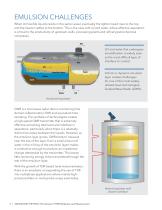
EMULSION CHALLENGES When immiscible liquids reside in the same vessel, eventually the lighter liquid rises to the top and the heavier settles to the bottom. This is the case with oil and water, where effective separation is critical to the productivity of upstream wells, processing plants and refinery/petrochemical complexes. Gas Oil and water that undergoes emulsification is widely seen as the most difficult type of interface to control. Emulsion layer Water Sand A thick or dynamic emulsion layer creates challenges for one of the most widely utilized level technologies: Guided Wave Radar (GWR)....
Open the catalog to page 3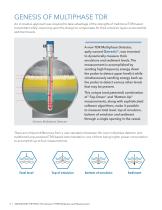
GENESIS OF MULTIPHASE TDR An innovative approach was required to take advantage of the strengths of traditional TDR-based transmitters while improving upon the design to compensate for thick emulsion layers and potential sediment levels. A new TDR Multiphase Detector, aptly named Genesis®, was invented to dynamically measure thick emulsions and sediment levels. The measurement is accomplished by sending high frequency energy down the probe to detect upper level(s) while simultaneously sending energy back up the probe to detect various other levels that may be present. Genesis Multiphase Detector...
Open the catalog to page 4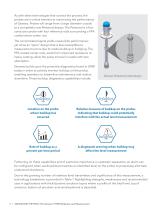
As with other technologies that contact the process, the probes are a critical element to maximizing the performance of Genesis. Probes will range from a large diameter coaxial to a completely new Pentarod design. The Pentarod is a fiveconductor probe with four reference rods surrounding a PFA coated active center rod. The concentrated signal yields coaxial-like performance; yet it has an “open” design that is less susceptible to measurement errors due to media buildup or bridging. The PFA coated center rods, aside from improved resistance to heavy coating, allow the pulse to travel in water...
Open the catalog to page 5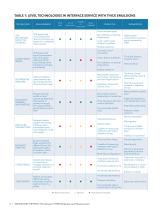
TABLE 1: LEVEL TECHNOLOGIES IN INTERFACE SERVICE WITH THICK EMULSIONS TECHNOLOGY TOTAL LEVEL SAND / SEDIMENT Thick emulsion layers TDR MULTIPHASE DETECTOR (GENESIS) TDR-based with concentrated topdown and bottom-up signals for multiphase measurement No calibration or density dependency Lower upfront cost relative to profilers Higher power consumption and price point compared to GWR Buildup detection GUIDED WAVE RADAR TDR-based with signal concentrated down the probe reflecting off the liquid level(s) when impedance changes are detected DIFFERENTIAL PRESSURE Inferred interface measurement near...
Open the catalog to page 6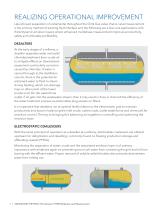
REALIZING OPERATIONAL IMPROVEMENT Liquid-liquid separation is fundamental throughout the Oil & Gas value chains. Level measurement is the primary method of tracking fluid interface and the following are a few core applications with thick/dynamic emulsion layers where enhanced multiphase measurement improves productivity, safety and ultimately profitability. DESALTERS At the early stages of a refinery, a desalter separates water and salts/ chlorides/sediment from crude oil to mitigate effects on downstream equipment—particularly corrosion caused by chlorides. If water is carried through to the...
Open the catalog to page 7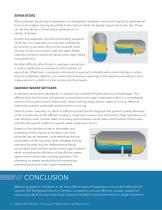
SEPARATORS Most upstream liquid-liquid separators are designed to separate immiscible liquids by gravitational force as the higher density liquid falls to the bottom while the lighter liquid rises to the top. These can be two-phase or three-phase separators in a variety of shapes. As with any separation process, particularly upstream Oil & Gas, it is imperative to maximize profitability by recovering as much of the oil as possible while limiting oil removal mixed in with the water. Better visibility into the thickness of the emulsion layer helps accomplish this. Another difficulty often found...
Open the catalog to page 8All Magnetrol - AMETEK catalogs and technical brochures
 Eclipse® 706 Hygienic
12 Pages
 TUFFY® II
12 Pages
 E4 Modulevel®
12 Pages
 Thermatel® TD1/TD2
16 Pages
 Crude Oil Processing
8 Pages
 Natural Gas Processing
12 Pages
 Interface In The Field
14 Pages
 PRODUCT LINE CATALOGUE
106 Pages
 Aurora® Magnetic Level Indicator
28 Pages
 Atlas™ Magnetic Level Indicator
24 Pages
 Echotel® 355
4 Pages
 STEAM DRUM LEVEL MATTERS
1 Page
 INTERFACE IN THE FIELD
1 Page
 Power Generation
16 Pages
 Petroleum Refining
16 Pages
 Seal Pots
4 Pages
 Mass Flow Measurement
12 Pages
 Heat Rate Awareness
8 Pages
 Ethylene Applications
8 Pages
 GEMINI™
32 Pages
 Pneumatic Tuffy®
12 Pages
 Models T5x & T6x
8 Pages
 Models T20/T21
12 Pages
 Series B73 and Series 75
12 Pages
 Series 3
24 Pages
 Model J52
2 Pages
 Model B40
4 Pages
 Floating Roof Detection
16 Pages
 Displacer Switches
20 Pages
 APM Pneumatic Modulevel®
12 Pages
 Flue Gas Desulferization
8 Pages
 Energy Management
4 Pages
 API 2350 Overfill Prevention
8 Pages
 PULSAR ® R96
1 Page
 Water & Wastewater
12 Pages
 Displacer Transmitters
4 Pages
 Guided Wave Radar
12 Pages
 Magnetic Level Indicators
12 Pages
 Thermal Dispersion
12 Pages
 Ultrasonic Contact
4 Pages
 R Series High Temp Switch
12 Pages
 Series K Pneumatic Switch
8 Pages
 J Series Pneumatic Switch
8 Pages
 Liquid Displacer Level Switches
16 Pages
 Crude Oil Processing
8 Pages
 Product Line Quick Reference
8 Pages




- MAGNETROL level switch
- MAGNETROL liquid level switch
- Level probe
- Liquid level sensor
- Measurement software
- Interface software
- MAGNETROL float level switch
- Analog level sensor
- MAGNETROL stainless steel level switch
- MAGNETROL level transmitter
- MAGNETROL liquid level transmitter
- Digital output level sensor
- MAGNETROL threaded level switch
- Vessel level sensor
- MAGNETROL analog level transmitter
- Liquids level gauge
- MAGNETROL tank level switch
- Flow sensor
- MAGNETROL magnetic float level switch
- Flow switch