
- Catalogs
- Magnetrol - AMETEK
- Crude Oil Processing

Crude Oil Processing

Crude Oil Processing
Catalog excerpts

A Guide to Level Instrumentation for Onshore/Offshore Oil Processing INDUSTRY APPLICATIONS
Open the catalog to page 1
Level & Flow Applications for CRUDE OIL PROCESSING Level and flow controls in these applications are crucial for both process control and safety shutdown systems. Crude Stream Level Applications ▲ Plant Inlet Level Applications: APPLICATION NOTE: The actual nature and number of steps in crude oil processing most often depends upon the source and makeup of the wellhead production stream. In some cases, several of the steps shown in the schematic below may be integrated into one unit or operation, performed in a different order or at alternative locations, or not required at all. 1. Production...
Open the catalog to page 2
PRODUCTION FLUID STORAGE Application: A variety of chemicals are typically stored in the field or processing facility to expedite processing time by preconditioning an inlet fluid. These fluids may first enter into a hold tank to allow upstream solids and liquids time to separate prior to production, which allows the facility to better handle upset conditions without stopping production. Stored additive chemicals include dispersants, flocculants, surfactants, glycols, diluents and rust inhibitors. Storage Tanks Challenges: Fluids are typically stored in a series of outdoor steel tanks. The tank...
Open the catalog to page 3
WELLSTREAM SEPARATORS Application: Separators are large drums designed to separate wellstreams into their individual components. They are commonly designed to separate two-phase (gas/liquid) or three-phase (gas/crude/water) wellstreams. Separators are also classified according to horizontal or vertical configuration (see below), operating pressure, turbulent or laminar flow, and test or production separation. Challenges: Interface level measurement will actuate a valve to adjust vessel level. An emulsion layer along the oil/water interface can contaminate the oil with water or the water with...
Open the catalog to page 4
CRUDE DEHYDRATION Application: Not all water is removed from crude oil during the first stage of gravity separation. Separated crude may contain up to 15% water which exists in an emulsified form that is difficult for a separator to remove. The oil and water emulsion must be broken down so that the water can be removed before the crude is shipped. De-emulsification processes are accomplished using chemical agents such as glycol and heat. Knock-out Drum ▲ Point Level: Series 3 FloatActuated External Cage Level Switch Challenges: Level control is found on two-phase and three-phase water knockout...
Open the catalog to page 5
CRUDE DEGASSING Application: By removing dissolved gases and hydrogen sulfide, crude stabilization and sweetening processes diminish safety and corrosion problems. Gases are removed by a stabilizer. Sweetening employs stabilization or vaporization processes along with a gas or steam-based stripping agent. Challenges: Removing dissolved gases by stabilization requires level control in the reboiler unit. Sweetening by stage vaporization and trayed stabilization require level control in a series of staged separators. Sweetening by reboiled trayed stabilization requires additional level control in...
Open the catalog to page 6
PROCESS & STORAGE TANKS Application: Crude oil and water are stored in oil fields. Unlike midstream tank farms at terminals and refineries, field storage consists of smaller vessels associated with oil and water processing. Diesel generator fuel, potable water, and fire water are also stored. Challenges: Tank level monitoring can be provided with overflow control and alarm systems or shutdown pumps when level falls below the specified low level. Interface controls will sense the beginning of an oil/water interface during tank dewatering and control the water draw-off. Storage Tanks API 2350:...
Open the catalog to page 7
AN INDUSTRY GUIDE TO LEVEL MEASUREMENT AND CONTROL FROM MAGNETROL Other industry and special application brochures from Magnetrol include: • • • • • • • • • Chemical Flue Gas Desulfurization Food & Beverage Interface Level Measurement Life Science Mass Flow Measurement Modular Skid Systems Natural Gas Processing Nuclear Power Petroleum Refining Power Generation Pulp & Paper Mills Renewable Energy Steam Generation Tank Bridle Level Measurement Tank Overfill Prevention Understanding Safety Integrity Level (SIL) Water & Wastewater PLEASE NOTE: The instruments recommended in these brochures are based...
Open the catalog to page 8All Magnetrol - AMETEK catalogs and technical brochures
 Eclipse® 706 Hygienic
12 Pages
 TUFFY® II
12 Pages
 E4 Modulevel®
12 Pages
 Thermatel® TD1/TD2
16 Pages
 Natural Gas Processing
12 Pages
 Interface In The Field
14 Pages
 Emulsion In The Field
9 Pages
 PRODUCT LINE CATALOGUE
106 Pages
 Aurora® Magnetic Level Indicator
28 Pages
 Atlas™ Magnetic Level Indicator
24 Pages
 Echotel® 355
4 Pages
 STEAM DRUM LEVEL MATTERS
1 Page
 INTERFACE IN THE FIELD
1 Page
 Power Generation
16 Pages
 Petroleum Refining
16 Pages
 Seal Pots
4 Pages
 Mass Flow Measurement
12 Pages
 Heat Rate Awareness
8 Pages
 Ethylene Applications
8 Pages
 GEMINI™
32 Pages
 Pneumatic Tuffy®
12 Pages
 Models T5x & T6x
8 Pages
 Models T20/T21
12 Pages
 Series B73 and Series 75
12 Pages
 Series 3
24 Pages
 Model J52
2 Pages
 Model B40
4 Pages
 Floating Roof Detection
16 Pages
 Displacer Switches
20 Pages
 APM Pneumatic Modulevel®
12 Pages
 Flue Gas Desulferization
8 Pages
 Energy Management
4 Pages
 API 2350 Overfill Prevention
8 Pages
 PULSAR ® R96
1 Page
 Water & Wastewater
12 Pages
 Displacer Transmitters
4 Pages
 Guided Wave Radar
12 Pages
 Magnetic Level Indicators
12 Pages
 Thermal Dispersion
12 Pages
 Ultrasonic Contact
4 Pages
 R Series High Temp Switch
12 Pages
 Series K Pneumatic Switch
8 Pages
 J Series Pneumatic Switch
8 Pages
 Liquid Displacer Level Switches
16 Pages
 Crude Oil Processing
8 Pages
 Product Line Quick Reference
8 Pages


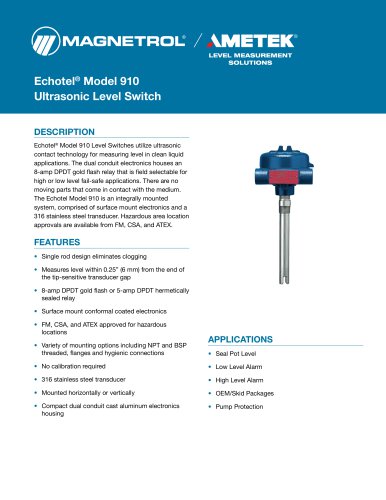
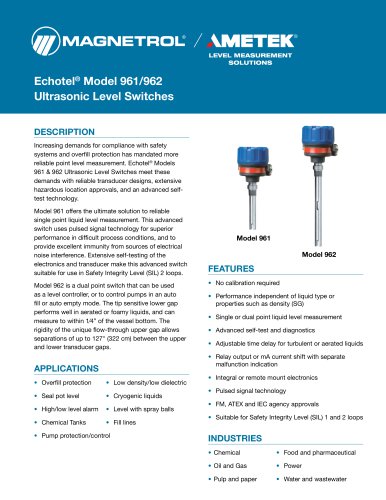
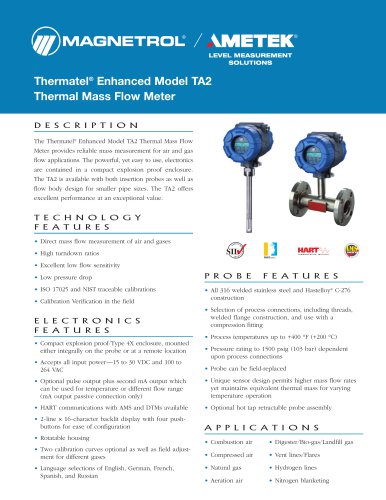
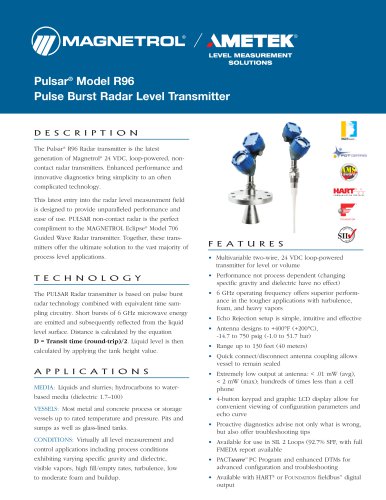



- MAGNETROL liquid level switch
- Level probe
- Liquid level sensor
- Measurement software
- Interface software
- MAGNETROL float level switch
- Analog level sensor
- MAGNETROL stainless steel level switch
- MAGNETROL level transmitter
- MAGNETROL liquid level transmitter
- Digital output level sensor
- MAGNETROL threaded level switch
- Vessel level sensor
- MAGNETROL analog level transmitter
- Liquids level gauge
- MAGNETROL tank level switch
- Flow sensor
- MAGNETROL magnetic float level switch
- Flow switch