
- Catalogs
- Magnetrol - AMETEK
- API 2350 Overfill Prevention

API 2350 Overfill Prevention

API 2350 Overfill Prevention
- Category 1: Fully attended, manual termination.
- Category 2: Semi-attended, requires Automatic Tank Gauge System (ATGS) with high-high alarm.
- Category 3: Unattended, requires ATGS with independent sensors and automatic termination capabilities.
Catalog excerpts

LEVEL INSTRUMENTS FOR TANK OVERFILL PROTECTION
Open the catalog to page 1
Tank Overfill Protection: Recommended Practice for Level Control External Floating Roof Tank overfill incidents in recent years have resulted in loss of life and billions of dollars in damages to petroleum facilities worldwide. One of the worst incidents — the overflow of a gasoline storage tank at Buncefield Oil Depot (U.K.) — has been traced to the failure of level control to maintain containment of the flammable liquid. More common are minor spills that cause significant environmental impact and result in millions of dollars in clean-up fees and environmental agency fines. In the wake of this...
Open the catalog to page 2
Tank Categories & Recommended Instrumentation API 2350 categorizes storage tanks by the extent to which personnel are in attendance during receiving operations. The overfill prevention methodology is based upon the tank catagory. ATG with High-High Alarm (Automatic Tank Gauge) Independent High-High Alarm Control Room (Automatic Tank Gauge) Control Room Category 1 Fully Attended • Personnel must always be on site during the receipt of product, must monitor the receipt continuously during the first and last hours, and must verify receipt each hour. • Personnel must be present during the initial...
Open the catalog to page 3
Levels of Concern (LOCs) Critical High AOPS Activation High-High Maximum Working Minimum Working Levels of Concern are calculated product levels in the tank upon which all alarm and alert positions and response times are based. Careful calculation of LOCs ensures the success of the OPS. Level Required Action Critical High Level (CH) - Required Highest level before tank damage or product overflow Spill Management Emergency Response Automated Overfill Prevention System (AOPS) Activation Level - Required with AOPS Maximum level at which termination can be automatically initiated without level reaching...
Open the catalog to page 4
Roof Types Fixed Roof or Floating Roof with Instrument Well Internal Floating Roof Recommended Equipment: • Eclipse® Guided Wave Radar Transmitter • Pulsar® Radar Transmitter • Jupiter® Magnetostrictive Transmitter (Orion Instruments®) • Echotel® Model 961/962 Ultrasonic Switch • Model A15 Displacer Switch External Floating Roof Recommended Equipment: • Pulsar® Radar Transmitter • Model A15 Displacer Switch Recommended Equipment: • Pulsar® Radar Transmitter • Model A15 Displacer Switch
Open the catalog to page 5
Recommended Level Switches Point Level Sensors Point level sensors actuate at one or more discrete levels. These types of instruments may be used as the HH sensor and may be of a mechanical or electronic technology. Sensors used on floating roof tanks must detect the roof as well as the liquid should the roof become submerged. Additional point sensors may be used for additional alarms or alerts as determined by the operator. Single-Point Top Mount Buoyancy Displacer Switch Single-Point ECHOTEL Model 961 Contact Ultrasound Switch Dual-Point ECHOTEL Model 962 Contact Ultrasound Switch • Furnished...
Open the catalog to page 6
Recommended Level Transmitters Continuous Level Sensors Continuous level sensors output an analog-type signal over a specified range of the tank height. Continous sensors may be used as the level sensor or as the high-high alarm sensor. Additional continous level sensors may be used to monitor additional alarm or alert points as determined by the tank operator. ECLIPSE Model 706 Guided Wave Radar Transmitter PULSAR Model RX5 Pulse Burst Radar Transmitter JUPITER Magnetostrictive Transmitter (Orion Instruments®) • Low dielectric media capability. • Non-contact technology • Continuous diagnostics...
Open the catalog to page 7
S p e c i a l A p p l i c at i o n S e r i e s Other industry and special application brochures from MAGNETROL include: • Chemical • Crude Oil Processing • Flue Gas Desulfurization • Food & Beverage • Interface Level Measurement • Life Science • Mass Flow Measurement • Modular Skid Systems • Natural Gas Processing • Nuclear Power • Petroleum Refining • Power Generation • Pulp & Paper Mills • Renewable Energy • Steam Generation • Tank Bridle Level Measurement • Understanding Safety Integrity Level (SIL) • Water & Wastewater PLEASE NOTE: The instruments recommended in these brochures are based...
Open the catalog to page 8All Magnetrol - AMETEK catalogs and technical brochures
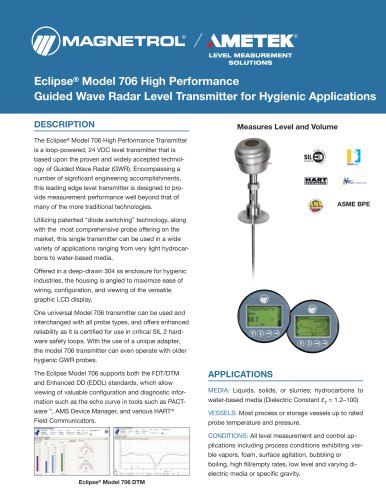 Eclipse® 706 Hygienic
12 Pages
 TUFFY® II
12 Pages
 E4 Modulevel®
12 Pages
 Thermatel® TD1/TD2
16 Pages
 Crude Oil Processing
8 Pages
 Natural Gas Processing
12 Pages
 Interface In The Field
14 Pages
 Emulsion In The Field
9 Pages
 PRODUCT LINE CATALOGUE
106 Pages
 Aurora® Magnetic Level Indicator
28 Pages
 Atlas™ Magnetic Level Indicator
24 Pages
 Echotel® 355
4 Pages
 STEAM DRUM LEVEL MATTERS
1 Page
 INTERFACE IN THE FIELD
1 Page
 Power Generation
16 Pages
 Petroleum Refining
16 Pages
 Seal Pots
4 Pages
 Mass Flow Measurement
12 Pages
 Heat Rate Awareness
8 Pages
 Ethylene Applications
8 Pages
 GEMINI™
32 Pages
 Pneumatic Tuffy®
12 Pages
 Models T5x & T6x
8 Pages
 Models T20/T21
12 Pages
 Series B73 and Series 75
12 Pages
 Series 3
24 Pages
 Model J52
2 Pages
 Model B40
4 Pages
 Floating Roof Detection
16 Pages
 Displacer Switches
20 Pages
 APM Pneumatic Modulevel®
12 Pages
 Flue Gas Desulferization
8 Pages
 Energy Management
4 Pages
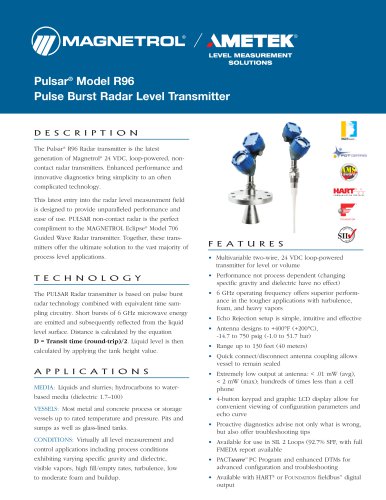
 PULSAR ® R96
1 Page
 Water & Wastewater
12 Pages
 Displacer Transmitters
4 Pages
 Guided Wave Radar
12 Pages
 Magnetic Level Indicators
12 Pages
 Thermal Dispersion
12 Pages
 Ultrasonic Contact
4 Pages
 R Series High Temp Switch
12 Pages
 Series K Pneumatic Switch
8 Pages
 J Series Pneumatic Switch
8 Pages
 Liquid Displacer Level Switches
16 Pages
 Crude Oil Processing
8 Pages
 Product Line Quick Reference
8 Pages


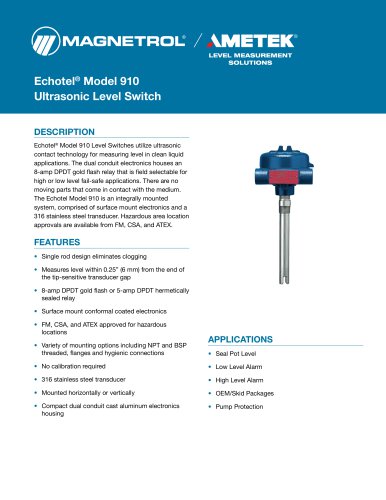
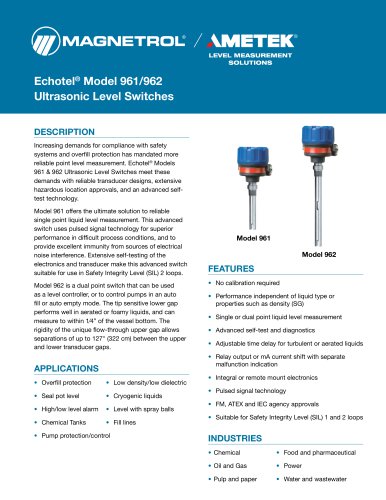
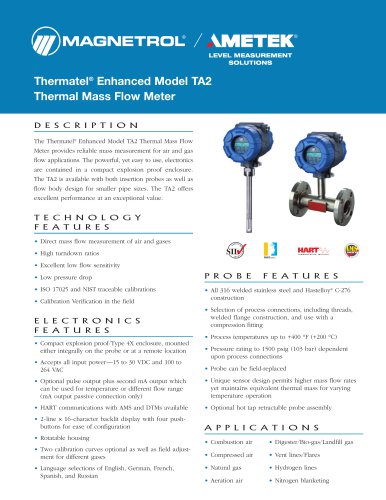



- MAGNETROL liquid level switch
- Liquid level sensor
- Measurement software
- Interface software
- MAGNETROL float level switch
- Analog level sensor
- MAGNETROL stainless steel level switch
- MAGNETROL liquid level transmitter
- Digital output level sensor
- MAGNETROL threaded level switch
- Vessel level sensor
- MAGNETROL analog level transmitter
- Liquids level gauge
- MAGNETROL tank level switch
- Flow sensor
- MAGNETROL magnetic float level switch
- Flow switch