
- Catalogs
- Magnetbau-Schramme GmbH & Co. KG
- Magnetbau Schramme, All Solenoids, English, German


- Company
- Products
- Catalogs
- News & Trends
- Exhibitions
Magnetbau Schramme, All Solenoids, English, German

1 / 133 PagesView full catalog
Magnetbau Schramme, All Solenoids, English, German
Product catalog summary
Technical Specifications Overview
Electromagnets GT8 Series:
- GT8 036: Operates at 24 VDC with a 100% duty cycle, 36 W power, pressure tight up to 350 bar, total stroke of 5.5 mm, and insulation class H.
- GT8 045: Similar to GT8 036 but with 42 W power and a total stroke of 6 mm.
- GT8 060: Features 51 W power, pressure tight up to 350 bar, and a total stroke of 8 mm.
Hose Pinch Valves GL5 and GL6:
- Used in medical and analytical technology for controlling difficult media.
- Features include chemical resistance, low power consumption, and availability in normally open or closed configurations.
- GL5 valves support hoses with 45/55 Shore hardness, available in materials like PVC, Silicon, and Viton.
- GL6 valves offer similar features with additional protection (IP 65) and different dimensions.
GC2 Series Solenoids:
- Universal solenoids with high precision and long lifespan.
- Available in various sizes with different force and power ratings.
- Installation can be in any position, but axial force application is recommended.
GE1 and GD1 Solenoids:
- GE1 are reverse stroke solenoids with two magnetic systems, offering high durability.
- GD1 are double stroke solenoids, providing double the stroke length compared to GE1.
- Both types require specific installation considerations to avoid lateral forces.
General Notes:
- Custom development is available for series projects, with no standard stock items.
- All products are designed to meet specific technical requirements and standards.
Overview: This document provides a comprehensive overview of various types of electromagnets produced by Magnetbau Schramme GmbH & Co. KG, including specifications, characteristics, and installation guidelines for different models such as GE1, GD1, GB4, GB5, GF1, GF2, GF3, GF4, and EG1.
Specifications: The document details the technical specifications for each type of magnet, including dimensions, power consumption, force at the start and end of the stroke, weight, and other relevant parameters. For instance, the GE1 series includes models with varying stroke lengths and power requirements, while the GD1 series features double-stroke magnets with specific force characteristics.
Procedures and Installation: Installation guidelines emphasize the importance of axial force application and avoiding lateral loads on the plunger. The document also highlights the need to follow technical introductions when using these devices.
Standards and Recommendations: The magnets are designed to meet specific standards, such as insulation class "H" according to VDE 0580 and protection class IP 65 or IP 43 as per DIN 40050. The document recommends considering these standards during installation and operation.
Key Characteristics: Each magnet type has unique characteristics. For example, the GD1 series has a horizontal force characteristic over the first 80% of the stroke, while the GF series magnets are designed for high force at short strokes. The EG1 series, being electro-holding magnets, are suitable for holding ferromagnetic objects with varying holding forces based on surface conditions.
Technical Data Summary: The document includes tables summarizing the technical data for each magnet type, such as stroke length, power consumption, force at different points, and weight. These tables provide a quick reference for comparing different models and their capabilities.
Conclusion: Magnetbau Schramme offers a range of electromagnets tailored for specific applications, with detailed specifications and guidelines to ensure proper use and installation. The document serves as a valuable resource for selecting the appropriate magnet for various industrial applications.
Overview: This document provides a comprehensive overview of various types of solenoids produced by Magnetbau Schramme GmbH & Co. KG. It includes technical specifications, operational characteristics, and installation instructions for different solenoid models, including linear, double proportional, miniature, and spreader solenoids.
1. Linear Solenoids (GC2 Series):
- Specifications: The GC2 series includes models from GC2 050 to GC2 165, with varying stroke lengths, magnetic forces, and power consumption. The solenoids are designed for 100%, 40%, and 25% duty cycles.
- Installation: Options include pulling/pushing with flange or cover hood. Dimensions and mounting details are provided for each model.
2. Reversing Linear Solenoids (GE1 Series):
- Function: These solenoids consist of two magnet systems, allowing stroke motion from one end position to the other using electromagnetic force.
- Characteristics: The force is flat to slightly rising during the initial 80% of travel, doubling in the final 20%. They are maintenance-free and can be installed in any position.
- Technical Data: Includes power, force at stroke start and end, and weight for models GE1 050 to GE1 115.
3. Double Proportional Solenoids (GD1 Series):
- Function: These solenoids provide stroke from the center to either end position, with external forces resetting them to the center.
- Characteristics: Similar force characteristics to reversing solenoids, with twice the stroke at the same size.
- Technical Data: Includes power, force at stroke start and end, and weight for models GD1 050 to GD1 115.
4. Miniature Solenoids (GB4 and GB5 Series):
- Operation: Single-action solenoids using electromagnetic force for motion, with external force for return.
- Characteristics: Flat response curve for the first 80% of travel, with a significant increase in magnetic force in the final 20%.
- Technical Data: Includes cycle times, magnetic force, holding force, power consumption, and weight for models GB4 016 to GB4 032.
5. Spreader Solenoids (GF1 and GF2 Series):
- Function: Used primarily as actuation magnets for brakes, with single-acting solenoids suitable for escalators and older elevators.
- Operation: Consist of one electromagnet system with a thrusting force, returned by external force.
- Characteristics: High force with short stroke, maintenance-free, and suitable for any installation position.
- Technical Data: Includes stroke, weight, and duty cycle information.
General Installation Instructions: Solenoids should be installed in any position, with power transfer only in the axial direction to avoid lateral loads. The nominal supply voltage is 24 VDC, with a relative duty cycle of 100% and insulation class "H" according to VDE 0580.
See more
All Magnetbau-Schramme GmbH & Co. KG catalogs and technical brochures
 DR1
DR11 Page
 WV1
WV11 Page
 SV3
SV31 Page
 Pinch Valve
2 Pages
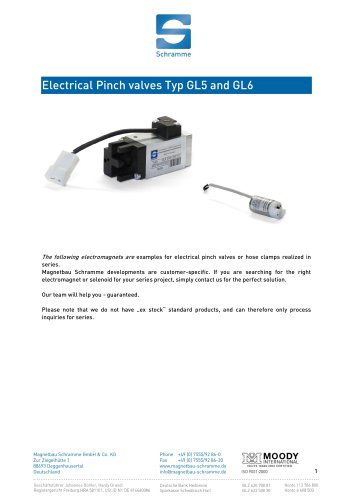 Typ GL5 and GL6
5 Pages
 Product Catalog 2013
21 Pages
 Linear Solenoids
5 Pages



Archived catalogs
 Speedstar - Service
4 Pages


Related Searches
- Electrically operated valve
- Regulating valve
- 2-way solenoid valve
- NC solenoid valve
- Directional control valve
- Direct-operated solenoid valve
- Oil valve
- Position transducer
- Hydraulic directional control valve
- 3-way valve
- Linear position transmitter
- Spool hydraulic directional control valve
- 3-way solenoid valve
- Threaded solenoid valve
- Oil solenoid valve
- Friction clutch
- Pressure-control valve
*Prices are pre-tax. They exclude delivery charges and customs duties and do not include additional charges for installation or activation options. Prices are indicative only and may vary by country, with changes to the cost of raw materials and exchange rates.
About DirectIndustry
DirectIndustry is a marketplace that offers B2B players a complete experience, from product sourcing to purchase. DirectIndustry is an entity of VirtualExpo Group.
Are you a buyer?
Are you a supplier?