


TENSA-POLYFLEX-ADVANCED PU

TENSA-POLYFLEX-ADVANCED PU
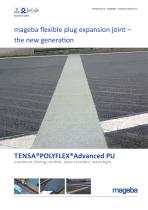
The TENSA®POLYFLEX®Advanced PU is a flexible plug expansion joint system designed for superior quality and longevity. It offers exceptional driver comfort, is watertight, and can be installed in sections, making it suitable for various infrastructure applications.
Product Characteristics
The system uses a durable, fully elastic PU material with high tear resistance and low reaction forces. It includes perforated steel angles for managing horizontal forces and ensuring a watertight seal. The material is resistant to environmental and chemical influences, with a lifespan exceeding most roadway surfaces. It can be cast into various joint shapes and is processed at ambient temperatures for quick installation and minimal traffic disruption.
Applications
The system is suitable for bridge structures, architectural and industrial structures, railway stations, parking decks, airport buildings, and environments requiring chemical resistance, such as pharmaceutical and food processing industries.
Client Benefits
Key advantages include long service life, high driver comfort, noise reduction, maintenance-free operation, and quick installation. The system is wear-resistant, easily repairable, and adaptable to various structural requirements.
Design Details & Movement Capacity
The joint system is designed to transfer horizontal loads safely and prevent asphalt depression. It accommodates movements up to 100mm and complies with European technical standards for expansion joints.
Testing and Verification
Tests have demonstrated superior performance in mechanical resistance, fatigue resistance, and movement capacity, with a service life more than twice that of conventional asphaltic plug joints.
Conclusion
The TENSA®POLYFLEX®Advanced PU expansion joint system represents a significant advancement in expansion joint technology, offering enhanced durability, flexibility, and performance for a wide range of infrastructure applications.
The document discusses the TENSA®POLYFLEX®Advanced PU expansion joint system, highlighting its testing, approval, material specifications, installation procedures, and quality assurance.
Specifications and Testing
The system demonstrated high performance under various conditions, including extreme temperatures and dynamic movements. Key tests included movement capacity under fast movements, artificial weathering, aging, spectroscopy, thermal analysis, hardness, tensile, dynamic-mechanical analysis, and bonding tests. Results surpassed traditional bituminous plug expansion joints.
European Technical Approval
Since July 2012, the system has held the European Technical Approval ETA 12/0260, updated in April 2019, based on EAD 120011 01 0107 and ETAG 032-1 guidelines.
Material Description
TENSA®POLYFLEX®Advanced PU is a solvent-free, elastic 2-component grout system designed for flexible plug expansion joints, with a polymer concrete support system adapted for workability and endurance.
Technical Data
Key properties include a density of 1.05 g/cm³, hardness of Shore A 65, tensile strength of 14 N/mm², elongation at break of 650%, and tear strength of 20 N/mm². Processing times and trafficability vary with temperature.
Installation Procedures
Installation involves marking, cutting, cleaning, creating a polymer-concrete base, and filling with the PU material. For concrete supports, a minimum compressive strength of 25 N/mm² is required. Waterproofing integration is crucial for system watertightness.
Digital Installation Supervision
Since 2021, mageba offers remote supervision using video technology, reducing costs and enhancing flexibility and sustainability.
Consulting and Support
mageba provides technical support for joint width determination and offers installation services by trained personnel. Quality is ensured through ISO 9001 certification and third-party control by the Material Testing Institute of the University in Stuttgart.
Reference Projects
Examples include installations at A7 Elbtunnel-Hamburg and Airport Schipol, Netherlands, among others.
Conclusion
The TENSA®POLYFLEX®Advanced PU system is a high-performance solution for expansion joints, supported by rigorous testing, technical approval, and comprehensive installation and support services.
Catalog excerpts
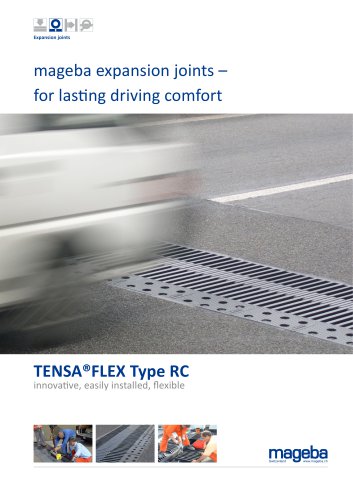
Infrastructure | Buildings | Industrial structures Expansion joints mageba flexible plug expansion joint – the new generation maximum driving comfort, wear-resistant, watertigh
Open the catalog to page 1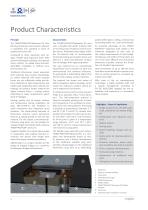
Product CharacteristicsPrinciple The TENSA®POLYFLEX®Advanced PU Flexible Plug Expansion Joint System achieves a completely new standard in terms of quality and service life. Compared to other expansion joint designs, flexible plug expansion joints offer several advantages including: unsurpassed driver comfort, no added noise emission, watertight, installable in sections (e.g. lane-by-lane), etc. Traditional bituminous based expansion joint materials have several disadvantages. Softer materials with lower reaction forces are not sufficiently stable and deform plastically at high temperatures and...
Open the catalog to page 2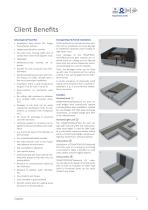
Client Benefits Advantages & Properties • Exceptional long service life, longer than adjacent surfaces • Highest possible driver comfort • No noise from crossing traffic due to surface that is flush with adjacent road • Maintenance-free; cleaning not required • Suitable for new structures and refur-bishments • Quickly installed lane-by-lane with minimal impact on traffic, drivable after a few hours (overnight installation) • Installation within a wide temperature range (5 °C to 35 °C/41 °F to 95 °F) • Wear-resistant; no mechanical wear parts • No rutting, high resistance to abrasion (e.g. braking...
Open the catalog to page 3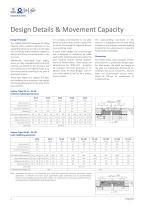
Design Details & Movement CapacityDesign Principles The TENSA®POLYFLEX®Advanced PU filling material shows excellent adhesion to the supporting structure as well as to the adjacent surfacing, and is therefore capable of safely transferring horizontal loads to the structure. Additionally, perforated steel angles, which are fully embedded within the joint material, are bolted to the structure and can transfer even the highest loads (e.g. from heavy vehicles braking on the joint at downward slopes). These steel angles also support the adjacent surfacing so as to prevent the asphalt from being depressed...
Open the catalog to page 4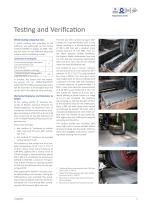
Testing and Verification Estimation of working life: Wheel tracking comparison test A wheel tracking test according to EN 12697-22 was performed by the Testing Institute MAPAG in August of 2009. Testing was done on two different plug joint systems with the following results: In practice, this means that the expected service life for TENSA®POLYFLEX® Advanced PU flexible plug expansion joints will be more than 2 times higher than the service life of the adjacent road surfacing. At the testing facility of Technical University of Munich, Germany (Prufamt fur Verkehrswegebau, TU Munchen) tests of...
Open the catalog to page 5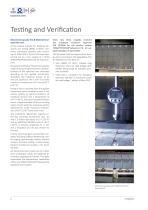
Expansion joints Testing and Verification Movement Capacity Test & Material Characteristics test At the Federal Institute for Materials Research and Testing (BAM) in Berlin, Germany, movement capacity tests according to ETAG 032-3, Annex 3-N have been carried out on a test sample of a PA 50 TENSA®POLYFLEX®Advanced PU expansion joint. During test method a) “Movement capacity under slow occurring movements“, the temperature of the specimen was controlled according to the applied movements. Therefore, the maximum tension of 33 mm was applied at -40 °C (-40 °F) and the maximum compression of 17 mm...
Open the catalog to page 6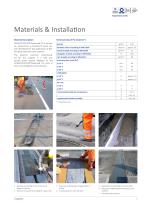
Expansion joints Materials & Installation Material Description TENSA®POLYFLEX®Advanced PU is an elastic, solvent-free 2-component grout system developed for the application of flexible plug expansion joint systems. The polymer concrete recommended for the support is a cold processed grout system adapted to the TENSA®POLYFLEX®Advanced PU joint in terms of workability and endurance. Technical data of PU material*) *) indications only.
Open the catalog to page 7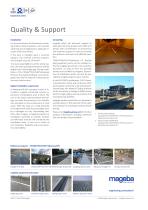
Expansion joints Quality & Support Installation For new structures, the bituminous surfacing shall be made in advance. For concrete surfacing and at edge beams, adequate recesses shall be provided. mageba offers full technical support to help determine the proper joint width and details with consideration of all technical and economic aspects in order to calculate the optimum and most cost-effective solution. If the joint is installed upon a concrete support, the minimal nominal compressive strength must be 25 N/mm². To ensure watertightness of the whole system, the waterproofing membrane shall...
Open the catalog to page 8All Mageba catalogs and technical brochures
 MIGUTEC
84 Pages
 LASTO-BLOCK B
4 Pages
 TENSA®MAT RM
2 Pages
 Prospectus seismic isolators
4 Pages
Archived catalogs
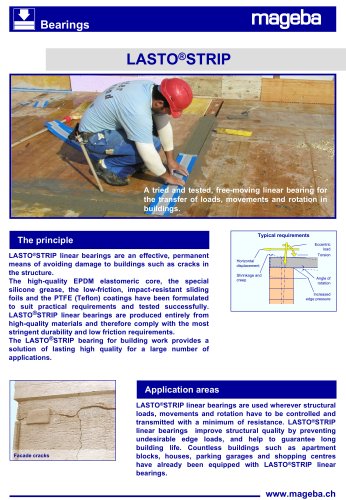 Prospect LASTO®STRIP
6 Pages
 Product brochure RESTON®POT
4 Pages
 Prospectus spherical bearing
4 Pages
 TENSA®FINGER GF
4 Pages
 TENSA®RAIL RSU
2 Pages
 RESTON®SPHERICAL
4 Pages
 RESTON®POT LIFT-CONTROL
4 Pages
 RESTON®LINEAR
2 Pages
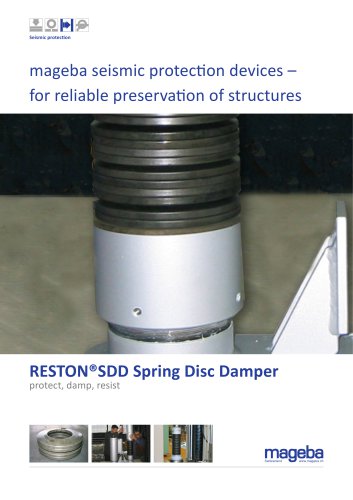 RESTON®SDD
2 Pages
 Prospect LASTO®WALL C
4 Pages



- Data logger
- USB datalogger
- Datalogger without display
- Battery-powered datalogger
- Hydraulic absorber
- Shock buffer
- Monitoring datalogger
- Plain bearing
- Mechanical buffer
- Real-time monitoring module
- Measurement monitoring module
- Bearing unit
- Data acquisition unit
- Industrial buffer
- Compact logger
- Metal damper
- Temperature monitoring module
- Anti-vibration damper
- Continuous monitoring module
- Condition monitoring module