
- Catalogs
- Madell Technology
- AE Series Convection Reflow Ovens

- Products
- Catalogs
- News & Trends
- Exhibitions
AE Series Convection Reflow Ovens

AE Series Convection Reflow Ovens
The AE series reflow ovens by Madell Technology Corporation include various models suitable for all SMT components. They are controlled by microcontrollers or computers and feature multiple heating zones.
- Site Requirements: Indoor installation away from high temperatures, moisture, and magnetic fields.
- Safety: Avoid foreign objects, hot surfaces, and perform maintenance only when cooled and unplugged.
- Environment: Operate within 5-40°C and 20-95% humidity.
- Power Supply: Requires 220V, 3-phase with a good ground connection.
- Adjustment: Ensure the oven is level.
- High heat efficiency with optimized chambers and hot air circulation.
- Compact design and long life due to stainless steel heating zones.
- Digital control for temperature and conveyor speed.
The ovens use a combination of hot air and infrared heating for even heat distribution, reducing oxidization and power consumption.
Suggested profiles include rapid preheating and maintaining reflow temperature, varying for different applications.
Consider PCB material, component density, and solder paste specifications. Adjust zone temperatures and conveyor speed accordingly.
Start with default settings, warm up, and adjust based on test results.
Turn on power, set temperatures, and use profiling devices to ensure profiles match designed ones.
Ensure no boards remain inside, turn off temperature switches, and let the conveyor cool down.
Process one side first, then flip for the second side using top heating only.
Details for models like AE-R330 and AE-RF430 include dimensions, power specifications, and default temperature settings.
- AE-F530-C: Computer-controlled floor model with five heating zones, dimensions of 2000x612x1220mm, and a weight of 180Kg.
- AE-F830: Features eight heating zones, dimensions of 2700x612x1220mm, and a weight of 200Kg.
- Conveyor Settings: Adjustable width and height, with a pass-through time of 3.5-5.5 minutes.
- Temperature Settings: Default settings for solder paste and glue across different zones.
- Reflow Oven Issues: Includes checks for power supply, fuse, SSR connections, and fan functionality.
- Circuit Board Reflow Problems: Addresses issues like paste not reflowing and PCB bending.
- Regular lubrication of the belt and motor, ensuring clean fans, and maintaining a good ground connection.
- Solder Paste Handling: Guidelines for storage and use.
- Stencil Printing: Recommendations for printing speed and pressure settings.
- Zone Temperature Controller: Instructions for using microcontroller-based temperature controllers.
- Computer Interface: Details on control panels for models equipped with a computer.
Catalog excerpts
AE Series Convection Reflow Ovens User’s Manual Madell Technology Corporation http://www.madelltech.com Copyright
Open the catalog to page 1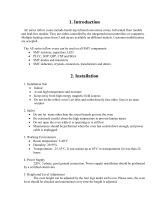
AE series reflow ovens include bench top infrared convection ovens, full scaled floor models and lead-free models. They are either controlled by the integrated microcontrollers or computers. Multiple heating zones from 3 and up are available on different models. Customer modifications are accepted. The AE series reflow ovens can be used on all SMT components: • SMT resistors, capacitors, LED • PLCC, SOP, QFP, CSP and BGA • SMT diodes and transistors • SMT inductors, crystals, connectors, transformers and others. 1. Installation Site • Indoor • Avoid high temperature and moisture • Keep away from...
Open the catalog to page 2
6. Notices: • The oven should be installed in a very clean site for high quality PCB boards assembling • Do not use or store the oven in an outside site, at high temperature or humidity • Do not install the oven in an area with strong electronic or magnetic interferences • Unplug the power cable every time the oven is under maintenance • The oven should be checked thoroughly every time it is moved. Make sure the conveyor or screen chain does not fall off, is not blocked and no foreign objects inside the oven chamber • The oven should be kept at a perfect horizontal level. Otherwise, the PCB boards...
Open the catalog to page 3
• No shadow areas or dead corners • Heat energy is transferred directly onto solder paste and pads • Prevent overheat of components • Even heat distribution on components • Even heat distribution on circuit boards • Accommodate different PCB’s, including flex ones Infra red heating has the following advantages: • Infra red waveform heats the chamber air directly, reduces heat circulation volume • Reduce oxidization of the solder paste • Reduce the oven power consumption • Short warm up time • Infra red waveform keeps the heating chamber cleaning. 2 Heating Zones 4.2.1 Number of heating zones...
Open the catalog to page 4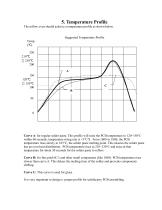
5. Temperature Profile The reflow oven should achieve a temperature profile as shown below. Suggested Temperature Profile Temp. (℃) 250 210℃ ~230℃ 200 A 150 120℃ ~150℃ 100 Curve A: for regular solder paste. This profile will raise the PCB temperature to 120~150°C within 60 seconds, temperature rising rate is <3°C/S. From 160S to 180S, the PCB temperature rises slowly to 183°C, the solder paste melting point. This ensures the solder paste has an even heat distribution. PCB temperature rises to 210~230°C and stays at that temperature for about 30 seconds for the solder paste to reflow. Curve B:...
Open the catalog to page 5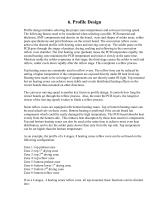
6. Profile Design Profile design includes selecting the proper zone temperatures and conveyor moving speed. The following factors need to be considered when selecting a profile: PCB material and thickness, SMT components and density on the board, sizes and shapes of solder areas, solder paste specifications and print thickness on the circuit board. The convection reflow ovens achieve the desired profile with heating zones and moving conveyor. The solder paste on the PCB goes through the stages of preheat, drying, melting and reflowing in the convection reflow oven chamber. The first heating zone...
Open the catalog to page 6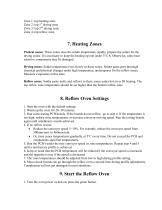
Zone 1: top heating zone Zone 2: top 1st drying zone Zone 3: top 2nd drying zone Zone 4: top reflow zone. 7. Heating Zones Preheat zones: These zones raise the solder temperature rapidly, prepare the solder for the drying zones. It is necessary to keep the heating up rate under 3°C/S. Otherwise, some heat sensitive components may be damaged. Drying zones: Solder temperature rises slowly in these zones. Solder paste goes thorough chemical and physical changes under high temperature, and prepares for the reflow zones. Moisture evaporates at this time. Reflow zones: Solder paste melts and reflows...
Open the catalog to page 7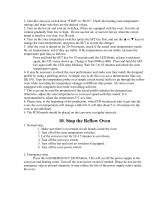
2. Turn the conveyor switch from “STOP” to “RUN”. Check the heating zone temperature settings and make sure they are the desired values. 3. Turn on the hot air and cool air switches, if they are equipped with the oven. Turn the air volume gradually from low to high. Do not use hot air, or use low hot air when the circuit board is small or very thin. Use IR only. 4. Turn on the zone temperature switches (press the SET key first, and use the ▲ or ▼ keys to change the zone temperatures, and press the SET to accept the change). 5. After the oven is turned on for 20-30 minutes, check if the actual...
Open the catalog to page 8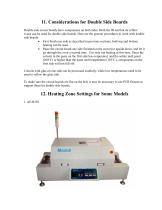
11. Considerations for Double Side Boards Double side circuit boards have components on both sides. Both the IR and hot air reflow ovens can be used for double side boards. Here are the general procedures to work with double side boards: • First finish one side as described in previous sections; both top and bottom heating can be used. • Place the circuit board one side finished on the conveyor upside down, and let it go through the oven a second time. Use only top heating at this time. Since the solvent in the paste on the first side has evaporated, and the solder melt point (260°C) is higher...
Open the catalog to page 9
• This is a table top IR convection reflow oven, with three top heating zones: one preheating zone, one drying zone and one reflow zone. • Dimensions: Outside: 1400(L)x612(W)x650(H)mm Heating chamber length: 860mm Weight: 50Kg Max. power (warm up): 5Kw Regular working power: 1.8Kw Power supply: 2 phase or 3 phase, 220V, 50/60Hz, 11A • Conveyor: Width: 300mm Height: 420±20mm Moving direction: left—>right (left<—right can be ordered) Pass through time: 4-5 minutes Speed: relative dial mark: 0-10 Actual moving speed: 200-800mm Usable speed marks: 0.5-3 • Heating zones: 1 Preheat zone, digital control,...
Open the catalog to page 10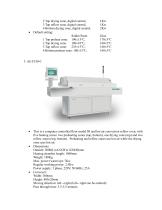
2 Top drying zone, digital control, 1Kw 3 Top reflow zone, digital control, 1Kw 4 Bottom drying zone, digital control, 2Kw • Default setting: Solder Paste Glue 4 Bottom preheat zone: 180±15°C, 160±5°C • This is a computer controlled floor model IR and hot air convection reflow oven, with five heating zones: two preheating zones (top, bottom), one drying zone (top) and two reflow zones (top, bottom). Preheating and reflow zones use hot air while the drying zone uses hot air. • Dimensions: Outside: 2000(L)x612(W)x1220(H)mm Heating chamber length: 1000mm Weight: 180Kg Max. power (warm...
Open the catalog to page 11All Madell Technology catalogs and technical brochures
 MADELL QK870
4 Pages
 MADELL QK857D
5 Pages
 Frequency counter series
3 Pages
 CA4810A Curve Tracer
12 Pages
- DC power supply
- AC/DC power supply
- Tabletop power supply
- Generator
- Multimeter
- Variable-output power supply
- Laboratory power supply
- Digital multimeter
- Screen printing machine
- Portable multimeter
- Automatic kiln
- Multiple-output power supply
- Automatic screen printing machine
- Cutting and stripping machine
- Industrial multimeter
- Cable stripping machine
- Soldering machine
- Oscilloscope