
- Catalogs
- Macro Engineering & Technology Inc.
- Polyolefin Biax Shrink Film Lines

Polyolefin Biax Shrink Film Lines

Polyolefin Biax Shrink Film Lines
- Versatile extrusion technology capable of producing a variety of shrink film products.
- Stable process allowing for long production runs without bubble breaks.
- Optimized primary tube cooling and calibration system for efficient and quality production.
- Microlayer technology enhances impact and tear resistance.
- Chlorine-Free Shrink Film & Bags
- High Clarity Shrink Packaging
- Antistatic Shrink Packaging for Electronics
- Models available: 1800, 1800-M, 2500, 2500-M
- Final Film Width: 1800 mm or 2500 mm
- Film Thickness Range: 12-25 µm
- Number of Layers: 3, 5, 7 or 24 microlayers
- Raw Materials: LLDPE/LDPE, Copolymer, Terpolymer
- Maximum Output Capacity: 200 Kg/h for 1800 models, 280 Kg/h for 2500 models
- Production Speed: 100 m/min
- Primary Tube Calibration: Water-quenching unit
- Orientation: Infrared heated second bubble
- Winding Options: AUTOMAX-SG Gap Surface Winder or AUTOMAX-T Turret Winder
- Maximum Roll Diameter: 600 mm (option to 800 mm)
- Web Tension Range: 2.5 – 25 Kg
- Infrared heated orientation configuration for reheating the film during the MD/TD orientation process.
- Gauge randomizing unit and programmable tension tapering with automatic cutovers.
Catalog excerpts
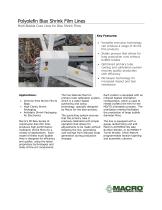
Key Features: • Versatile extrusion technology can produce a range of shrink film products • Stable process that allows for long production runs without bubble breaks • Optimized primary tube cooling and calibration system ensures quality production with efficiency • Microlayer technology for increased impact and tear resisitance Applications: • Chlorine-Free Shrink Film & Bags • High Clarity Shrink Packaging • Antistatic Shrink Packaging for Electronics Macro's PE Biax Series of coextrusion biax film lines produces high performance multilayer shrink films for a variety of applications. Each model of these multi-bubble lines is designed for efficiency and quality, using the latest proprietary technologies and state-of-the-art components. The line features Macro's primary tube calibration system, which is a water-based quenching and sizing technology, specially designed by Macro for the biax process. The quenching system ensures that the primary tube is precisely calibrated with simple operation that allows for adjustments to be made without stopping the line, generating cost savings from reduced scrap generation during production changes. Each system is equipped with an infrared heated orientation configuration, which is used to reheat (soften) the film for the MD/TD orientation process. The orientation method facilitates the production of large bubble diameter films. The line is equipped with a gauge randomizing unit and Macro's AUTOMAX-SG Gap Surface Winder, or AUTOMAX-T Turret Winder, which feature programmable tension tapering and automatic cutovers.
Open the catalog to page 1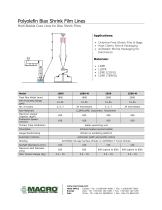
Applications: • Chlorine-Free Shrink Film & Bags • High Clarity Shrink Packaging • Antistatic Shrink Packaging for Electronics Materials: • LDPE • LLDPE • LDPE (COPO) • LDPE (TERPO) www.macroeng.com Head Office Canada - Tel: +1(905)507-9000 | Fax: +1(905)507-3000 Europe Italy - Tel: +39 0321 182 7286 | Fax: +39 0321 182 7287
Open the catalog to page 2All Macro Engineering & Technology Inc. catalogs and technical brochures
 Barrier Cast Film Lines
2 Pages
 CPP Film Lines
2 Pages
 Sheet Extrusion Technology
2 Pages
 PS Foam Extrusion Line
2 Pages
 DIO Air Rings
2 Pages
 Blown Prestretch Film Lines
2 Pages
 Barrier Biax Film Lines
2 Pages
 Multilayer Blown Film Lines
2 Pages


- Extrusion line
- Thermoplastic extrusion line
- Panel extrusion line
- Multilayer extrusion line
- PVC extrusion line
- Automatic winder
- PE extrusion line
- Flat-film extrusion line
- Blown film extrusion line
- Single layer extrusion line
- Coextrusion line
- Multilayer coextrusion line
- Film winder
- Food film extrusion line
- Blown film coextrusion line
- PS extrusion line
- Medical packaging extrusion line
- Extrusion line winder
- Foam sheet extrusion line
- Coating extrusion line