
- Catalogs
- Maanshan Tianjun Machinery Manufacturing Co., Ltd.
- railway wheels manufacturing progress

railway wheels manufacturing progress
railway wheels manufacturing progress
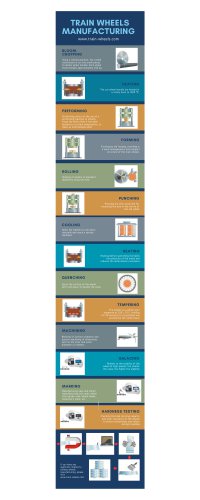
This document outlines the manufacturing process of train wheels, focusing on hardness testing and various production stages.
Each wheel mould weighs approximately 450 kg. The wheels are tempered at 520 ± 10°C for 90 minutes to achieve the desired hardness and stability.
- Bloom-Cropping: Cutting cooled round steel into small pieces to create wheel moulds.
- Heating: Wheel moulds are heated to 1300 ℃ in a rotary oven.
- Preforming: Initial forging of the billet to create an intermediate billet.
- Forming: Die forging for a homogeneous and compact wheel structure.
- Rolling: Shaping wheels to standard diameters using roll mills.
- Punching: Creating a round hole for axle mounting.
- Tempering: Heating before quenching to increase metal plasticity and reduce deformation resistance.
- Cooling: Natural cooling to achieve certain hardness.
- Quenching: Surface spraying with cold water to harden the steel.
- Machining: Removal of surface oxidation and precise dimension machining.
- Balancing: Ensuring wheel stability at high speeds.
- Marking: Stamping manufacturing details and codes on the wheels.
Checking load carrying capacity and wear resistance to ensure smoothness and safety during travel.
For further inquiries, visit www.train-wheels.com.
Catalog excerpts

TRAIN WHEELS MANUFACTURING www.train-wheels.com BLOOMCROPPING Using a cutting machine, the cooled round steel is cut into small pieces to obtain wheel moulds. Each wheel mould weighs approximately 450 kg HEATING The cut wheel moulds are heated in a rotary oven to 1300 ℃. PREFORMING Preforming refers to the use of a preforming machine to initially forge the billet after it has been heated to a certain temperature, to make an intermediate billet FORMING Forming by die forging, resulting in a more homogeneous and compact structure of the train wheels. ROLLING Shaping of wheels to standard diameters using roll mills PUNCHING Pressing out the round hole for mounting the axle in the centre of the rail wheel COOLING Allow the wheels to cool down naturally and reach a certain hardness HEATING Heating before quenching increases the plasticity of the metal and reduces the deformation resistance QUENCHING Spray the surface of the wheel with cold water to harden the steel TEMPERING The wheels as a whole were tempered at 520 ± 10°C. Holding for 90 minutes to recrystallise and austenitise the rolled tissue MACHINING Removal of surface oxidation and precise machining of dimensions such as the inner and outer diameters of wheels. BALACING Relates to the stability of the wheel at high speeds, the smaller the value, the higher the stability MARKING Manufacturing year and month, manufacturing unit code, wheel steel grade code, wheel model, inspector's mark, etc. HARDNESS TESTING Checking the load carrying capacity and wear resistance of the wheels to ensure smoothness and safety during travelling If you have any questions related to railway wheels manufacturing, please visit www.train-wheels.co
Open the catalog to page 1All Maanshan Tianjun Machinery Manufacturing Co., Ltd. catalogs and technical brochures
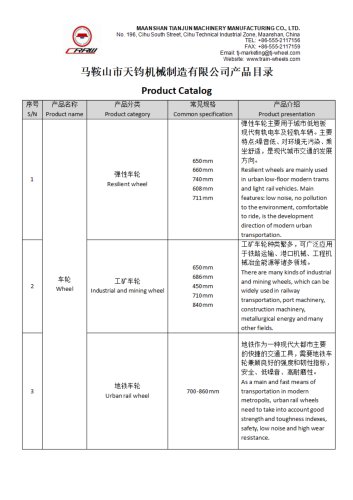
- Bogie
- Standard gauge bogie
- 2-axle bogie
- Freight bogie
- 1435 mm bogie
- Railway wheelset
- Y25 bogie
- Wagon bogie
- Freight railway wheelset
- AAR railway wheelset
- Locomotive railway wheelset
- ISO railway wheelset
- Regional train bogie
- Metro railway wheelset
- Steel axle
- Railway axle
- Metro train wheel
- UIC bogie
- Regional train train wheel