
- Catalogs
- Lumex Instruments
- CAPEL - 105M


- Company
- Products
- Catalogs
- News & Trends
- Exhibitions
CAPEL - 105M

CAPEL - 105M
High performance capillary electrophoresis (HPCE) operates on the principle of differential migration of sample components within a narrow fused silica capillary, driven by an electric field. The separated solutes are quantified using a highly sensitive spectrophotometer detector.
- Extended instrumental options with spectra scanning for peak identification.
- Broad range of controlled injection pressures for analyzing viscous samples.
- Reverse sample injection under vacuum for ultra-short analysis time and improved detection limits.
- Precise liquid temperature control of the capillary (± 0.1°C).
- Extended range of applied buffers for increased separation efficiency.
- User-friendly interface with complete PC control and powerful software package "Elforun®".
- Unique design allowing quick capillary cassette changes and optimized optical scheme for lower detection limits.
- Unique separation power (up to 1,000,000 theoretical plates).
- Extremely low consumption of reagents and samples.
- Very low analysis cost and fast analysis time.
- CAPEL®-105M capillary electrophoresis system.
- Spare capillary cassette and Elforun® software package.
- Compatible with most CE-kits from any manufacturer.
- 12-month warranty on all CAPEL®-105M HPCE systems.
- Installation and personnel training services available.
- Environmental analysis: Surface, ground, and waste water analysis.
- Quality control of food and beverages: Analysis of water, beverages, wines, and foodstuff.
- Pharmacology and biochemistry: Technological monitoring, enantiomers separation, and protein analysis.
- Forensic studies: Analysis of explosives, drugs, and writing paper components.
- Chemical industry: Technological monitoring and raw material testing.
- Detection wavelength: 190–400 nm, using a deuterium lamp.
- Analysis voltage: 1–25 kV, current: 0–200 μA, pressure: 0–99 mbar.
- Programmable changes in wavelength, pressure, and voltage during analysis.
- Capillary length: 30–100 cm, internal diameter: 50, 75, 100 μm.
- Temperature control: Liquid thermostating from -10 to +30 °C, ±0.1°C.
- Sampler: Autosamplers for 10 inlet and 10 outlet vials.
- Power requirements: 110–240 VAC, 50/60 Hz, 200 W.
- Dimensions/weight: 500x500x500 mm, 25 kg.
- Control: Elforun® software.
Catalog excerpts
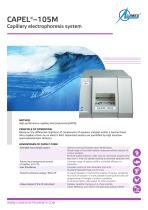
High performance capillary electrophoresis [HPCE] Based on the differential migration of components of aqueous samples within a narrow fused silica capillary driven by an electric field. Separated solutes are quantified by high sensitive spectrophotometer detector.
Open the catalog to page 1
Detection wavelength ❖ Unique separation power (up to 1000000 TP] ❖ Extremely low reagents and samples consumption ❖ Very low analysis cost ❖ Fast analysis time EQUIPMENT AND OPTIONS ❖ Capillary electrophoresis system CAPEL®-105M ❖ Spare capillary cassette ❖ Elforun® software package ❖ Kits for analysis (by request); most of CE-kits of any manufacturers are compatible with CAPEL®-105M WARRANTY All CAPEL®-1 05m HPCE systems are covered by a 12-month warranty. SERVICES installation of LUMEx instruments can be carried out at a Customer's site by our service engineers. Personnel training specific...
Open the catalog to page 2All Lumex Instruments catalogs and technical brochures
 CAPEL - 105M
2 Pages
 Air mercury monitor RA-915AM
2 Pages
 FLUORAT–02
2 Pages
 Benzene analyzer BA-15
2 Pages


Archived catalogs

- Gas analyzer
- Lumex Instruments concentration analyzer
- Monitoring analyzer
- Lumex Instruments liquids analyzer
- Lumex Instruments automatic analyzer
- Benchtop analyser
- Solids analyser
- Spectrometer
- Process analyzer
- Portable analyzer
- Continuous analyzer
- Water analyzer
- Real-time analyzer
- Laboratory analyzer
- Integration analyzer
- Compact analyzer
- Calibration analyzer
- Monitoring detector
- Temperature analyzer
- Laboratory spectrometer