
- Catalogs
- LUKAS Hydraulik GmbH
- Instruction manual for rescue equipment

- Products
- Catalogs
- News & Trends
- Exhibitions
Instruction manual for rescue equipment

Instruction manual for rescue equipment
This section categorizes safety notes using pictograms and keywords to indicate danger levels, from immediate danger (DANGER) to less dangerous situations (CAUTION). It includes advice for safe application to prevent injury or damage.
LUKAS products are designed for optimal performance and safety. Operators must be trained, follow safety instructions, and use only original parts for repairs. Safety gear is mandatory, and equipment should be inspected for defects.
LUKAS cutters and combi tools are used for rescuing accident victims by cutting, spreading, pulling, and squeezing. They can operate underwater up to 40m but should not cut live cables or hardened parts.
The equipment uses hydraulically activated pistons to operate blade arms for cutting and spreading, maintaining load-holding function when disconnected from the hydraulic supply.
Equipment connects to the hydraulic pump via mono-couplings or quick-disconnect couplings, ensuring safety and functionality.
Preparatory measures include deaeration of the rescue tool by opening and closing the blade arms in various positions. Proper lighting and safety precautions are necessary during operation.
Safety notes emphasize securing objects and avoiding cutting certain materials. The section details the operation of the star grip for controlling movements.
Post-operation procedures include inspecting and maintaining the equipment. Regular checks and adherence to maintenance schedules are crucial.
Guidelines for preventative service and repairs are provided. Troubleshooting tips help address common issues.
Specifications for cutters and combi tools, including torque, cutting performance, and recommended hydraulic fluid, are detailed.
Compliance with European standards is confirmed for cutters and combi tools.
Additional notes emphasize the importance of following safety and operational guidelines to prevent accidents and ensure environmental protection.
Before commissioning or after repairs, the equipment must be deaerated. Connect it to the hydraulic pump and operate the blade arms without load at least twice. Ensure actuating valves are set to depressurized circulation before starting the hydraulic unit.
Stabilize the obstacle before rescue operations. Wear protective clothing, helmet, gloves, and goggles. In explosive areas, ensure explosion prevention measures are in place. Maintain a safe distance from the equipment during operation to avoid injury from flying debris.
To open the device, turn the star grip clockwise; to close, turn it counterclockwise. The "dead-man’s" function ensures the star grip returns to the central position when released.
For cutting, position blades at a 90° angle to the object. Avoid cutting high-strength vehicle parts to prevent damage. For spreading, use the front area of the tips to increase the gap. Only use LUKAS chain sets for pulling, ensuring correct attachment to prevent slipping. Squeezing should be done in the area of the tips.
Conduct visual inspections after each use and every six months. Perform a crack test on blades every three years. Clean and lubricate equipment before long-term storage. Regularly check the torque of the pivot bolt and inspect hoses for damage.
Repairs should only be performed by the manufacturer or trained personnel using LUKAS spare parts. Ensure cleanliness during assembly to prevent damage.
Clean the exterior to prevent corrosion and apply oil to metallic surfaces. Change hydraulic fluid after 200 uses or three years, following specific procedures to avoid contamination.
- Ensure the rescue equipment is clean before starting.
- Close the blade arms until the tips are almost touching to access blade bolts.
- Remove screws, hand guards, nuts, washers, and bolts in sequence to detach blades.
- Replace blades and reassemble in reverse order, ensuring proper torque settings.
- Apply LUKAS special grease to all sliding surfaces.
- Follow specific steps for replacing protective covers, pivot bolts, handles, and blades for different cutter models.
- Ensure correct torque settings and use of LUKAS special grease during assembly.
- For sharpening blades, only remove burrs and avoid grinding sliding faces.
- Replace hoses if leaks or defects are detected, ensuring correct torque and coupling types.
- Mono-couplings and quick-disconnect couplings must be replaced if damaged or leaking.
- Common issues include slow blade movement, hydraulic fluid leaks, and coupling problems.
- Solutions involve checking connections, replacing defective parts, and ensuring correct hydraulic fluid levels.
- Specifications for various cutter models include dimensions, cutting force, weight, and operating pressure.
- Ensure compatibility with hydraulic fluid volume and coupling systems.
LUKAS Hydraulik GmbH offers several hydraulic devices, including models SC 358, SC 557, and SC 758. Each device is classified based on its spreading force and width, as well as the minimum performance of the cutter. The performance is categorized using a letter system (A-K) that corresponds to different material profiles and dimensions.
- SC 358: Spreading force of CK 38 / 372 with a classification of 1I-2J-3I-4J-5J.
- SC 557: Spreading force of CK 41.5 / 430 with a classification of 1J-2K-3K-4K-5K.
- SC 758: Spreading force of CK 43 / 475 with a classification of 1J-2K-3K-4K-5K.
Use mineral oil DIN ISO 6743-4 for LUKAS hydraulic equipment. The recommended viscosity range is 10...200 mm²/s (10…200 cSt). Operating temperature ranges from -20 to +55°C (-4 to +131°F), and storage temperature ranges from -30 to +60°C (-22 to +140°F).
The document includes sections on EC Declarations of Conformity for cutters and combi tools, ensuring compliance with European standards.
LUKAS Hydraulik GmbH is a unit of IDEX Corporation, located at Weinstraße 39, D-91058 Erlangen, Germany. Contact can be made via phone at (+49) 0 91 31 / 698 - 0 or email at [email protected].
Proper disposal of packaging materials and dismantled parts is advised to ensure environmental responsibility.
Catalog excerpts

Instruction manual for rescue equipment Cutters and Combi Tools Blade forms: (Translation of the original instruction manual)
Open the catalog to page 1
4.4 Control of the operating movements 5.3 Coupling the quick-disconnect couplings 7. Cutting, spreading, pulling and squeezing 6.2 Operating the star grip 7.3 Spreading (combi tools only) 7.4 Pulling (combi tools only) 7.5 Squeezing (combi tools only) 8. Dismantling the equipment / deactivation following operation 8.1 Cutters / Combi tools 9.1 Cutters / Combi tools, overall
Open the catalog to page 2
12.3 Torque of the pivot bolt 12.5 Datasheets for the product performance 12.6 Recommended hydraulic fluid 12.7 Operating and storage temperature ranges
Open the catalog to page 3
We distinguish between various categories of safety notes. The table below gives you an overview of the assignment of symbols (pictograms) and key words to the specific hazard and possible consequences. Immediate danger Death or major injury Potentially dangerous situation Potential death or major injury Less dangerous situation Minor or slight injury Danger of damage to device / environment Damage to the equipment, damage to the environment, damage to surrounding materials Advice for application and other important / useful information and advice No injury / damage to persons / environment /...
Open the catalog to page 4
LUKAS products are developed and manufactured in order to guarantee the best performance and quality when used properly. Operator safety is the most important aspect of the product design. Moreover, the operating instructions are intended to help the safe use of LUKAS products. The generally applicable, legal and other binding regulations pertaining to the prevention of accidents and protection of the environment apply and are to be implemented in addition to the operating instructions. The equipment may only be operated by persons with appropriate training in the safety aspects of such equipment...
Open the catalog to page 5
Observe all safety and danger notes on the equipment and in the operating instructions. All safety and danger notes on the equipment are to be kept complete in a legible condition. Any mode of operation which impairs safety and/or stability of the equipment is forbidden! Comply with all specified dates or dates specified in the operating instructions pertaining to regular controls / inspections on the equipment. Safety devices may never be deactivated! The maximum permitted operating pressure noted on the equipment must not be exceeded. Before the equipment is switched on/started up, and during...
Open the catalog to page 6
Always keep these operating instructions within reach where the equipment is used. Ensure the proper disposal of all removed parts, left-over oil and hydraulic fluid as well as packaging materials! The generally applicable, legal and other binding national and international regulations pertaining to the prevention of accidents and protection of the environment apply and are to be implemented in addition to the operating instructions. The equipment is to be used exclusively for the purpose stated in the operating instructions (see chapter “Proper Use”). Any other or further use is not considered...
Open the catalog to page 7
LUKAS “SC” combi tools and LUKAS “S” cutters are designed specifically for rescuing victims in traffic, rail or air accidents and for making rescues from buildings. They serve the purpose of freeing injured people in accidents e. g. by cutting doors, roof bars and hinges. By using the LUKAS combi tools, trapped persons can also be freed e. g. by spreading doors and / or by removing obstacles with the aid of a chainset. Basically, the combi tools can be used to cut, pull, spread, squeeze and lift. Basically, LUKAS cutters can only be used to cut objects. All objects which are to be worked on are...
Open the catalog to page 8
LUKAS cutters and combi tools can also be used under water at a depth of up to 40m (131 ft). CAUTION! In this case, you must strictly observe any leaks in order to avoid threats to the environment. CAUTION! All objects which are to be worked on are to be secured using stable supports or substructures. WARNING / CAUTION! The following may not be cut / squeezed: - cables live - hardened parts such as springs, spring steels, steering columns and rollers - tubes / hoses under gas or liquid pressure, - compound materials (steel/concrete) - explosive bodies such as airbag cartouches NEVER operate the...
Open the catalog to page 9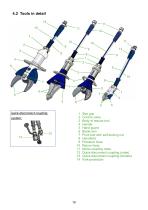
quick-disconnect coupling 1 Star grip 2 Control valve 3 Body of rescue tool 4 Handle 5 Hand guard 6 Blade arm 7 Pivot bolt with self-locking nut 8 Handhold 9 Pressure hose 10 Return hose 11 Mono-coupling male 12 Quick-disconnect coupling (male) 13 Quick-disconnect coupling (female) 14 Kink-protection
Open the catalog to page 10
quick-disconnect coupling 1 Star grip 2 Control valve 3 Body of rescue tool 4 Handle 5 Hand guard 6 Blade arm 7 Pivot bolt with self-locking nut 8 Handhold 9 Pressure hose 10 Return hose 11 Mono-coupling male 12 Quick-disconnect coupling (male) 13 Quick-disconnect coupling (female) 14 Kink-protection
Open the catalog to page 11
To enable comprehension of the function, a simplified hydraulic cylinder of the rescue equipment (A) + hand valve (B) are depicted here. cut / close / pulling / squeezing spreading / opening 4.4 Control of the operating movements The spreading arms movement is controlled via the star grip of the mounted valve. (see cover, item 1 and, below, figure 3). star grip A LUKAS motor pump or hand pump only may be used to drive the equipment. If the pump unit is a different make, you must make sure that it complies with LUKAS specifications, otherwise potential dangers may occur which are not the responsibility...
Open the catalog to page 12
5. Connecting the equipment 5.1 General information There are two short hoses on the side of the equipment: they are connected to the pump unit via two hoses. All hose assemblies are marked with a colour and have couplings to enable unmistakable connection. REMARK: The devices can be equipped with different coupling systems. They differ only by the article number and not by the designation. Of course the coupling systems can also be reequipped at a later time. WARNING / CAUTION! Before connecting the equipment you have to pay attention that all used components are suitable to the max operation...
Open the catalog to page 13All LUKAS Hydraulik GmbH catalogs and technical brochures
 SP 777 E2
15 Pages
 Catalog Industrial
51 Pages


- Double-acting cylinder
- Hydraulic cylinder
- Single-acting cylinder
- Pack unit
- Compact cylinder
- Electric hydraulic power unit
- Steel cylinder
- Stainless steel cylinder
- Manually-controlled hydraulic pump
- Compact hydraulic pump
- High-pressure hydraulic pump
- Cutting tool
- Compact hydraulic power unit
- Mobile hydraulic power unit
- Screw cylinder
- Heavy load cylinder
- Air-operated hydraulic pump
- Cylinder for lifting applications