
- Catalogs
- LU-VE S.p.A.
- Manufacturing Range

Manufacturing Range

Manufacturing Range
LU-VE Group is a prominent international company specializing in the design, production, and sales of heat exchangers and components for commercial and industrial refrigeration, air conditioning, and industrial applications. Headquartered in Uboldo, Italy, the group operates 8 production facilities and 14 sales companies globally. It employs 1,350 skilled workers, covers a total area of 330,000 m², and generates an annual turnover exceeding €220 million, with 70% of its products exported to 90 countries.
The document outlines specifications for various products such as unit coolers, air-cooled condensers, and dry coolers. It includes technical data on tube geometry, number of tubes, rows, and fin block lengths for different models, showcasing the flexibility and range of products available.
Innovation is a key aspect of LU-VE's leadership, being the first to implement grooved tube technology and specialized heat exchange surfaces. The use of Computational Fluid Dynamics (CFD) has enhanced the understanding of fluid dynamics and heat transfer, leading to improved performance standards.
LU-VE's philosophy, "Leadership with passion," combines experience, innovation, and a commitment to environmental sustainability. The company prioritizes safety, energy efficiency, and social responsibility, including initiatives for employing disabled individuals.
LU-VE products are engineered for high efficiency and reliability, featuring TURBOCOIL® heat exchangers with internally grooved tubes and TURBOFIN® fins. The products aim to reduce energy consumption, noise, and refrigerant volume while optimizing space and transport efficiency.
LU-VE was the first in Europe to receive the Eurovent "Certify-All" certification for its entire product range, ensuring high standards of performance and quality across its unit coolers, condensers, and dry coolers.
The "Towards Excellence" program is central to LU-VE's core business, focusing on products that enhance quality of life through applications in food refrigeration, air conditioning, energy production, and industrial processes.
- Commercial and Industrial Refrigeration: Includes fresh food conservation, food processing, freezing, and logistics.
- Air Conditioning: Used in shopping centers, data centers, hospitals, and telecommunications.
- Industrial Processes: Applicable in automotive, chemical, pharmaceutical, and energy sectors.
- OEM Applications: Includes refrigerated cabinets, ice machines, and custom solutions.
LU-VE products comply with several directives, including the EC Machine Directive 2006/42/CE, and are guaranteed for two years against construction defects, excluding corrosion damage. The company reserves the right to make product improvements without prior notice.
LU-VE holds multiple certifications, including ISO 9001 and Eurovent "Certify All," ensuring product performance and energy efficiency. The company was the first in Europe to achieve Eurovent certification for its entire product range.
LU-VE employs advanced technologies such as the patented JETSTREAMER® grille and JET-O-MATIC® system to enhance air throw and unit cooler capacity. The SAFETUBES SYSTEM® protects coil tubes, and new electronic fans reduce energy consumption.
The product range includes compact and industrial unit coolers, air-cooled condensers, and dry coolers, all designed for energy efficiency and low noise operation.
The document provides detailed technical specifications and dimensions for various models of unit coolers, as listed in the LHS catalogue. The power range for these units is between 7.6 kW and 216.3 kW, with 230 models and 1400 versions available. Key parameters include heat exchanger modules, fan number and diameter, air quantity, air throw, surface area, and motor power consumption.
Performance metrics are provided for different models, including power ratings, air quantity, air throw, and surface area. The document also discusses the efficiency of the units, highlighting features such as TurboCooler, Super Silent, and New Electronic Motors.
The document mentions the use of various refrigerant fluids, including HFC, GLYCOL, NH3, and CO2. It emphasizes the growing use of CO2 due to its low Global Warming Potential (GWP) compared to HFCs, and its lack of toxicity, flammability, and ozone layer impact.
A software tool, REFRIGER®, is available for selecting air coolers and unit coolers. This tool operates in a Windows environment and aids in the selection process based on specific requirements.
The document notes that certain products are not included in the Eurovent certification programme. It also provides guidelines for testing unit cooler capacities in dry and humid atmospheres, in accordance with ENV 328 standards.
Correction factors for unit cooler capacities are provided, taking into account different operating conditions such as room temperature and evaporating temperature. These factors adjust for latent heat due to water vapor condensation on the cooler surface.
Common technical characteristics and dimensions for air coolers and unit coolers are consistent with those stated in the catalogue for models like FHC, FHD, SHD, SHA, SMA, CDH, CHS, and LHS.
The document provides detailed specifications for motors and coils used in refrigeration systems. It includes data on circuit volume, number of circuits, dimensions, and motor power consumption. The specifications are presented for both single and twin coil configurations, with varying motor power ratings and air quantities.
The document outlines the procedure for subcooling the liquid condensate before it is expanded and admitted to the evaporator. This process increases the enthalpy change of the refrigerant, enhancing the refrigeration capacity and energy efficiency.
It is recommended to refer to the SHVC catalogue for conditions not covered in the document. The document also provides guidelines on the positioning of subcoolers in refrigeration plants to optimize performance.
The tables provide detailed data on motor power consumption at different voltages and frequencies, air quantity, and sound pressure levels. Figures illustrate the positioning of subcoolers and the impact on the Coefficient of Performance (COP) with changes in ambient temperature.
The document emphasizes the thermodynamic advantage of subcooling, which increases the refrigerating capacity and energy efficiency. The COP is a critical parameter, indicating the efficiency of the refrigeration system, with higher COP values leading to reduced energy consumption for the same refrigerating effect.
- Models: Various models including XDHLF, XDHLN, XDHLS, XDHLX, XDHLT, XDHLU, XDHLR, XXLDF, XXLDN, XXLDX, XXLDU.
- Power Rating: Ranges from 36 kW to 2333 kW depending on the model and conditions (∆T 15K, Glycol 34%).
- Flowrate: Refrigerant fluid flowrate ranges from 6.7 m3/h to 436.2 m3/h.
- Pressure Drop: Varies between 11 kPa to 95 kPa.
- Air Quantity: Air flow ranges from 9,800 m3/h to 631,400 m3/h.
- Motor Power Consumption: Varies from 335 W to 71,500 W.
- Sound Pressure Level: Ranges from 24 dB(A) to 70 dB(A).
- External Surface Area: TURBOCOIL ranges from 112 m2 to 5058 m2.
- Internal Surface Area: Ranges from 7.2 m2 to 326 m2.
- Circuit Volume: Ranges from 2x11 dm3 to 2x866 dm3.
- Dimensions: Length ranges from 1250 mm to 12808 mm.
- Includes features like dual discharge, safe tubes system, and energy-saving technologies.
- Models are equipped with electronic motors and are designed for efficient and silent operation.
- Smart patented systems for enhanced performance.
- Designed for use with various refrigerants including Glycol, NH3, and CO2.
The document provides detailed specifications for various models of air-cooled condensers and dry coolers, including power ratings, refrigerant fluid flow rates, air quantity, motor power consumption, sound pressure levels, and dimensions. Key data points include:
- Power ratings range from 347 kW to 997 kW with 34% glycol at ΔT 15K.
- Refrigerant fluid flow rates vary from 64.9 m3/h to 186.5 m3/h.
- Sound pressure levels range from 34 dB(A) to 44 dB(A).
The document lists common data for the units, such as the number of fans, external and internal surface areas, and volume of the circuit. It also provides dimensions for each model.
Several electronic fan speed controllers are described, including:
- SP-SCU: Suitable for low and medium capacity units, based on cut phase principle.
- AURT: For medium and high capacity units, offering precise control.
- ARUS: Advanced technology with voltage steps, free from electromagnetic noise.
This compact silencer reduces sound pressure levels by up to 5 dB(A) and offers energy savings up to 10%. It is confirmed by TÜV of Munich and provides benefits such as reduced unit footprint and elimination of warm air recirculation.
The "Dry and Spray" system is introduced as an alternative to traditional cooling towers, offering advantages like reduced water consumption, no risk of Legionella, low energy consumption, and silent operation. It is designed to operate efficiently under varying ambient conditions, with spray usage limited to about 200 hours per year.
- Air Cooled Condensers: Designed for efficient heat exchange in refrigeration and air conditioning systems.
- Unit Coolers: Suitable for industrial applications, providing effective cooling solutions.
- Dry Coolers: Offer energy-saving benefits and reduced operational costs.
- Telecom Coolers and Gravity Coolers: Specialized cooling solutions for specific industrial needs.
- CO2 Gas Coolers and Tube and Fin Heat Exchangers: Advanced systems for commercial and industrial refrigeration.
Catalog excerpts

PRODUCTION RANGE UNIT COOLERS www. e u rove nfc-c e rtif i c ati o n. com leadership with passionJK^
Open the catalog to page 1
INDICE / INDEX PRODOTTI Research & Innovation LU-VE Technology LU-VE Technology Indice prodotti Product index Aeroevaporatori Industriali Industrial Unit Coolers Condensatori Ventilati Active Control Technology Active Control Technology Varianti costruttive / Accessori Construction variants / Accessories Water Spray System Water Spray System
Open the catalog to page 2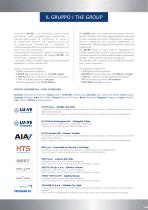
IL GRUPPO / THE GROUP Il marchio LU-VE è un riferimento internazionale nell’ambito della progettazione, produzione e commercializzazione di scambiatori di calore e di componenti destinati alle apparecchiature per la refrigerazione commerciale e industriale, il condizionamento dell’aria, le applicazioni industriali e il close control air conditioning. Un processo di innovazione culturale e tecnologica ha reso possibile la costituzione del Gruppo LU-VE, con sede in Italia a Uboldo (Varese). Un progetto solido e ad ampio raggio che conta 8 aziende produttive e 14 filiali commerciali. The LU-VE name...
Open the catalog to page 3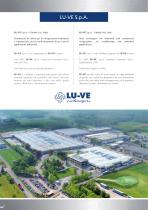
LU-VE S.p.A. LU-VE S.p.A. - Uboldo (Va), Italia Scambiatori di calore per la refrigerazione industriale e commerciale, per il condizionamento d’aria e per le applicazioni industriali. Heat exchangers for industrial and commercial refrigeration, air conditioning and industrial applications. LU-VE S.p.A. è la capogruppo di LU-VE Group. LU-VE S.p.A. is the holding company of LU-VE Group. Nel 1985, LU-VE S.p.A. acquisisce Contardo S.p.A., nata nel 1928. In 1985 LU-VE S.p.A. acquired Contardo S.p.A., established in 1928. Nel 1986 inizia la sua attività produttiva. LU-VE si è distinta e imposta presto...
Open the catalog to page 4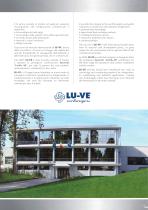
È la prima azienda al mondo ad applicare soluzioni d’avanguardia alla refrigerazione commerciale e industriale: • la tecnologia dei tubi rigati; • la tecnologia delle superfici di scambio specializzate; • la certificazione delle prestazioni; • materiali e colori innovativi; • design avanzato. Il successo sul mercato internazionale di LU-VE, deriva dalla sua politica di ricerca e sviluppo, dal rispetto dei principi fondamentali di salvaguardia dell’ambiente e dall’osservanza di rigorosi principi, etici e commerciali. Nel 2000, LU-VE è stata la prima azienda in Europa a ottenere la prestigiosa...
Open the catalog to page 5
FILOSOFIA / PHILOSOPHY Leadership with passion. LU-VE è questo. È la sintesi di esperienza, tradizione, propensione al futuro e innovazione. Leadership with passion. This sums up LU-VE: a synthesis of experience and tradition with forward thinking and innovation. LU-VE è l’applicazione del principio che le aziende sono, prima di tutto, donne, uomini e idee: persone con una lunga esperienza, giovani dotati di creatività ed entusiasmo, specialisti di altissimo livello accademico, accomunati dalla passione per il proprio lavoro e dalla visione di un mondo più vivibile, avanzato e consapevole. LU-VE...
Open the catalog to page 6
RICERCA & INNOVAZIONE RESEARCH & INNOVATION TECNOLOGIA HITEC® HITEC® TECHNOLOGY L’innovazione costituisce il cardine su cui LU-VE ha costruito la propria leadership: prima al mondo ad applicare la tecnologia dei tubi rigati alla refrigerazione, prima a usare la tecnologia delle superfici di scambio specializzate. Innovation is the cornerstone upon which LU-VE has built its leadership: the first in the world to apply the technology of grooved tubes to refrigeration, the first to use the technology of special heat exchange surfaces. In termini tecnici l’utilizzo dei codici CFD (Computational Fluid...
Open the catalog to page 7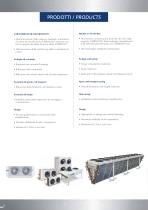
PRODOTTI / PRODUCTS PRODUCT FEATURES • Massimizzazione della potenza mediante scambiatori di calore ad alta efficienza TURBOCOIL® realizzati con tubi a rigatura elicoidale interna e alette TURBOFIN®. • Performance maximisation given by the new high capacity TURBOCOIL® heat exchanger manufactured with internally grooved tubes and TURBOFIN® fins. • Ottimizzazione della ventilazione dello scambiatore di calore. • Heat exchanger ventilation optimisation. • Risparmio nei consumi di energia • Energy consumption reduction • Riduzione della rumorosità • Noise reduction • Riduzione del volume interno...
Open the catalog to page 8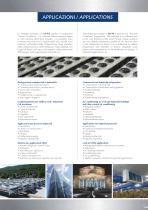
APPLICAZIONI / APPLICATIONS La strategia produttiva di LU-VE applica il programma “Verso l’eccellenza”. Un concetto intrinsecamente legato al core business dell’intero Gruppo, i cui prodotti sono in stretta relazione con la qualità della vita, poiché sono utilizzati nell’ambito della refrigerazione degli alimenti, della climatizzazione, nelle abitazioni, negli ospedali, nei luoghi di lavoro, nei mezzi di trasporto, nella produzione dell’energia, nelle applicazioni industriali ecc. The production strategy of LU-VE is based on its “Towards Excellence” programme. This concept is an inherent part...
Open the catalog to page 9
NORME E GARANZIA STANDARDS AND GUARANTEE NORME Gli apparecchi sono stati progettati e costruiti per poter essere incorporati in macchine come definito dalla Direttiva Macchine 2006/42/CE e successivi emendamenti. The products are provided for incorporation in machines as defined in the EC Machine Directive 2006/42/CE and subsequent modifications. • Direttiva 2004/108/CE e successivi emendamenti. Compatibilità elettromagnetica. • Directive 2004/108/CE and subsequent modifications. Electromagnetic compatibility. • Direttiva 2006/95/CE Bassa tensione. Tutti i nostri prodotti sono costruiti con materiali...
Open the catalog to page 10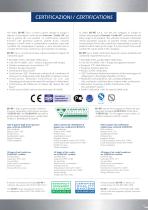
CERTIFICAZIONI / CERTIFICATIONS Nel 2000, LU-VE S.p.A. è stata la prima azienda in Europa a ottenere la prestigiosa certificazione Eurovent “Certify All” per tutta la gamma dei suoi prodotti. La certificazione volontaria Eurovent (che garantisce potenze, portate d’aria, consumi energetici e livelli sonori e caratteristiche costruttive) copre tutti i prodotti che compongono la gamma e viene rilasciata solo se i risultati dei test sono conformi ai valori riportati nel catalogo. In 2000, LU-VE S.p.A. was the first company in Europe to achieve the prestigious Eurovent “Certify All” certification...
Open the catalog to page 11All LU-VE S.p.A. catalogs and technical brochures
 Water Spray System
6 Pages
 Industrial Applications
36 Pages
 Electronic fan speed controllers
16 Pages
 Compact unit coolers for O.E.M.
68 Pages
 Dry Coolers
112 Pages
 Industrial Refrigeration
21 Pages
 Commercial Unit Coolers
92 Pages
 Air-Cooled Condensers
136 Pages
 Industrial Unit Coolers
112 Pages
 DRY and SPRAY
12 Pages