


Jaw

Jaw
This document provides comprehensive information on Lovejoy's Jaw Type Couplings, which are available in numerous bore/keyway combinations for light to heavy-duty applications. These couplings are maintenance-free, resistant to various environmental factors, and offer over 850,000 bore size combinations.
- Torque ratings: 3.5 in-lbs to 170,004 in-lbs.
- Bore range: 0.125 inches to 7 inches.
- Materials: Sintered metal, aluminum, bronze, steel, stainless steel, ductile iron.
- L Type: Standard industrial applications.
- LC Type: Includes snap wrap spider and retaining ring.
- AL Type: Lightweight aluminum hubs.
- SS Type: For harsh environments.
- RRS Type: Easy elastomer installation.
- SW Type: Snap wrap elastomer.
- C & H Types: Medium and heavy-duty applications.
- Solid Center Spider: Standard gap separation.
- Open Center Spider: Short distance positioning.
- Cushions: For C and H Type couplings.
- Snap Wrap Flexible Spider: Easy removal.
- SOX (NBR) Rubber: Flexible, oil-resistant.
- Urethane: High torque, chemical resistance.
- Hytrel: High torque and temperature.
- Bronze: Low-speed applications.
- Calculate Nominal Torque: (HP x 63025) / RPM.
- Select service factor from chart.
- Calculate Design Torque: Nominal Torque x Service Factor.
- Select elastomer using performance data chart.
- Ensure coupling bore size fits shaft diameters.
Follow safety instructions to prevent injury, adhering to OSHA and ASME standards.
- Nominal Torque: 700.28 in-lb.
- Service Factor: 1.25 for electric motor driving rotary pump.
- Design Torque: 875.35 in-lb.
- Elastomer: NBR for 72°F and <1° misalignment.
- Coupling Size: L190 for 2.125-inch bore.
- Specific UPC numbers for L190 spider and hubs.
- Service Factors Chart: Importance of correct factor selection.
- Spider Performance Data Chart: Elastomer characteristics.
- Jaw Nominal Rated Torque Data: Aids in coupling size selection.
- Ensure coupling size fits shaft sizes.
- Match operating conditions with elastomer specifications.
- Consult Lovejoy Engineering for reciprocating engines.
- AL and SS Type Couplings: AL is lightweight, SS offers rust protection.
- RRS and RRSC Type Couplings: Radially removable spacer couplings.
- C Type Couplings: Greater torque and bore capacity.
- H Type Couplings: Includes inside sleeves, greater capacity.
- RRC Type Couplings: Hub adapters and spacer assembly.
- UPC prefix: 685144 for components.
- Engineering data available in document sections.
- Horsepower and torque ratings at varying RPMs.
- Dimensional data for each coupling type.
- Elastomer information: Solid center, open center, snap wrap spiders.
- Applicability of configurations.
- Ordering special lengths.
- Additional performance data references.
Catalog excerpts

■■ RRS and RRSC Types - Spacer ■■ C and H Type - Medium / Heavy Duty
Open the catalog to page 1
Safety Warning When using Lovejoy products, you must follow these instructions and take the following precautions. Failure to do so may cause the power transmission product to break and parts to be thrown with sufficient force to cause severe injury or death. Refer to this Lovejoy Catalog for proper selection, sizing, horsepower, torque range, and speed range of power transmission products, including elastomeric elements for couplings. Follow the installation instructions included with the product, and in the individual product catalogs for proper installation of power transmission products....
Open the catalog to page 2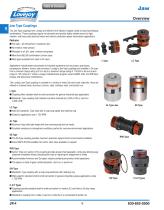
The Jaw Type couplings from Lovejoy are offered in the industry’s largest variety of stock bore/keyway combinations. These couplings require no lubrication and provide highly reliable service for light, medium, and heavy duty electrical motor and internal combustion power transmission applications. ■■No metal to metal contact ■■Fail-safe – will still perform if elastomer fails ■■Resistant to oil, dirt, sand, moisture and grease ■■Most types available from stock in 24 hours L Type ■■ oupling offers standard shaft-to-shaft connection for general industrial duty applications C The Lovejoy Jaw Type...
Open the catalog to page 4
Lovejoy offers four types of elastomer designs to allow for additional flexibility in addressing specific application requirements. One piece designs are used in the “L” and “AL” models (referred to as spiders) and multiple part “load cushions” are used in the “C” and “H” model couplings. The load cushions are in sets of 6 to 14 pieces depending on coupling size. Solid Center Spider ■■The solid center design is commonly used design when shafts of the driver and driven equipment can be kept separate by a standard gap Open Center Spider ■■The open center design allows for the shafts of the driver...
Open the catalog to page 5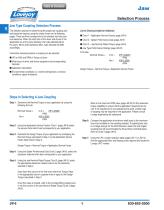
The selection process for determining the proper jaw coupling size and elastomer requires using the charts shown on the following pages. There are three components to be selected, two hubs and one elastomer. When the shaft size of the driver and driven of the application are of the same diameter, the hubs selected will be the same. When shaft diameters differ, hubs selected will differ accordingly. Jaw Type Coupling Selection Process JW Selection Process List of Charts provided for Selection: ■■Chart 1 – Application Service Factors (page JW-8) ■■Chart 2 – Spider Performance Data (page JW-9) ■■Chart...
Open the catalog to page 6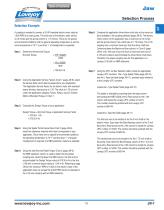
Selection Example Step 7: Using the UPC number Selection table, locate the appropriate Lovejoy UPC numbers. The L Type Spider Table (page JW-10), and the L Type hub table (page JW-11), provides easy reference to the Lovejoy UPC numbers. Step 3: Calculate the Design Torque of your application: Design Torque = Nominal Torque x Application Service Factor = 700.28 x 1.25 = 875.35 in-lb Locate the L Type Spider Table (page JW-10). The spider is selected by scanning down the type column and locating the NBR (Solid) entry. Read across to the L190 column and locate the Lovejoy UPC number of 12274. This...
Open the catalog to page 7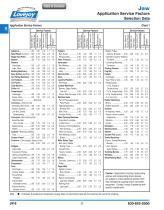
Lovejoy Coupling Solutions Jaw Application Service Factors Selection Data Application Service Factors Chart 1 Service Factors Service Factors Service Factors Caution: Applications involving reciprocating engines and reciprocating driven devices are subject to critical rotational speeds which may damage the coupling and/or connected equipment. Contact Lovejoy Engineering with specific requirements. Note: ■ 1 indicates: If people are transported, Lovejoy does not recommend and will not warranty the use of the coupling.
Open the catalog to page 8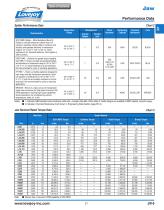
Lovejoy Coupling Solutions Data Chart 2 Temperature Characteristics Range Notes: ■ 1 indicates: NBR standard shore hardness is 80A ±5A - Except L035=60A. Other softer or harder designs are available in NBR material; consult Lovejoy. ■ 2 indicates: Chemical Resistance chart shown in Engineering Data Section (page ED-9). Chart 3 Jaw Nominal Rated Torque Data Max Bore Note: ■ Bronze has a maximum RPM capability of 250 RPM. www.lovejoy-inc.com 21 JW
Open the catalog to page 9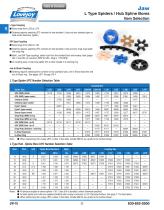
Lovejoy Coupling Solutions Jaw L Type Spiders / Hub Spline Bores Item Selection L Type Coupling ■ Sizes range from L035 to L276 ■ Ordering requires selecting UPC numbers for two standard L hubs and one standard open or solid center elastomer (spider) SW Type Coupling ■ Sizes range from L090 to L190 ■ Ordering requires selecting UPC numbers for two standard L hubs and one snap wrap spider with snap ring ■ Both L and SW Type couplings, select hubs from the standard bore and keyway chart (pages JW-11 and JW-12) maximum RPM forSW + Ring is 1,750 RPM ■ LC coupling uses a snap wrap spider with a collar...
Open the catalog to page 10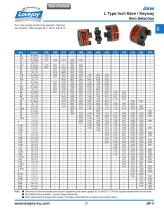
Coupling Solutions Jaw L Type Inch Bore / Keyway Item Selection The L Type coupling consists of two standard L Type hubs and one spider. Refer to pages JW-11, JW-12, and JW-10. Bore
Open the catalog to page 11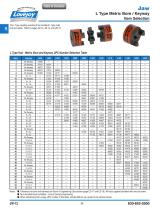
Jaw L Type Metric Bore / Keyway Item Selection The L Type coupling consists of two standard L Type hubs and one spider. Refer to pages JW-10, JW-12, and JW-10. L Type Hub - Metric Bore and Keyway UPC Number Selection Table Bore
Open the catalog to page 12
Love/oy Coupling Solutions LC Type / Inch Bore / Keyway Item Selection LC Type Couplings The LC Type coupling consists of one standard L Type hub (without collar attachment), one LC Type hub (provides collar attachment), one standard snap wrap center and one collar with screws. Refer to pages JW-11, JW-12 and JW-13 for details. Features ■ Radially removable insert ■ Collar allows for maximum speed of 3,600 RPM ■ Collar manufactured from 1018 Steel Notes: ■ These “LC” hubs are drilled and tapped to accept collar mounting screws but the collar and hardware are not included. ■ See L Type (inch or...
Open the catalog to page 13
LC Type Spiders / Metric Bore / Keyway The LC Type coupling consists of one standard L Type hub (without collar attachment), one LC Type hub (provides collar attachment), one standard snap wrap center and one collar with screws. Refer to pages JW-11, JW-12 and JW-13 for details. Item Selection ■■Radially removable insert Features ■■Collar allows for maximum speed of 3,600 RPM ■■Collar manufactured from 1018 Steel LC Type Wrap Spider / Collar UPC Number Selection Table LC099 Snap Wrap Spider/No Ring Collar Only w/Screws LC Type Hub - Metric Bore and Keyway UPC Number Selection Table Notes: n 1...
Open the catalog to page 14All Lovejoy catalogs and technical brochures
 Torsional
42 Pages
 HercuFlex Gear Couplings
28 Pages
 Lovejoy Hydraulics
24 Pages
 RunRight by Lovejoy Catalog
68 Pages
 HercuFlex Couplings Catalog
28 Pages
 QUICK FLEX® Couplings
56 Pages
 Grid catalog
19 Pages
 High Performance Gear Catalog
20 Pages
 4 BOLT DISC COUPLING
2 Pages
 Disc
Disc28 Pages
 Universal Joints Catalog
12 Pages
 Specialty Products Catalog
28 Pages
 Curved Jaw Couplings Catalog
22 Pages
 Stainless Steel Jaw Catalog
2 Pages
 Complete Lovejoy Catalog
522 Pages
 HydraulicReservoir
24 Pages
 LH COUPLINGS
2 Pages
 Motion Control Catalog
22 Pages
 Jaw In-Shear
8 Pages
 4 Bolt Disc Catalog
2 Pages
 Disc Catalog
28 Pages
 Jaw Type Catalog
28 Pages
 Lovejoy / Sier-Bath Gear Catalog
78 Pages
 FARR Gear Catalog
7 Pages
 Stainless Steel Jaw
2 Pages
 Torsional catalog
42 Pages
 Specialty catalog
28 Pages
 Universal Joint catalog
12 Pages
 BNZ Cooler Catalog
32 Pages
 Pump/Motor Mount Catalog
24 Pages
 Shaft Locking Devices catalog
24 Pages
 Motion Control Couplings
22 Pages
 Gear catalog
78 Pages
 Curved Jaw catalog
22 Pages
 Jaw In-Shear catalog
8 Pages
 L-LOC Clamp Feature
1 Page


Archived catalogs
 RunRight Products Catalog
68 Pages
 Jaw Coupling
28 Pages
 S-Flex
22 Pages
 Full Line Catalog
56 Pages
 S-Flex catalog
22 Pages
 Engineering Data
24 Pages
 FARR Rigid Couplings
6 Pages

- Fitting
- Hydraulic fitting
- Vessel
- Metal fitting
- Heat exchanger unit
- Flexible coupling
- Shaft shaft coupling
- Industrial tank container
- Vertical tank
- Liquid/liquid heat exchanger
- Flange coupling
- Anti-vibration mount
- Torque coupling
- Tubular heat exchanger
- Rigid coupling
- Zero-backlash shaft coupling
- Transmission coupling
- Metal anti-vibration mount
- Sleeve coupling
- Compact coupling