1. Catalogs
  2. LMT Tools
  3. Threading - Tools and Knowledge Catalog
video corpo

Threading - Tools and Knowledge Catalog

Threading - Tools and Knowledge Catalog
1 / 208 PagesView full catalog

Threading - Tools and Knowledge Catalog

Product catalog summary
Overview: The document is a technical guide from LMT Tools, focusing on selecting the right tap for threading applications. It provides a structured approach to choosing the appropriate tool based on material and thread type, along with detailed product specifications and industry solutions.
Specifications and Material Selection: The guide begins with a list of materials, helping users identify the processed material starting from page 10. It includes material group numbers and characteristics, such as strength and hardness. An example is provided for material 1.4460, highlighting its application in stainless steel threading.
Hole and Thread Type: This section guides users to the appropriate pages for descriptions of different hole and thread types, such as through-hole threads. It emphasizes the importance of selecting the correct type based on material group and thread specifications.
Product Details: Detailed information about specific products, including article numbers and type descriptions, is provided. The guide highlights the importance of considering chamfer form, thread depth, and tolerances when selecting taps.
Company Overview: LMT Tools is introduced as a leading expert in precision tool development and production. The company offers a wide range of standard and special tools, focusing on milling, tapping, rolling systems, gear cutting, and advanced tooling.
Global Presence: LMT Tools has production sites in Germany, the USA, and India, with sales representations across Europe, the Americas, and the Asia-Pacific region, ensuring worldwide customer support.
Industry Solutions: The document outlines LMT Tools' solutions for various industries, including transportation, stationary applications, mould and die, pump and valve, and general machining.
Training and Knowledge Transfer: LMT Tools offers training through its Academy, providing theoretical and practical knowledge to employees and customers. Training includes webinars and live sessions conducted by industry experts.
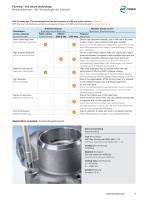
Forming Technology: The guide discusses the advantages of thread forming technology, such as higher thread strength, improved wear resistance, and better corrosion resistance. It details the application range and features of forming taps, emphasizing the benefits of the HPF Max former over solid thread formers.
Overview of High Performance Forming (HPF Max): This document provides a detailed overview of the High Performance Forming (HPF Max) technology, highlighting its advantages, features, and applications. It emphasizes the future potential of forming technology in machining processes.
Advantages for Customers:
  • Solid Forming Tap and Modular Thread Former: These tools offer flexibility and efficiency in machining.
  • Short Machining Times: Achieved through high peripheral speeds and the use of wear-resistant carbide inserts.
  • High Process Reliability: Ensured by a steel main body with high torsional stiffness and a stable connection between the main body and insert.
  • Maximum Service Life: Enhanced by a carbide insert with a high-performance TiCN Plus PVD multilayer coating.
  • High Flexibility: The replaceable forming head allows for multiple thread sizes and tolerances on one main body.
  • Resource Saving: Only the carbide forming head is replaced at the end of its service life, not the entire tool.
  • Cost Minimization: Achieved by reducing stock and work-in-progress inventory.
Application Example: The document provides an example of general machining using the HPF Max Forming tap 6095, M8 x 1.25, with TiCN Plus coating on die-cast aluminium AlSi8Cu3, highlighting specific cutting data and coolant usage.
Material Explanation: The document categorizes materials into six main classes: Steel, Stainless Steel, Cast Iron, Non-ferrous Metals, Titanium/Super Alloys, and Chilled/Hardened Steel. Each class is further divided into subclasses based on specific characteristics such as strength and hardness.
Material Classification: A detailed list of materials is provided, including their DIN descriptions, material numbers, and characteristics. This classification aids in selecting the appropriate materials for specific machining applications.
Key Sections:
  • Free Cutting Steel: Includes cold-drawn, tempered, and untreated variants with strengths ranging from 590 N/mm² to 980 N/mm².
  • Carbon Steel: Covers untreated and low-temperature variants with strengths from 400 N/mm² to 700 N/mm².
  • Spring Steel: Features high-strength materials with strengths up to 1010 N/mm².
  • Nitriding Steel: Noted for its high strength, up to 1000 N/mm².
  • Fine-Grained Cold-Pressure Steel: Includes several grades with strengths ranging from 540 N/mm² to 750 N/mm².
  • Cast-Steel: Includes untreated and case-hardened variants with strengths up to 700 N/mm².
  • Case-Hardened Steel: Features untreated and case-hardened variants with strengths up to 880 N/mm².
  • Heat-Treated Steel: Includes soft-annealed and alloyed variants with strengths up to 1000 N/mm².
  • Tool Steel: Covers a wide range of alloyed and soft-annealed variants with strengths up to 900 N/mm².
  • Stainless Steel: Includes ferritic stainless steel with high strength.
  • High-Speed Steel: Features high-strength materials with hardness up to 300 HB.
Critical Information: The document highlights the mechanical properties of each steel type, including tensile strength and hardness, which are crucial for selecting the appropriate material for specific applications. It also categorizes steels based on their treatment processes, such as cold-drawing, tempering, and annealing, which affect their performance characteristics.
Nickel Alloys: The document lists several nickel alloys, each identified by a unique material number. Key characteristics include their composition (e.g., NiCr, NiCo, NiMo) and tensile strength, which ranges from below 900 N/mm² to over 1400 N/mm². Notable alloys include Udimet 700, Waspaloy, Inconel series, and Hastelloy.
Aluminum Alloys: Aluminum alloys are categorized by their material numbers and compositions, such as AlMn, AlMg, and AlCu. These alloys are described as either long or short chipping, with tensile strengths ranging from 110 N/mm² to 600 N/mm². The document includes both wrought and cast aluminum alloys.
Titanium Alloys: Titanium alloys are listed with their respective material numbers and compositions, such as TiAl, TiCu, and TiV. Their tensile strengths vary widely, with some alloys exceeding 1300 N/mm². These alloys are used for their high strength-to-weight ratio and corrosion resistance.
Plastics: The document also includes thermoplastic and thermosetting plastics, such as polyamide, polycarbonate, and epoxy resins. These materials are characterized by their chipping behavior (long or short) during machining.
Tool Steels: Various tool steels are listed, identified by their material numbers and compositions, such as CrMo and CrMn. These steels are noted for their hardness and are used in applications requiring wear resistance and toughness.
Conclusion: This document serves as a reference for selecting materials based on their mechanical properties and compositions, suitable for various industrial applications.
Material Specifications: The document provides a comprehensive list of materials according to DIN standards, detailing their group, DIN and DIN EN numbers, Werkstoffnummer (W.-Nr.), strength/hardness, and characteristics. The materials are categorized into groups such as M1, M2, P2, P3, and S1, with specific examples including stainless steel (austenitic, martensitic, ferritic), tool steel, valve steel, and high-quality heat-resistant steel. Each material entry includes its specific composition and mechanical properties, such as tensile strength or hardness.
Threading Tools for Steel: The document outlines various threading tools for steel, categorized by material group and tensile strength. It includes specifications for through hole and blind hole threads, with details on dimensions, helix angles, and coatings. The tools are designed for different steel types, including those with tensile strengths below 500 N/mm², between 500-1000 N/mm², and above 1000 N/mm². Specific tap types like Rasant® and Markant® are mentioned, highlighting their applications and performance characteristics.
Tool Descriptions and Applications: Detailed descriptions of tap types are provided, including their dimensions, helix angles, and coatings. The document specifies the applications of these tools in various steel types, such as alloyed and unalloyed carbon steel, free cutting steel, and cast steel. It also mentions the use of high-performance taps with specific coatings for enhanced tool life and process reliability.
Technical Data and Catalog Information: The document includes technical data such as thread depth, chamfer, tolerance, helix, and coating types. It provides catalog numbers for easy reference and ordering. The tools are categorized by their primary and secondary applications, with recommended cutting speeds for different steel types.
Specifications: The catalog lists machine taps with various dimensions and thread types, including M (metric), UNF (Unified Fine), and G (BSP). Each entry includes parameters such as diameter (d1), pitch (P), length (l1, l2, l3), and shank type (reinforced or standard).
Material Compatibility: The taps are categorized based on their suitability for different materials:
  • Steel: Suitable for steel with tensile strength <500 N/mm², 500-1000 N/mm², and >1000 N/mm².
  • Stainless Steel: Includes austenitic and martensitic types.
  • Cast Iron: Grey and nodular cast iron.
  • Aluminum & Copper Alloys: Long and short chipping with varying silicon content.
  • Titanium Alloys: Medium and high strength.
  • Hardened Steel: Chilled and hardened steel with 45-55 HRC.
Performance Recommendations: The document provides cutting speed recommendations (vc) for each material type, indicating primary (◼) and secondary (◻) applications.
Product Features:
  • Rasant® Steel: High-speed steel (HSS) with TiCN coating, designed for efficient chip removal and long tool life.
  • Markant® INOX: Features controlled chip flow and specific geometry for stainless steel and titanium, recommended with cutting oil for optimal performance.
Additional Notes: The catalog includes a guide for selecting taps for stainless steels, emphasizing the importance of using cutting oil to enhance tool life and process reliability.
Specifications: The document outlines various types of machine taps, including Markant® and Rasant®, with specifications such as depth of thread (3×D, 2–3), chamfer (0°, 45°), and material (HSS-E). It also provides details on the coating (Novalis INOX) and type (B ISO2, C ISO2).
Applications: The taps are categorized based on their primary and secondary applications. For instance, they are suitable for different types of steel (P1, P2, P3), stainless steel (M1, M2), cast iron (K1, K2), aluminum and copper alloys (N1, N2, N3), graphite (N4), titanium alloys (S1, S2), and hardened steel (H1).
Performance Parameters: The document specifies cutting speeds (vc) for various materials, such as 20–25 m/min for steel <500 N/mm² and 10–15 m/min for austenitic stainless steel.
Product Variants: Different product variants are listed with their respective dimensions, such as M3 to M20 for reinforced straight shank taps and UNF sizes for standard straight shank taps.
Cast Iron Taps: The document also covers taps for cast iron, detailing through hole and blind hole threads for grey and nodular cast iron. It describes the modular XChange tap with a carbide head and steel shank for high cutting speed and maximum tool life.
Type Descriptions: The document includes descriptions of various tap types, such as the XChange tap with patented interface and the HSS-E-PM tap with AL2 Plus coating, suitable for both through and blind hole threads.
Specifications: The document lists machine taps suitable for different materials such as steel, stainless steel, cast iron, aluminum, copper alloys, graphite, and titanium alloys. Each material type is associated with specific cutting speeds (vc) and tap dimensions.
Product Types: The document categorizes taps into different series, such as Markant® and XChange, each with unique features like reinforced shanks or indexable nib sets. The XChange series is highlighted for its versatility and adaptability with different shank sizes and configurations.
Technical Details: Detailed tables provide dimensions for each tap type, including thread size, length, diameter, and shank description. The document also specifies the recommended cutting speeds for various materials, indicating primary and secondary applications.
Recommendations: The document suggests using specific tap types for different materials based on their hardness and chipping characteristics. It also provides torque specifications for TorqueFix screwdrivers used with these taps.
Additional Information: References to spare parts and additional accessories are included, with instructions to consult further pages for more details. The document emphasizes the importance of selecting the correct tap type and configuration for optimal performance and tool life.
Specifications: The document provides detailed specifications for various types of forming taps and thread milling cutters. It includes information on materials such as titanium alloys, stainless steels, and cast irons, with specific tensile strengths and hardness levels. The document also specifies recommended cutting speeds for different materials.
Procedures: It outlines the procedures for using solid carbide indexable nib sets and forming taps, emphasizing the importance of proper lubrication. The document recommends using highly activated cutting oils or pastes and provides guidelines for mixing ratios of emulsions.
Standards and Recommendations: The document references standards such as ASME-B1.1 for UNF threads and provides recommendations for drill sizes. It also highlights the use of TiCN coating for improved tool life and performance.
Product Features: The HPF Max forming taps are highlighted for their modular design, allowing for easy tool head changes without replacing the entire tool. The document emphasizes the benefits of using HPF Max, including longer tool life, faster machining times, and resource efficiency.
Application Examples: Several application examples are provided, demonstrating the cost-effectiveness and efficiency of using HPF Max forming taps in various industrial settings. The document includes a success story showcasing significant improvements in tool life and production cost savings.
Tables and Data: The document contains tables listing various thread sizes, dimensions, and identification numbers for different products. Key data includes nominal sizes, shank dimensions, and recommended drill sizes.
Conclusion: The document concludes with a focus on the advantages of using HPF Max forming taps, including their suitability for large-series production and mechanical engineering applications. It also stresses the importance of proper lubrication to enhance tool performance and longevity.
Overview: The document provides detailed specifications and descriptions of various thread milling cutters and combined drilling and threading milling cutters. These tools are designed for creating internal threads and are made from solid carbide, allowing for operations such as drilling, threading, and countersinking in a single step without the need for tool changes.
Specifications: The document lists different types of thread milling cutters, including those suitable for left- and right-hand threads, blind and through-hole threads, and those with a 45° chamfer. The tools are categorized by their nominal sizes, thread pitches, and other dimensions, with specific catalog numbers and LMT codes provided for each type.
Materials and Applications: The tools are suitable for a variety of materials, including different types of steel, stainless steel, cast iron, aluminum and copper alloys, graphite, and titanium alloys. The document specifies the appropriate cutting speeds (vc) and feed rates (fz) for each material type.
Technical Data: Detailed tables provide information on the dimensions and tolerances of the tools, including thread depth, chamfer, and coating types. The document also includes recommended torque values for tapping and forming operations, as well as recommended drill sizes for tapping and forming taps.
Additional Information: The document contains sections on the explanation of LMT codes, tolerance limits for taps, torque and power calculations, and recommended core hole diameters. It also includes conversion tables, hardness comparison charts, and troubleshooting guides for common issues with taps.
Overview: The document provides a comprehensive overview of various thread types used in Germany, detailing their specifications, applications, and standards. It includes metric ISO trapezoidal threads, knuckle threads, and other specialized threads for different engineering applications.
Specifications: The document outlines the specifications for metric ISO trapezoidal threads according to DIN 103, including formulas for calculating dimensions such as H1, H4, and h3. It also covers knuckle threads as per DIN 405, providing details on dimensions like d2, d3, and r.
Thread Types and Applications: A detailed list of threads used in Germany is provided, including their designations, nominal diameter ranges, and applications. Examples include metric ISO threads for precision engineering, aeronautics, and general use, as well as specialized threads for rail vehicles, plastic containers, and hydraulic presses.
Standards and Norms: The document references various DIN standards applicable to each thread type, ensuring compliance with German engineering norms. It includes standards for both common and less popular thread types, such as cylindrical round threads and tapered Whitworth threads.
Key Data from Tables: The tables in the document list thread designations, profiles, nominal diameter ranges, and applications. They provide a quick reference for engineers to select the appropriate thread type for specific applications, ensuring compatibility and performance.
Recommendations: The document suggests using specific thread types based on application requirements, such as using metric ISO threads for precision engineering and buttress threads for mining applications. It also highlights the importance of adhering to DIN standards for quality assurance.
Overview: The document provides technical specifications, procedures, and solutions related to various types of taps and threading tools, particularly focusing on the V-Magic and VR15 types. It includes details on manufacturing processes, common problems, and solutions for regrinding taps and forming taps.
Specifications and Specialities:
  • V-Magic: Features a rake angle vaporized to create short swarf, with a recommendation to change from a 40° tap to a 15° tap and use a negative chamfer.
  • VR15: Includes a negative chamfer in the chamfer area, with manufacturing involving grinding based on a sketch and subsequent deburring.
Common Problems and Solutions:
  • Regrinded Taps: Issues such as thread oversize, narrow threads, and rough surfaces are addressed by removing burrs, checking geometry, and replacing taps if necessary.
  • Forming Taps: Problems like incomplete thread formation and material sticking are solved by adjusting pre-drill diameters, improving coolant/lubrication, and using coated forming taps.
Manufacturing and Standards:
  • Details on manufacturing processes for coated and uncoated taps, including grinding and deburring.
  • Standards for shanks and cutting edges, including DIN specifications and tolerance classes.
Materials and Coatings:
  • Information on cutting materials such as solid carbide and high-speed steel, along with various coatings like TiCN and Vap Novalis.
Additional Information:
  • Pictogram overview of cutting materials, cooling methods, and thread types.
  • Contact information and links to further product catalogs and brochures.
See more

Catalog excerpts

Threading - Tools and Knowledge Catalog-1

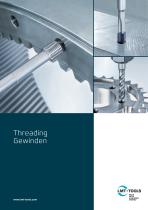
ThreadingGewinden www.lmt-tools.com

 Open the catalog to page 1

Threading - Tools and Knowledge Catalog-2

LMT Guide – 4 steps to find the right tap LMT Guide – 4 Schritte zum richtigen Gewindebohre

 Open the catalog to page 2

Threading - Tools and Knowledge Catalog-3

LMT Guide - 4 steps to find the right tap LMT Guide - 4 Schritte zum richtigen Gewindebohrer Example: Material 1.4460, M10, Through hole thread, 6H, 3xD Beispiel: Werkstoff 1.4460, M10, Durchgangsgewinde, 6H, 3xD List of material: Find your processed material starting page 10 with material group and page number (see example). Werkstoffliste: Finden Sie Ihren zu bearbeitenden Werkstoff ab Seite 10 mit Werkstoffgruppe und Seitenzahl (siehe Beispiel). Product page: Here you will find the details and article numbers to the desired type. Produktseite: Hier finden Sie alle Infos und Bestellnummern...

 Open the catalog to page 3

Threading - Tools and Knowledge Catalog-4

Imprint Publisher: LMT Tools Global Operations GmbH & Co. KG, Vogesenstrasse 23, 77933 Lahr, Germany, Phone: +49 78 21 943-0 Responsible according to the press law.: Jörn Grindel Design: deckermedia GbR, Graal-Müritz Printed by: Druckerei Weidner GmbH, Rostock For readability reasons, the masculine form is used for personal designations and personal nouns for a general understanding. Corresponding terms apply to all genders for the purpose of equal treatment. Impressum Herausgeber: LMT Tools Global Operations GmbH & Co. KG, Vogesenstrasse 23, 77933 Lahr, Deutschland: +49 78 21 943-0 Verantwortlich...

 Open the catalog to page 4
Threading - Tools and Knowledge Catalog-5

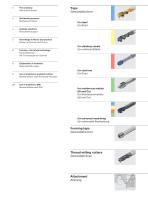
TapsGewindebohrer 3 Worldwide presence Weltweite Prasenz 4 Industry solutions Branchenlosungen 5 Knowledge in theory and practice Wissen in Theorie und Praxis 6 Forming - the future technology Gewindeformen -Die Technologie der Zukunft for stainless steels fur rostfreie Stahle 8 Explanation of materials Materialerklarungen 9 List of material to material number Werkstoffliste nach Werkstoff-Nummer for cast iron fur Guss 26 List of material to DIN Werkstoffliste nach DIN for nonferrous metals (Al and Cu) fur Nichteisenmetalle (Al und Cu) for universal machining fur universelle Bearbeitung Forming...

 Open the catalog to page 5

Threading - Tools and Knowledge Catalog-6

The company Das Unternehmen LMT Tools is one of the most renowned experts in the development and production of precision tools. Our passion for precision ensures that our industrial customers implement unparalleled quality at the interface between the machine and the workpiece. We offer an extensive product range of standard and special tools focusing on milling and tapping, rolling systems, gear cutting and advanced tooling. LMT Tools ist einer der renommiertesten Experten fur die Entwicklung und Produktion von Prazisionswerkzeugen. Unser leidenschaftlicher Einsatz fur Prazision sorgt dafur,...

 Open the catalog to page 6

Threading - Tools and Knowledge Catalog-7

• LMT Tools production sites: Germany: Lahr, Schwarzenbek India: Pune Deutschland: Lahr, Schwarzenbek USA: Waukegan Indien: Pune Europe: Czech Republic, France, Germany, Italy, Romania, Russia, Spain, United Kingdom. Americas: Brazil, Mexico, USA. Asia-Pacific: China, India, Korea. Europa: Deutschland, Frankreich, Italien, Rumanien, Russland, Spanien, Tschechische Republik, Vereinigtes Konigreich. Amerika: Brasilien, Mexiko, USA. Asien-Pazifik: China, Indien, Korea. Contact us and our experts: www.lmt-tools.com Nehmen Sie Kontakt zu uns und unseren Experten auf: www.lmt-tools.com

 Open the catalog to page 7

Threading - Tools and Knowledge Catalog-8

Industry solutions Branchenlosungen The key element of the services at LMT Tools is our eye for detail and passion for precision to help our customers implement their visions, ideas and needs. We see precision tools as the key to bringing ideas to life. These ideas then go on to become market successes, driven forward by efficiency and innovative power. The extensive product range combines the competence of the LMT Belin, LMT Fette, LMT Kieninger and LMT Onsrud brands. It offers perfect solutions for various applications in different industries: ■ Transportation & Transmission: automotive, trucks,...

 Open the catalog to page 8

Threading - Tools and Knowledge Catalog-9

Knowledge in theory and practice Wissen in Theorie und Praxis Our Academy is the central training and further education unit of the corporate group. At the LMT Tools Training Center, holistic knowledge in theory and practice is passed on to our employees and customers worldwide in order to quickly provide knowledge in response to continuous global market changes in products and production processes. Unsere Academy ist die zentrale Schulungs- und Weiterbildungseinheit der Unternehmensgruppe. Im LMT Tools Training Center wird ganzheitliches Wissen in der Theorie und Praxis weltweit an unsere Mitarbeiter...

 Open the catalog to page 9

Threading - Tools and Knowledge Catalog-10

Forming - the future technology Gewindeformen - Die Technologie der ZukunftAdvantages: ■ The micro structure of the material is not cut, but is reshaped and compacted by the thread forming process. - Higher thread strength and component reliability - Harder thread surfaces - Greater profile precision - Polished thread faces - Improved wear resistance - Better corrosion resistance ■ Maximum process security - as chips are not created, chip packing cannot occur ■ Longer tool life and fewer tool changes ■ Higher process speeds ■ No scrap threads when the pilot hole diameter is correct ■ No axial...

 Open the catalog to page 10
Threading - Tools and Knowledge Catalog-11

Forming - the future technology Gewindeformen - Die Technologie der ZukunftHPF-Forming tap: The advantages and the performance of HSS and solid carbide in one tool HPF-Former: Die Vorteile und das Leistungsvermogen von HSS und Vollhartmetall in einem Werkzeug Advantages for the customer Tool Werkzeuge: HPF Max Forming tap 6095, M8 x 1.25 HPF Max Gewindeformer 6095, M8 x 1,25 Coating Beschichtung: TiCN Plus Die cast aluminium AlSi8Cu3 Aluminium-Druckguss AlSi8Cu3 Cutting data Schnittwerte: Coolant Kuhlung:

 Open the catalog to page 11

Threading - Tools and Knowledge Catalog-12

Explanation of materials Materialerklarungen Material group Werkstoffgruppe

 Open the catalog to page 12
Threading - Tools and Knowledge Catalog-13

List of material to material number Werkstoffliste nach Werkstoff-Nr. The materials are divided into 6 upper classes at LMT: P = Steel, M = Stainless steel, K = Cast iron, N = Non-ferrous metals, S = Titanium/Super alloys, H = Chilled steel + hardened steel. This upper classes are also divided into subclasses (e. g. P1 = Steel < 500 N/mm2 etc.), an overview of this material classifications can be found on the page 12. Die Materialien sind bei LMT in 6 Oberklassen eingeteilt: P = Stahl, M = Rostfrei, K = Guss, N = Nichteisenmetalle, S = Titan/Superlegierungen, H = Hartguss + Harte Stahle. Diese...

 Open the catalog to page 13

All LMT Tools catalogs and technical brochures
*Prices are pre-tax. They exclude delivery charges and customs duties and do not include additional charges for installation or activation options. Prices are indicative only and may vary by country, with changes to the cost of raw materials and exchange rates.