Overview: The document is a comprehensive product catalog for SIDACtor® Protection Thyristors by Littelfuse, Inc., focusing on semiconductor products designed to protect telecom equipment from transient conditions. It includes specifications, applications, compliance information, and guidelines for various SIDACtor series.
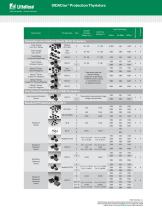
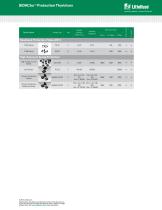
Specifications: The catalog details multiple SIDACtor series, including package types, standoff voltages (VDRM), switching voltages (VS), and peak pulse ratings. These devices comply with RoHS and UL standards, ensuring environmental and safety compliance.
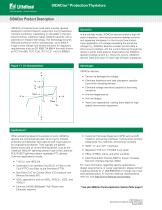
Product Description: SIDACtor devices are solid-state crowbar devices that protect telecom equipment by simulating a short circuit during overvoltage conditions. They handle surge currents up to 5000A and comply with standards such as GR 1089, TIA-968-A, ITU-T K.20, K.21, and UL 60950-1.
Operation: In standby mode, SIDACtor devices have high off-state impedance, preventing leakage currents. When the voltage exceeds the switching voltage, they enter a protective mode, crowbarring the circuit until the current drops below the holding current, at which point they reset.
Advantages: SIDACtor devices are robust against voltage damage, eliminate hysteresis and heat dissipation, and have low capacitance, making them suitable for high-speed transmission equipment.
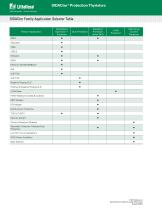
Applications: These devices are used in various telecom applications, including T1/E1/J1, SLIC in FTTC and FTTP, xDSL applications, Ethernet systems, and customer premises equipment like VoIP and modems.
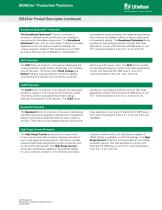
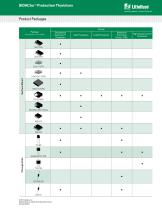
Product Families: The catalog describes several product families, each tailored for specific protection needs: Broadband Optimized, SLIC, LCAS, Baseband, and High Surge Current Protection. Each family addresses different regulatory and performance requirements.
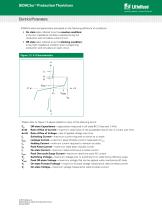
Construction and Operation: SIDACtor devices use a thyristor structure to provide precise overvoltage protection with low voltage overshoot and high surge current capabilities. Key parameters include VDRM, IDRM, VS, IH, and VT.
Compliance and Recommendations: The document emphasizes compliance with environmental and safety standards and provides guidelines for PCB layout and soldering for optimal device performance.
Overview of SIDACtor Devices: SIDACtor devices are bidirectional thyristors used for overvoltage protection. They operate by switching from a high to low impedance state when the voltage exceeds a certain threshold, allowing them to protect circuits from voltage spikes.
Key Specifications: The document outlines several electrical parameters including:
- VDRM (Peak Off-state Voltage): Maximum voltage while maintaining off state.
- VS (Switching Voltage): Voltage prior to switching to on state.
- IH (Holding Current): Minimum current to maintain on state.
- IPP (Peak Pulse Current): Maximum rated peak impulse current.
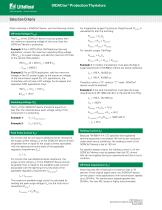
Selection Criteria: When selecting a SIDACtor device, consider:
- Off-state Voltage (VDRM): Must be greater than the maximum operating voltage of the circuit.
- Switching Voltage (VS): Should be equal to or less than the peak voltage rating of the component it protects.
- Peak Pulse Current (IPP): Should be greater than or equal to the surge currents from regulatory tests.
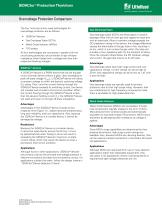
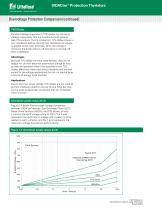
Comparison with Other Technologies: The document compares SIDACtor devices with Gas Discharge Tubes (GDTs), Metal Oxide Varistors (MOVs), and TVS diodes, highlighting their respective advantages and applications.
Applications: SIDACtor devices are primarily used in telecommunications and data communications circuits for overvoltage protection.
Quality and Reliability Assurance: Littelfuse emphasizes quality through management leadership, continuous improvement, and mutually beneficial supplier relationships.
Quality Assurance and Testing Procedures: Littelfuse employs rigorous quality assurance processes to ensure product reliability and compliance with specifications. This includes incoming material inspections, process controls using statistical methods, parametric testing, and final inspections. Reliability testing is conducted on random samples, and finished goods are inspected before shipping. The company uses advanced computer-aided design and production techniques to maintain high-quality standards.
Reliability Stress Tests: Littelfuse conducts various reliability tests to evaluate product durability under different conditions. These include high-temperature AC blocking, high-temperature storage life, biased temperature and humidity tests, temperature cycling, thermal shock, autoclave testing, resistance to solder heat, solderability, lead bend tests, moisture sensitivity, and ESD tests. Each test follows specific standards such as MIL-STD-750 and JEDEC.
Environmental Compliance and Management: Littelfuse is committed to environmental sustainability, focusing on reducing hazardous substances like lead, cadmium, and mercury in its products. The company adheres to RoHS compliance and promotes recycling and pollution prevention. Environmental management practices are communicated to employees, and performance is regularly monitored.
Telecommunications Protection: Modern telecommunications equipment requires protection against system transients caused by lightning and power faults. Littelfuse provides solutions to protect against longitudinal and metallic surges, direct power faults, power induction, and ground potential rise. These protections are crucial for maintaining the integrity of telecommunications systems.
Lightning Phenomenon: Lightning is a significant natural phenomenon that can cause damage to electronic equipment. It involves complex interactions within thunderstorms, leading to electrical discharges. Lightning strikes can induce transient overvoltages, affecting equipment even at a distance. Littelfuse highlights the importance of protecting electronic systems from these surges to prevent damage and operational disruptions.
Introduction: This document provides guidelines for PCB design and surface mount processes, focusing on Littelfuse's SIDACtor® Protection Thyristors and QFN packages. It emphasizes the importance of protecting electronic systems from transient overvoltage damage and offers detailed specifications for PCB layout and grounding techniques.
Lightning Protection: Lightning can strike the same location multiple times, making sites that have been struck once particularly vulnerable. Protecting electronic systems from transient overvoltage damage is cost-effective compared to the potential damage costs.
PCB Layout Considerations: For telecommunications protection, the document highlights the importance of trace widths, trace separation, and grounding. It recommends a 0.025-inch trace width with one-ounce copper for effective grounding during surge events. The document provides guidelines for maintaining minimum trace separation to prevent arcing and suggests routing Tip and Ring traces towards the PCB edge.
Grounding Techniques: Grounding is crucial for protection interface circuits. The document advises using a large copper plane for the ground reference and choosing between single-point or multi-point grounding schemes based on circuit dimensions. It also provides equations to calculate voltage contributions from trace inductance.
PCB Design Guidelines for High-Speed Circuits: For Ethernet applications, a 4-layer PCB is recommended, with specific layers designated for ground and power planes. The document advises on trace width, separation, and impedance control to minimize signal ringing and reflections. It also suggests using FR-4 PCB material for frequencies up to 500 MHz and placing high-speed devices close to the power supply.
QFN Package Design: The document describes the QFN package design, emphasizing its suitability for high-density circuits and handheld electronics. It provides guidelines for PCB pad patterns, surface finishes, and solder paste application to ensure reliable assembly.
Conclusion: This document serves as a guideline for developing effective PCB designs and surface mount processes, with a focus on protecting electronic systems from overvoltage damage and optimizing high-speed circuit performance.
Stencil Design: The document outlines the optimal design for solder paste stencils to achieve reliable solder joints on perimeter pads. The recommended standoff height is 50 to 75 microns. Key design ratios include the Area Ratio and Aspect Ratio, which should be greater than 0.66 and 1.5, respectively. Stencil apertures should match PCB pad sizes, and laser cutting with electropolishing is advised for better paste release.
Package Placement and Alignment: Accurate placement and alignment are crucial, with slight misalignments self-correcting during reflow. Gross misalignments must be corrected before reflow to prevent solder bridges.
Solder Reflow: Standard reflow profiles apply, with specific temperature guidelines to prevent voiding and ensure proper soldering. The peak temperature should be 30°C to 40°C above the solder's melting point, without exceeding the package's maximum temperature.
PCB Cleaning: Using "No Clean" solder paste eliminates the need for cleaning, though testing for contamination is recommended.
Solder Joint Inspection: X-ray inspection is used to monitor solder joint quality, detecting defects like bridging and voids.
Rework Methodology: Rework involves careful removal of the QFN package to avoid overheating nearby components. Standard SMT rework systems are recommended, with preheating to remove moisture.
Component Removal and Site Redress: Components are removed using controlled heating, and residual solder is carefully cleaned from the PCB pads.
Component Replacement and Reflow: Manual placement without magnification is discouraged. Reflow can be done using the original profile or localized heating.
Lead-Free Soldering Recommendations: RoHS-compliant devices require adjustments in soldering parameters due to higher melting points and different wettability of Sn-Ag-Cu alloys.
Reflow and Wave Soldering: Reflow soldering is preferred for surface mount components, with specific temperature profiles to ensure reliable connections. Wave soldering is an alternative but has limitations like solder bridging.
Liability and Changes: Littelfuse disclaims liability for errors and reserves the right to change product specifications without notice.
Legal Disclaimers: Littelfuse products are not intended for life-sustaining applications unless explicitly stated. Customers using these products for such applications do so at their own risk and must indemnify Littelfuse for any resulting damages. No intellectual property rights are granted by this document.
Regulatory Requirements: The document outlines various telecommunications standards and regulatory requirements, including TIA-968-B, GR 1089, and international standards like ITU, CNET, VDE, ANSI, and IEC. These standards ensure the safety and compatibility of telecommunications equipment.
Surge Waveforms for Various Standards: The document provides a detailed table (Table 3.1) listing surge waveforms for different standards, specifying peak voltage, current, and SIDACtor device ratings required for compliance.
GR-1089-CORE: This section discusses the GR-1089-CORE standard, which provides criteria for electromagnetic compatibility and electrical safety for network telecommunications equipment. It includes sections on electrostatic discharge, electromagnetic interference, lightning and AC power fault resistibility, and bonding and grounding.
Changes to GR-1089: The document details changes to the GR-1089 standard, including updates to testing procedures, criteria for wireless systems, and harmonization with international standards.
Overview: The document outlines technical criteria and testing procedures for telecommunications equipment, focusing on protection against electrical disturbances such as lightning, electrostatic discharge (ESD), and power faults. It includes updates to various sections, specifying criteria for equipment protection and grounding requirements.
Section 7: Electrical Safety Criteria: Revisions have been made to the test procedures for classifying source limits and powering limitation criteria, ensuring equipment safety under electrical stress conditions.
Section 9: Bonding and Grounding: Grounding requirements for embedded power sources under 150 VA have been revised for specific applications, enhancing safety and compliance.
Section 10: DC Power Port of Telecom Equipment: Criteria for grounding requirements of embedded power sources under 150 VA are updated, focusing on equipment powered from a shared DC power plant.
Regulatory Requirements: The document includes specifications for SIDACtor® Protection Thyristors, with a focus on ESD and EFT immunity requirements. Equipment must withstand specified voltages and currents without damage, ensuring operational integrity.
Lightning and AC Power Fault Tests: Detailed test conditions for various port types are provided, including intra-building and inter-building tests. Equipment must meet first and second-level criteria, ensuring it does not become a safety hazard during electrical disturbances.
Tables and Figures: Several tables outline specific test conditions, such as ESD immunity levels, EFT requirements, and lightning surge tests. Figures illustrate test setups and connections, providing visual guidance for compliance testing.
Key Points:- Equipment must withstand specified electrical disturbances without damage.
- Grounding and bonding requirements are critical for safety and compliance.
- Testing procedures are aligned with international standards like IEC 61000.
- Coordination with primary protection devices is essential for effective surge protection.
Current Limiting Protector Test: The test determines if the Equipment Under Test (EUT) allows excessive current flow under power fault conditions. The EUT is connected to a circuit with a fuse as a wiring simulator. If the fuse opens, the EUT fails the criteria, necessitating external current limiting protectors. The test is conducted at various current levels for 15 minutes each until the current is interrupted or reduced below 50 mA.
Short-circuit Test: This test ensures compliance with GR 1089 by applying a short-circuit condition to the EUT for 30 minutes. The EUT must function normally post-test without manual intervention, and no safety hazards should be present.
Lightning Protection Tests: For high exposure locations, equipment must withstand a 4kV open circuit and 500A short circuit surge. The primary protector's characteristics must be determined before testing.
Severe Climatic Conditions: For Type 3 and 4 ports, severe lightning surge events are applied. Specific surge levels and conditions are detailed in tables.
Regulatory Requirements: Equipment must meet various criteria for interfacing with coaxial cable ports, antennas, and power ports. Tests include lightning surge and AC power fault tests with specified voltages, currents, and durations.
ITU-T Standards: ITU-T K.20 and K.21 standards apply to telecommunications equipment, focusing on equipment reliability. Tests cover surges from lightning, AC voltage induction, and direct contact with power lines. Acceptance criteria include withstanding tests without damage and preventing fire hazards.
Testing Conditions: Tables provide detailed test conditions for lightning and power fault tests under ITU-T standards, specifying voltage, current, and acceptance criteria for different equipment types.
Overview: This document outlines the technical specifications and regulatory requirements for terminal equipment connected to the Public Switched Telephone Network (PSTN) in the USA, focusing on TIA-968-A and TIA-968-B standards. It includes details on voltage surge tests, on-hook impedance measurements, and compliance with IEC standards for electrostatic discharge (ESD) and electrical fast transient (EFT) immunity.
Specifications: The document specifies various test conditions for voltage surges, including both metallic and longitudinal surges. For example, Type A metallic surges are 800 V, 100 A peak, while Type B surges are 1000 V, 25 A peak. Longitudinal surges are applied with both positive and negative polarity, with Type A reaching 1500 V, 200 A peak.
Procedures: The document describes the procedures for conducting overvoltage tests, including the application of surges across Tip and Ring in all operational states. It also outlines the requirements for on-hook impedance measurements, which involve testing the DC resistance between various conductor combinations.
Standards and Norms: TIA-968-A and TIA-968-B standards are highlighted, which mandate uniform standards to protect the telephone network. These include environmental simulations and overvoltage tests. The document also references IEC 61000-4-2, 61000-4-4, and 61000-4-5 standards for ESD and EFT immunity testing.
Recommendations: For long-term reliability, it is recommended to comply with Type A surge requirements operationally. The document also suggests considering higher surge repetition rates than those specified in TIA-968-B for enhanced protection.
Key Data from Tables and Figures: The document includes tables detailing test levels for ESD and EFT immunity, with specific voltage and current values for different test levels. For instance, ESD test levels range from 2 kV to 15 kV, with corresponding current peak values. The EFT test levels specify repetition rates and voltage values for power and I/O ports.
Critical Information: The acceptance criteria for surges are specified, with Type A surges allowing for non-operational passage, while Type B surges require operational passage. The document emphasizes the importance of on-hook impedance in determining the Ringer Equivalent Number (REN) and ensuring compliance with regulatory standards.
Overview: The document outlines technical standards and testing procedures for evaluating equipment resistibility to electrical surges, particularly those caused by lightning and electrical switching. It includes specifications for SIDACtor® Protection Thyristors and references various international and Chinese standards.
Key Sections:
1. Surge Immunity Testing: The document describes test procedures for assessing equipment's resistance to uni-directional surges from electrical switching and lightning. It discusses two coupling methods: capacitive coupling for unbalanced I/O circuits and arrestor coupling for unshielded balanced circuits.
2. IEC 61000-4-5 Standards: This section details the surge immunity test levels and requirements, including different classes of environmental protection and specific voltage/current levels for various interfaces and power supplies.
3. YD/T 950-1998 Standard: This Chinese standard specifies technical requirements and test methods for overvoltage and overcurrent protection in telecommunication switching equipment. It includes tests for lightning waveforms and power line induction, both with and without primary protection.
4. YD/T 993-1998 Standard: This standard focuses on lightning protection for telecommunication terminal equipment, outlining test conditions for lightning surge simulations and electrical insulation tests.
5. YD/T 1082-2000 Standard: It specifies overvoltage and overcurrent protection requirements for access network equipment, detailing the sequence of testing and environmental conditions for ESD testing.
6. Regulatory Requirements: The document lists the necessary documentation and testing standards for compliance with Chinese regulations, including safety, lightning resistibility, and electromagnetic compatibility tests.
Tables and Figures: The document includes several tables and figures that provide detailed test conditions, waveform parameters, and schematic diagrams for various tests.
Overview: The document outlines various technical standards and regulatory requirements related to immunity and emissions in electronic devices, particularly focusing on mobile terminals and protection devices used in communication circuits. It also discusses the transition to a new Compulsory Product Certification System in China.
Technical Specifications:- Immunity to conducted disturbances and emissions, including electrostatic discharge (ESD) and surge immunity, are specified for different types of mobile terminals (GSM, CDMA, cordless phones).
- Testing procedures for lightning-induced surges and power fault events are detailed, including specific surge requirements and temperature limits.
Regulatory Framework:- The Compulsory Product Certification System (CPCS) in China, effective from May 1, 2002, replaces the old Safety License System. It mandates certification for products related to safety, health, and environmental protection.
- Products must obtain a new certificate and mark before being marketed or imported, with specific transition guidelines provided for products certified under the old system.
UL 497 Series Standards:- The UL 497 series provides safety requirements for protection devices in low-voltage circuits, covering primary, secondary, and data communication protectors.
- Key performance tests include breakdown voltage measurement, impulse spark-over voltage measurement, and discharge tests to ensure safety and compliance.
Performance and Construction Requirements:- Detailed construction and performance requirements are outlined for protectors, including tests for corrosion, dielectric voltage withstand, and overvoltage protection.
- Specific tests ensure that protectors do not pose fire or safety hazards and maintain functionality under various conditions.
Overview: This document outlines the regulatory requirements and testing procedures for SIDACtor® Protection Thyristors, focusing on various UL standards applicable to communication and fire alarm circuits, coaxial cable circuits, and secondary protector components.
UL 497A Requirements: This section covers the breakdown voltage measurement and overvoltage tests for secondary protectors. Key tests include:
- Strike Voltage Breakdown Test: Protectors must break down within a specified range.
- Endurance Conditioning: Involves 50 impulse cycles with specific voltage and current parameters.
- Discharge Tests: Protectors must withstand multiple discharges without exceeding specified voltage limits.
UL 497B Requirements: Focuses on protectors for communication circuits, detailing construction and performance requirements such as:
- Strike Voltage Breakdown: Must be within ±25% of the specified range.
- Endurance Conditioning: Involves 500 impulse cycles with varying parameters.
- Variable Ambient Conditioning: Tests at different temperatures to ensure compliance.
UL 497C Requirements: Pertains to coaxial cable circuits, with tests including:
- High Current Ground Path Test
- Impulse Spark-over Voltage Measurement
- Flame and Impact Tests
UL 497D Requirements: Covers secondary protector components, emphasizing:
- Overvoltage Tests: Conducted with reduced test voltage based on component ratings.
- Dielectric Voltage-Withstand Test: Ensures no breakdown under specified conditions.
UL 60950-1 Requirements: This standard addresses safety for telecommunication equipment, focusing on:
- Insulation Classes: Defines protection levels based on insulation type.
- Creepage and Clearance Distances: Specifies minimum distances based on pollution degree and voltage.
- SELV and TNV Circuits: Differentiates between safe and hazardous voltage levels.
Conclusion: The document provides comprehensive guidelines for testing and compliance with UL standards to ensure the safety and reliability of SIDACtor® Protection Thyristors in various applications.
Specifications and Standards:
The document outlines the specifications for creepage and clearance distances in electrical circuits, particularly focusing on TNV (Telecommunication Network Voltage) circuits. It specifies that for Material Group IIIb, the creepage distance is 2 mm, and clearance distance is 1.8 mm under certain voltage conditions. The highest transient voltage for TNV circuits is determined using specific voltage and current waveshape surge events.
Procedures:
Testing procedures for insulation and overvoltage protection are detailed. For circuits with nominal AC mains supply greater than 130 V, a 1.5 kV insulation test is conducted, while for those less than 130 V, a 1 kV test is applied. Surge suppressors are involved in these tests to ensure compliance with safety standards.
Regulatory Requirements:
The document refers to UL 60950-1 standards, detailing the separation of telecommunication networks from earth and the necessary tests to ensure safety. It includes impulse and steady-state tests to protect users from overvoltages.
Recommendations:
For coated PCBs, smaller separation distances can be used if a quality control program is in place. The document also provides guidelines for overvoltage protection in telecom applications, including the use of SIDACtor® Protection Thyristors.
Tables and Data:
Several tables provide detailed data on minimum clearances and creepage distances based on voltage levels and material groups. These tables are crucial for ensuring compliance with safety standards.
Overvoltage Testing:
The document includes a flowchart and detailed procedures for overvoltage testing, emphasizing the importance of using functional circuitry and wiring simulators to ensure safety and compliance.
Test Conditions and Compliance:
1. Test condition 1 requires a 300 mm length of 0.5 mm (24 AWG) copper wire. Test conditions 2, 3, and 4 do not require a wiring simulator or secondary protector simulator. Tests 1 and 5 may use secondary protection simulators similar to the test fuse in UL 497A.
2. Compliance is achieved if there is no ignition or charring of the cheesecloth indicator, the wiring simulator does not open during test conditions 1 or 5, and the integral I2t is less than 100 A2s for test condition 1.
3. Post-overvoltage tests require compliance with either the Dielectric Voltage-withstand Test or the Leakage Current Test.
SIDACtor® Device and UL 60950-1:
1. The SIDACtor® device uses UL recognized epoxy and meets UL 94V-0 flammability requirements.
2. Specific UL 60950-1 requirements include impulse testing and UL recognition of components.
3. Insulation between primary circuits and cable distribution systems must pass voltage surge or impulse tests as per UL 60950-1 Clauses 7.4.2 and 7.4.3.
Surge Testing:
1. A 10 kV surge generator applies 50 surges at a maximum rate of 12 pulses per minute.
2. Surge events include ±10 10x700 µS voltage waveshape with open circuit values of 5 kV and 4 kV for different equipment types.
SIDACtor® Protection Thyristors Features:
1. Compatible with VDSL2 and G.fast, offering balanced overvoltage protection, low distortion, and low insertion loss.
2. The device is RoHS compliant and Pb-free.
3. It provides surge protection exceeding global standards for lightning surge withstand capability.
Electrical Characteristics:
1. Various part numbers with specific voltage and current ratings are listed, with capacitance values provided.
2. Devices are bi-directional and have specific thermal and storage temperature ranges.
Soldering and Thermal Considerations:
1. Soldering parameters include preheat and reflow conditions with specific temperature and time requirements.
2. Thermal resistance and junction temperature ranges are specified for optimal performance.
Packaging and Dimensions:
1. The 5x6 QFN package dimensions and tape and reel specifications are detailed for manufacturing and assembly purposes.
Overview: The document provides detailed technical specifications and guidelines for SIDACtor® Protection Thyristors, focusing on their application in DSL protection devices. It includes information on dimensions, environmental and physical specifications, electrical characteristics, and recommended soldering parameters.
Specifications: The document outlines the dimensions for SOT23-6 and 3x3 QFN packages, emphasizing the importance of precise measurements and tolerances. It specifies that all dimensions are in millimeters and highlights the importance of compliance with standards such as ANSI 14.5M-1982 and JEDEC MO-178.
Environmental Specifications: The document details various environmental tests, including temperature cycling, bias humidity, pressure cooker tests, and high-temperature storage. These tests ensure the reliability of the devices under extreme conditions, adhering to standards like Mil-STD-883 and JESD 22.
Physical Specifications: The materials used in the construction of the devices include copper alloy for leads and molded epoxy for the body, with a flammability rating of V-0. The lead plating is matte tin, ensuring RoHS compliance.
Electrical Characteristics: The document provides detailed electrical parameters for different part numbers, including breakdown voltage, holding current, and capacitance. It also includes surge ratings and thermal considerations, ensuring the devices can handle high current surges and operate within specified temperature ranges.
Soldering Parameters: Guidelines for reflow soldering are provided, including temperature profiles and time limits to ensure proper assembly without damaging the components.
Applications: The SIDACtor series is designed for overvoltage protection in DSL applications, offering features like low insertion loss, bidirectional protection, and compatibility with various global standards. The document includes application examples and schematic symbols for integration into DSL interfaces.
Conclusion: The document serves as a comprehensive guide for engineers and designers, providing all necessary information to integrate SIDACtor® Protection Thyristors into DSL protection applications effectively.
Overview: The document provides technical specifications and guidelines for SIDACtor® Protection Thyristors, specifically designed for DSL and broadband applications. These devices offer overvoltage protection to prevent damage from electrical surges.
Specifications: The SIDACtor devices are available in various voltage ratings, ranging from 8V to 700V, and are packaged in a SOT23-5 surface mount design. They are compliant with RoHS and are designed to meet global regulatory standards such as IEC 61000-4-2, IEC 61000-4-5, and ITU K.20/21.
Features & Benefits: Key features include low overshoot protection, low insertion loss, bidirectional transient voltage protection, and robust surge ratings. The devices are designed to minimize impact on broadband signals and are suitable for high-density card designs.
Environmental and Physical Specifications: The devices are tested under various environmental conditions, including temperature cycling from -65°C to +150°C, high-temperature storage, and thermal shock. They are also compliant with soldering standards and have a matte-tin plated terminal material.
Electrical Characteristics: The document details the electrical parameters such as the minimum and maximum off-state voltage (VDRM), surge current ratings (Ipp), and capacitance values. The devices are designed to handle repetitive surge events without degradation.
Applications: These protection devices are suitable for use in DSL modems, DSLAMs, and other broadband equipment. They provide protection against lightning-induced surges and other overvoltage transients.
Packaging and Part Numbering: The devices are available in tape and reel packaging, with a minimum order quantity specified. Part numbers are structured to indicate the nominal working voltage, package type, and other construction variables.
Conclusion: SIDACtor® Protection Thyristors offer a reliable solution for protecting broadband equipment from overvoltage transients, ensuring compliance with international standards while maintaining signal integrity.
Overview: The document provides detailed specifications and guidelines for SIDACtor® Protection Thyristors, specifically designed for broadband CPE equipment protection against overvoltage transients. It includes electrical characteristics, applicable standards, features, benefits, and environmental specifications.
Specifications: The document lists various models of SIDACtor® thyristors with their voltage, current, and capacitance ratings. Key parameters include VDRM, VS, IH, IS, IT, VT, and capacitance values at specific conditions. The components are bi-directional and have specific surge ratings.
Applicable Standards: The products comply with global standards such as TIA-968-A/B, ITU K.20/21/45, GR 1089, IEC 61000-4-5, and YD/T standards. A-rated parts require series resistance.
Features and Benefits: The thyristors offer low voltage overshoot, low on-state voltage, and maintain surge capability after multiple events. They are RoHS compliant, halogen-free, and have 40% lower capacitance than baseband protectors, enhancing signal integrity.
Thermal and Environmental Specifications: The document outlines operating and storage temperature ranges, thermal resistance, and various environmental tests such as high temp voltage blocking, temp cycling, biased temp & humidity, high temp storage, low temp storage, thermal shock, and autoclave tests.
Soldering and Physical Specifications: Details on soldering parameters, lead material, terminal finish, and body material are provided. The document also includes dimensions and packing options for different package types like DO-214AA and TO-92.
Surge Ratings and Waveforms: The document specifies surge ratings for different series and provides waveform characteristics for peak pulse current and voltage.
Conclusion: The SIDACtor® Protection Thyristors are optimized for broadband protection, ensuring compliance with international standards while maintaining high performance and reliability in various environmental conditions.
High Temperature Storage: The document specifies storage at +150°C for 1008 hours according to MIL-STD-750 (Method 1031) and JEDEC, JESD22-A-101 standards.
Low Temperature Storage: Storage conditions are set at -65°C for 1008 hours.
Thermal Shock: The procedure involves cycling between 0°C and +100°C with a 5-minute dwell and 10-second transfer for 10 cycles, following MIL-STD-750 (Method 1056) and JEDEC, JESD22-A-106 standards.
Autoclave (Pressure Cooker Test): Conducted at +121°C, 100% RH, 2 atm for 24 to 168 hours as per EIA/JEDEC, JESD22-A-102.
Resistance to Solder Heat: The test involves exposure to +260°C for 30 seconds, following MIL-STD-750 (Method 2031).
Moisture Sensitivity Level: Conditions include 85% RH, +85°C for 168 hours, with 3 reflow cycles at +260°C peak, adhering to JEDEC-J-STD-020, Level 1.
Reflow Condition: For Pb-Free assembly, preheat temperatures range from +150°C to +200°C for 60-180 seconds, with a maximum ramp-up rate of 3°C/sec. The reflow temperature (TL) is +217°C, with a peak temperature (TP) of +260(+0/-5)°C.
Part Marking and Packaging: The document includes details on part marking codes, date codes, and packaging options for the SIDACtor® Protection Thyristors, including tape and reel and tube pack specifications.
Electrical Characteristics: The SIDACtor® Protection Thyristors are designed for low voltage overshoot, low on-state voltage, and compatibility with positive and negative ringing signals. They are RoHS compliant and lead-free.
Applicable Standards: The components comply with global standards such as TIA-968-A/B, ITU K.20/21, GR 1089, IEC 61000-4-5, and others.
Thermal Considerations: Operating junction temperature ranges from -40 to +125°C, with storage temperature ranging from -65 to +150°C.
Surge Ratings: The document provides detailed surge ratings for various waveforms and conditions.
Disclaimer: Users are advised to independently evaluate the suitability of the products for their applications, as specifications are subject to change.
Material and Finish Specifications:
- Lead Material: Copper Alloy
- Terminal Finish: 100% Matte-Tin Plated
- Body Material: UL Recognized epoxy meeting flammability classification V-0
Environmental and Thermal Specifications:
- High Temp Voltage Blocking: 80% Rated VDRM (VDC Peak) at +125°C or +150°C for 504 or 1008 hours, compliant with MIL-STD-750 (Method 1040) and JEDEC, JESD22-A-101
- Temperature Cycling: -65°C to +150°C, 15 min dwell, 10 to 100 cycles, compliant with MIL-STD-750 (Method 1051) and EIA/JEDEC, JESD22-A104
- Biased Temp & Humidity: 52 VDC at +85°C, 85%RH for 504 to 1008 hours, compliant with EIA/JEDEC, JESD22-A-101
- High Temp Storage: +150°C for 1008 hours, compliant with MIL-STD-750 (Method 1031) and JEDEC, JESD22-A-101
- Low Temp Storage: -65°C for 1008 hours
- Thermal Shock: 0°C to +100°C, 5 min dwell, 10 sec transfer, 10 cycles, compliant with MIL-STD-750 (Method 1056) and JEDEC, JESD22-A-106
- Autoclave (Pressure Cooker Test): +121°C, 100%RH, 2atm, 24 to 168 hours, compliant with EIA/JEDEC, JESD22-A-102
- Resistance to Solder Heat: +260°C for 30 secs, compliant with MIL-STD-750 (Method 2031)
- Moisture Sensitivity Level: 85%RH, +85°C for 168 hours, 3 reflow cycles (+260°C Peak), compliant with JEDEC-J-STD-020, Level 1
Reflow Conditions:
- Pb-Free Assembly
- Pre Heat: Temperature Min (Ts(min)) +150°C, Temperature Max (Ts(max)) +200°C, Time (Min to Max) (ts) 60-180 secs
- Average ramp up rate (Liquidus Temp (TL) to peak) 3°C/sec Max
- TS(max) to TL - Ramp-up Rate 3°C/sec Max
- Reflow: Temperature (TL) (Liquidus) +217°C, Temperature (tL) 60-150 secs
- Peak Temp (TP) +260(+0/-5)°C
- Time within 5°C of actual Peak Temp (tp) 30 secs Max
- Ramp-down Rate 6°C/sec Max
- Time 25°C to Peak Temp (TP) 8 min Max
- Do not exceed +260°C
Part Numbering and Marking:
- Part Numbering: B1xx 1 U C 4 L xx
- Part Marking Code: Refer to Electrical Characteristics Table
- Date Code: MS-013 Part Marking Drawing_2009-03-05.eps
Electrical Characteristics:
- Asymmetrical Multiport Series are SIDACtor® components designed to protect LCAS (Line Circuit Access Switch) devices from damaging overvoltage transients
- Features: Low voltage overshoot, Low on-state voltage, Does not degrade surge capability after multiple surge events within limit, Fails short circuit when surged in excess of ratings, Replaces four discrete components, Two-port protection, RoHS Compliant, Lead-Free and Halogen Free
- Applicable Global Standards: TIA-968-A, TIA-968-B, ITU K.20/21 Enhanced Level, ITU K.20/21 Basic Level, GR 1089 Inter-building, GR 1089 Intra-building, IEC 61000-4-5 2nd edition, YD/T 1082, YD/T 993, YD/T 950
Package and Dimensions:
- Package Type: Modified MS-013 6-pin
- Tape and Reel Pack: 1500 RP EIA-481-D
- Tube Pack: 500 (50 per tube) TP N/A
- Dimensions: Provided in inches and millimeters
Overview: The document provides detailed specifications and guidelines for SIDACtor® Protection Thyristors, designed by Littelfuse, Inc. These components are used to protect baseband equipment such as phones, faxes, modems, line cards, CPE, and DSL from overvoltage transients.
Specifications: The document lists various models of SIDACtor® Thyristors with their respective electrical characteristics, including minimum and maximum voltage ratings (VDRM and VS), holding current (IH), and capacitance values. The components are bi-directional and have specific surge current ratings.
Thermal and Environmental Considerations: The operating junction temperature range is -40°C to +150°C, and storage temperature range is -65°C to +150°C. The document outlines thermal resistance and provides guidelines for thermal management.
Physical and Soldering Specifications: The components are made with copper alloy leads and 100% matte-tin plated terminals. Soldering parameters include a peak temperature of +260°C and specific ramp-up and ramp-down rates.
Compliance and Standards: The SIDACtor® series complies with global regulatory standards such as TIA-968-A/B, ITU K.20/21/45, GR 1089, and IEC 61000-4-5. The components are RoHS compliant and halogen-free.
Packaging and Part Numbering: The document describes the packaging options, including tape and reel specifications, and explains the part numbering system for identifying different models.
Key Features: The thyristors offer low voltage overshoot, low on-state voltage, and maintain surge capability after multiple events. They are designed to fail short circuit when surged beyond ratings, ensuring protection of connected equipment.
Overview: The document provides detailed specifications and characteristics of SIDACtor® Protection Thyristors, designed for baseband protection in voice and DS-1 applications. It includes electrical characteristics, capacitance values, thermal considerations, and compliance with global standards.
Specifications: The document lists various part numbers with their corresponding electrical characteristics such as VDRM, VS, VT, IH, IS, IT, and capacitance values. These parameters are crucial for understanding the performance and suitability of each thyristor for specific applications.
Capacitance Values: The capacitance values are provided for different pin configurations, indicating the minimum and maximum capacitance for each part number. This information is essential for ensuring compatibility with the intended circuit design.
Thermal Considerations: The document outlines the operating and storage temperature ranges, as well as the thermal resistance from junction to ambient. These parameters are critical for ensuring the device operates within safe temperature limits.
Surge Ratings: The surge ratings section provides information on the peak pulse current ratings and the applicable temperature range. It also includes details on the waveform characteristics, which are important for assessing the device's ability to handle transient overvoltage events.
Compliance and Standards: The SIDACtor® thyristors comply with various global standards, including TIA, ITU, GR, IEC, and YD/T. This compliance ensures the devices meet the necessary regulatory requirements for use in telecommunications equipment.
Soldering and Reflow Conditions: The document specifies the soldering parameters and reflow conditions for Pb-free assembly, including preheat temperatures, ramp-up rates, and peak temperatures. These guidelines are crucial for ensuring proper assembly and reliability of the devices.
Physical and Environmental Specifications: The physical specifications include details on lead material, terminal finish, and body material. Environmental specifications cover aspects like moisture sensitivity and resistance to solder heat, ensuring the devices can withstand various environmental conditions.
Overview: The document provides detailed specifications and testing procedures for SIDACtor® Protection Thyristors, designed to protect baseband equipment from overvoltage transients. It includes information on electrical characteristics, environmental specifications, and compliance with global standards.
Specifications: The SIDACtor® Balanced Series offers balanced overvoltage protection with low voltage overshoot and low on-state voltage. It is RoHS compliant and lead-free, with a patented 'Y' configuration to prevent longitudinal to differential conversion. The series is suitable for voice through DS-1 equipment and meets various global regulatory standards.
Testing Procedures: The document outlines several testing procedures, including:
- High Temp Voltage Blocking: Tested at 80% Rated VDRM at +125°C or +150°C for 504 or 1008 hours.
- Temperature Cycling: Ranges from -65°C to +150°C with 15-minute dwell times for 10 to 100 cycles.
- Biased Temperature & Humidity: Conducted at 52 VDC (+85°C) and 85% RH for 504 to 1008 hours.
- High Temp Storage: Conducted at +150°C for 1008 hours.
- Thermal Shock: Ranges from 0°C to +100°C with 5-minute dwell and 10-second transfer for 10 cycles.
- Autoclave Test: Conducted at +121°C, 100% RH, 2 atm for 24 to 168 hours.
- Resistance to Solder Heat: Tested at +260°C for 30 seconds.
- Moisture Sensitivity Level: Conducted at 85% RH, +85°C for 168 hours with 3 reflow cycles at +260°C peak.
Part Numbering and Marking: The document provides a detailed part numbering system, including construction variables, packing options, and package types. It also includes part marking codes and date codes for identification.
Dimensions and Packaging: The document includes detailed dimensions in inches and millimeters for the MS-013 package type, along with tape and reel specifications and tube pack specifications.
Compliance and Standards: The SIDACtor® devices comply with various standards, including TIA-968-A/B, ITU K.20/21/45, GR 1089, IEC 61000-4-5, and YD/T standards. They are also UL/IEC 60950-1 compliant for creepage and clearance.
Disclaimer: The document includes a disclaimer noting that specifications are subject to change and that users should independently evaluate the suitability of the products for their applications.
Overview: The document provides detailed specifications and guidelines for SIDACtor® Protection Thyristors, specifically the T10A and T10B series, designed to protect baseband equipment from overvoltage transients. It includes information on packing options, electrical characteristics, applicable standards, and environmental specifications.
Packing Options: The document outlines two main packing options: Reel Pack (RP) and Tube Pack (TP). The T10A series is available in DO-15 and MS-013 package types, while the T10B series is available in DO-201AD package type. Each package type has specific dimensions and quantities for tape and reel or bulk packing.
Electrical Characteristics: The T10A and T10B series are characterized by low voltage overshoot, low on-state voltage, and high surge current rating. They are RoHS compliant and designed to fail short circuit when surged beyond ratings. The document provides detailed tables of electrical parameters such as VDRM, VS, IH, IS, IT, VT, and capacitance for various part numbers.
Applicable Standards: The products comply with global standards including TIA-968-A/B, ITU K.20/21/45, GR 1089, IEC 61000-4-5, and YD/T standards. These standards ensure the products meet regulatory requirements for protection against overvoltage transients.
Thermal and Environmental Specifications: The document specifies operating and storage temperature ranges, thermal resistance, and surge ratings. It also details environmental tests such as high-temperature voltage blocking, temperature cycling, biased temperature and humidity, high-temperature storage, low-temperature storage, thermal shock, and autoclave testing.
Soldering and Physical Specifications: Soldering parameters for Pb-free assembly are provided, including preheat, reflow, and peak temperature conditions. Physical specifications include lead material, terminal finish, and body material, with emphasis on UL recognition and flammability classification.
Conclusion: The document serves as a comprehensive guide for the selection and application of SIDACtor® Protection Thyristors, ensuring compliance with industry standards and providing robust protection for telecommunications equipment.
Overview: The document provides detailed specifications and guidelines for SIDACtor® Protection Thyristors, focusing on high surge current protection for electronic equipment. It includes information on different series, electrical characteristics, packaging options, and compliance with global standards.
Specifications: The document outlines the electrical characteristics of various SIDACtor® series, including the T10B and 5kA series. Key parameters such as holding current, surge ratings, and thermal resistance are specified. The T10B series offers options for holding current (120mA or 180mA) and packaging (bulk or reel pack). The 5kA series is designed for high exposure environments with a robust TO-218 package.
Procedures: The document details soldering parameters and thermal considerations, including operating and storage temperature ranges, and thermal resistance values. It also provides guidelines for reflow conditions and soldering processes to ensure product reliability.
Standards and Compliance: The SIDACtor® components comply with various global standards such as TIA-968, ITU K.20/21/45, GR 1089, and IEC 61000-4-5. They are RoHS compliant, lead-free, and halogen-free, ensuring environmental safety and compatibility with industry regulations.
Recommendations: Users are advised to independently evaluate the suitability of the products for their applications. The document emphasizes the importance of testing each product under specific conditions to ensure performance and reliability.
Key Features: The SIDACtor® thyristors offer low voltage overshoot, low on-state voltage, and maintain surge capability after multiple events. They are designed to fail short circuit when surged beyond ratings, providing robust protection for electronic equipment.
Packaging and Dimensions: Detailed dimensions for DO-15 and DO-214AA packages are provided, along with packing options such as tape and reel specifications. The document includes diagrams and measurements to assist in product integration.
Overview: The document provides detailed specifications and features of SIDACtor® Protection Thyristors by Littelfuse, designed for high surge current protection in primary protection applications. These components are compliant with various global standards and are available in a modified TO-220 package.
Features and Benefits:- High holding current options and failsafe options available.
- Low voltage overshoot and low on-state voltage.
- RoHS Compliant and Halogen-Free.
- Does not degrade surge capability after multiple surge events within limit.
- Fails short circuit when surged in excess of ratings.
Specifications:- Operating Junction Temperature Range: -40 to +150°C.
- Storage Temperature Range: -65 to +150°C.
- Thermal Resistance: Junction to Ambient is 60 °C/W.
- Various part numbers with specific electrical characteristics such as VDRM, VS, IH, IS, IT, and capacitance values.
Electrical Characteristics: The document lists various part numbers with their respective electrical characteristics, including minimum and maximum voltage ratings, current ratings, and capacitance values.
Thermal Considerations: Details on thermal resistance and operating temperature ranges are provided, ensuring the device operates within safe thermal limits.
Soldering and Environmental Specifications:- Lead Material: Copper Alloy.
- Terminal Finish: 100% Matte-Tin Plated.
- Body Material: UL Recognized epoxy meeting flammability classification V-0.
Part Numbering and Packing Options: The document explains the part numbering system and available packing options, including bulk and reel packs.
Conclusion: The SIDACtor® Protection Thyristors offer robust protection against overvoltage conditions, with various options to suit different application needs. They are designed to meet stringent global standards and provide reliable performance in high surge current scenarios.
Product Overview: The document details the specifications for the PE 60 Lead Form Bulk Pack 500, a special order item requiring factory contact for details. It features a modified TO-220 package designed to meet JEDEC publication number 95 mechanical standards.
Specifications: The dimensions of the modified TO-220 package are provided in both inches and millimeters, with specific measurements for various parts labeled A through P. Key dimensions include:
- A: 0.400 - 0.410 inches (10.16 - 10.42 mm)
- D: 0.360 - 0.375 inches (9.14 - 9.53 mm)
- F: 0.110 - 0.130 inches (2.80 - 3.30 mm)
- G: 0.540 - 0.575 inches (13.71 - 14.61 mm)
Additional Features: The document also includes dimensions for a modified TO-220 type with failsafe and tape and reel specifications. Key measurements for tape and reel include a direction of feed and specific spacing dimensions.
Disclaimer: A disclaimer is provided, emphasizing the need for users to independently evaluate the suitability of the product for their applications. Littelfuse products are not universally applicable, and users are directed to the full disclaimer at the Littelfuse website.





 Dc Disconnect Switches
 ESR_Fuse_Datasheet
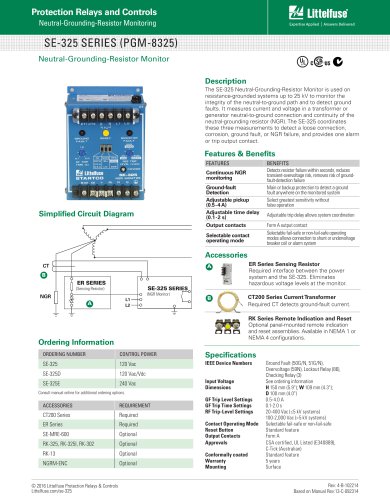 SE-325 SERIES (PGM-8325)
 SE-CS10 SERIES
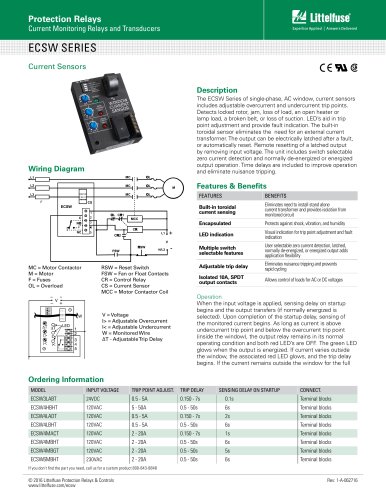 ECSW SERIES
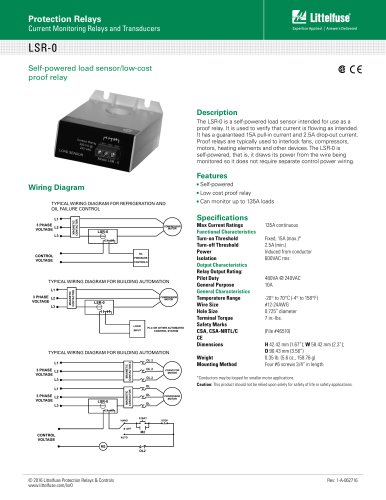 LSR-0
LSR-0 LSRU SERIES
 LSRX / LSRX-C SERIES
 50R-400-ALT
 ALT SERIES
 QJxx30LH4 series
 Thyristors QJ8012xHx Series
 30KPA-HRA Series
 AK1-Y Series
 QJxx40xx Series
 TS Series
 Littelfuse SIDACtor Products Catalog
 Electronic Fuse Products Catalog
 Passenger Car Catalog
 Polyfuse PPTC Catalog
 POWRGARD Electrical Product Catalog
 Protection Relays SSAC Catalog
 Sensors Products Catalog
 TVS Diode Array (SPA) Catalog
 Varistors Catalog
 SOLAR PRODUCTS CATALOG
 MP8000
 MicroPlex® SSR18 AND SSR30
 606 Series
 ST Series
 885 Series Fuse
 MicroPlex® 7X, 7H, & 7L
 TPSMB Series
 TPSMD Series
 ISOBUS SYSTEM
 POLYFUSE®
 Passenger Car Solutions
 TVS Diode Catalog
 Switching Thyristor Product Catalog
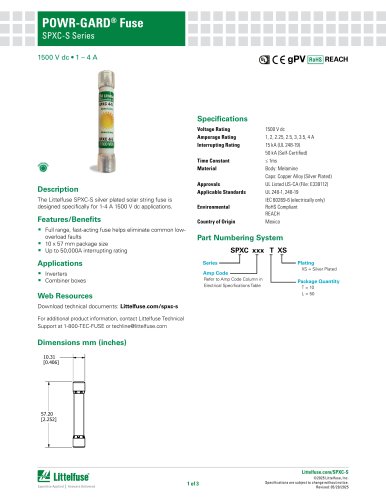


 HIGH-SPEED SEMICONDUCTOR
 INDUSTRIAL CIRCUIT PROTECTION
 Fuse Fundamentals
 Power Semiconductor & IC
 SURGE PROTECTIVE DEVICES
 ELECTRICAL COILS
 PRODUCTS FOR AGRICULTURE
 CIRCUIT PROTECTION
 MSL Classification
 AFTERMARKET PRODUCTS CATALOG
 AFTERMARKET PRODUCTS CATALOG 2018
 Littelfuse Thyristor Catalog


