
- Catalogs
- Littelfuse
- Littelfuse Temperature Derating For Electronic Fuses Catalog


- Company
- Products
- Catalogs
- News & Trends
- Exhibitions
Littelfuse Temperature Derating For Electronic Fuses Catalog

1 / 1 PageView full catalog
Littelfuse Temperature Derating For Electronic Fuses Catalog
Product catalog summary
Fuse Selection Guide
Selection Factors:
1. Normal Operating Current: Fuses are typically derated by 25% at 25°C to prevent nuisance blowing. For example, a 10A fuse should not operate above 7.5A at 25°C.
2. Application Voltage: The fuse's voltage rating must be equal to or greater than the circuit voltage.
3. Ambient Temperature: Affects the current-carrying capacity of fuses. Higher temperatures reduce fuse life, while lower temperatures extend it.
4. Overload Current and Duration: The fuse must open within a specified time under overload conditions.
5. Maximum Available Fault Current: The fuse must handle the maximum fault current.
6. Pulses and Transients: Consideration of surge, inrush, and transient currents is necessary.
7. Physical Size Limitations: Constraints such as length, diameter, or height.
8. Agency Approvals: Compliance with standards like UL, CSA, VDE, etc.
9. Mounting and Form Factor: Includes ease of removal, axial leads, and visual indication.
10. Fuseholder Features: Options like clips, mounting blocks, and R.F.I. shielding.
Voltage and Temperature Considerations:
- The voltage rating must meet or exceed the circuit voltage.
- Current-carrying capacity tests are conducted at 25°C. Higher ambient temperatures reduce fuse life, while lower temperatures extend it.
- Fuses should operate at no more than 75% of their catalog rating at room temperature for indefinite life.
Effect of Ambient Temperature:
- A chart illustrates how different fuse types (Thin-Film, Fast-Acting, Resettable PTCs) are affected by ambient temperature changes.
- Example: For a 2.25A operating current using a Very Fast Acting fuse at room temperature, a 3A fuse is recommended.
Melting I2t and Clearing I2t:
- The melting I2t is the energy required to melt the fuse element, expressed in Ampere Squared Seconds (A2 Sec.).
- Laboratory tests determine the nominal melting I2t by applying a pulse of current and measuring the time to melt.
- Clearing I2t includes both melting and arcing phases, with nominal values provided for the melting phase.
Selection Factors:
1. Normal Operating Current: Fuses are typically derated by 25% at 25°C to prevent nuisance blowing. For example, a 10A fuse should not operate above 7.5A at 25°C.
2. Application Voltage: The fuse's voltage rating must be equal to or greater than the circuit voltage.
3. Ambient Temperature: Affects the current-carrying capacity of fuses. Higher temperatures reduce fuse life, while lower temperatures extend it.
4. Overload Current and Duration: The fuse must open within a specified time under overload conditions.
5. Maximum Available Fault Current: The fuse must handle the maximum fault current.
6. Pulses and Transients: Consideration of surge, inrush, and transient currents is necessary.
7. Physical Size Limitations: Constraints such as length, diameter, or height.
8. Agency Approvals: Compliance with standards like UL, CSA, VDE, etc.
9. Mounting and Form Factor: Includes ease of removal, axial leads, and visual indication.
10. Fuseholder Features: Options like clips, mounting blocks, and R.F.I. shielding.
Voltage and Temperature Considerations:
- The voltage rating must meet or exceed the circuit voltage.
- Current-carrying capacity tests are conducted at 25°C. Higher ambient temperatures reduce fuse life, while lower temperatures extend it.
- Fuses should operate at no more than 75% of their catalog rating at room temperature for indefinite life.
Effect of Ambient Temperature:
- A chart illustrates how different fuse types (Thin-Film, Fast-Acting, Resettable PTCs) are affected by ambient temperature changes.
- Example: For a 2.25A operating current using a Very Fast Acting fuse at room temperature, a 3A fuse is recommended.
Melting I2t and Clearing I2t:
- The melting I2t is the energy required to melt the fuse element, expressed in Ampere Squared Seconds (A2 Sec.).
- Laboratory tests determine the nominal melting I2t by applying a pulse of current and measuring the time to melt.
- Clearing I2t includes both melting and arcing phases, with nominal values provided for the melting phase.
See more
All Littelfuse catalogs and technical brochures
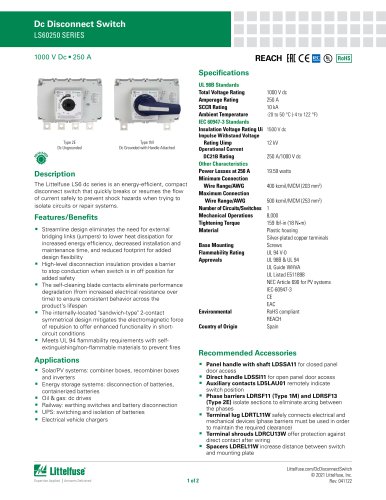 Dc Disconnect Switches
2 Pages
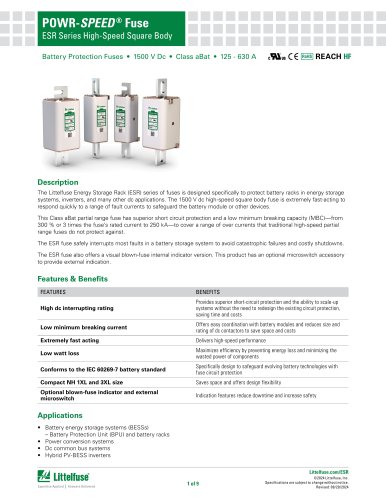 ESR_Fuse_Datasheet
9 Pages
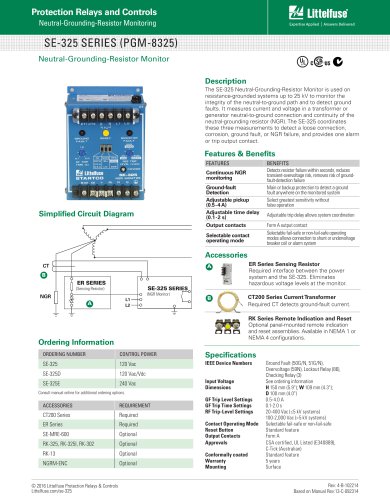 SE-325 SERIES (PGM-8325)
1 Page
 SE-CS10 SERIES
2 Pages
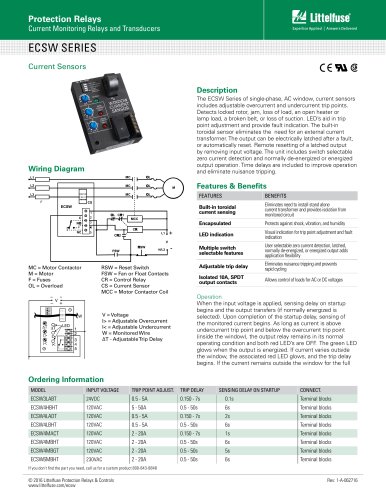 ECSW SERIES
3 Pages
 LSR-0
LSR-01 Page
 LSRU SERIES
2 Pages
 LSRX / LSRX-C SERIES
2 Pages
 50R-400-ALT
1 Page
 ALT SERIES
2 Pages
 QJxx30LH4 series
6 Pages
 Thyristors QJ8012xHx Series
8 Pages
 30KPA-HRA Series
7 Pages
 AK1-Y Series
4 Pages
 QJxx40xx Series
8 Pages
 TS Series
11 Pages
 Littelfuse SIDACtor Products Catalog
239 Pages
 Electronic Fuse Products Catalog
409 Pages
 Passenger Car Catalog
60 Pages
 Polyfuse PPTC Catalog
128 Pages
 POWRGARD Electrical Product Catalog
202 Pages
 Protection Relays SSAC Catalog
524 Pages
 Sensors Products Catalog
20 Pages
 SIDACtor Catalog
239 Pages
 TVS Diode Array (SPA) Catalog
215 Pages
 Varistors Catalog
254 Pages
 SOLAR PRODUCTS CATALOG
28 Pages
 MP8000
2 Pages
 MicroPlex® SSR18 AND SSR30
2 Pages
 606 Series
3 Pages
 ST Series
3 Pages
 885 Series Fuse
3 Pages
 MicroPlex® 7X, 7H, & 7L
2 Pages
 TPSMB Series
6 Pages
 TPSMD Series
6 Pages
 ISOBUS SYSTEM
2 Pages
 POLYFUSE®
6 Pages
 Passenger Car Solutions
60 Pages
 TVS Diode Catalog
174 Pages
 Switching Thyristor Product Catalog
442 Pages



Archived catalogs
 HIGH-SPEED SEMICONDUCTOR
72 Pages
 INDUSTRIAL CIRCUIT PROTECTION
292 Pages
 Fuse Fundamentals
20 Pages
 Power Semiconductor & IC
133 Pages
 SURGE PROTECTIVE DEVICES
32 Pages
 ELECTRICAL COILS
2 Pages
 PRODUCTS FOR AGRICULTURE
36 Pages
 CIRCUIT PROTECTION
15 Pages
 MSL Classification
2 Pages
 AFTERMARKET PRODUCTS CATALOG
136 Pages
 AFTERMARKET PRODUCTS CATALOG 2018
132 Pages
 Littelfuse Thyristor Catalog
467 Pages


Related Searches
- Connector
- Data connector
- Temperature probe
- Transformer
- Dry transformer
- Surge protector
- Resistance temperature sensor
- Proximity switch
- Level probe
- Switching relay
- Liquid level sensor
- Cylindrical proximity sensor
- Circuit breaker
- Class II surge protector
- Panel panel meter
- Protection relay
- Isolator switch
- Current transformer
- Position transducer
- IP67 proximity sensor
*Prices are pre-tax. They exclude delivery charges and customs duties and do not include additional charges for installation or activation options. Prices are indicative only and may vary by country, with changes to the cost of raw materials and exchange rates.
About DirectIndustry
DirectIndustry is a marketplace that offers B2B players a complete experience, from product sourcing to purchase. DirectIndustry is an entity of VirtualExpo Group.
Are you a buyer?
Are you a supplier?