
- Catalogs
- Lithoz GmbH
- CeraFab Multi 2M30


CeraFab Multi 2M30
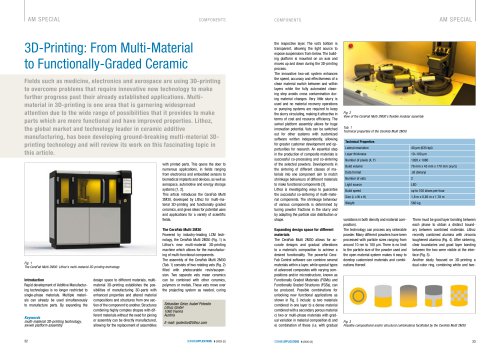
CeraFab Multi 2M30
The document discusses the rapid development of additive manufacturing technologies, particularly focusing on multi-material 3D-printing. This technology allows for the creation of parts with enhanced properties by using different materials simultaneously. The potential applications span across various fields such as electronics, biomedical implants, aerospace, automotive, and energy storage systems.
The CeraFab Multi 2M30
The CeraFab Multi 2M30, developed by Lithoz, is a multi-material 3D-printing machine that utilizes LCM technology. It features two rotating vats filled with photocurable resin/suspension, enabling the combination of ceramics with other materials like polymers or metals. This system enhances speed, accuracy, and effectiveness in material switching, and supports the development of customized materials.
Technical Properties
The CeraFab Multi 2M30 offers a lateral resolution of 40 µm, layer thickness ranging from 10–100 µm, and a build volume of 76 mm x 43 mm x 170 mm. It supports a build speed of up to 100 slices per hour and uses an LED light source.
Applications and Innovations
The machine allows for the creation of Functionally Graded Materials (FGMs) and Structures (FGSs), enabling new functional applications. It supports the production of complex structures, such as ceramic-polymer composites, and is beneficial for industries like electronics, biomedical, and aerospace. The technology also facilitates the design of components with multifunctional properties, such as combining hard and ductile materials or electrically conductive and insulating materials.
Conclusion
Lithoz's CeraFab Multi 2M30 represents a significant advancement in multi-material 3D-printing, offering new possibilities for creating innovative components with diverse material properties. This technology is poised to benefit various industries by enabling the production of complex, functional parts.
Catalog excerpts

3D-Printing: From Multi-Material to Functionally-Graded Ceramic Fields such as medicine, electronics and aerospace are using 3D-printing to overcome problems that require innovative new technology to make further progress past their already established applications. Multimaterial in 3D-printing is one area that is garnering widespread attention due to the wide range of possibilities that it provides to make parts which are more functional and have improved properties. Lithoz, the global market and technology leader in ceramic additive manufacturing, has been developing ground-breaking multi-material 3Dprinting technology and will review its work on this fascinating topic in this article. with printed parts. This opens the door to numerous applications, in fields ranging from electronics and embedded sensors to biomedical implants and devices, as well as aerospace, automotive and energy storage systems [1, 2]. This article introduces the CeraFab Multi 2M30, developed by Lithoz for multi-material 3D-printing and functionally graded ceramics, and gives ideas for potential uses and applications for a variety of scientific fields. Fig. 1 The CeraFab Multi 2M30: Lithoz’s multi-material 3D-printing technology Introduction Rapid development of Additive Manufacturing technologies is no longer restricted to single-phase materials. Multiple materials can already be used simultaneously to manufacture parts. By expanding the Keywords multi-material 3D-printing technology, swivel platform assembly design space to different materials, multimaterial 3D-printing establishes the possibilities of manufacturing 3D-parts with enhanced properties and altered material compositions and structures from one section of the component to another. Structures combining highly complex shapes with different materials without the need for joining or assembly can be directly manufactured, allowing for the replacement of assemblies The CeraFab Multi 2M30 Powered by industry-leading LCM technology, the CeraFab Multi 2M30 (Fig. 1) is Lithoz’s new multi-material 3D-printing machine which allows for the manufacturing of multi-functional components. The assembly of the CeraFab Multi 2M30 (Tab. 1) consists of two rotating vats (Fig. 2) filled with photocurable resin/suspension. Two separate vats mean ceramics can be combined with other ceramics, polymers or metals. These vats move over the projecting system as needed, curing Sebastian Geier, Isabel Potestio Lithoz GmbH 1060 Vienna Austria E-mail: [email protected] the respective layer. The vat’s bottom is transparent, allowing the light source to expose suspensions from below. The building platform is mounted on an axis and moves up and down during the 3D-printing process. The innovative two-vat system enhances the speed, accuracy and effectiveness of a clean material switch between and within layers while the fully automated cleaning step avoids cross contamination during material changes. Very little slurry is used and no material recovery operations or pumping systems are required to keep the slurry circulating, making it attractive in terms of cost and resource efficiency. The swivel platform assembly allows for huge innovation potential. Vats can be switched out for other systems with customized software written independently, allowing for greater customer development and opportunities for research. An essential step in the production of composite materials is successful co-processing and co-sintering of the selected powders. Developments in the sintering of different classes of materials into one component aim to match shrinkage behaviours of different materials to make functional components [3]. Lithoz is investigating ways to guarantee the successful co-sintering of multi-material components. The shrinkage behaviour of various components is determined by tuning powder fractions in the slurry and by adapting the particle size distribution or shape. Expanding design space for different materials The CeraFab Multi 2M30 allows for accurate designs and gradual alterations to a material’s composition to achieve a desired functionality. The powerful CeraFab Control software can combine several materials within a layer, while special types of advanced composites with varying compositions and/or microstructure, known as Functionally Graded Materials (FGMs) and Functionally Graded Structures (FGSs), can be produced. Possible combinations for unlocking new functional applications as shown in Fig. 3 include: a) two materials combined in one layer b) a dense material combined with a secondary porous material c) two or multi-phase materials with gradual variation in material composition d) and e) combination of these (i.e. with gradual Fig. 2 View of the CeraFab Multi 2M30’s flexible modular assembly Tab. 1 Technical properties of the CeraFab Multi 2M30 Technical Properties Lateral resolution Layer thickness Build volume Data format Light source Build speed variations in both density and material composition). The technology can process any sinterable powder. Many different powders have been processed with particle sizes ranging from around 10 nm to 100 µm. There is no limit to the particle size of the powder used and the open material system makes it easy to develop customized materials and combinations thereof. There must be good layer bonding between each phase to obtain a distinct boundary between combined materials. Lithoz recently combined alumina with zirconia toughened alumina (Fig. 4). After sintering, clear boundaries and good layer bonding between the two were visible at the interface (Fig. 5). Another study focused on 3D-printing a dual-color ring, combining white and two- Fig. 3 Possible compositional and/or structural combinations facilitated by the Cera
Open the catalog to page 1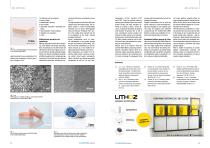
The following can be combined: • porous | dense; • bioresorbable | bioinert; • hard | ductile; • lectrically conductive | electrically insue lating; • heat conductive | heat insulating; • magnetic | non-magnetic; • colors. Fig. 4 ZTA–Al2O3 composites green part manufactured on the CeraFab Multi 2M30 colored alumina for luxury applications. The sintered ring, consisting of a voronoi structure, is shown in Fig. 6. Multifunctional properties and applications Medical applications benefit from introducing multi-material 3D-printing technology. Bone microstructures vary from dense and stiff external...
Open the catalog to page 2All Lithoz GmbH catalogs and technical brochures
 Lithoz company folder
5 Pages
 CeraFab System S65 Medical
4 Pages
- Additive manufacturing machine
- Industrial 3D printer
- Plastic additive manufacturing machine
- High-performance 3D printer
- High-speed 3D printer
- Metal 3D printing machine
- Medical 3D printing machine
- Dental additive manufacturing machine
- Multi-material 3D printer
- 3D printing software
- Design 3D printing software
- Ceramic 3D printer
- Process control 3D printing software