


NH3

NH3
Product Name: Ammonia, anhydrous
Trade Names: Ammoniak, Ammoniak 3.6 Detector, Ammoniak 3.8, Ammoniak vloeibaar
EC No: 231-635-3, CAS No: 7664-41-7
Company: Linde Gas Benelux, Belgium
Emergency Phone: +32 (0) 2 890 95 10
Hazards Identification:
Ammonia is classified as a liquefied, flammable, and toxic gas. It causes severe skin burns, eye damage, and is very toxic to aquatic life. It is corrosive to the respiratory tract.
Label Elements:
Signal Word: Danger
Hazard Statements: H280, H221, H331, H314, H400, EUH071
Precautionary Statements: P210, P280, P260, P273, P377, P381, P303+P361+P353+P315, P304+P340+P315, P305+P351+P338+P315, P403, P405
Composition/Information on Ingredients:
Substance: Ammonia, anhydrous
Contains no other components or impurities influencing classification.
First Aid Measures:
Inhalation: Remove to fresh air, keep warm and rested, call a doctor.
Skin/Eye Contact: Flush with water for at least 15 minutes, remove contaminated clothing, seek medical assistance.
Ingestion: Not a potential route of exposure.
Fire Fighting Measures:
Specific Hazards: Containers may rupture/explode in fire.
Extinguishing Media: All known extinguishants can be used.
Protective Equipment: Use self-contained breathing apparatus and protective clothing.
Accidental Release Measures:
Evacuate area, use protective equipment, ensure ventilation, and monitor concentration.
Environmental Precautions: Stop release, reduce vapour with water spray.
Clean Up: Ventilate area, wash contaminated sites with water.
Handling and Storage:
Use specified equipment, avoid backfeed, keep away from ignition sources, and ensure leak checks.
Storage: Secure cylinders, store below 50°C, segregate from oxidants, and check for leaks.
Exposure Controls/Personal Protection:
Exposure Limits: TLV (ACGIH) 25 ppm, Belgium STEL 50 ppm, TWA 20 ppm.
Personal Protection: Protect eyes, face, and skin from splashes.
Physical and Chemical Properties:
Appearance: Colourless gas
Odour: Ammoniacal
Boiling Point: -33°C
Flammability Range: 15% - 30%
Stability and Reactivity:
Reacts violently with oxidants and acids, forms explosive mixtures with air.
Toxicological Information:
Inhalation can cause severe respiratory issues.
Ecological Information:
May cause pH changes in water systems.
Disposal Considerations:
Avoid discharge to atmosphere, scrub gases before release.
Transport Information:
UN Number: 1005
Class: 2.3
Labels: 2.3, 8
Packing Instruction: P200
Regulatory Information:
May require SEVESO II submission.
Other Information:
Ensure compliance with regulations, train operators, and conduct safety studies before use.
Catalog excerpts
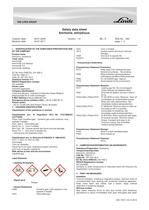
Safety data sheet Ammonia, anhydrous. Creation date : Revision date : 28.01.2005 04.01.2011 Version : 1.0 1 IDENTIFICATION OF THE SUBSTANCE/PREPARATION AND OF THE COMPANY Product name Ammonia, anhydrous. Trade name Ammoniak Ammoniak 3.6 Detector Ammoniak 3.8 Ammoniak vloeibaar H331 H314 H400 EUH071 Classification of the substance or mixture Classification acc. to Regulation (EC) No 1272/2008/EC (CLP/GHS) Press. Gas (Liquefied gas) - Contains gas under pressure; may explode if heated. Flam. Gas 2 - Flammable gas. Acute Tox. 3 - Toxic if inhaled. Skin Corr. 1B - Causes severe skin burns and eye damage. Acute Tox. 1 - Very toxic to aquatic life. - Corrosive to the respiratory tract. Classification acc. to Directive 67/548/EEC & 1999/45/EC R10 | T; R23 | C; R34 | N; R50 Flammable Toxic by inhalation. Cause burns (to eyes, respiratory system and skin). Very toxic to aquatic organisms. Risk advice to man and the environment Liquefied gas. Label Elements - Labelling Pictograms Toxic if inhaled. Causes severe skin burns and eye damage. Very toxic to aquatic life. Corrosive to the respiratory tract. Precautionary Statement Prevention P210 Keep away from heat/sparks/open flames/hot surfaces. - No smoking. P280 Wear protective gloves/protective clothing/eye protection/face protection. P260 Do not breathe gas, vapours. P273 Avoid release to the environment. Precautionary Statement Reaction P377 Leaking gas fire: Do not extinguish, unless leakcan be stopped safely. P381 Eliminate all ignition sources if safe to do so. P303+P361+P353+P315 IF ON SKIN (or hair): Remove / Take off immediately all contaminated clothes. Rinse skin with water/shower. Get immediate medical advise/attention. P304+P340+P315 IF INHALED: Remove victim to fresh air and keep at rest in a position comfortable for breathing. Get immediate medical advise/attention. P305+P351+P338+P315 IF IN EYES: Rinse cautiously with water for several minutes. Remove contact lenses, if present and easy to do. Continue rinsing. Get immediate medical advise/attention. Precautionary Statement Storage P403 Store in a well-ventilated place. P405 Store locked up. Precautionary Statement Disposal None. 3 - Signal word Danger Contains gas under pressure; may explode if heated. Flammable gas. COMPOSITION/INFORMATION ON INGREDIENTS Substance/Preparation: Substance. Components/Impurities Ammonia, anhydrous. CAS No: 7664-41-7 Index-Nr.: 007-001-00-5 EC No (from EINECS): 231-635-3 REACH Registration number: Not available. Contains no other components or impurities which will influence the classification of the product. 4 H221 SDS No. : 002 page 1 / 3 - Precautionary Statements EC No (from EINECS): 231-635-3 CAS No: 7664-41-7 Index-Nr. 007-001-00-5 Chemical formula NH3 REACH Registration number: Not available. Known uses Industrial application. Company identification Linde Gas Benelux - Industrial & Specialty Gases Belgium, Westvaartdijk 85, B-1850 Grimbergen E-Mail Address [email protected] Emergency phone numbers (24h): +32 (0) 2 890 95 10 Poison center: +32 (0) 70 245 245 (Anti Poison Centre, Brussels). 2 HAZARDS IDENTIFICATION - Hazard Statements H280 BE / E FIRST AID MEASURES Inhalation Toxic by inhalation. Irritating to respiratory system. Remove victim to uncontaminated area wearing self contained breathing apparatus. Keep victim warm and rested. Call a doctor. Apply artificial respiration if breathing stopped. Skin/eye contact May cause chemical burns to skin and cornea (with temporary disturbance to vision) Immediately flush eyes thoroughly with water 002 / EDV / 20.12.2010
Open the catalog to page 1
Safety data sheet Ammonia, anhydrous. Creation date : Revision date : 28.01.2005 04.01.2011 Version : 1.0 for at least 15 minutes. Remove contaminated clothing. Drench affected area with water for at least 15 minutes. Obtain medical assistance. Ingestion Ingestion is not considered a potential route of exposure. 5 FIRE FIGHTING MEASURES Specific hazards Exposure to fire may cause containers to rupture/explode. Hazardous combustion products If involved in a fire the following toxic and/or corrosive fumes may be produced by thermal decomposition: Suitable extinguishing media All known extinguishants...
Open the catalog to page 2
Safety data sheet Ammonia, anhydrous. Creation date : 28.01.2005 Version : 1.0 BE / E SDS No. : 002 Revision date: 04.01.2011 page 3/3 May cause pH changes in aqueous ecological systems. Do not discharge into any place where its accumulation could be dangerous. Avoid discharge to atmosphere. Contact supplier if guidance is required. Gas may be scrubbed in sulphuric acid solution. Gas may be scrubbed in water. Toxic and corrosive gases formed during combustion should be scrubbed before discharge to Whilst proper care has been taken in the preparation of this document, no liability for injury or...
Open the catalog to page 3All Linde Gas catalogs and technical brochures
 Overview of Shielding Gases
12 Pages
 propane
1 Page
 lindoflamm_flame_solutions
2 Pages
 hydrogen
2 Pages
 acetylene
2 Pages
 ETO
ETO3 Pages
 DA
DA2 Pages
 Cl2
Cl23 Pages
 C2H6
C2H63 Pages
 CO
CO2 Pages
 D2
D22 Pages
 Ar
Ar2 Pages
 Air
Air2 Pages
 Liquid Helium - He
2 Pages
 Carbon Dioxide -CO2
3 Pages
 Liquid Argon - Ar
2 Pages
 linde annual 2009
96 Pages
 AXENIS Water Treatment
8 Pages
 LINSPRAY Thermal Spray Solutions
16 Pages
 LINDOFLAMM Brochure
12 Pages
 Acetylene Brochure
9 Pages
 Bottom Injection systems
2 Pages

