


Modified Atmosphere Packaging (MAP)

Modified Atmosphere Packaging (MAP)
Linde Gas presents MAPAX®, a modified atmosphere packaging (MAP) solution aimed at preserving food freshness and flavor without chemical preservatives. The document emphasizes the growing consumer demand for fresh, minimally processed foods and the challenges food producers face in meeting these expectations. It highlights the role of packaging in extending shelf-life and ensuring food safety.
MAP technology significantly extends the shelf-life of food products, facilitating broader distribution and reducing spoilage. It allows companies to expand their product range and market reach, enhancing productivity and market share. By reducing the need for preservatives, MAP improves company image and decreases product returns.
MAP uses specific gas mixtures to inhibit microbial growth and oxidation, preserving food quality. Key gases include carbon dioxide (CO2), nitrogen (N2), and oxygen (O2). CO2 inhibits microbial activity, while N2 prevents oxidation. The document stresses the importance of maintaining low temperatures and hygienic conditions to maximize MAP effectiveness.
The choice of packaging materials is crucial for MAP's success. Materials must provide high barriers against oxygen, light, and moisture to prevent food deterioration. Common materials include polyester, polypropylene, and polyethylene, often combined to enhance barrier properties. The document also notes ongoing research into environmentally friendly packaging solutions.
Five main types of packaging machines are used in MAP technology: vertical flow-pack, horizontal flow-pack, tray-sealer, deep-drawing, and vacuum chamber machines. Each machine type is suited for specific products and packaging processes, such as gas flushing or vacuum extraction, to replace air with a modified atmosphere, enhancing product shelf-life.
The document discusses the use of gases like CO2, N2, and O2 in MAP storage, emphasizing the importance of choosing the right gas mixture based on food type and packaging requirements. Linde Gas provides food-grade gases and offers MAPAX® solutions, a tailored MAP program that considers factors like product handling, microorganism levels, and packaging material properties to ensure food freshness and safety.
The document compares the shelf-life of various food products when packed in air versus MAPAX®. For example, raw red meat's shelf-life extends from 2-4 days in air to 5-8 days with MAPAX®, while raw light poultry extends from 4-7 days to 16-21 days.
Practical applications of MAP technology are highlighted, particularly for meat and poultry products, which are prone to bacterial growth. The document recommends specific gas mixtures for different meat products to inhibit bacterial growth and extend shelf-life, emphasizing the importance of hygiene and temperature control in processing and packaging.
Poultry packaging requires a head-space volume nearly as large as the product volume. Unlike red meats, poultry does not discolor irreversibly in the presence of oxygen. Spoilage is mainly due to microbial growth, particularly Pseudomonas and Achromobacter species, which are inhibited by CO2. Levels above 20% CO2 are needed to extend shelf-life, but higher levels may cause package collapse and excessive drip. In bulk packaging, 100% CO2 is recommended, with nitrogen used as an inert filler gas.
Meat products have different microflora due to processing methods like marinating and smoking. This affects the gas composition in packaging. To avoid souring, CO2 concentration is kept low (20-50%). Examples include MAP for whole sausages and sliced meat products to prevent sticking.
A Swedish company uses MAPAX® technology with Barrier Display Film (BDF) for packaging chicken, extending shelf-life from 4 to 21 days. This method simplifies distribution and enhances product attractiveness, increasing competitive edge and export potential.
Fresh fish deteriorates quickly due to microbial growth and enzymatic processes. MAP with CO2 levels above 20% inhibits bacteria like Pseudomonas. Oxygen is used to maintain color and prevent anaerobic bacteria growth, but not for high-fat fish to avoid rancidity. Recommended gas mixtures vary by product type, with shelf-life extensions noted.
Microbial growth and rancidity affect dairy products. Hard cheeses use CO2 to prevent mold, while soft cheeses use increased CO2 and low oxygen to inhibit bacteria. Nitrogen is used to prevent cream from souring. MAPAX® technology extends shelf-life and maintains product quality.
Packaging material permeability is crucial for MAP of fresh produce. Incorrect permeability can lead to anaerobic conditions or moisture loss, deteriorating quality. Achieving an optimal equilibrium modified atmosphere (EMA) with 3–10% O2 and 3–10% CO2 can significantly extend the shelf-life of fruits and vegetables. This requires selecting the right packaging film and considering factors like respiration rate and temperature.
Dry foods are sensitive to oxidation. Maintaining low oxygen levels (<0.2%) in packaging is essential to prevent rancidity. In bakery products, carbon dioxide can effectively control mold growth, extending shelf-life. Different gas mixtures are suggested for products like pre-baked bread and milk powder to enhance shelf-life.
Prepared foods face deterioration due to microbial contamination and oxidation. Maintaining low oxygen and high carbon dioxide levels can extend shelf-life. The gas mixture in packaging depends on the moisture content and composition of the food, affecting microbial growth and oxidation rates.
Various food products such as pizza, pasta, sandwiches, and ready meals have specific storage requirements under MAP. The typical gas mixtures used are combinations of CO2 and N2, with storage temperatures maintained between 2–4 °C. The shelf-life varies from a few days to several weeks depending on the product.
The document lists minimum pH, water activity (aw), and temperature conditions for the growth of various microorganisms associated with chilled MAP foods. For example, Listeria monocytogenes can grow at a minimum pH of 4.4 and a temperature as low as -0.1°C.
De Tropen, a producer of meal components in the Netherlands, uses MAP with a 30% CO2 and 70% N2 mixture to maintain the quality of their products without pasteurization. They plan to expand production while maintaining quality standards.
Sandwiches benefit from MAPAX® technology, which extends their shelf-life by 5-7 days when packed in 30% CO2 and 70% N2 at 2–4 °C. This allows for efficient preparation and storage.
The document addresses common questions about MAP, including shelf-life extension, freezing, gas mixtures, and packaging issues like condensation and package collapse. It emphasizes the importance of using food-grade gases and maintaining proper packaging conditions to prevent spoilage and maintain product quality.
Proper labeling, headspace management, and temperature control are crucial for effective MAP. Issues like package blow-up and collapse are discussed, with solutions provided to mitigate these problems.
The document discusses advanced packaging materials that interact with the internal gas environment to extend food shelf-life. These technologies modify the gas environment by adding or removing gases within a package, with examples including oxygen scavenging and carbon dioxide production.
Definitions are provided for aerobic and anaerobic organisms, highlighting their growth conditions. Aerobic organisms require air, while anaerobic organisms can grow without oxygen, with some being obligate anaerobes.
Anti-fogging properties are achieved by producing films with high surface tension and hydrophilic properties to prevent fogging.
The document lists various gases like argon, carbon dioxide, and nitrogen, detailing their properties and roles in packaging. For instance, carbon dioxide inhibits microorganism growth, while nitrogen is inert and used in MAP.
A comprehensive glossary explains terms related to packaging and food preservation, such as bacteriostatic effect, controlled atmosphere, and modified atmosphere packaging (MAP).
The document describes technologies like gas flushing and pressure swing adsorption (PSA) for producing nitrogen on-site. It also covers processes like fermentation and enzymatic reactions.
HACCP is mentioned as a systematic approach to food safety, and the importance of controlling the atmosphere around food to maintain quality is emphasized.
A list of reference literature is provided, offering further reading on topics like modified atmosphere packaging and food microbiology.
Linde Gas is highlighted as a leader in innovative gas solutions, offering tailored and standardized solutions to enhance productivity and profitability across industries.
Catalog excerpts
The ultimate combination for freshness. MAPAX® modifi ed atmosphere packaging.
Open the catalog to page 1
MAPAX® Treating Food Better. 2
Open the catalog to page 2
MAPAX® and BIOGON® are registered trademarks of the Linde Group. Table of contents Table of contents. Introduction 4 MAP benefi ts 6 MAP – Modifi ed Atmosphere Packaging 8 Packaging materials 12 Packaging machines 16 Linde: BIOGON® and gas supply 18 MAPAX® solutions 20 MAPAX® – best for meat and meat products 24 MAPAX® – best for fi sh and seafood 28 MAPAX® – best for dairy products 32 MAPAX® – best for fruits and vegetables 36 MAPAX® – best for dry foods and bakery products 40 MAPAX® – best for prepared foods and catering 44 FAQ 48 Glossary 51 Reference literature 54 3
Open the catalog to page 3
Taking a leaf out of nature’s book, Linde Gas provides innovative solutions to seal in the natural freshness and fl avour of foodstuffs – without the use of chemical preservatives. MAP – an innovative response to food deterioration. Introduction Winning the race against time Nowadays, good food has to be healthy, minimally processed and at tractively pack aged – as consumers’ expectations from foodstuffs are con ti nuously rising. Consequently, demands on food producers and pro ducers of packaging machines and ma terials are increasing, too. The consumer of today reacts sensitively when it comes...
Open the catalog to page 4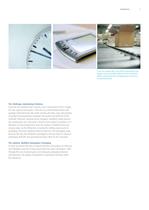
In the race against time, you profi t by rationalising your logistics. Even perishable products can be trans ported farther, still arriving fresh and appetising for sale over an extended period. Introduction The challenge: maintaining freshness From the very moment fruit is picked, corn is harvested or fi sh is caught, the race against time begins. From now on, natural deterioration and spoilage (internal factors like water activity, pH-value, type and quantity of product microorganisms) endanger the quality and shelf-life of the foodstuff. However, external factors (hygienic conditions while...
Open the catalog to page 5
MAP benefi ts. A short story about long-term profi ts The success story begins with the consumers’ buying decision. Which foodstuffs do they buy and which ones do they refuse? And why? MAP individual packaging solutions are based on consumer statistics and intensive market research in order to be able to react directly to consumer preferences and buying patterns. By packaging the foodstuff in a modifi ed atmosphere, it is possible to maintain high quality and extend shelf-life by days or even weeks. Products that previously could not be stored fresh throughout the distribution chain can now be...
Open the catalog to page 6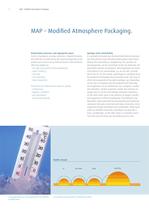
MAP – Modifi ed Atmosphere Packaging. Deterioration processes and appropriate gases Food is a biological, sensitive substance. Origi nal freshness and shelf-life are affected by the inherent properties of the product just as much as by external factors. Internal factors affecting quality are: – the type and quantity of microorganisms – water activity aw – pH-value – cell respiration – food composition External factors affecting the inherent quality: – temperature – hygienic conditions – gas atmosphere – processing methods MAP – Modifi ed Atmosphere Packaging Low temperatures are very important...
Open the catalog to page 8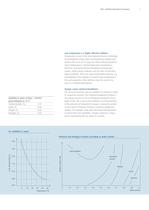
MAP – Modifi ed Atmosphere Packaging Low temperature is a highly effective inhibitor Temperature is one of the most important factors controlling microbiological activity. Most micro organisms multiply optimally in the 20 to 30 °C range and show reduced growth at lower temperatures. Careful temperature monitoring is there fore vital during all food handling and distribution stages. Chilling alone, however, will not solve all microbiological problems. There are some psychro philic bacteria, e.g. Pseudomonas, that multiply at relatively low temperatures. For such organisms, other defenses must...
Open the catalog to page 9
From food preservation to the protection of natural quality Present developments are moving away from the previous preservative methods that physically or chemically alter the product toward less severe methods that leave the product unchanged. The methods that represent the ultimate attempt to protect the inherent quality of a food product range from processes such as high-pressure and microwave methods to various packaging techniques, e.g. oxygen absor ption, vacuum, sous-vide techniques and MAP. MAP is a natural shelf-life-enhancing method that is growing rapidly on an international scale....
Open the catalog to page 10
Dr. Michael Washuettl, Head of Department of Modifi ed and Active Packaging ofi Packaging Institute Vienna, Austria MAP – Modifi ed Atmosphere Packaging MAP is used to increase the shelf-life of foodstuffs as well as to improve the quality of the packaged product. The key to this technology lies in varying the concentration of different gases (generally CO2, N2 and O2) in coordination with the respective product. The most important prerequisites for successful MAP technologies are: good original quality of the product and the raw materials, appropriate temperature control, good hygienic conditions...
Open the catalog to page 11
Perfect food comes in perfect packaging. Tailored solutions for any kind of product Packaging materials are of decisive importance for food quality and shelf-life. Many sophisticated packaging solutions have been developed to prevent rapid deterioration caused by oxygen, light and bacteria or by foreign odour and taste substances that come into contact with the pro duct. The manufacturer of foodstuffs faced with choosing suitable packaging designs and materials has many im portant decisions to make, and also has to comply with general legal demands for packaging materials. What does the product...
Open the catalog to page 12
Relation permeability N2 : O2 : CO2 1 : 5 : 25 Packaging materials Various material properties combined Packaging materials used with all forms of MAP foods (with the exception of fruit and vegetables) should have high barrier characteristics. Polymers used include polyester, polypropylene, polystyrene, polyvinyl chloride, nylon, ethylene vinyl acetate and ethylene vinyl alcohol polymers. These are usually laminated or coextruded with polyethylene, which comes into direct contact with the food and is the heatsealing medium. 13
Open the catalog to page 13All Linde Gas catalogs and technical brochures
 Overview of Shielding Gases
12 Pages
 propane
1 Page
 lindoflamm_flame_solutions
2 Pages
 hydrogen
2 Pages
 acetylene
2 Pages
 ETO
ETO3 Pages
 DA
DA2 Pages
 Cl2
Cl23 Pages
 NH3
NH33 Pages
 C2H6
C2H63 Pages
 CO
CO2 Pages
 D2
D22 Pages
 Ar
Ar2 Pages
 Air
Air2 Pages
 Liquid Helium - He
2 Pages
 Carbon Dioxide -CO2
3 Pages
 Liquid Argon - Ar
2 Pages
 linde annual 2009
96 Pages
 AXENIS Water Treatment
8 Pages
 LINSPRAY Thermal Spray Solutions
16 Pages
 LINDOFLAMM Brochure
12 Pages
 Acetylene Brochure
9 Pages
 Bottom Injection systems
2 Pages
