


Liquid Argon - Ar

Liquid Argon - Ar
Product: Argon, refrigerated liquid. CAS No: 7440-37-1. EC No: 231-147-0. Company: Linde AG, Linde Gas Division. Emergency contact: 089-7446-0.
Argon is classified as a refrigerated gas that may cause cryogenic burns or injury. It is an asphyxiant in high concentrations. Precautionary measures include wearing cold insulating gloves and eye protection, and storing in a well-ventilated place.
Argon is a pure substance with no additional components affecting its classification.
Inhalation of high concentrations may cause asphyxiation. Move the victim to fresh air and seek medical attention. For skin or eye contact, flush with water and seek medical assistance.
Argon is non-flammable. In case of fire, containers may rupture. Use any extinguishing media and wear self-contained breathing apparatus in confined spaces.
Evacuate the area and ensure proper ventilation. Prevent entry into confined spaces and stop the release if possible.
Prevent water backflow into containers. Store below 50°C in a well-ventilated area.
Protective measures include eye, face, and skin protection from liquid splashes and ensuring adequate ventilation.
Argon is a colorless liquid with no odor. It has a boiling point of -186°C and is heavier than air, potentially accumulating in low areas.
Liquid argon can cause embrittlement of materials.
No known toxicological effects.
Argon can cause frost damage to vegetation.
Avoid discharge into areas where accumulation could be dangerous. Contact the supplier for guidance.
Classified under UN 1951 as Argon, refrigerated liquid. Ensure proper ventilation and secure containers during transport.
Not polluting to waters according to VwVwS.
Observe all regulations and conduct safety studies before use. Linde provides additional safety advice on handling gases.
Catalog excerpts
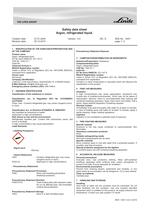
Safety data sheet Argon, refrigerated liquid. Creation date : Revision date : 27.01.2005 20.12.2010 Version : 4.0 1 IDENTIFICATION OF THE SUBSTANCE/PREPARATION AND OF THE COMPANY Product name Argon, refrigerated liquid. EC No (from EINECS): 231-147-0 CAS No: 7440-37-1 Index-Nr. Chemical formula Ar REACH Registration number: Listed in Annex IV/V of Regulation (EC) No 1907/2006 (REACH), exempted from registration. Known uses Not known. Company identification Linde AG, Linde Gas Division, Seitnerstraße 70, D-82049 Pullach E-Mail Address [email protected] Emergency phone numbers (24h): 089-7446-0 HAZARDS IDENTIFICATION Classification of the substance or mixture Classification acc. to Regulation (EC) No 1272/2008/EC (CLP/GHS) Press. Gas - Contains refrigerated gas; may cause cryogenic burns or injury. Classification acc. to Directive 67/548/EEC & 1999/45/EC Not classified as hazardous to health. Asphyxiant in high concentrations. Risk advice to man and the environment Refrigerated liquefied gas. Contact with productmay cause cold burns or frostbite. In high concentrations may cause asphyxiation. Label Elements - Labelling Pictograms - Signal word Warning - Hazard Statements H281 3 EIGA-As - Precautionary Statements Precautionary Statement Prevention P282 Wear cold insulating gloves/face shield/eye protection. Precautionary Statement Reaction P336+P315 Thaw frosted parts with lukewarm water. Do no rub affected area. Get immediate medical advice/attention. Precautionary Statement Storage P403 Store in a well-ventilated place. COMPOSITION/INFORMATION ON INGREDIENTS Substance/Preparation: Substance. Components/Impurities Argon, refrigerated liquid. CAS No: 7440-37-1 Index-Nr.: EC No (from EINECS): 231-147-0 REACH Registration number: Listed in Annex IV/V of Regulation (EC) No 1907/2006 (REACH), exempted from registration. Contains no other components or impurities which will influence the classification of the product. FIRST AID MEASURES Inhalation In high concentrations may cause asphyxiation. Symptoms may include loss of mobility/consciousness. Victim may not be aware of asphyxiation. Remove victim to uncontaminated area wearing self contained breathing apparatus. Keep victim warm and rested. Call a doctor. Apply artificial respiration if breathing stopped. Skin/eye contact Immediately flush eyes thoroughly with water for at least 15 minutes. In case of frostbite spray with water for at least 15 minutes. Apply a sterile dressing. Obtain medical assistance. Ingestion Ingestion is not considered a potential route of exposure. 5 FIRE FIGHTING MEASURES Specific hazards Exposure to fire may cause containers to rupture/explode. Non flammable. Hazardous combustion products None. Suitable extinguishing media All known extinguishants can be used. Specific methods Move container away or cool with water from a protected position. If possible, stop flow of product. Special protective equipment for fire fighters In confined space use self-contained breathing apparatus. 6 Contains refrigerated gas; may cause cryogenic burns or injury. Asphyxiant in high concentrations. SDS No. : 8301 page 1 / 2 Precautionary Statement Disposal 4 2 DE / E ACCIDENTAL RELEASE MEASURES Personal precautions Evacuate area. Use protective clothing. Wear self-contained breathing apparatus when entering area unless atmosphere is proved to be safe. Ensure adequate air ventilation. Environmental precautions Prevent from entering sewers, basements and workpits, or any place where its accumulation can be dangerous. Try to stop release. Clean up methods Ventilate area. 7 HANDLING AND STORAGE Handling Suck back of water into the container must be prevented. Do not allow backfeed into the container. Use only properly specified equipment which is suitable for this product, its supply pressure and temperature. Contact your gas supplier if in doubt. 8301 / EDV / 20.12.2010
Open the catalog to page 1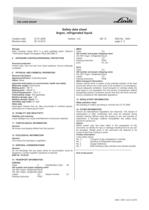
Safety data sheet Argon, refrigerated liquid. Creation date : Revision date : 27.01.2005 20.12.2010 Version : 4.0 Storage Keep container below 50°C in a well ventilated place. Observe "Technische Regeln Druckgase (TRG) 280 Ziffer 5" 8 EXPOSURE CONTROLS/PERSONAL PROTECTION Personal protection Protect eyes, face and skin from liquid splashes. Ensure adequate ventilation. 9 PHYSICAL AND CHEMICAL PROPERTIES General information Appearance/Colour: Colourless liquid. Odour: None. Important information on environment, health and safety Molecular weight: 40,00 g/mol Melting point: -189 °C Boiling point:...
Open the catalog to page 2All Linde Gas catalogs and technical brochures
 Overview of Shielding Gases
12 Pages
 propane
1 Page
 lindoflamm_flame_solutions
2 Pages
 hydrogen
2 Pages
 acetylene
2 Pages
 ETO
ETO3 Pages
 DA
DA2 Pages
 Cl2
Cl23 Pages
 NH3
NH33 Pages
 C2H6
C2H63 Pages
 CO
CO2 Pages
 D2
D22 Pages
 Ar
Ar2 Pages
 Air
Air2 Pages
 Liquid Helium - He
2 Pages
 Carbon Dioxide -CO2
3 Pages
 linde annual 2009
96 Pages
 AXENIS Water Treatment
8 Pages
 LINSPRAY Thermal Spray Solutions
16 Pages
 LINDOFLAMM Brochure
12 Pages
 Acetylene Brochure
9 Pages
 Bottom Injection systems
2 Pages

