
- Catalogs
- Lincoln Electric
- CONSOMMABLES METRODE


- Products
- Catalogs
- News & Trends
- Exhibitions
CONSOMMABLES METRODE
1 /420Pages

CONSOMMABLES METRODE
1 /420Pages
Catalog excerpts
WELDING CONSUMABLES A Lincoln Electric Company
Open the catalog to page 1
WORLDWIDE WELDING CONSUMABLES FOR HIGH INTEGRITY APPLICATIONS - Power Generation A L - Nuclear Industry - Petrochemical Industry - Offshore Industry
Open the catalog to page 2
INTRODUCTION TO METRODE 1. The company Metrode was founded in 1963 as a privately owned company. In the subsequent years it has grown to become the UK's leading manufacturer and supplier of alloyed welding consumables. The Company is particularly strong in those industries which require the highest integrity from their welding consumables, such as power generation, chemical and petrochemical, offshore oil and gas, LNG and nuclear. In the two last decades, the export market has been vigorously developed and Metrode has markets globally. It also has an extensive overseas network of distributors...
Open the catalog to page 4
9. Technical support Technical support is available to help with any aspect of consumable choice, applications or procedural guidance. Field based staff can advise on procedural aspects and factors needed to achieve optimum performance. Facilities are available at Metrode as well as large numbers of other Lincoln facilities worldwide for demonstration, training and evaluation for all the major welding processes which utilise Metrode consumables. 10. Specifications and certification Metrode consumables are manufactured to conform with the current issues of BS EN, BS EN ISO or AWS-ASME standards...
Open the catalog to page 5
DATA SHEETS : INTRODUCTION AND EXPLANATORY NOTES The individual data sheets collect all of the processes (MMA, TIG, MIG, SAW and FCAW) onto a single data sheet, allowing all products for any alloy type – eg 316L – to be seen at a glance. The front page of each data sheet provides the generic information on that particular alloy – alloy type, materials to be welded, applications, microstructure, welding guidelines, PWHT, additional information and products available. The data specific to the individual products – product description, specifications, analysis, mechanical properties etc – are then...
Open the catalog to page 6
DATA SHEETS: INTRODUCTION AND EXPLANATORY NOTES All-weld mechanical properties Minimum and typical tensile and impact properties are given where applicable to satisfy national specifications or material requirements. Caution is generally advised in translating these all-weld (longitudinal) values to joint (transverse) test values. Operating parameters Current ranges are based on satisfactory fusion and arc stability. Optimum conditions are influenced by variables such as welding position, base material thickness, and heat input considerations, etc. Most electrodes operate smoothly on DC+ (positive...
Open the catalog to page 7
Section A : Low Alloy Steels METRODE PRODUCTS LTD HANWORTH LANE, CHERTSEY SURREY, KT16 9LL, UK Tel: +44[0]1932 566721 / Fax: +44[0]1932 565168 Email: [email protected] Website: www.metrode.com This section includes consumables suitable for welding general engineering and structural steels, from medium tensile grain-refined CMn and semi-cryogenic steels (approximately -75°C) to specialised heat and creep-resistant CrMo types reaching the threshold of stainlessness at 12%Cr. Flux coverings of all electrodes are of all-positional basic low-hydrogen type and employ binders giving high resistance to...
Open the catalog to page 8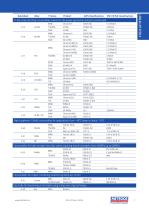
Datasheet Alloy Process Product AWS Classifications EN / EN ISO Classifications Cr-Mo creep resisting consumables mainly for the power generation industry [continued] LOW ALLOY STEELS E CrMoWV 12 1 B W CrMoWV12 1 High toughness 1-3%Ni consumables for applications from -40°C down to about -75°C Consumables for high strength low alloy steels requiring tensile strengths from 620MPa up to 825MPa Consumables for copper containing weathering steels eg. Corten Electrode for the joining of rail steels using a slag-over-slag technique
Open the catalog to page 9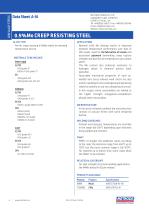
ALLOY TYPE Nominal 0.5% Mo alloying results in improved elevated temperature performance over that of CMn steels. Used for the fabrication of vessels and associated pipework demanding creep rupture strength and ductility at temperatures up to about 450°C. The Mo content also enhances resistance to hydrogen attack in chemical process plant operation. Favourable mechanical properties of both as-welded and stress-relieved weld metal are also useful in welding structural and general engineering steels for ambient or sub-zero temperature service. In this respect these consumables are related to the...
Open the catalog to page 10
Mo.BMOLYBDENUM ALLOYED MMA ELECTRODE FOR ELEVATED TEMPERATURE SERVICE PRODUCT DESCRIPTION Basic flux, metal powder type coating on high purity mild steel core wire. Moisture resistant coating giving very low weld metal hydrogen levels. Recovery is about 120% with respect to core wire, 65% with respect to whole electrode. SPECIFICATIONS ASME IX QUALIFICATION BS and AWS Mn ranges overlap, but required specification should be stated on order. WELDING POSITIONS (ISO/ASME) CHEMICAL COMPOSITION (WELD METAL WT %) C Mn Si S P Cr ALL-WELD MECHANICAL PROPERTIES * BS and DIN: 600°C/1h;...
Open the catalog to page 11
CMo0.5%Mo SOLID TIG AND MIG WIRE FOR CREEP RESISTING STEELS PRODUCT DESCRIPTION Copper coated solid wire for TIG and MIG. SPECIFICATIONS ASME IX QUALIFICATION CHEMICAL COMPOSITION (WIRE WT %) C Mn Si S P Cr Mo Ni Cu V ALL-WELD MECHANICAL PROPERTIES Properties as-welded (AW) or PWHT: Tensile strength (MPa) ‘Minimum values are after PWHT 620°C/1h [AWS] or 595°C/0.5h [DIN] and as-welded for BS EN. MAG welds using more oxidising shielding gas [higher CO2 + O2] will have lower strength than shown. TYPICAL OPERATING PARAMETERS Shielding gas Current Diameter (mm) Parameters...
Open the catalog to page 12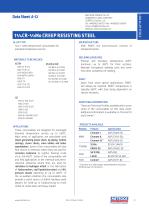
METRODE PRODUCTS LTD HANWORTH LANE, CHERTSEY SURREY, KT16 9LL, UK Tel: +44(0)1932 566721 / Fax: +44(0)1932 565168 Email: [email protected] Website: www.metrode.com 1¼CR-½Mo CREEP RESISTING STEEL MICROSTRUCTURE After PWHT, the microstructure consists of tempered bainite. ALLOY TYPE 1¼Cr-½Mo alloyed steel consumables for elevated temperature service WELDING GUIDELINES Preheat and interpass temperature 200°C minimum, up to 300°C for thick sections. Maintain throughout welding cycle and some time after completion of welding. PWHT Apart from some special applications, PWHT will always be required....
Open the catalog to page 13All Lincoln Electric catalogs and technical brochures
 MAGNUM® PRO BARREL HDE™ GUNS
9 Pages
 ARC GOUGING TORCH
3 Pages
 HYPERFILL®
6 Pages
 DLF™-82 Wire Feeder
2 Pages
 Power Wave ® C300
4 Pages
 DOWNFLEX® 200-M AND 400-MS/A
3 Pages
 WELDING GLOVES
13 Pages
 PIPEFAB™
12 Pages
 CONSOMMABLES
644 Pages
 LINC TORCH TIG TORCHES RANGE
16 Pages
 WELD FUME CONTROL
3 Pages
 POWER WAVE® R450
2 Pages
 VIKING™ 1740 Series
2 Pages
 FUME DOESN’T STAND A CHANCE
2 Pages
 PIPE MILL Industry
2 Pages
 LN-25 PRO WIRE FEEDERS
6 Pages
 FLEXTEC® 350X
2 Pages
 Precision TIG 275/375
8 Pages
 WELD FUME CONTROL
4 Pages
 WELD FUME CONTROL
2 Pages
 Mobiflex® 100
2 Pages
 MOBIFLEX
3 Pages
 RP6 ™
RP6 ™2 Pages
 MIG Wire
2 Pages
 HARDFACING COMPARISON CHART
4 Pages
 PROCESS Z
6 Pages
 WELDING & CUTTING EQUIPMENT
140 Pages
 Vantage® 500
8 Pages
 Vantage® 400
8 Pages
 Vantage® 300 EPA
8 Pages
 Classic® 300 HE EPA
6 Pages
 Ranger® 305 LPG
6 Pages
 Ranger® 250 GXT
6 Pages
 Ranger® 225
6 Pages
 Outback® 185 Engine
4 Pages
 Outback® 145
4 Pages
 Bulldog® 5500
4 Pages
 Inverter Racks
2 Pages
 Power Wave® S700
8 Pages
 Power Wave® 455M
8 Pages
 Power Wave® S500
4 Pages
 Power Wave® STT®
4 Pages
 Power Wave® S350
4 Pages
 Power Wave® C300
4 Pages
 Power Wav e Advanced Module
4 Pages
 Idealarc® DC600
2 Pages
 Idealarc® DC400
2 Pages
 Flextec? 450
4 Pages
 ARC TRACKER
2 Pages
 Idealarc® CV400 MIG Welder
2 Pages
 Idealarc® CV305 MIG Welder
2 Pages
 POWER MIG® 350MP MIG
4 Pages
 POWER MIG® 256 MIG Welder
4 Pages
 POWER MIG® 216 MIG Welder
4 Pages
 Invertec® V160-T TIG Welder
2 Pages
 Idealarc 250
2 Pages
 V275-S
2 Pages
 AC/DC 225/125
2 Pages
 AC225
AC2252 Pages
 VIKING 2450D DIGITAL
1 Page
 VIKING 3350 Series
2 Pages
 Wireless Pedal
1 Page
 S500
S5004 Pages
 Power Wave S350
4 Pages
 POWER MIG 350MP
4 Pages
 84 SERIES
4 Pages
 Flex Feed ? 74 HT
4 Pages
 Air Vantage ® 650
8 Pages
 WELDING CONSUMABLES
719 Pages
 Magnum Semiautomatic Guns
8 Pages
 X-TRACTOR® 1GC
4 Pages
 Mobiflex®-100NF
2 Pages
 Invertec® STT ® II
6 Pages
 Multi-WeldTM350
6 Pages
 Idealarc® R3R-400 & 500
2 Pages
 POWER MIG® 256
4 Pages
 SP-180T
2 Pages
 POWER MIG® 180C
2 Pages
 SP-140T
2 Pages
 POWER MIG® 140C
2 Pages
 Precision TIG ® 375
6 Pages
 Precision TIG ® 275
6 Pages
 Invertec® V311-T AC/DC
8 Pages
 Precision TIG® 225
6 Pages
 Invertec® V205-T DC
4 Pages
 Invertec® V205-T AC/DC
4 Pages
 Square Wave TIG 175
2 Pages
 Invertec® V160-T
2 Pages
 Idealarc® 250
2 Pages
 e2161
e21612 Pages
 e2100
e21002 Pages
 e260
e2602 Pages
 e9502
e95024 Pages
 e9181
e918124 Pages
 K210-2/e910
4 Pages
 e8200
e82004 Pages
 e8101
e81014 Pages
 K316L-1/e890
2 Pages
 K1560-2/e452
6 Pages
 K3038-1/e1213
2 Pages
 K2647-4/e1203
6 Pages
 Cougar push pull gun
2 Pages
 K2618-1/e342
6 Pages
 K2535-1/e337
6 Pages
 K2808-2/e11300
4 Pages
 e11500
2 Pages
 K2807-1/e11200
4 Pages
 e11100
4 Pages
 e12150
12 Pages
 Ranger 250 GXT
6 Pages
 SP-180T
4 Pages
 SP-180T
4 Pages
 X-Tractor 1GC
4 Pages
 Pipeliner 200D (Kubota)
4 Pages
 Miniflex
4 Pages
 Power Wave AC/DC 1000 SD
24 Pages
 Invertec V350-PRO
4 Pages
 Invertec V155-S
4 Pages


Archived catalogs
 Air Vantage® 650
8 Pages
- Fabric clothing
- Mechanical protection protection gloves
- Lincoln Electric welder
- Industrial safety gloves
- Lincoln Electric arc welder
- Lincoln Electric portable welder
- Work jacket
- Thermal protection safety gloves
- Industrial fume extractor
- Black protection gloves
- Inverter welder
- Mobile fume extractor
- Lincoln Electric single-phase welder
- MIG-MAG welder
- Lincoln Electric TIG welder
- Lincoln Electric DC welder
- MMA welder
- Lincoln Electric three-phase welder
- XL safety gloves
- Fabric jacket
- VirtualExpo Group
- Our Partners
- Recruitment
- Testimonials