


Fundamentals of leak detection

Fundamentals of leak detection
Leybold GmbH, part of the Atlas Copco Group, is a leader in vacuum technology. This document provides an overview of vacuum technology to enhance understanding of the field, emphasizing customer partnerships and innovation.
The document discusses the importance of leak detection in vacuum systems and industries requiring hermetic sealing, highlighting the necessity of specific leak rates for acceptance testing.
Leaks are categorized by origin, including detachable connections, permanent connections, porosity, thermal effects, virtual leaks, indirect leaks, serial leaks, and one-way leaks. Permeation is also discussed.
The document explains that no system is completely vacuum-tight, but the leak rate must be low enough to maintain required pressure. The concept of "leak rate" is introduced, measured in mbar·l/s, with a relationship to gas mass flow explained.
Methods include pressure rise/drop tests, bubble immersion, and foam-spray tests, each detailed with applications and limitations.
Different types of leak detectors, such as halogen and mass spectrometers, are covered, explaining their principles, detection limits, calibration, and connection to vacuum systems.
Specifications for acceptable leak rates are provided, with guidelines for different systems based on required tightness.
Techniques such as the vacuum method, positive pressure method, and envelope test are discussed with applications and effectiveness.
The document outlines industrial applications of leak testing, emphasizing precise leak detection's importance in various industries.
A comprehensive formulary covers pressure units, gas quantity, gas flow, pumping speed, leak rate, and unit conversion for leak detection calculations.
Discusses ultimate operating pressure in vacuum systems, determined by leak rate and effective pumping speed, with practical limitations like cost and space.
Failure to reach desired pressure often results from leaks or gas liberation from vessel walls and seals, differentiated using partial-pressure analysis or pressure rise tests.
Helium is preferred for leak detection due to higher sensitivity. The document provides rough estimates of leak rates based on hole size and discusses helium leak detectors.
Figures and tables illustrate the relationship between hole diameter and leak rate for air, showing smaller holes result in lower leak rates.
Methods include vacuum and positive pressure methods, spray and sniffer techniques for local leak detection.
Explains the helium standard leak rate concept for consistent measurement and comparison of leak rates.
Provides formulas for converting pressure and gas type, distinguishing between laminar viscous and molecular flow.
Methods like the pressure rise test measure pressure increase time in a vacuum system without specialized detectors.
Emphasizes accurate measurement and helium use for sensitivity in leak detection.
Provides an overview of methods and technologies in leak detection, particularly in vacuum systems, discussing principles, procedures, and equipment.
Explains how pressure rise in a vacuum container indicates a leak, with an example calculation provided.
Less common for vacuum systems but applicable in tank engineering, monitoring pressure drop over time.
Various techniques like vacuum gauges, bubble immersion, foam-spray tests, and krypton 85 tests are detailed.
Tables compare methods, highlighting test gases, pressure ranges, and detection limits, noting helium's high sensitivity.
Details operation of leak detectors using halogen and mass spectrometry, explaining helium's advantages as a test gas.
Emphasizes selecting appropriate methods and equipment for specific requirements and conditions.
Explains operation using a mass spectrometer, focusing on the test gas spray method, with key equations for gas flow and pressure calculations.
Discusses detection limit influenced by test gas background level, recommending techniques to manage background levels.
Describes calibration using known leaks, detailing internal and external calibration methods.
Describes quadrupole mass spectrometers for larger masses and helium leak detectors with sector field mass spectrometers for sensitivity.
Distinguishes between direct-flow and counter-flow detectors based on gas supply methods to the mass spectrometer.
Provides an overview of leak detection fundamentals, focusing on vacuum systems and techniques, detailing components and processes.
Explains auxiliary pumps' role in pre-evacuating test objects and connection lines, distinguishing between main flow and counter-flow detectors.
Describes counter-flow detectors where the high-vacuum pump evacuates only the mass spectrometer, detailing the detection process.
Recommended when achieving start pressure is challenging, using an auxiliary pump to handle more test gas flow.
Outlines methods for connecting leak detectors to vacuum systems, emphasizing partial-flow method and strategic placement.
Defines time constant and provides examples of signal response times, explaining partial-flow operation's efficiency.
Lists key specifications for leak detectors, including smallest detectable leak rate and effective pumping speed.
Discusses techniques for using vacuum leak detectors, including the spray technique for local leak testing.
Emphasizes understanding principles and techniques for accurate and efficient vacuum system operation.
Adjust test gas amount based on leak rate and object size, using a choke valve to control gas flow.
Involves filling the test object with test gas, tracing potential leaks with a sniffer tip detected by a mass spectrometer.
Uses helium as a test gas, enclosing the test object in an envelope, suitable for automated industrial testing.
Used for hermetically sealed components, placing them in a helium-filled pressure vessel before testing for leaks.
Helium is used in industrial settings, integrated into manufacturing lines for cost-effective, reliable results.
Provides equations and units for pressure, gas quantity, gas flow, pumping speed, leak rate, and adjustments for temperature and pressure.
Provides a guide on leak detection fundamentals, focusing on techniques, gas properties, and conversion units for accurate measurement.
Provides formulas for vacuum and positive-pressure techniques, and molecular flow.
Provides formulas for laminar viscous and molecular flow.
Lists gases with chemical symbols, molar masses, and viscosities.
Provides formula for conversion.
Defines partial-flow ratio and provides calculation formula.
Provides formulas for calculating response time based on test object volume and effective pumping speed.
Provides formulas for calculating pump-down time and required pumping speed.
Includes tables for converting pressure, gas flow/leak rate, and temperature units.
Compares various temperature points, including body and room temperature, ice point, boiling point of liquid nitrogen, and absolute zero.
Outlines important gas laws under continuum theory, including Boyle-Mariotte, Gay-Lussac's, Amonton's, Dalton's, Poisson's, Avogadro's, General Gas Equation, Van der Waals, and Clausius-Clapeyron equations.
Document printed in Germany on chlorine-free bleached paper, published by Leybold GmbH.
Catalog excerpts
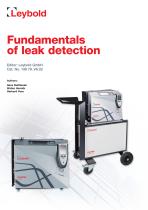
Fundamentals of leak detection Editor: Leybold GmbH Cat. No. 199 79_VA.02 Authors: Leybold GmbH Bonner Str. 498 · D-50968 Köln T +49 (0) 221-347-0 F +49 (0) 221-347-1250 [email protected] BICOM 13619.13810.19979_VA.02 0.2.12.16 mzs Printed in Germany on chlorine-free bleached paper Technical alterations reserved Hans Rottländer Walter Umrath Gerhard Voss
Open the catalog to page 1
Fundamentals of Leak Detection Leybold, a member of the globally active industrial Atlas Copco Group of companies has developed into the world market leader in the area of vacuum technology. In this leading position, we recognize that our customers around the world count on Leybold to deliver technical superiority and maximum value for all our products and services. This brochure is meant to provide an easy to read overview covering the entire range of vacuum technology and is independent of the current Leybold product portfolio. The presented product diagrams and data are provided to help promote...
Open the catalog to page 2
Fundamentals of Leak Detection Leak rate, leak size, (gas) mass flow . . . . . . . . . . . . . . . . . . . . . . . . . . . . . . . . . . . . 5 Helium standard leakrate . . . . . . . . . . . . . . . . . . . . . . . . . . . . . . . . . . . . . . . . . . . . 8 Leak detection methods without leak detector . . . . . . . . . . . . . . . . . . . . . . . . . . . . . . . 11 Pressure rise test . . . . . . . . . . . . . . . . . . . . . . . . . . . . . . . . . . . . . . . . . . . . . . . 11 Pressure drop test . . . . . . . . . . . . . . . . . . . . . . . . . . . . . . . . . . . . . . . . . . . . . . . 12...
Open the catalog to page 3
Fundamentals of Leak Detection Industrial leak test . . . . . . . . . . . . . . . . . . . . . . . . . . . . . . . . . . . . . . . . . . . . . . 30 Formulary for leak detection technique . . . . . . . . . . . . . . . . . . . . . . . . . . . . . . . . . . . 32 Pressure of a gas and pressure units . . . . . . . . . . . . . . . . . . . . . . . . . . . . . . . . . . . . . 32 9.1.1 Partial pressure - total pressure . . . . . . . . . . . . . . . . . . . . . . . . . . . . . . . . . . . . . . . . 32 9.2 9.2.1 Equation of state for ideal gases . . . . . . . . . . . . . . . . . . . . . . . . . . . . . ....
Open the catalog to page 4
Fundamentals of Leak Detection Fundamentals of Leak Detection Introduction In addition to the actual vacuum systems and their individual components (vacuum vessel, lines, valves, measuring devices, etc .) there are numerous other systems and products in the fields industry and research with high requirements regarding tightness or so-called "hermetic sealing" . These include, in particular, assemblies for the automotive and refrigeration industry Generalized statements often made, such as “no detectable leaks” or “leak rate zero”, do not represent an adequate basis for acceptance testing Every...
Open the catalog to page 5
Fundamentals of Leak Detection 2 Leak rate, leak size (gas) mass flow No vacuum device or system can ever be absolutely vacuum-tight and it does not actually need to be. The simple essential is that the leak rate must be low enough that the required operating pressure, gas balance and ultimate pressure in the vacuum container are not influenced. It follows that the requirements in regard to the gas-tightness of an apparatus are the more stringent the lower the required pressure level is. In order to be able to register leaks quantitatively, the concept of the "leak rate" with the symbol qL and...
Open the catalog to page 6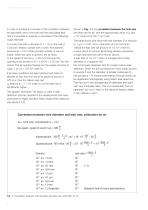
Fundamentals of Leak Detection In order to achieve an overview of the correlation between the geometric size of the hole and the associated leak rate it is possible to operate on the basis of the following, rough estimate: A circular hole with a diameter D = 1 cm in the wall of a vacuum vessel is closed with a valve. Atmospheric pressure (p = 1013 mbar) prevails outside, a vacuum inside. When the valve is opened, the air flows at the speed of sound (vS = 330 m/s) through the opening cross section of A = p-(D2/4) - 0.79 cm2 into the vessel. The air quantity flowing into the vessel amounts to qL(air)...
Open the catalog to page 7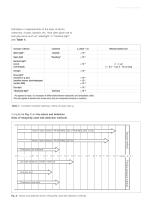
Fundamentals of Leak Detection Estimates or measurements of the sizes of atoms, molecules, viruses, bacteria, etc. have often given rise to everyday terms such as “watertight” or “bacteria-tight” (see Table 1).
Open the catalog to page 8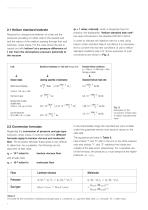
Fundamentals of Leak Detection 2.1 Helium standard leakrate Required for unequivocal definition of a leak are the pressures prevailing on either side of the (vessel) wall and the nature of the medium passing through that wall (viscosity, molar mass). For the case where the test is carried out with helium4 at a pressure difference of 1 bar from the atmosphere pressure (external) to the vacuum (p < 1 mbar, internal), which is frequently found in practice, the designation "helium standard leak rate" has been introduced in the standard DIN EN 1330-8. In order to indicate the rejection rate for a...
Open the catalog to page 9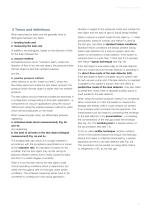
Fundamentals of Leak Detection 3 Terms and definitions When searching for leaks one will generally have to distinguish between two tasks: 1. locating leaks and 2. measuring the leak rate In addition, we distinguish, based on the direction of flow for the fluid, between the a. vacuum method (sometimes known as an "outside-in leak"), where the direction of flow is into the test object; the pressure inside the test object is less than ambient pressure and the b . positive pressure method (often referred to as the “inside-out leak”), where the flow takes place from inside the test object outward;...
Open the catalog to page 10
Fundamentals of Leak Detection Fig. 4: Usage options for a vacuum leak detector based on the vacuum method (a, b) and based on the positive pressure method (c, d)
Open the catalog to page 11
Fundamentals of Leak Detection 4 Leak detection methods without leak detector The most sensible differentiation between the test methods used is the differentiation as to whether or not special leak detection equipment is used. In the simplest case a leak can be determined qualitatively and, when using certain test techniques, quantitatively as well (this being the leak rate) without the assistance of a special leak detector. For example, the quantity of water dripping from a leaking water faucet over a certain period of time can be determined by collecting the water with a measuring vessel....
Open the catalog to page 12All Leybold catalogs and technical brochures
 Full Line Catalog
1046 Pages
 GRAPHIX Series
2 Pages
 DRYVAC Energy Saver
2 Pages
 DRYVAC PowerBoost
8 Pages
 DRYVAC SERIES
5 Pages
 Mechanical Vacuum Systems
8 Pages
 Renewable Energies
6 Pages
 Coating Technologies
8 Pages
 Fundamentals of Vacuum Technology
200 Pages
 Product Overview 2019
24 Pages
 Vacuum Pumps
6 Pages
 SmartCheck
4 Pages
 LEYASSIST
2 Pages
 Ion Getter Pumps
6 Pages
 Vacuum Measurement - Sensors
8 Pages
 PHOENIX 4 Leak Detector
8 Pages
 Multi Inlet TURBOVAC i
8 Pages
 SOGEVAC NEO
8 Pages
 Food & Packaging
36 Pages
 Product Overview 2018
24 Pages
 Full Line Catalogue 2018
980 Pages
 COMBIVAC Series
2 Pages
 PHOENIX Series
8 Pages
 COOLPOWER
2 Pages
 DIJ - Oil Diffusion Pumps
4 Pages
 RUVAC® WH / WHU Roots Pumps
8 Pages
 DRYVAC Systems
6 Pages
 CVS Central Vacuum Stations
4 Pages
 CLAWVAC
6 Pages
 VACUBE
12 Pages
 ECODRY plus
8 Pages
 TRIVAC T
6 Pages
 Oil Sealed Vacuum Pump
194 Pages
 Cryogenics
8 Pages
 Rotary Vane Pumps
8 Pages
 Flat Panel Display
12 Pages
 Research & Development
12 Pages
 Coating Applications
8 Pages
 TURBOVAC i
12 Pages
 SOGEVAC SV 16 - 25 D
2 Pages
 SOGEVAC SV 10 B - SV 120 B
4 Pages
 SOGEVAC SV 300 B
4 Pages
 COOLVAC
6 Pages
 Turbomolecular Pump System
6 Pages
 UNIVEX
8 Pages
 Diffusion Pumps
4 Pages
 TURBOVAC iX
12 Pages
 Fluid entrainment pumps
8 Pages
 MAG digiLine
4 Pages
 RUVAC WA(U) / WS(U)
4 Pages
 SOGEVAC SV10 B - SV 120 B
4 Pages


Archived catalogs
 PHOENIXL 300
6 Pages
 Oil-free Scroll Vacuum Pumps
4 Pages
 ATEX Vacuum Pumps
6 Pages


- Manual valve
- Fitting
- Stainless valve
- Control valve
- Hydraulic fitting
- Vacuum generator
- Regulating valve
- Electric valve
- Single-stage vacuum pump
- Pressure limiter
- Single-pole switch
- Gas valve
- Calibration system
- Synthetic lubricant
- Single-stage pressure regulator
- Gate valve
- Industrial pressure limiter
- Lubricated vacuum generator