
- Catalogs
- LEROY-SOMER
- Moteurs asynchrones avec freins 160 au 315 HA


Moteurs asynchrones avec freins 160 au 315 HA

Moteurs asynchrones avec freins 160 au 315 HA
MOTEURS PATAY, established in 1886, is a specialist in electric motors, particularly for hoisting and handling applications. Since joining the LEROY-SOMER group in 1981, the company has focused on special induction motors and medium power electromagnetic brakes, maintaining ISO 9001 accreditation.
The catalogue includes brake induction motors with frame sizes 160 to 315, designed for single-speed and multi-speed operations, with various housing materials and protection levels.
Brake motors offer various mounting configurations with specific restrictions. Protection levels range from IP 23 to IP 55, with shock resistance standardized at IK 08.
Standard connections are available for single-speed and multi-speed motors, with specific configurations for slip-ring motors. Insulation is class F, with balancing options including half-key, full-key, and no-key.
Motors feature different rotor types, such as aluminium and slip-ring rotors, suited for specific duty cycles. Key parameters like efficiency, torque, and current adhere to IEC standards.
Guidelines cover braking torque, starting classes, and duty cycles, emphasizing proper configuration to prevent overheating and ensure efficiency.
The FCPL series includes D.C. brakes with separate power supply options, suitable for continuous and intermittent duty, with specified protection and power supply details.
- Coil Rated Voltage: 180 V.
- Braking Torque: Adjustable by changing the number of springs, protected against loss of adjustment.
- Air Gap Adjustment: Easily adjustable by removing the brake cover.
- Friction Lining: Asbestos-free with low abrasion.
- Individual Checks: Routine tests, checks on resistors and options, running-in, and traceability of the brake disk.
- Options: Various brake voltages, release by lever, brake release indicator, lining wear indicator, and adaptation for additional components like encoders.
- Description: The coil, when not energized, keeps the disk pressed between the armature and plate by spring action, stopping the motor rotor. Energizing the coil releases the disk and rotor.
- Range: Includes various models with different mechanical characteristics and thermal capacities.
- Thermal Capacity: Overheating is caused by Joule effect and friction, with specific capacities for non-periodic and periodic braking.
- Lining Wear: Adjustment frequency is based on dissipated energy for complete disk wear and 1 mm lining wear.
- Response Time: Depends on coil type, voltage supply tolerance, air gap size, and braking torque.
- Description: Similar operational principles as FCPL brakes, with electromagnet and spring action controlling the disk and rotor.
- Thermal Capacity: Similar considerations for Joule effect and friction losses.
- Lining Wear: Adjustment based on dissipated energy for disk and lining wear.
- Voltage and Current: Detailed specifications for S3 and S1 coils across different models.
- Power Supply: Includes rectifier and CDF doping device for improved brake response time and reduced coil temperature rise.
The document provides comprehensive technical details for the operation, adjustment, and maintenance of CDF and FCPL brakes, emphasizing the importance of proper setup and regular checks to ensure optimal performance.
1. Brake Release Time (Pick-up Time): Influenced by air gap size and braking torque, involving two stages of current flow through the coil.
2. Braking Time (Engage Time): Short, ranging from 10 to 20 ms, depending on brake type and torque.
1. Tolerances: Standard voltage is 230/400 V at 50 Hz with a tolerance of +5% to -10%.
2. Connections: Connection terminal block details and wire color codes are provided for different brake models.
Operating voltage is 400 V at 50 Hz. Electrical characteristics such as current, resistance, and power for various FAP brake models are detailed.
1. Motor Protection: Standard IP 55 protection.
2. Brake Protection: Standard IP 44 protection.
3. Motor Housing: Made with cooling fins and pressure die-cast in aluminum alloy.
4. Bearings: C3 sealed ball bearings with regreasable options for larger sizes.
5. Finish: Zinc bichromate or cadmium finish with RAL 6000 paint.
6. Power Supply: Standard 230/400 V at 50 Hz for motors and separate D.C. supply for brakes.
1. Motor Options: Multi-speed, construction for different starting methods, protection sensors, and forced ventilation.
2. Brake Options: Various voltage options, manual release, indicators for release and wear, and special terminal box positions.
Detailed dimensions for flange and foot-mounted configurations are provided for various motor and brake types.
The document outlines the specifications for FLS series motors and brakes, including power ratings from 4 to 75 kW, frame sizes from 160 to 280 mm, and configurations with 4, 6, and 8 poles. The motors operate at 230/400 V and 50 Hz, with standard motor protection at IP 55 and brake protection at IP 44 or IP 55.
Options for motors include multi-speed configurations, IP 56 non-ventilated motors, and various protection sensors (PTO, PTF, PTC). Brake options include different voltage settings (20 V, 100 V, 200 V), release by lever, and indicators for brake release and lining wear.
The document provides detailed technical data for various motor types, including rated power, speed, current, power factor, efficiency, starting current, torque, moment of inertia, and weight. This data is crucial for selecting the appropriate motor and brake configuration for specific applications.
The motors feature cast iron cooling fins, sealed C3 ball bearings, and a zinc bichromate or cadmium finish on screws. The rotor is made from a squirrel cage pressure die-cast in aluminum, suitable for S1 duty.
Dimensions for flange-mounted and foot-mounted configurations are provided, with detailed measurements for each motor type. The document also includes information on output shaft dimensions and flange specifications.
The document specifies the permissible number of starts per hour for continuous duty and provides guidelines for higher operating rates, advising consultation with Leroy-Somer for larger frame sizes or higher operating rates.
Each motor undergoes routine tests, including no-load, short-circuit, and dielectric tests, to ensure quality and performance. The document emphasizes the importance of running-in and traceability of the brake disk.
The document outlines the specifications for FLSB motors and FCPL/FAP brakes. The motors are available in various frame sizes and power ratings, with standard class F winding and IP 55 protection. The brakes have separate power supplies and offer high braking torque with IP 44 or IP 55 protection.
Before dispatch, motors undergo routine tests including no-load, short-circuit, and dielectric tests. The direction of rotation and rotor voltage are also checked. Running-in and traceability of brake disks are ensured.
The stator is connected via a terminal block with six terminals. The rotor connection varies by frame size, and the brake has specific terminal box configurations depending on the model.
The motors allow up to 150 starts per hour at 60% duty. For higher operating rates, consultation with Leroy-Somer is recommended.
Available options for motors include protection sensors, space heaters, regreasable bearings, and forced ventilation. Brake options include various voltage settings, release indicators, and wear indicators.
The document provides detailed dimensions for flange and foot-mounted configurations, including specific measurements for each motor type. It also notes that certain models have a second terminal box for rotor connection.
Tables provide detailed performance data for various motor models, including rated power, speed, current, efficiency, and torque values. This data is crucial for selecting the appropriate motor and brake combination for specific applications.
For larger sizes or specific configurations, consultation with Leroy-Somer is advised. The document emphasizes the importance of adhering to specified conditions of use and selecting appropriate options to ensure optimal performance.
Standard version IP 44 for brake protection ensures safety and reliability in operation.
Constructed from aluminum alloy for frame sizes up to 225, with cooling fins for sizes 250 and 280. Frame size 315 is made from steel.
Made from cast iron and secured with tie rods, providing robust protection.
Utilizes C3 ball bearings, sealed for sizes 160 to 180, and regreasable for larger sizes. Bearings are designed to handle thrust at the front and are heavily preloaded at the rear to prevent axial oscillation.
Components are assembled using zinc bichromate or cadmium finish on screws, with a RAL 6000 green paint finish and identification on a riveted aluminum plate.
Standard supply is 230/400 V at 50 Hz.
Separate D.C. supply from the 400 V supply via an S07 rectifier or a CDF doping device.
Standard class F winding with a squirrel cage rotor for continuous duty (S1) and special alloy for S3 duty.
Sealed and fitted with a cable gland, mounted on top of the motor.
Motor connection via a terminal block with 6 terminals. Brake connection integrated in the motor terminal box for sizes 160 to 225, and in the brake for sizes 250 to 315.
Includes routine tests, no-load test, short-circuit test, dielectric test, and checks on options and direction of rotation.
Allows 6 starts per hour for continuous duty, with specific operating factors for different sizes. Higher operating rates require consultation with Leroy-Somer.
Includes multi-speed motors, various protection sensors, space heaters, regreasable and roller bearings, and forced ventilation options.
Includes various brake voltages, release mechanisms, indicators, and adaptation for additional devices.
Detailed specifications for various motor types, including rated power, speed, current, efficiency, and torque, are provided in tabular form.
Dimensions for flange and foot-mounted motors are provided, with additional details for installing encoders and output shafts.
The document describes a 15 kW geared motor with specific characteristics including a 4-pole motor running at 1455 rpm, motor inertia of 0.09 kg.m2, and gearbox inertia of 0.01 kg.m2. An FCPL D.C. brake is required.
- Rated motor torque is calculated as 99 Nm.
- Hoisting movement torque is 158 Nm, allowing the use of the FCPL54 - 215 brake.
- Total inertia applied to the motor is 0.1175 kg.m2.
- The brake coil is suitable for 40% duty cycle.
- Thermal capacity of the brake is sufficient, with no thermal limit.
- Lining wear is calculated for 0.6 mm, allowing 241,000 braking actions before adjustment.
- Coil response time is 150 ms for brake release and 70 ms for braking.
- Total load stopping time is 430 ms.
Application Area: Acceptance of tenders implies acceptance of conditions without exception. These conditions prevail over customer stipulations.
Orders: Orders are valid only after written acceptance. Modifications to goods can occur without prior notice.
Price: Prices are exclusive of tax and may be revised. Special manufacture incurs additional costs.
Delivery: Governed by INCOTERMS. Goods are transported at consignee's risk.
Delivery Dates: Stated for information only and subject to compliance with order provisions.
Tests: Goods are tested before leaving the factory. Specific tests are customer's responsibility.
Terms of Payment: Sales are payable at the vendor's office. Non-payment incurs penalties.
Compensation Clause: Debts can be compensated between vendor and customer.
Transfer of Risks and Title: Risks transfer upon handing over goods. Title transfers upon full payment.
Confidentiality: Both parties must maintain confidentiality of information.
Industrial and Intellectual Property Rights: Vendor retains ownership of developed results and data.
Cancellation Clause: Vendor can cancel sale for non-payment or breach of obligations.
Warranty: Goods are warranted against defects for twelve months, with conditions applied.
The warranty is limited to the replacement or repair of parts or goods recognized as defective by the vendor's technical departments. Repairs by third parties require vendor approval. Goods should not be returned without written authorization from the vendor and must be sent prepaid. If not repaired under warranty, return shipping costs will be charged to the customer. The warranty does not cover dismantling and reinstallation costs. Repair or replacement during the warranty period does not extend the warranty duration. These provisions are the vendor's sole warranty obligations.
The vendor is liable for bodily injury caused by their goods or personnel. Property damage repair is limited to the value of the defective goods. Both vendor and customer waive claims for indirect, consequential, or punitive damages, including loss of production, profit, market withdrawal costs, recall costs, dismantling and reinstallation costs, and loss of contracts.
Spare parts and accessories are available on request, subject to availability. Related costs are added to the invoice. The vendor may require a minimum order quantity or invoice amount.
If any provision is unenforceable, it should be adjusted to reflect the parties' intent. Other provisions remain valid and enforceable.
These conditions are governed by French law. Disputes are subject to the jurisdiction of the courts of Angoulême, France, unless amicably settled.
Catalog excerpts

Brake induction motors Frame sizes 160 to 315 Technical catalogue
Open the catalog to page 1
in 1886 by Marius PATAY, MOTEURS PATAY began by specializing in the production of electric motors and the PATAY trademark quickly became synonymous with high-performance products. The company is based in Lyon and has benefited from the region's rapid industrial expansion to expand into electromechanics and electrical engineering. Over the years, MOTEURS PATAY has become well-known throughout the world for offering innovative, technical solutions adapted to increasingly varied requirements. The company's reputation and expertise are especially relevant in the field of hoisting and handling applications....
Open the catalog to page 2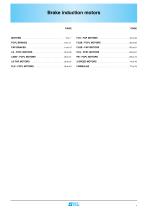
Brake induction motors FLSB - FCPL MOTORS . . . . . . . . . . . . . . . . . . . . . . . . 50 to 55 LSMV - FCPL MOTORS . . . . . . . . . . . . . . . . . . . . . . . . 26 to 31
Open the catalog to page 3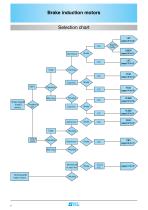
Drip-D proof Brake induction motors Selection chart Cage "LEROY' iSOMBi
Open the catalog to page 4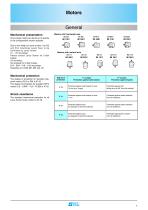
Mechanical presentation All our brake motors can be set up to operate in the configurations shown opposite. Due to the weight of some motors, the B5 and B14 mountings would have to be confirmed by Leroy Somer. V1 - V5 mountings: Please consult Leroy Somer for 2-disk brakes. V3 mounting: Not possible for 2-disk brakes. B14 - B34 - V18 - V19 mountings: Restricted to LS160 MP, MR and LR. Motors with horizontal axis IM B3 IM B5 Mechanical protection The degree of protection for standard drip-proof motors (PLS or PB) is IP 23. The degree of protection for standard TEFV motors (LS - LSMV - FLS -...
Open the catalog to page 5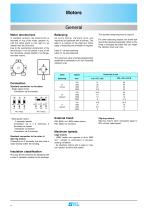
Motor terminal box In standard versions, the terminal box is mounted on top of the motor (position A), with the cable gland on the right (1) as viewed from the drive end. Due to the symmetrical construction of the terminal box, it can be placed in any of the four directions, except position 2 on flange-mounted motors. Connection Standard connection to the stator - Single-speed motor Connection via 6 terminals. - Multi-speed motors • 2 separate speeds Connection via 2 x 3 terminals, 3 terminals per speed. • Dahlander connection Connection via 6 terminals. Standard connection to the rotor of slip-ring...
Open the catalog to page 6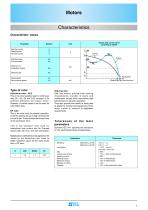
Characteristics Characteristic values Parameter Torque and current curve according to speed (Rated) (Synchronous) Type of rotor Aluminium rotor - ALU This is the most suitable type for continuous duty (S1, S2, S9 and S10) because of its optimum efficiency and power factor. However, in certain cases it can be used for intermittent duty. DP rotor This is the ideal rotor for periodic operation, since the starting torque is high whereas the current is low. It also reduces the torque drop of the aluminium rotor. This is the standard rotor used for intermittent duty motors and for 2-speed motors...
Open the catalog to page 7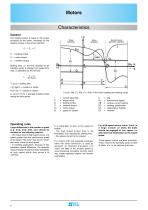
Df = braking torque Cr = resistive torque NS = synchronous speed DC = regenerative braking EF = reversal General The braking torque is equal to the torque produced by the motor, increased by the resistive torque of the driven machine. Cf = Cm + Cr Cf = braking torque Cm = motor torque Cr = resistive torque Braking time, i.e. the time required for an induction motor to change from speed N to stop, is calculated by the formula: T = n ■ J - IN f 30 ■ Cf(av) Tf (in s) = braking time J (in kgm2) = moment of inertia N (in min-1) = speed of rotation Cf (av) (in N.m) = average braking...
Open the catalog to page 8
Operating factor Expressed as a percentage, this is the ratio of the motor power-up time during the cycle to the total cycle time, provided that the total cycle time is less than 10 minutes. Starting class Class = N = Nd + K.Nf + K'.Ni Nd: number of complete starts per hour Nf: number of electrical braking operations (deceleration) per hour Ni: number of pulses (incomplete starts up to a third of maximum speed) per hour Constants K and K' have the following values: cage motors: K = 3 K' = 0.5 slip-ring motors: K = 0.8 K' = 0.25 An electrical braking operation is defined as an operation...
Open the catalog to page 9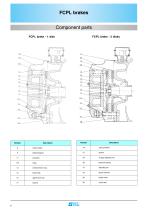
"LEROY' iSOMBi
Open the catalog to page 10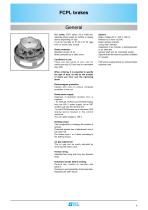
D.C. brake, FCPL series, 65 to 2400 Nm, separate power supply by rectifier or doping device depending on size. It can be mounted on IP 23 or IP 55 cage rotor or wound rotor motors. Brake protection Standard version IP 44. Brake protected by a steel cover. Conditions of use There are two types of coil, one for continuous duty (S1) and one for intermittent duty (S3). When ordering, it is essential to specify the type of duty, as well as the number of starts per hour and the operating factor. Options Brake voltage (20 V, 100 V, 200 V). Release by a lever (DLRA). Brake release indicator. Lining wear...
Open the catalog to page 11
* Operation with CDF device. (1) Can operate without a CDF device. The maximum air gap before adjustment is limited to 1.2 mm. 1) Description When stationary, the coil 9 is not energised, the disk 15 sliding on a splined sleeve is pressed between the armature 11 and the plate 8 by action of the springs 28. The motor rotor rotation is stopped. The air gap is between the yoke 9 and the armature 11. When the coil 9 is energised, the armature 11 is attracted, the springs are compressed, the disk 15 and the rotor are released. On braking, disconnection of the current eliminates the magnetic field,...
Open the catalog to page 12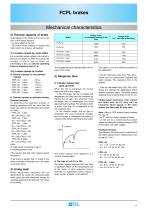
braking - FCPL 40 - 1 disk: - 35 kJ 3) Thermal capacity of brake Overheating of the brake and its coil is the sum of the losses caused: - by Joule effect in the coil - by friction when braking or starting the motor when the brake is still applied. 3-1) Losses caused by Joule effect For a constant supply voltage, the current in the coil is constant (I = U/R). As a result, the number of starts has no effect on overheating of the coil, only the operating factor is important (see 5-1-a). 3-2) Losses caused by friction a) Thermal capacity on non periodic b) Thermal capacity on periodic braking...
Open the catalog to page 13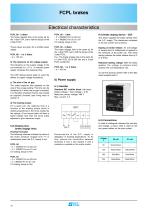
FCPL 60 - 2 disks: The brake release time is the same as for the 1-disk FCPL set to half the torque of the 2-disk FCPL. These values are given for a rectifier power supply. FCPL 88 - 1 or 2 disks: - ta = 150 ms b) The tolerance on the voltage supply The tolerance on the supply voltage to the coil terminals is ± 10 %. A reduced power supply increases the response time. The CDF doping device helps to avoid the effects of supply voltage fluctuations. c) The size of the air gap The brake response time depends on the size of the air gap setting. This time can be multiplied by 3 when the air gap is...
Open the catalog to page 14All LEROY-SOMER catalogs and technical brochures
 IMfinity® 3-phase induction motors
152 Pages
 FFB brake motors
52 Pages
 Brake motors range
16 Pages
 POULIBLOC
8 Pages
 DYNABLOC
100 Pages
 IMfinity® ATEX induction motors
16 Pages
 MULTIBLOC - IMfinity
88 Pages
 Cb, Ot, Mub, Mb, FFB
84 Pages
 LS FFB - LSES FFB
52 Pages
 LSK
LSK164 Pages
 asynchrones triphasés
176 Pages
 INDUCTION MOTORS
60 Pages
 Electromechanical drive systems
20 Pages
 Powerdrive MD2 & Systemiz
2 Pages
 Industrial Refrigeration
16 Pages
 Energy Efficiency Solutions
24 Pages
 Proxidrive
2 Pages
 Digistart D3
8 Pages
 Multibloc
2 Pages
 Training Courses 2018
52 Pages
 Environmental Policy
2 Pages
 Express Availability Commitment
12 Pages
 LEROY-SOMER QUALITY POLICY
2 Pages
 Port Logistics
20 Pages
 Hydroelectricity
2 Pages
 Nuclear Applications
16 Pages
 Marine Applications
20 Pages
 Minerals Industry
12 Pages
 Crane and hoist solutions
16 Pages
 Unimotor
2 Pages
 LC liquid cooled motors
92 Pages
 Induction motors for axial fans
60 Pages
 3-phase induction motors
176 Pages
 Geared motors 3000 Range
16 Pages
 IMfinity® induction motor range
20 Pages
 FFB brake motors
24 Pages
 TAL 040 - TAL 042 - TAL 044
36 Pages


Archived catalogs

- Synchronous motor
- LEROY SOMER AC motor
- LEROY SOMER multipole motor
- LEROY SOMER gear-motor
- LEROY SOMER asynchronous motor
- LEROY SOMER three-phase motor
- Precision gearhead
- Servo-motor
- Compact gearhead
- Solid-shaft gearhead
- LEROY SOMER compact motor
- LEROY SOMER 2-pole motor
- LEROY SOMER IP55 motor
- High-efficiency electromotor
- Gear train gear reducer
- Servo-amplifier
- Machining service