
- Catalogs
- Leitz GmbH
- Chapter 05 Routing

Chapter 05 Routing

Chapter 05 Routing
- Abbreviations: A comprehensive list of abbreviations used throughout the document, such as A (dimension A), CNC (Computerized Numerical Control), and HW (tungsten carbide).
- Routing: Detailed information on routing processes, including sizing, grooving, jointing, rebating, bevelling, profiling, face milling, and finishing. Each subsection provides specific tool types, applications, and technical features.
- Sizing and Grooving: Focuses on shank cutters, slotting cutters, and mortising bits. It includes technical features like shank tolerances, recommended RPM, and feed speeds. Various cutting methods such as ramp plunging and spiral plunging are discussed.
- Jointing, Rebating, and Bevelling: Tools and techniques for jointing and rebating, including the use of bevelling tools.
- Portable Routers: Tools for sizing, grooving, profiling, and working with solid surface materials and composite panels. It also covers drills for portable routers.
- Profiling: Tools for finger joints, internal doors, furniture, and special profiles.
- Troubleshooting: Signs of wear and troubleshooting tips for routing tools.
- Technical Specifications: Detailed tables and diagrams provide specifications for various tools, including dimensions, materials, and operational parameters.
- Tool Specifications: Detailed dimensions and material specifications for each tool type.
- Operational Guidelines: Recommended RPM and feed speeds for different materials and operations.
- Safety and Best Practices: Emphasis on proper workpiece clamping and chip removal techniques to ensure safety and tool longevity.
The document provides detailed specifications for router cutters designed for sizing and grooving operations. The tools are suitable for use with softwood, hardwood, chipboard, and various fiber materials. The cutters feature tungsten carbide turnblades with a spiral edge arrangement, which can be turned four times for extended use. The tools are designed for use with stationary routers, CNC machines, and machining centers.
Tool Specifications:
- Diameter (D): Ranges from 8 mm to 30 mm.
- Groove Length (GL): Varies from 65 mm to 235 mm.
- Nominal Length (NL): Ranges from 20 mm to 160 mm.
- Shank (S): Available in various sizes, including 10x40 mm and 25x60 mm.
- RPM: Operating speeds range from 6,000 to 24,000 min-1 depending on the tool size.
Application Notes:
- Circular pockets and boreholes deeper than the tool diameter should be cut circularly.
- Ramp-in cutting is recommended for producing mortises.
- Feed speed (vf) varies based on RPM and material type, with correction factors for materials like MDF and glulam.
Spare Parts and Accessories:
The document lists various spare knives and parts, including turnblade knives and clamping wedges, with specific dimensions and IDs for easy identification. Torx® screws and keys are also specified for maintenance and adjustments.
Routing Guidelines:
- Feed speed is dependent on cutting depth and material type, with specific guidelines provided for different operations such as jointing and sizing.
- Correction factors are provided for machining across grain and specific materials like MDF.
Conclusion:
The document serves as a comprehensive guide for selecting and using router cutters for woodworking applications, providing detailed specifications, application notes, and maintenance guidelines to ensure optimal performance and longevity of the tools.
The document provides detailed specifications for various router cutters used in machining different materials such as softwood, hardwood, chipboard, fibre materials, duromers, plastomers, and decorative laminates. The cutters are designed for sizing, grooving, and finish cutting with high demands on finish quality. They are available in different designs (short, long, spiral, alternate twist) and configurations (Z 2, Z 3, Z 1+1, Z 2+2, Z 3+3) to suit various applications and material thicknesses.
The document outlines the ideal use of these cutters after roughing cutters with a finish cut allowance of approximately 1-2 mm. It emphasizes checking the twist direction for good top layer quality and suggests using short designs for increased stability and low vibration, while long designs are recommended for larger material thickness at reduced feed speeds.
Detailed tables provide guidance on feed speed (vf) depending on cutting depth (ap) for different materials and operations. Correction factors are provided for hardwood and machining across grain. The recommended RPM ranges from 16,000 to 24,000 min-1 for various operations.
Some cutters feature Marathon coating for increased performance time and reduced resin build-up, while others have alternate twist angles for tear-free cut edges. The Diamaster PRO series is noted for its solid tungsten carbide tool body, suitable for plunging and resharpenable multiple times.
The cutters are compatible with stationary routers, CNC-controlled machining centres, and milling machines with spindles to mount shank tools. They are suitable for a wide range of materials, including uncoated, plastic coated, veneered, laminated veneer lumber, and composite materials with aluminium top layers.
The document provides detailed specifications for various router cutters, including Diamaster PLUS, Diamaster PRO, and Diamaster PRO3. These cutters are designed for sizing and grooving operations, particularly suitable for machining materials like MDF, chipboard, and fibre materials. The cutters are available in different diameters, lengths, and shank sizes, with specific IDs for each type.
Procedures:
The document outlines the routing procedures, emphasizing the importance of selecting the correct feed speed (vf) based on the cutting depth (ap) and material type. It provides tables and graphs to guide users in adjusting feed speeds for optimal performance.
Standards and Recommendations:
For optimal performance, the document recommends using stationary routers with or without CNC control, machining centres, and milling machines with spindles to mount shank tools. It also highlights the importance of following application data parameters and using tools with continuous edges for cuts to be painted in MDF.
Technical Information:
The cutters feature spiral cutting edge arrangements with alternate shear angles and tungsten carbide plunging tips. They are resharpenable multiple times with normal wear. The document specifies RPM ranges for different materials, emphasizing the need for tear-free cut edges and optimized chip collection.
Key Data from Tables and Graphs:
The document includes tables and graphs showing recommended feed speeds and workpiece thicknesses for various cutter types and operations. Correction factors for different materials, such as MDF and uncoated chipboard, are provided to adjust feed speeds accordingly.
Critical Information:
Users are advised to adhere to the specified RPM ranges and correction factors for different materials to ensure efficient and precise cutting. The document also emphasizes the availability of cutters ex-stock or at short notice, directing users to visit the manufacturer's website for further instructions.
The document provides specifications for various cutting tools, including maximum RPM for different diameters (e.g., 85 mm: 17900 min-1, 110 mm: 15600 min-1). Tools are generally right-hand rotation unless stated otherwise. Details on cutter arbors and spare knives are provided, with specific part numbers and dimensions.
Procedures:
Instructions for ordering tool sets and selecting appropriate arbors are included. The document outlines applications for jointing, rebating, and bevelling using specific cutterheads like the Diamaster WhisperCut, which is designed for tear-free and low-noise operations.
Technical Information:
The document details the technical aspects of various cutterheads, including noise reduction features, efficient chip collection, and lightweight designs. It also covers the adjustable bevel angles for different cutterheads and the materials they are suitable for, such as softwood, hardwood, MDF, and fibre-reinforced plastics.
Recommendations:
Recommendations for workpiece clamping, RPM, and feed speeds are provided to ensure smooth cutting results. The importance of exact vertical alignment of the machine spindle to the table is emphasized to avoid scoring and tool marks.
Spare Parts and Tools:
A comprehensive list of spare parts, including clamping wedges, screws, and Torx® keys, is provided with part numbers for easy ordering.
Applications:
The document describes applications for various tools, such as face milling, finishing, and profiling, including specific use cases like V-groove profiles and finger joints. It highlights the versatility of tools like the ProFix cutterhead for different joint profiles.
Conclusion:
This technical document serves as a detailed guide for selecting and using various cutting tools and accessories in machining operations, emphasizing precision, efficiency, and adaptability to different materials and applications.
- Frame profiles are available for both one-sided and two-sided applications with specific tongue and rebate dimensions.
- Tools are categorized by type, tool number, maximum speed (nmax), and ID for easy identification.
- Wood thickness specifications are provided for different profiling applications.
- Routing and profiling procedures are outlined, including the use of specific tool sets for creating longitudinal and counter profiles.
- Instructions for converting tools from tongue to rebate profiles are included.
- Profiling tools are specified for use with various materials such as chipboard, MDF, and plywood.
- Tools are designed for use on CNC-controlled routing machines and machining centers.
- Tools are available for jointing, bevelling, rounding, and decorative grooves.
- Technical features include cutterheads with replaceable knives and specific application parameters for different materials.
- Detailed lists of spare knives and parts are provided, including part numbers and specifications.
- Tools and accessories are available ex-stock or at short notice, with instructions available on the manufacturer's website.
- Proper workpiece clamping is emphasized to ensure quality cuts and tool longevity.
- Specific cutting speeds and chip loads are recommended for different materials and operations.
- Application: Used for cutting decorative grooves, internal and external profiles.
- Machine Compatibility: Stationary routers with/without CNC control, milling machines with spindle mounts.
- Workpiece Material: Suitable for softwood, hardwood, chipboard, fibre materials, and various coated and veneered surfaces.
- Technical Details: Features profiled changeable knives, shear angle knives, and the ability to create different profiles with one tool body.
- Application: Designed for specific profiling tasks such as bevelling, panel raising, and decorative grooves.
- Machine Compatibility: Stationary routers and milling machines.
- Workpiece Material: Includes softwood, hardwood, chipboard, fibre materials, and non-ferrous metals.
- Technical Features: High precision knife clamping, modular system for interchangeable profiles, and resharpenable knives.
- Application: Used for sizing, jointing, grooving, and profiling.
- Machine Compatibility: Portable routers with guide bearings or templates.
- Workpiece Material: Suitable for a wide range of materials including softwood, hardwood, and composite panels.
- Technical Features: Tools are available in various designs with different cutting materials, recommended RPMs for different operations, and specific guidelines for manual feed speed.
- Application: Designed for sizing and grooving operations, including automatic door seals.
- Machine Compatibility: Portable routers with specific shank sizes.
- Workpiece Material: Includes softwood, hardwood, chipboard, and fibre materials.
- Technical Information: Features straight cuts, tungsten carbide tips, and options for increased cutting depth.
- Application: Used for sizing and grooving with spiral edges.
- Machine Compatibility: Portable routers.
- Workpiece Material: Suitable for softwood, hardwood, thermoplastics, and solid surface materials.
- Technical Information: Made from solid tungsten carbide with ground plunging edges.
- Application: Used for sizing and grooving to achieve finish quality.
- Machine Compatibility: Suitable for portable routers like Scheer and DeWalt.
- Materials: Effective on softwood, hardwood, chipboard, MDF, HDF, and various coated materials.
- Technical Details: Features a tungsten carbide plunging tip and a Teflon-coated body to reduce resin build-up.
- Application: Designed for edge trimming and cutting apertures in veneered or laminated panels.
- Technical Details: Includes a V-point plunging tip for straight cuts.
- Application: Used for grooving panel edges.
- Technical Details: Flat tooth design without arbor, suitable for various materials.
- Application: For trimming or chamfering edges of veneer, laminates, or edgeband materials.
- Technical Details: Guided by a ball bearing ring, suitable for use with templates.
- Application: For edge trimming or bevelling with guide systems.
- Technical Details: Features replaceable tungsten carbide knives and a ball bearing guide ring.
- Application: For cutting rebates with variable widths.
- Technical Details: Straight cut with a ball bearing guide ring.
- Application: For rounding edges using templates or guide systems.
- Technical Details: Edges with shear angle, without plunging tip.
- Application: For rounding over workpiece edges.
- Technical Details: Guided by a ball bearing ring, suitable for use with templates.
- Application: For bevelling workpiece edges.
- Technical Details: Guided by a ball bearing ring, available in various angles.
- Application: For cutting draining grooves and copy shaping.
- Technical Details: Designed for use with guide rings and templates.
- Application: Used for cutting cove moulds.
- Machine: Portable routers.
- Materials: Suitable for softwood, hardwood, chipboard, MDF, HDF, and laminated veneer lumber.
- Technical Info: Features a ball bearing guide ring for use with templates or guide rail systems. Available in various sizes with specific RPM ranges.
- Application: Designed for creating dovetail joints.
- Machine: Portable routers.
- Materials: Suitable for softwood, hardwood, and laminated veneer lumber.
- Technical Info: Includes cutting edges with shear angle and options with or without spurs for enhanced cutting quality.
- Application: Used for cutting V-grooves and engraving.
- Machine: Portable routers.
- Materials: Suitable for a variety of wood and composite materials.
- Technical Info: Features shear angle cutting edges, suitable for fine engraving operations.
- Application: Used for profiling and creating finger pulls on furniture fronts.
- Machine: Portable routers.
- Materials: Suitable for various wood and composite materials.
- Technical Info: Includes a guide ring for edge guiding and shear angle cutting edges.
- Application: Designed for cutting T-grooves and keyholes.
- Machine: Portable routers.
- Materials: Suitable for a range of wood and composite materials.
- Technical Info: Features a straight cut design.
- Application: Used for cutting glue joint profiles.
- Machine: Portable routers.
- Materials: Suitable for softwood, hardwood, and laminated veneer lumber.
- Technical Info: Straight cut design with side stop or guide rail system guidance.
- Application: Used for sizing and grooving solid surface materials.
- Machine: Portable routers.
- Materials: Suitable for solid surface materials like Corian and Varicor.
- Technical Info: Features spiral-shaped edges and a ground plunging edge.
- Application: Used for trimming protrusions of glued solid surface materials.
- Machine: Portable routers.
- Materials: Suitable for solid surface materials.
- Technical Info: Includes a plastic-covered ball bearing guide ring to prevent marks.
- Application: Used for cutting panel raising profiles.
- Machine: Portable routers.
- Materials: Suitable for solid surface materials.
- Technical Info: Optimized cutting geometry for clean surfaces.
- Application: Used for cutting V-grooves in composite panels for folding.
- Machine: Portable routers.
- Materials: Suitable for composite panels with thermoplastic cores and aluminum coverage.
- Technical Info: Features stable edges and a flat point for folding operations.
- Application: For drilling blind holes, particularly dowel holes in furniture construction.
- Machine: Portable routers.
- Materials: Suitable for various wood and composite materials.
- Technical Info: Spurs geometry with shear cut and reduced diameter for minimal friction.
- Application: For drilling through holes in furniture construction.
- Machine: Portable routers.
- Materials: Suitable for various wood and composite materials.
- Technical Info: Conical tip design for tear-free through-holes.
- Application: For drilling hinge holes in furniture construction.
- Machine: Portable routers.
- Materials: Suitable for various wood and composite materials.
- Technical Info: Features good centering in solid wood and minimized friction.
- Provides solutions for common issues such as marks on workpieces, chatter marks, and cutting edge breakages. Recommendations include adjusting feed speed, using solid tools, and ensuring proper clamping and machine maintenance.
Catalog excerpts

Leitz Lexicon Edition 7
Open the catalog to page 1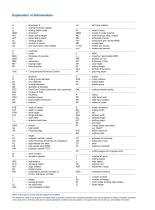
dimension A cutting thickness (radial) cutting depth (axial) dimension panel raising length panel raising depth working length number of knives anti sound (low noise design) LH = left hand rotation metric thread minimum order quantity multi-purpose steel, coated thickness of knife revolutions per minute (RPM) morse taper metres per minute metres per second CNC = Computerized Numerical Control RPM maximum permissible RPM position of hub thickness of hub zero height cutting length pinhole dimensions grooving depth diameter cutting circle diameter zero diameter outside Diameter diameter of shoulder...
Open the catalog to page 2
5.1 Sizing and grooving 5.1.1 Shank cutters HW and HW turnblade 5.1.2 Shank cutters HW-solid spiral design 5.1.3 Shank cutters DP 5.1.4 Slotting cutters and mortising bits 5.2 Jointing, rebating and bevelling 5.2.1 Jointing and rebating tools 5.2.2 Bevelling tools 5.3 Face milling and finishing 5.3.1 Planing cutters 5.3.2 V-groove and finishing cutters 5.4 Profiling 5.4.1 Finger joints 5.4.2 Tools for internal doors 5.4.3 Tools for furniture and interior construction 5.4.4 Tools for multi-purpose profiles 5.4.5 Tools for special profiles 5.5 Portable routers 5.5.1 Tools for sizing and grooving...
Open the catalog to page 3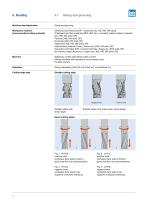
Working step/Application Workpiece material [recommended cutting material] Softwood and hardwood [SP - softwood only, HS, HW, HW solid]. Chipboard and fibre materials (MDF, HDF etc.), uncoated, plastic coated, veneered etc. [HW, HW solid, DP]. Plywood [HW, HW solid, DP]. Duromers [HW, HW solid, DP]. Plastomers [HS, HW, HW solid, DP]. Solid surface material (Corian, Varicor etc.) [HW, HW solid, DP]. Decorative laminates (HPL-compact laminate, Trespa etc.) [HW solid, DP]. Non-ferrous metal (Aluminium, copper etc.) [HS, HW, HW solid, DP]. Stationary routers with/without CNC control. Milling machines...
Open the catalog to page 4
5.1 Sizing and grooving leitz The dimensions in the table below refer to the following tool parameters: Shank tolerances The recommended RPM and feed speeds are detailed in the diagrams next the tool tables. The following plunging methods are recommended for sizing and grooving tools: Ramp plunging Spiral plunging Router bits with mainly negative cutting shear angles and HW solid router bits with RH/LD and LH/RD and router bits without plunging edge are not suitable for axial plunging. Axial plunging
Open the catalog to page 5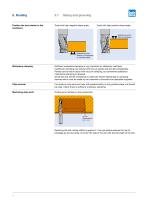
Position the tool relative to the workpiece Tools with high negative shear angle. Tools with high positive shear angle.. Reference Reference point: point: Top of Top of workpiece workpiece Reference Reference point: point: Bottom of workpiece Bottom of workpiece or machine or machine table table Workpiece clamping Sufficient workpiece clamping is very important on stationary machines. Insufficient clamping can reduce both the cut quality and tool life considerably. Panels can be held in place with vacuum clamping, but sometimes additional mechanical clamping is required. Small and and arched...
Open the catalog to page 6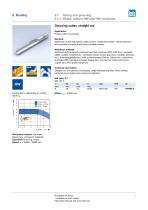
5.1 Sizing and grooving 5.1.1 Shank cutters HW and HW turnblade leitz Grooving cutter, straight cut Application: Router cutter for grooving. Machine: Stationary routers with/without CNC control, machining centres, milling machines with spindles to mount shank tools, portable routers. Workpiece material: Softwood and hardwood, chipboard and fibre materials (MDF, HDF etc.), uncoated, plastic coated, veneered etc., laminated veneer lumber (plywood, multiplex plywood etc.), duromers, plastomers, solid surface material (Corian, Varicor etc.), decorative laminates (HPL-compact laminate, Trespa etc.),...
Open the catalog to page 7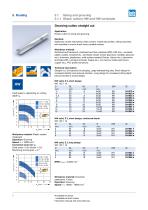
5.1 Sizing and grooving 5.1.1 Shank cutters HW and HW turnblade leitz Grooving cutter, straight cut Application: Router cutter for sizing and grooving. Machine: Stationary routers with/without CNC control, machining centres, milling machines with spindles to mount shank tools, portable routers. Workpiece material: Softwood and hardwood, chipboard and fibre materials (MDF, HDF etc.), uncoated, plastic coated, veneered etc., laminated veneer lumber (plywood, multiplex plywood etc.), duromers, plastomers, solid surface material (Corian, Varicor etc.), decorative laminates (HPL-compact laminate,...
Open the catalog to page 8
5.1 Sizing and grooving 5.1.1 Shank cutters HW and HW turnblade leitz Grooving cutter, Z 2 Application: Router cutter for sizing and grooving. Machine: Stationary routers with/without CNC control, machining centres, milling machines with spindles to mount shank tools, portable routers. Workpiece material: Softwood and hardwood, chipboard and fibre materials (MDF, HDF etc.), uncoated, plastic coated, veneered etc., laminated veneer lumber (plywood, multiplex plywood etc.). Technical information: Straight cut, tungsten carbide plunging tip. Feed speed Vf depending on cutting depth ap Workpiece...
Open the catalog to page 9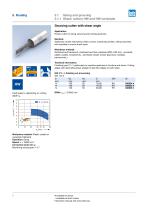
5.1 Sizing and grooving 5.1.1 Shank cutters HW and HW turnblade leitz Grooving cutter with shear angle Application: Router cutter for sizing, grooving and cutting apertures. Machine: Stationary routers with/without CNC control, machining centres, milling machines with spindles to mount shank tools. Workpiece material: Softwood and hardwood, chipboard and fibre materials (MDF, HDF etc.), uncoated, plastic coated, veneered etc., laminated veneer lumber (plywood, multiplex plywood etc.). Technical information: Finishing type Z 1+1 particularly to machine apertures in furniture and doors. Cutting...
Open the catalog to page 10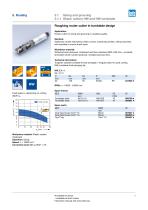
5.1 Sizing and grooving 5.1.1 Shank cutters HW and HW turnblade leitz HW Feed speed vf depending on cutting depth ap Roughing router cutter in turnblade design Application: Router cutter for sizing and grooving to roughing quality. Machine: Stationary routers with/without CNC control, machining centres, milling machines with spindles to mount shank tools. Workpiece material: Softwood and hardwood, chipboard and fibre materials (MDF, HDF etc.), uncoated, laminated veneer lumber (plywood, multiplex plywood etc.). Technical information: Tungsten carbide turnblade knives arranged in irregular pitch...
Open the catalog to page 11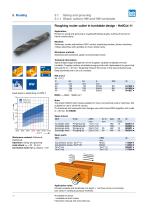
5.1 Sizing and grooving 5.1.1 Shank cutters HW and HW turnblade leitz Roughing router cutter in turnblade design - HeliCut 11 Application: Router for sizing and grooving to roughing/finishing quality. Cutting of tenons for frame constructions. Machine: Stationary routers with/without CNC control, machining centres, joinery machines, milling maschines with spindles to mount shank tools. Workpiece material: Softwood and hardwood, glulam and laminated wood. Technical information: Spiral shaped edge arrangement of the tungsten carbide turnblades (4 times turnable). Tungsten carbice turnblade plunging...
Open the catalog to page 12All Leitz GmbH catalogs and technical brochures
 Knives and spare parts
56 Pages
 Clamping systems
86 Pages
 Drilling
60 Pages
 Manual feed
72 Pages
 Planing and profiling
100 Pages
 Panel processing
86 Pages
 Sawing
96 Pages
- Milling tool
- Milling tool with replaceable insert
- Saw blade
- Coated milling cutter
- Circular saw blade
- Cutting saw blade
- Diamond milling cutter
- Carbide saw blade
- Wood saw blade
- Plastic milling cutter
- Diamond saw blade
- Machine tool milling cutter
- Angle milling cutter
- Tungsten carbide saw blade
- External grooving tool
- Manual clamping system
- High-resistance saw blade
- Wood planer knife