
- Catalogs
- Leine & Linde
- About encoders (general)

About encoders (general)

About encoders (general)
Leine & Linde is committed to minimizing environmental impact through energy and resource conservation, compliance with environmental legislation, and continuous improvement of environmental practices. The company holds ISO 9001 and ISO 14001 certifications, demonstrating its dedication to quality and environmental management.
Certain encoder models are explosion-proof and comply with ATEX or IECEx directives. All rotary encoders in the 300, 500, 600, and 800 Series adhere to UL safety regulations for the US and CSA regulations for Canada.
Products in the 300, 500, 600, and 800 Series meet EMC protection requirements under Council Directive 2004/108/EC. Declarations of Conformity are available upon request.
The quality policy emphasizes measurable targets, continuous improvement, and strong internal communication, supporting customer collaboration from product development to post-installation. The environmental policy focuses on reducing environmental impact through strategic choices and a waste disposal program.
Encoders, either incremental or absolute, are used in industries such as paper, steel, and robotics. Incremental encoders provide velocity feedback or relative positioning, while absolute encoders offer precise positioning and digital speed calculation.
- Model 300 Series: Miniature encoders for space-constrained applications, supporting TTL, HTL, and RS-422 interfaces.
- Model 500 Series: Versatile encoders for industrial applications, offering customizable solutions.
- Model 600 Series: Industrial encoders with fieldbus interfaces like Ethernet, PROFIBUS, or CAN.
- Model 800 Series: Heavy-duty encoders with optional ADS™ for maintenance and reliability in demanding environments.
Leine & Linde encoders use optical scanning with precise graduations for high-quality output signals. Absolute encoders provide immediate position values, while incremental encoders offer relative positioning and velocity feedback.
Key parameters for encoders include resolution, line count, and pulse rate. Incremental encoders have a permissible accuracy of ±50 el°, while absolute encoders have an accuracy of ±1 LSB. Calibration charts are available upon request.
Output signals are incremental with edge evaluation, and channel separation should be 90 ±25 el°. The duty cycle is typically 180 elº or 1:1. Each encoder is verified for accuracy, channel separation, and duty cycle.
Lifetime is influenced by shaft bearings, load, speed, and temperature. High-quality lubricated bearings are used, with nominal dynamic shaft loads specified for a service life of approximately 50,000 hours at 1500 rpm. High-quality shaft-coupling and bearing boxes are recommended to minimize shaft load.
Maximum vibration values apply for frequencies between 55 to 2000 Hz, and shock values are valid for 6 ms. Avoid using hammers for adjustments.
Maximum relative humidity is 75%, temporarily 95%, with no condensation allowed. Storage temperature range is –30°C to +70°C, influenced by mounting conditions and self-heating.
Encoders require stabilized DC voltage with specified ripple content. They meet electromagnetic compatibility standards for industrial environments when properly installed.
Encoders meet IP 67 protection standards, with parts painted or anodized, and stainless-steel options available. Comprehensive tests are required for systems integrating encoders.
TTL/RS-422 interfaces transmit incremental signals as digital square-wave pulse trains, with differential transmission available for noise-proof operation. HTL and HC-HTL electronics digitize sinusoidal scanning signals.
Incremental signals are transmitted as digital square-wave pulse trains, phase-shifted by 90 degrees, with a reference mark signal and inverse signals for noise-proof differential transmission. A STATUS signal indicates fault conditions, useful for machine shutdowns during automated production.
The permissible cable length for incremental encoders with HTL signals depends on scanning frequency, power supply, and operating temperature. Various output signals and recommended electronics for TTL and HTL interfaces are outlined.
The ADS system detects fault functions in rotating incremental pulse encoders, using rapid logic and a microprocessor to monitor encoder functions, allowing early fault detection. Fault information is communicated to the operator for analysis using diagnostic software.
Several serial transmission standards for encoders are discussed, including EnDat, Parallel, Analog, BiLL, and SSI interfaces, each with specific characteristics like bidirectional communication and real-time data availability.
PROFIBUS DP, CANopen, and DeviceNet interfaces are covered. PROFIBUS DP supports various encoder profiles and functionalities, CANopen offers robust fieldbus communication with flexible configuration, and DeviceNet provides connections between industrial devices and controllers.
The Encoder Profile for encoders connected to a DeviceNet network details the objects used from the DeviceNet Object library, including the Position Sensor Object (0x23 Hex) for position fetching, scaling, and additional information.
- Absolute position value transfer
- Velocity output values
- Change of code sequence
- Preset value settings
- Scaling of encoder resolution
- Encoder identification
- Operating status
- Operating time
- Alarms and warnings
The company is ISO 9001 and ISO 14001 certified.
Leine & Linde AB, Olivehällsvägen 8, SE-64542 Strängnäs, Sweden. Phone: +46 (0)152 26500, Fax: +46 (0)152 26505, Email: [email protected], Website: www.leinelinde.com
Catalog excerpts
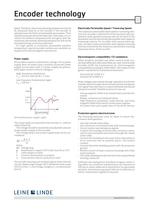
speed. Therefore, the actual operating temperature shouldbe measured directly at the encoder if the encoder isoperated near the limits of permissible parameters. Thensuitable measures should be taken (fan, heat sinks, etc.) toreduce the ambient temperature far enough so that themaximum permissible operating temperature will not be exceeded during continuous operation.For high speeds at maximum permissible ambienttemperature, special encoder versions are available on request with reduced degree of protection. > The maximum permissible shaft speed or traversing velo-city of an encoder is derived...
Open the catalog to page 9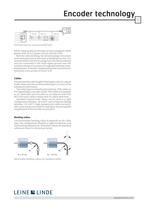
Potential sources causing interference. Permissible bending radius for standard cables. When using multiturn encoders in electromagnetic fieldsgreater than 30 mT, please consult Leine & Linde.Both the cable shielding, the metal housings of encodersand subsequent electronics have a shielding function. It isrecommended that the housings have the same potentialand are connected to the main signal ground over the machine chassis or by means of a separate potential comp-ensating line. Potential compensating lines should have aminimum cross section of 6 mm > 2 (Cu). > The permissible cable lengths...
Open the catalog to page 10
Leine & Linde ABT +4615226500 F +4615226505 Visiting address: Olivehllsvgen 8 P.O. Box 8, SE-64521 Str䤤ngns, Sweden www.leinelinde.com [email protected] >
Open the catalog to page 18All Leine & Linde catalogs and technical brochures
 300 Series
8 Pages
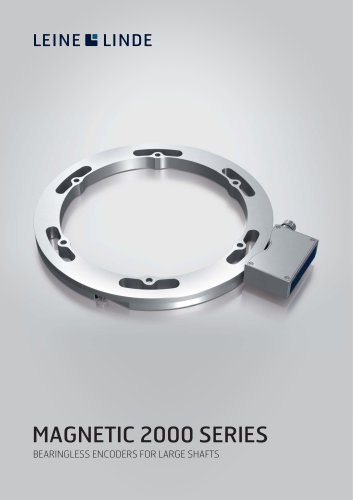 2000 series
7 Pages
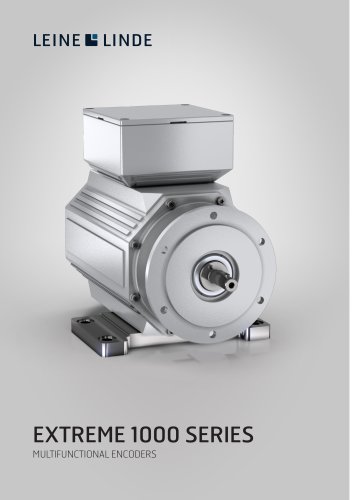 1000 series
7 Pages
 Product Overview
15 Pages
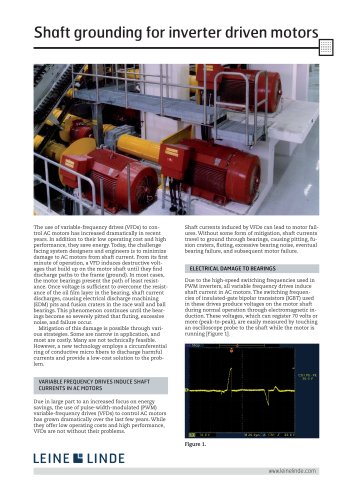 Shaft grounding
4 Pages
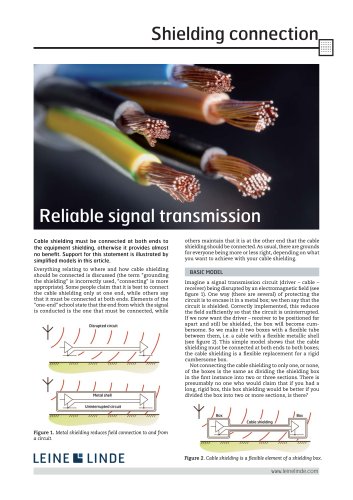 Shielding connection
4 Pages
- Automation software solution
- Management software solution
- Analysis software solution
- Measuring machine
- Real-time software
- Cloud-based software
- Control software
- Incremental rotary encoder
- Monitoring software solution
- Flexible coupling
- Shaft shaft coupling
- Absolute rotary encoder
- Solid-shaft rotary encoder
- Optical rotary encoder
- Industrial rotary encoder
- Hollow-shaft rotary encoder
- Magnetic rotary encoder
- Limit switch