
- Catalogs
- Leica Microsystems GmbH
- TCS SP8 Objective

TCS SP8 Objective

TCS SP8 Objective
Leica Microsystems has a long history of excellence in optics, providing advanced solutions for research, industry, and medicine. Their production processes ensure high-quality objectives that enhance spectral imaging capabilities.
Leica has been a pioneer in confocal microscopy innovations, including multi-dye applications, spectral detectors, and reprogrammable beam splitters.
Leica objectives are designed with various specifications to meet diverse research needs, including:
- PL/PLAN: Excellent field planarity for thin specimens.
- APO/IRAPO/FLUOTAR: Wavelength correction for multicolor specimens.
- L: Long working distance for complex setups.
- Numerical Aperture (NA): Higher NA offers better resolution.
- Immersion Medium: Affects focusing depth and resolution.
- Correction Collar: Adjusts for coverglass thickness variations.
High NA objectives provide better resolution, while low NA offers a larger depth of field. Leica's objectives minimize imaging errors, ensuring sharp images.
Apochromatic objectives provide superior color correction, crucial for high-resolution fluorescence imaging.
- PL APO CS2: Optimized for confocal scanning.
- PL IRAPO: Designed for multicolor multiphoton imaging.
- PL FLUOTAR: Suitable for routine fluorescence imaging.
Leica Microsystems continues to innovate in optical microscopy, enhancing imaging quality and resolution for various applications.
Matching the refractive indices of optical elements with the objective's design is crucial for optimal performance.
- Oil Immersion: Best for fixed samples near the cover glass.
- Glycerol Immersion: Ideal for glycerol-based media.
- Water Immersion: Optimal for live cell imaging and thick specimens.
- Generalists: Suitable for water, glycerol, and oil.
- Specialists: Designed for specific immersion media.
The refractive index affects light speed in a medium, influencing image generation. The Abbe number is crucial for avoiding chromatic aberrations.
Water immersion objectives are preferred due to the refractive index match with living cells.
Using longer wavelengths and optical clearing methods improves imaging depth and contrast.
Leica offers objectives for specific applications, ensuring high color correction and transmission.
Features like adaptive focus control and free working distance are highlighted.
Selecting the appropriate immersion objective and medium based on specimen type and imaging requirements is crucial for optimal results.
The document lists objectives with details such as order number, focal working distance, immersion type, and performance ratings.
Objectives are rated for color correction and transmission efficiency across different spectra.
Compatibility with adaptive focus control and phase contrast is highlighted.
Equations related to optical performance, such as the Rayleigh Criterion, are provided.
A table of refractive indices for various media is included.
General rules for objective use based on immersion medium and NA are suggested.
Catalog excerpts
Leica Objectives Superior Optics for Confocal and Multiphoton Research Microscopy
Open the catalog to page 1
Working "with the user, for the user" (Ernst Leitz I, 1843-1920) describes our drive to innovate and the success of Leica Microsystems for over 160 years. Leica TCS 4D - First First use of AOTF four-detector confocal for for laser modulation multi-dye applications in a confocal Leica Microsystems: Optics for Your Discoveries We have designed and produced superior optics for a wide variety of applications in research, industry, and medicine for more than 160 years. Today, the innovation power of our optics designers and the experience and expertise of our precision optical engineers come together...
Open the catalog to page 2
AOBS - First reprogrammable beam splitter Leica TCS SP5 - Broadband confocal with the first switchable tandem scanner Leica TCS SP5 X - First white light laser confocal with tunable VIS excitation Leica TCS SP8 - New confocal platform, modular system Leica TCS SP5 MP Leica TCS SP8 STED 3X - Fast with OPO, excitation and direct super-resolution X blue objectives optimized for 405 nm excitation First motCORR objectives with motorized correction collar I IRAPO objectives with color correction up to 1300 nm HC PLAPO STED WHITE with superior broadband color correction First motCORR for objectives...
Open the catalog to page 3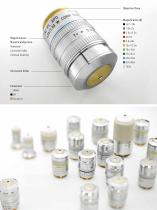
Magnification/ — Numerical Aperture Immersion Correction Collar Confocal Scanning Correction Collar Objective Class
Open the catalog to page 4
Leica objectives comply with
Open the catalog to page 5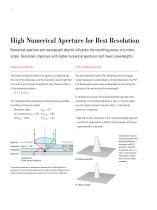
High Numerical Aperture for Best Resolution Numerical aperture and wavelength directly influence the resolving power of a microscope. Resolution improves with higher numerical apertures and lower wavelengths. NUMERICAL APERTURE POINT SPREAD FUNCTION The numerical aperture (NA) of an objective is described by The point spread function (PSF) describes how an imaging the sine of the half-angle α of the maximum cone of light that system represents a point object in three dimensions. The PSF can enter or exit the lens multiplied by the refractive index n of a fluorescence microscope is dependent on...
Open the catalog to page 6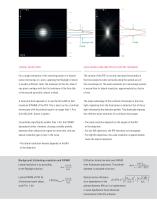
Rayleigh Limit LATERAL RESOLUTION AXIAL RESOLUTION AND OPTICAL SECTION THICKNESS For a rough estimation of the resolving power of a fluores- The volume of the PSF is not only restricted horizontally in cence microscope in x and y, applying the Rayleigh criterion the focus plane but also vertically along the optical axis of is usually sufficient. Here, the maximum of the Airy disk of the microscope (z). The axial resolution of a microscope system one point overlaps with the first minimum of the Airy disk is worse than its lateral resolution, approximately by a factor of the second point (left,...
Open the catalog to page 7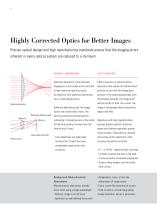
Highly Corrected Optics for Better Images Precise optical design and high manufacturing standards ensure that the imaging errors inherent in every optical system are reduced to a minimum. SPHERICAL ABERRATIONS FIELD CURVATURE Spherical aberration is the dominant Field curvature is a monochromatic imaging error that needs to be corrected aberration that causes the optimal focus in high numerical aperture optics. position to vary with the image point An objective with spherical aberrations position. It increases quadratically with the distance between the image point and the center of field. As...
Open the catalog to page 8
AXIAL COLOR LATERAL COLOR Axial color causes the optimal focus Lateral chromatic aberration causes the position to vary with the wavelength. magnification to vary with the This aberration occurs in the center of wavelength. It increases linearly with field and remains constant over the the distance between the image point whole field of view. In polychromatic applications this Image points near the edge of the field aberration causes a loss of contrast, show a distinctive colored smearing for colored fringes and a best focus which the human eye is very sensitive. In quantitative applications,...
Open the catalog to page 9
It’s All About Color Preparing your specimen for microscopy is only the first step to a stunning image. Choosing the best objective for your purpose should be done with as much care. Besides magnification and numerical aperture, the appropriate color correction is crucial. Apochromatic Color Correction Apochromats allow the image resolution to reach the diffraction limit over a wide range of wavelengths. For fluorescence imaging, 1.0 all excitation and detection wavelengths must be included to ensure that image resolution is as high as physically possible. For optimal colocalization, superior...
Open the catalog to page 10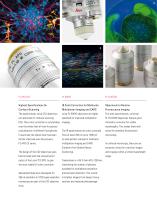
Highest Specifications for Confocal Scanning The apochromatic Leica CS2 objectives are optimized for confocal scanning (CS). Their color correction is outstanding over the whole field of view for precise colocalization of different fluorophores. In particular the lateral color has been further improved over the previous PL APO CS series. The design of the CS2 objectives goes hand in hand with the innovative UV optics of the Leica TCS SP8, to give the most stable UV color correction. Specialized objectives developed for 355 nm excitation or STED super-resolution microscopy are part of the CS2...
Open the catalog to page 11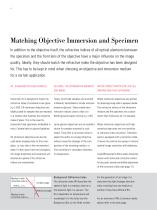
Matching Objective Immersion and Specimen In addition to the objective itself, the refractive indices of all optical elements between the specimen and the front lens of the objective have a major influence on the image quality. Ideally, they should match the refractive index the objective has been designed for. This has to be kept in mind when choosing an objective and immersion medium for a certain application. OIL: STANDARD FOR FIXED SAMPLES GLYCEROL: THE OPTIMUM FOR MOUNTED SPECIMENS WATER: PERFECT MATCH FOR LIVE CELL IMAGING AND THICK SPECIMENS Immersion oil is designed to match the refractive...
Open the catalog to page 12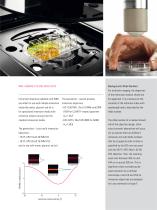
Background: Abbe Number For multicolor imaging, the dispersion of the immersion medium should not Immersion objectives labelled with IMM The specialists – special purpose are either for use with multiple immersion immersion objectives: variation of the refractive index with media like water, glycerol and oil or for specialized immersion media with VISIR for CLARITY-treated specimen refractive indices varying from the s tandard immersion media. Abbe number. The Abbe number of a medium should match the objective design, other - The generalists – Leica multi-immersion wise chromatic aberrations...
Open the catalog to page 13All Leica Microsystems GmbH catalogs and technical brochures
 Visoria M flyer
2 Pages
 Visoria M brochure
12 Pages
 Mateo FL Flyer EN
2 Pages
 DVM6 Brochure en
16 Pages
 Leica M50, M60, M80
12 Pages
 XL Stand
4 Pages
 LED1000
16 Pages
 LED3000 BLI
20 Pages
 LED5000 NVI
20 Pages
 LED3000 NVI
20 Pages
 LED3000 DI
20 Pages
 LED5000 HDI
20 Pages
 LED5000 CXI
20 Pages
 LED2500
8 Pages
 LED5000 MCI
20 Pages
 LED3000 MCI
20 Pages
 LED5000 SLI
20 Pages
 LED3000 SLI
20 Pages
 LED2000
8 Pages
 LED5000 RL
20 Pages
 LED3000 RL
20 Pages
 EL6000
4 Pages
 M320 F12 for ENT
12 Pages
 M620 TTS
4 Pages
 M220 F12
8 Pages
 RUV800
4 Pages
 DI C800
2 Pages
 M620 F20
8 Pages
 M822 F40 / F20
20 Pages
 M844 F40 / F20
16 Pages
 Proveo 8
16 Pages
 Envisu
8 Pages
 EnFocus
8 Pages
 M525 F20
12 Pages
 FL400
FL4004 Pages
 Leica M525 OH4
20 Pages
 Leica M720 OH5
24 Pages
 Leica M530 OH6
16 Pages
 Leica M530 OHX
16 Pages
 Leica CaptiView
4 Pages
 Leica GLOW800
4 Pages
 Leica ARveo
16 Pages
 Leica PROvido
8 Pages
 LAS X Steel Expert
4 Pages
 Leica LMD Software
16 Pages
 Leica Map
12 Pages
 Leica Cleanliness Expert
4 Pages
 Leica LAS X Industry
4 Pages
 Leica LAS X Life Science
4 Pages
 Leica EM CPD300
12 Pages
 Leica EM TP
4 Pages
 Leica EM VCT500
2 Pages
 Leica EM ACE900
12 Pages
 Leica EM ACE200
12 Pages
 Leica EM KMR3
8 Pages
 Leica EM AFS2
8 Pages
 Leica EM ICE
12 Pages
 TCS SP8 DLS
16 Pages
 Leica LIGHTNING
2 Pages
 Leica SP8 DIVE
20 Pages
 Leica K5
2 Pages
 Leica DFC295
6 Pages
 Leica DFC3000 G
6 Pages
 Leica EC4
4 Pages
 Leica DFC7000 T / DFC7000 GT
4 Pages
 Leica DFC9000
2 Pages
 Leica MZ10 F
4 Pages
 Leica M165 FC
16 Pages
 Leica DM IL LED
12 Pages
 Leica DMi1
2 Pages
 THUNDER Imager Tissue
2 Pages
 Leica FS M
12 Pages
 Leica FS C
20 Pages
 Leica FS CB
20 Pages
 Leica DM3000 / DM3000 LED
16 Pages
 Leica DM750
12 Pages
 Leica DM500
12 Pages
 Leica DM300
8 Pages
 Leica DM1750 M
12 Pages
 Leica FS4000 LED
20 Pages
 Leica DM2000 / DM2000 LED
16 Pages
 Leica DM1000
16 Pages
 Leica DM1000 LED
16 Pages
 Leica DM2500 & DM2500 LED
16 Pages
 Leica DM4 B & DM6 B
16 Pages
 Leica DMC2900
6 Pages
 Leica DMC6200
8 Pages
 Leica DMC5400
4 Pages
 Leica Z6 APO
16 Pages
 Leica Z16 APO
16 Pages
 Leica M205 FCA / M205 FA
16 Pages
 Leica DM12000 M
8 Pages
 Leica DM8000 M
8 Pages
 Leica DM4 P, DM2700 P, DM750 P
12 Pages
 Leica EM ACE600
12 Pages
 Leica EM RAPID
8 Pages
 Leica EM TRIM2
8 Pages
 Leica EM TIC 3X
16 Pages
 Leica EM TXP
10 Pages
 Leica DM2700 M
12 Pages
 DMi8 M / C / A
12 Pages
 Leica A60 S / Leica A60 F
16 Pages
 SOLUTIONS FOR MATERIALS SCIENCE
12 Pages
 Leica StereoZoom line
20 Pages
 TL-Bases
12 Pages
 TCS SP8
20 Pages
 TCS SP8 STED 3X
24 Pages
 AOBS
AOBS16 Pages
 Leica DM3 XL
7 Pages
 Leica DMi8 S
12 Pages
 Leica M50/M60/M80
12 Pages
 Leica DM750 M
12 Pages
 Leica DM4 M/ DM6 M
12 Pages
 Leica A60 S/A60 F
16 Pages


- Digital imager
- Visible imager
- CMOS camera module
- Industrial camera module
- Leica LED lighting
- Positioning table
- Analysis software solution
- Full-color camera system
- Leica Windows software
- Translation stage
- USB camera module
- Monochrome camera module
- Leica optical microscope
- Industrial software
- 3D software solution
- HD camera module
- Leica laboratory microscope
- LED hand lamp
- Quality software