

AOBS

AOBS
Catalog excerpts

AOBS – The Most Versatile Beam Splitter ® Acousto-Optical Beam Splitter for the TCS SP8 Confocal • High transparency and narrow excitation bands increase cell viability and reduce photobleaching. • The freely programmable AOBS perfectly adapts to challenging multicolor experiments, new laser lines, and the tunable White Light Laser of the TCS SP8 X. • Provides fast line sequential imaging of living cells having spectrally close fluor
Open the catalog to page 1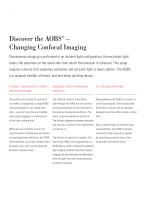
Discover the AOBS® -Changing Confocal Imaging Fluorescence imaging is performed in an incident light configuration: the excitation light enters the specimen on the same side from which the emission is collected. This setup requires a device that separates excitation and emission light: a beam splitter. The AOBS is a uniquely flexible, efficient, and fast beam splitting device. FLEXIBILITY AND VERSATILITY SIMPLIFY MULTICOLOR IMAGING GAIN MORE LIGHT WITH MAXIMUM SENSITIVITY FAST, RELIABLE SWITCHING The position of the band for excitation is tunable. Consequently, a single AOBS is programmable for...
Open the catalog to page 2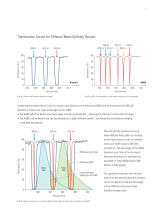
Transmission Curves for Different Beam Splitting Devices 488 nm Fig. 1a: Dichroic. Non-flexible reflections on bands. Fig. 1b: AOBS. All wavelength are fully flexible, adjusting to your experiment. Comparing the transmission curves of a typical triple dichroic mirror (blue) and AOBS (red) for excitation with 488, 561, and 633 nm shows two major advantages of the AOBS: • The AOBS reflection bands have steep edges and narrow bandwidth – allowing the collection of more emission light. • The AOBS is more flexible and can accomodate up to eight reflection bands – facilitating the simultaneous imaging...
Open the catalog to page 3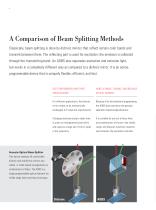
A Comparison of Beam Splitting Methods Classically, beam splitting is done by dichroic mirrors that reflect certain color bands and transmit between them. The reflecting part is used for excitation; the emission is collected through the transmitting band. An AOBS also separates excitation and emission light, but works in a completely different way as compared to a dichroic mirror. It is an active, programmable device that is uniquely flexible, efficient, and fast. SPLITTING MIRRORS HAVE FIXED AOBS: A SINGLE, FLEXIBLE, AND RELIABLE OPTICAL ELEMENT For different applications, the dichroic Because...
Open the catalog to page 4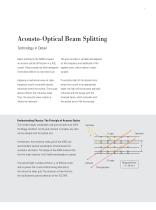
Acousto-Optical Beam Splitting Technology in Detail Beam splitting by the AOBS is based The grid constant is variable and depends crystal. These crystals are fully transparent applied wave, which makes it easily from below 400 nm to more than 4 μm. Applying a mechanical wave at radio- If excitation light of the desired color frequency results in periodic density enters the crystal at an appropriate variations within the crystal. The crystal angle, the light will be acousto-optically density affects the refractive index. refracted and will merge with the Thus, the acoustic wave creates a principal...
Open the catalog to page 5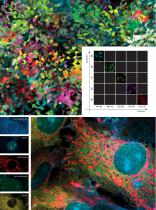
plasma membrane early endosomes
Open the catalog to page 6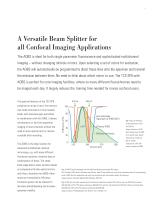
A Versatile Beam Splitter for all Confocal Imaging Applications The AOBS is ideal for both single parameter fluorescence and sophisticated multichannel imaging – without changing dichroic mirrors. Upon selecting a set of colors for excitation, the AOBS will automatically be programmed to direct these lines onto the specimen and transmit the emission between them. No need to think about which mirror to use. The TCS SP8 with AOBS is perfect for core imaging facilities, where so many different fluorochromes need to be imaged each day. It largely reduces the training time needed for novice confocal...
Open the catalog to page 7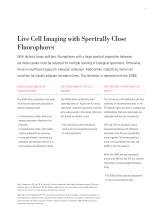
Live Cell Imaging with Spectrally Close Fluorophores With dichroic beam splitters, fluorophores with a large spectral separation between excitation peaks must be selected for multiple staining of biological specimens. Otherwise, there is insufficient space for emission collection. Additionally, multichroic mirrors do not allow for closely adjacent excitation lines. This limitation is removed with the AOBS. CHOOSE SIMULTANEOUS OR FAST SWITCHING FOR LIVE CELL FAST SPECTRAL SEPARATION OF GFP SEQUENTIAL MODE The AOBS offers excitation with laser The AOBS offers sufficiently short The efficiency of...
Open the catalog to page 9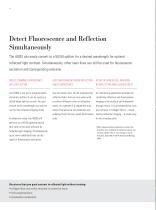
Detect Fluorescence and Reflection Simultaneously The AOBS can easily convert to a 50/50 splitter for a desired wavelength for optimal reflected light contrast. Simultaneously, other laser lines can still be used for fluorescence excitation and corresponding emission. FREELY COMBINE FLUORESCENCE FAST SWITCHING BETWEEN REFLECTION STUDY OF CANCER CELL INVASION WITH REFLECTION The AOBS is not just a programmable Any excitation color can be employed for An interesting application example for chromatic splitter. It can be used as a reflected light. And you may even wish combining reflection and fluorescence...
Open the catalog to page 10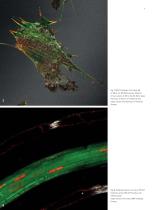
Fig. 7: NIH3T3 fibroblasts. Actin Alexa 488, Ex 488 nm, Em 500-550 nm (green). Reflection of focal contacts, Ill 476 nm Det 467-492 nm (gray). Paxilin Cy3, Ex 561 nm, Em 570-627 nm (red). Image courtesy of M. Bastmeyer, KIT Karlsruhe, Germany. Fig. 8: Arabidopsis thaliana, root tissue. PINI-GFP (membrane, green), REV-2xYFP (nucleus, red), reflection (gray). Image courtesy of M. Heisler, EMBL Heidelberg, Germany.
Open the catalog to page 11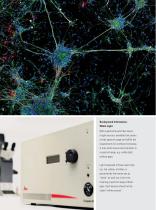
Background Information: White Light With supercontinuum fiber lasers, a light source is available that covers a wide spectral range and fulfills the requirements for confocal microscopy. A truly white source emits photons in a spectral range, e.g. visible light, without gaps. Light composed of three laser lines, e.g. red, yellow, and blue, is perceived by the human eye as "white" as well, but is far from covering a spectral range without gaps. Such devices should not be called "white sources".
Open the catalog to page 12
A Freely Tunable Beam Splitter for the White Light Laser The White Light Laser (WLL) used in the TCS SP8 X combines a white light source that covers the spectral range from 470 nm to 670 nm and an acousto-optical tunable device for the selection of single lines. Up to eight lines can be selected from the spectrum, each line being freely tunable in both color and intensity. TUNABLE EXCITATION REQUIRES FREELY TUNABLE BEAM SPLITTING FAST AND EASY AUTOMATIC SETUP OF THE BEAM SPLITTER TRUE SPECTRAL DETECTION WITH THE TCS SP8 The WLL provides any color combination within the visible range. Illumination routines...
Open the catalog to page 13All Leica Microsystems GmbH catalogs and technical brochures
 Visoria M flyer
2 Pages
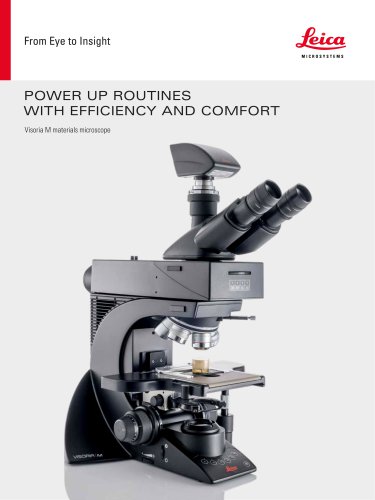 Visoria M brochure
12 Pages
 Mateo FL Flyer EN
2 Pages
 DVM6 Brochure en
16 Pages
 Leica M50, M60, M80
12 Pages
 XL Stand
4 Pages
 LED1000
16 Pages
 LED3000 BLI
20 Pages
 LED5000 NVI
20 Pages
 LED3000 NVI
20 Pages
 LED3000 DI
20 Pages
 LED5000 HDI
20 Pages
 LED5000 CXI
20 Pages
 LED2500
8 Pages
 LED5000 MCI
20 Pages
 LED3000 MCI
20 Pages
 LED5000 SLI
20 Pages
 LED3000 SLI
20 Pages
 LED2000
8 Pages
 LED5000 RL
20 Pages
 LED3000 RL
20 Pages
 EL6000
4 Pages
 M320 F12 for ENT
12 Pages
 M620 TTS
4 Pages
 M220 F12
8 Pages
 RUV800
4 Pages
 DI C800
2 Pages
 M620 F20
8 Pages
 M822 F40 / F20
20 Pages
 M844 F40 / F20
16 Pages
 Proveo 8
16 Pages
 Envisu
8 Pages
 EnFocus
8 Pages
 M525 F20
12 Pages
 FL400
FL4004 Pages
 Leica M525 OH4
20 Pages
 Leica M720 OH5
24 Pages
 Leica M530 OH6
16 Pages
 Leica M530 OHX
16 Pages
 Leica CaptiView
4 Pages
 Leica GLOW800
4 Pages
 Leica ARveo
16 Pages
 Leica PROvido
8 Pages
 LAS X Steel Expert
4 Pages
 Leica LMD Software
16 Pages
 Leica Map
12 Pages
 Leica Cleanliness Expert
4 Pages
 Leica LAS X Industry
4 Pages
 Leica LAS X Life Science
4 Pages
 Leica EM CPD300
12 Pages
 Leica EM TP
4 Pages
 Leica EM VCT500
2 Pages
 Leica EM ACE900
12 Pages
 Leica EM ACE200
12 Pages
 Leica EM KMR3
8 Pages
 Leica EM AFS2
8 Pages
 Leica EM ICE
12 Pages
 TCS SP8 DLS
16 Pages
 Leica LIGHTNING
2 Pages
 Leica SP8 DIVE
20 Pages
 Leica K5
2 Pages
 Leica DFC295
6 Pages
 Leica DFC3000 G
6 Pages
 Leica EC4
4 Pages
 Leica DFC7000 T / DFC7000 GT
4 Pages
 Leica DFC9000
2 Pages
 Leica MZ10 F
4 Pages
 Leica M165 FC
16 Pages
 Leica DM IL LED
12 Pages
 Leica DMi1
2 Pages
 THUNDER Imager Tissue
2 Pages
 Leica FS M
12 Pages
 Leica FS C
20 Pages
 Leica FS CB
20 Pages
 Leica DM3000 / DM3000 LED
16 Pages
 Leica DM750
12 Pages
 Leica DM500
12 Pages
 Leica DM300
8 Pages
 Leica DM1750 M
12 Pages
 Leica FS4000 LED
20 Pages
 Leica DM2000 / DM2000 LED
16 Pages
 Leica DM1000
16 Pages
 Leica DM1000 LED
16 Pages
 Leica DM2500 & DM2500 LED
16 Pages
 Leica DM4 B & DM6 B
16 Pages
 Leica DMC2900
6 Pages
 Leica DMC6200
8 Pages
 Leica DMC5400
4 Pages
 Leica Z6 APO
16 Pages
 Leica Z16 APO
16 Pages
 Leica M205 FCA / M205 FA
16 Pages
 Leica DM12000 M
8 Pages
 Leica DM8000 M
8 Pages
 Leica DM4 P, DM2700 P, DM750 P
12 Pages
 Leica EM ACE600
12 Pages
 Leica EM RAPID
8 Pages
 Leica EM TRIM2
8 Pages
 Leica EM TIC 3X
16 Pages
 Leica EM TXP
10 Pages
 Leica DM2700 M
12 Pages
 DMi8 M / C / A
12 Pages
 Leica A60 S / Leica A60 F
16 Pages
 SOLUTIONS FOR MATERIALS SCIENCE
12 Pages
 Leica StereoZoom line
20 Pages
 TL-Bases
12 Pages
 TCS SP8
20 Pages
 TCS SP8 STED 3X
24 Pages
 TCS SP8 Objective
24 Pages
 Leica DM3 XL
7 Pages
 Leica DMi8 S
12 Pages
 Leica M50/M60/M80
12 Pages
 Leica DM750 M
12 Pages
 Leica DM4 M/ DM6 M
12 Pages
 Leica A60 S/A60 F
16 Pages


- Digital imager
- Visible imager
- CMOS camera module
- Industrial camera module
- Leica LED lighting
- Positioning table
- Analysis software solution
- Full-color camera system
- Leica Windows software
- Leica microscope
- Translation stage
- USB camera module
- Monochrome camera module
- Leica optical microscope
- Industrial software
- 3D software solution
- HD camera module
- Leica laboratory microscope
- LED hand lamp
- Quality software