
- Catalogs
- THE LEE COMPANY
- Hi-Bar Insert Retained Safety Screens

- Company
- Products
- Catalogs
- News & Trends
- Exhibitions
Hi-Bar Insert Retained Safety Screens

Hi-Bar Insert Retained Safety Screens
The document is a product data sheet for the HI-BAR® Insert Retained Safety Screen by The Lee Company. These screens are designed for simple installation into fluid passageways and are constructed from stainless steel. They feature a robust, one-piece screen element capable of withstanding pressure differentials up to 7500 psid.
Specifications
- Construction: Stainless steel
- Burst/Collapse Pressure: 7500 psid
- Hole Sizes: Available from 50 microns to 500 microns
- Body Diameters: 0.187", 0.250", 0.375", and 0.500"
Features
- Simple installation with a field-proven locking end
- Leak-proof seal due to the locking mechanism
- Precision cleaned and packaged before shipment
- Special designs available upon request
Technical Data
The document includes detailed tables listing the specifications for different screen models, including:
- Lee Part Number
- Hole Size (inches and microns)
- Open Area (in.²)
- Total Area (in.²)
- Number of Holes
- ROB Number: Indicates resistance to blockage
- Lohm Rate: Measure of flow resistance
Contact Information
For additional information or technical assistance, contact your local Lee Sales Engineer or visit the company's website.
Catalog excerpts

PRODUCT DATA SHEET The Lee Company now offers a complete line of HI-BAR® Insert Retained Safety Screens. These new screens combine a robust, high pressure locking end with a one-piece, HI-BAR screen element that can withstand pressure differentials up to 7500 psid without rupture. Using the proven Lee Insert Principal*, these screens allow for a simple installation directly into a fluid passageway. This installation technique locks the screen into the surrounding housing and provides a reliable, leak-proof seal. ■ Simple installation into fluid passageway with field proven locking end ■ Stainless steel construction ■ Strong, one-piece screen element ■ Burst/collapse pressure: 7500 psid ■ Hole sizes from 50 micron to 500 micron The HI-BAR Insert Retained Safety Screens are available in 4 different body diameters, 0.187", 0.250", 0.375", and 0.500". In addition, standard screen hole sizes include 50, 75, 100, 150, 200, 250, 380, and 500 microns. All Lee Safety Screens are precision cleaned and packaged before shipment. In addition to offering a wide range of standard screens, special designs are available upon request. Contact your local Lee Sales Engineer for additional information or technical assistance. *Refer to our website, or the Lee Technical Hydraulic Handbook for additional details. 187 HI-BAR INSERT RETAINED SAFETY SCREEN The Lee Company • 2 Pettipaug Road, PO Box 424, Westbrook, Connecticut 06498-0424 Tel: 860-399-6281 • Fax: 860-399-7037 • www.theleeco.com
Open the catalog to page 1
500 HI-BAR INSERT RETAINED SAFETY SCREEN LEE PART NUMBER * The Lohm is a measure of flow resistance. Example: One Lohm will permit a flow of 100 GPM of water at 25 psid at 80°F. ** The Rob Number indicates the relative resistance to blockage when comparing one screen to another. The higher the Rob Number, the greater the resistance to blockage. Additional information can be found at www.theleeco.com or by contacting your local Lee Sales Engineer. The Lee Company • 2 Pettipaug Road, PO Box 424, Westbrook, Connecticut 06498-0424 Tel: 860-399-6281 • Fax: 860-399-7037 • www.theleeco.com
Open the catalog to page 2All THE LEE COMPANY catalogs and technical brochures
 DISPENSE PUMPS
6 Pages
 CONTROL SOLENOID VALVES
6 Pages
 AIRCRAFT ENGINE SOLUTIONS
6 Pages
 ZERO LEAK SOLENOID VALVE
2 Pages
 QUICK INSTALLATION LEE PLUG®
2 Pages
 LEE PLUG JET
2 Pages
 LEE IMH 5mm Short Betaplug
2 Pages
 LEE VILA
2 Pages
 LEE 250 PRI
2 Pages
 HIGH PRESSURE 250 FLOSERT®
2 Pages
 LEE BURST DISC PLUG
2 Pages
 LEE BOSS MOUNT STRAINERS
2 Pages
 687 SIDE EXIT PRV
2 Pages
 375 ZERO LEAK CHEK
2 Pages
 250 SERIES SOLENOID VALVE
2 Pages
 187 ZERO LEAK PRI
2 Pages
 156 LEE BENDER JET
2 Pages
 LEE 5K JEVA
2 Pages
 18mm Short Betaplug
2 Pages
 Lee IMH 6mm Short Betaplug
2 Pages
 NACE 250H BenderJet
2 Pages
 Latching Solenoid Valve
2 Pages
 687 Side Exit Flosert
2 Pages
 375 HD PRI
2 Pages
 Dual Sealing AFO Plug
2 Pages
 LPD Precision Dispense Pump
2 Pages
 Respiratory Care Brochure
4 Pages
 HDI Brochure
4 Pages
 Dispense Pump Brochure
6 Pages
 Industrial Microhydraulics Handbook
216 Pages
 281 ZERO LEAK PRI®
2 Pages
 Precision Microhydraulics
819 Pages
 500 Zero Leak LeeChek
2 Pages
 281 PRI/Chek Valve
2 Pages
 HIGH PRESSURE 281 FLOSERT
2 Pages
 NACE COMPLIANT FLOSERT
2 Pages
 375 DETENTED SHUTTLE VALVE
2 Pages
 375 PRI®/CHEK® VALVE
2 Pages
 HI-Q PRESSURE RELIEF VALVE
2 Pages
 093 LEE CHEK®
2 Pages
 250 PRI Product Data Sheet
2 Pages
 375 BYPASS VALVE
2 Pages


Archived catalogs
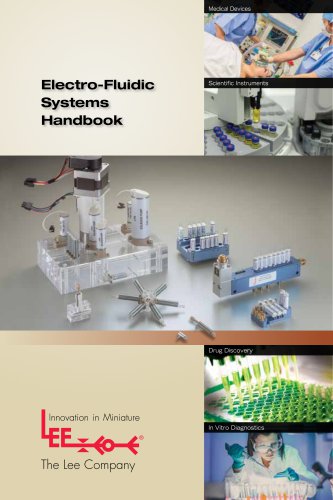 Electro-Fluidic Systems_2017
323 Pages
 HIGH PRESSURE 500 FLOSERT
2 Pages
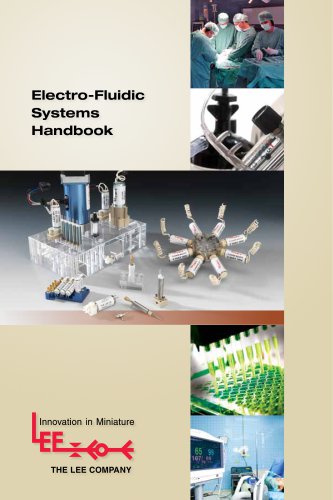 Electro-Fluidic Systems_2013
323 Pages

- Pump
- Industrial pump
- THE LEE COMPANY valve
- Pump with electric motor
- Stationary pump
- Seawater pump
- Self-priming pump
- Chemical pump
- THE LEE COMPANY stainless steel valve
- Control valve
- Ball valve
- THE LEE COMPANY solenoid valve
- Liquid filter
- On/off valve
- Diaphragm pump
- Compact pump
- THE LEE COMPANY flap valve
- THE LEE COMPANY check valve
- Gas solenoid valve
- THE LEE COMPANY 2-way solenoid valve