
- Catalogs
- THE LEE COMPANY
- 375 HD PRI

- Company
- Products
- Catalogs
- News & Trends
- Exhibitions
375 HD PRI

375 HD PRI
- The product offers extremely stable relief flow across various flow rates and pressure combinations.
- It is constructed with a durable 440C Poppet and Seat, designed for system pressures up to 5000 psi.
- The product weighs 21 grams and is endurance tested to a minimum of 100,000 cycles.
- Leakage at minimum cracking and shut-off pressure is limited to 2 mL/minute maximum.
- The nominal system pressure is up to 5000 psi, with a peak pressure of 6750 psi.
Materials
- The body is made of 304 CRES AMS 5639.
- Other components include 17-4PH CRES, 440C CRES, 17-7PH CRES, 15-5PH CRES, and 13-8 MO CRES.
Installation and Usage
- The 375 HD PRI is designed for applications requiring stability, featuring dual dampening chambers.
- It supports forward and reverse relief flow directions with cracking pressures for 3000, 4000, and 5000 psi systems.
- Each valve is 100% tested and inspected for reliable performance.
Lohm Laws and Calculations
- The Lohm system defines fluid resistance in hydraulic components, similar to Ohms in electrical systems.
- Lohm calculations compensate for discharge coefficients and dimensional tolerances.
- A 1 Lohm restriction allows a flow of 100 gallons per minute of water with a 25 psi pressure drop at 80°F.
- The document provides formulas for volumetric and gravimetric flow units, introducing compensation factors for liquid density and viscosity.
- A free slide rule is available for basic Lohm calculations.
Flow Units and Constants
- The document includes tables for gravimetric and volumetric flow units across different pressure units (psi, bar, kPa).
- It also provides a units constant (K) for liquid flow calculations.
Catalog excerpts

PRECISION MICROHYDRAULICS PRODUCT DATA SHEET The Lee Company’s new 375 HD PRI, Hi-Damped Pressure Relief Insert, has been designed for applications where stability is a must. Dual dampening chambers provide an extremely stable relief flow over various flow rates and pressure combinations. It features a rugged 440C Poppet and Seat for durability and long life. Available in forward and reverse relief flow directions, the 375 HD PRI offers a range of cracking pressures for 3000, 4000 and 5000 psi systems with system peak pressures up to 6750 psi. Each relief valve is 100% tested and inspected to ensure reliable, consistent performance. ■ Extremely stable relief flow over various flow rates and pressure combinations ■ Durable 440C Poppet and Seat ■ Designed for system pressures up to 5000 psi ■ Weighs only 21 grams ■ Endurance tested to 100,000 cycles minimum Finish: AH CRES Parts Passivated. Pins are prewaxed. Do not degrease. Do not lubricate. * The Lohm is a measure of flow resistance. Additional information can be found at www. TheLeeCo. com. The Lee Company • 2 Pettipaug Road, PO Box 424, Westbrook, Connecticut 06498-0424 Tel: 860-399-6281 • Fax: 860-399-7037 • www.theleeco.com
Open the catalog to page 1
LOHM LAWS (liquids) Every engineer will be interested in our simple system of defining the fluid resistance of Lee hydraulic components. Just as the OHM is used in the electrical industry, we find that we can use a liquid OHM or "Lohm" to good advantage on all hydraulic computations. When using the Lohm system, you can forget about coefficients of discharge and dimensional tolerances on drilled holes. These factors are automatically compensated for in the Lohm calculations, and confirmed by testing each component to establish flow tolerances. The resistance to flow of any fluid control component...
Open the catalog to page 2All THE LEE COMPANY catalogs and technical brochures
 DISPENSE PUMPS
6 Pages
 CONTROL SOLENOID VALVES
6 Pages
 AIRCRAFT ENGINE SOLUTIONS
6 Pages
 ZERO LEAK SOLENOID VALVE
2 Pages
 QUICK INSTALLATION LEE PLUG®
2 Pages
 LEE PLUG JET
2 Pages
 LEE IMH 5mm Short Betaplug
2 Pages
 LEE VILA
2 Pages
 LEE 250 PRI
2 Pages
 HIGH PRESSURE 250 FLOSERT®
2 Pages
 LEE BURST DISC PLUG
2 Pages
 LEE BOSS MOUNT STRAINERS
2 Pages
 687 SIDE EXIT PRV
2 Pages
 375 ZERO LEAK CHEK
2 Pages
 250 SERIES SOLENOID VALVE
2 Pages
 187 ZERO LEAK PRI
2 Pages
 156 LEE BENDER JET
2 Pages
 LEE 5K JEVA
2 Pages
 18mm Short Betaplug
2 Pages
 Lee IMH 6mm Short Betaplug
2 Pages
 NACE 250H BenderJet
2 Pages
 Latching Solenoid Valve
2 Pages
 687 Side Exit Flosert
2 Pages
 Dual Sealing AFO Plug
2 Pages
 LPD Precision Dispense Pump
2 Pages
 Respiratory Care Brochure
4 Pages
 HDI Brochure
4 Pages
 Dispense Pump Brochure
6 Pages
 Industrial Microhydraulics Handbook
216 Pages
 281 ZERO LEAK PRI®
2 Pages
 Precision Microhydraulics
819 Pages
 500 Zero Leak LeeChek
2 Pages
 281 PRI/Chek Valve
2 Pages
 HIGH PRESSURE 281 FLOSERT
2 Pages
 NACE COMPLIANT FLOSERT
2 Pages
 375 DETENTED SHUTTLE VALVE
2 Pages
 375 PRI®/CHEK® VALVE
2 Pages
 HI-Q PRESSURE RELIEF VALVE
2 Pages
 093 LEE CHEK®
2 Pages
 250 PRI Product Data Sheet
2 Pages
 375 BYPASS VALVE
2 Pages


Archived catalogs
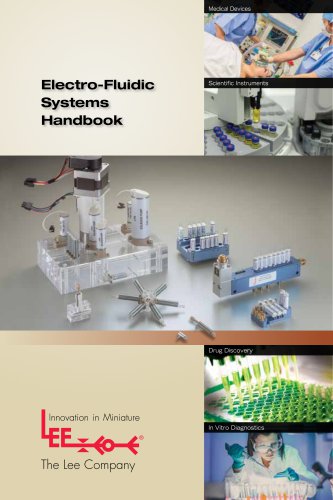 Electro-Fluidic Systems_2017
323 Pages
 HIGH PRESSURE 500 FLOSERT
2 Pages
 Electro-Fluidic Systems_2013
323 Pages

- Pump
- Industrial pump
- Pump with electric motor
- Stationary pump
- Seawater pump
- Self-priming pump
- Chemical pump
- THE LEE COMPANY stainless steel valve
- Control valve
- Ball valve
- THE LEE COMPANY solenoid valve
- Liquid filter
- On/off valve
- Diaphragm pump
- Compact pump
- THE LEE COMPANY flap valve
- THE LEE COMPANY check valve
- Gas solenoid valve
- THE LEE COMPANY 2-way solenoid valve