
- Catalogs
- LASER COMPONENTS
- Infrared Components Catalog

- Products
- Catalogs
- News & Trends
- Exhibitions
Infrared Components Catalog

Infrared Components Catalog
LASER COMPONENTS, established in 1982, specializes in infrared (IR) components, particularly detectors. The company offers a wide range of IR detectors using various technologies for different applications and provides personalized assistance for custom products.
IR WORKshop
Since 2012, LASER COMPONENTS has hosted the IR WORKshop, an international platform for IR technologies, held biennially in Germany and the USA, gathering global experts to discuss IR detectors and applications.
In-House Manufacturing
The LASER COMPONENTS Detector Group in Tempe, Arizona, focuses on producing Avalanche Photodiodes and PbS/PbSe detectors, leading in PbS/PbSe manufacturing and advancing detector technology.
Technological Developments
Developments include lattice-matched and extended InGaAs PIN photodiodes and extended InGaAs linear arrays. PbS and PbSe detectors cover spectral ranges from 1000 to 3500 nm and 1000 to 5500 nm, respectively.
Pyroelectric Detectors
The Pyro Group in Florida focuses on pyroelectric detectors using LiTaO3 and DLaTGS crystals for applications in gas analysis, safety, FTIR spectroscopy, and process control.
Innovation and Future Directions
Despite the maturity of IR technologies, there is room for innovation in improving detector performance and reliability. The company explores new materials and techniques to enhance detector capabilities.
Conclusion
LASER COMPONENTS continues to lead in IR technology development, offering a wide range of detectors and hosting international workshops to foster innovation and collaboration.
From 2015 to 2017, LASER COMPONENTS introduced innovations like the differential pyroelectric detector, establishing itself as a significant player in the infrared detector market.
Detector Specifications
The document compares different detector materials and their spectral responses, emphasizing the importance of selecting the right technology for specific applications.
Innovation and Collaboration
LASER COMPONENTS focuses on innovation through collaboration with customers and participation in international workshops, supporting MEMS technologies and aiming to standardize linearity specifications in infrared detectors.
Applications
IR detectors are used in applications like flame detection, gas monitoring, and non-contact temperature measurement. The document details the use of pyroelectric detectors for flame detection and the advantages of non-dispersive infrared (NDIR) methods for gas analysis.
Non-Contact Temperature Measurement
This method exploits blackbody radiation to determine an object's temperature without physical contact, crucial for quality assurance in industries like glass, plastics, and steel manufacturing.
Gas Analysis
Gas analysis using IR detectors is common, with NDIR being the most widely used method due to its simplicity and effectiveness in detecting gases like CO2.
Conclusion
LASER COMPONENTS is committed to advancing infrared technologies and providing high-quality, innovative solutions for various industrial applications.
Spectrophotometry is used for analyzing samples to detect unknown constituents in fields like environmental monitoring, security, forensics, quality control, and biomedical analysis.
FTIR Spectroscopy
FTIR spectroscopy collects spectral data over a wide range with high resolution, using a broadband source and a Michelson interferometer.
Array Spectrometers
Advancements in IR detector technology have made IR arrays more affordable, allowing their use in various applications.
Laser Power Monitoring
Laser power monitoring involves using detectors to produce a feedback loop for stabilized output power.
Choosing the Right Detector
For power monitoring, small photodiodes are usually sufficient, but larger area photodiodes are recommended for recording absolute power.
Squeezed States in Quantum Metrology
Squeezed states of light are used to overcome quantum noise in experiments like gravitational wave interferometry.
InGaAs PIN Photodiodes
InGaAs PIN photodiodes are photovoltaic quantum detectors with a sensitivity range from 500 nm to 2600 nm.
Technical Note on Photovoltaic Detectors
Photovoltaic detectors convert optical signals to electrical signals and are preferred for their high sensitivity and fast response.
Amplifier Selection
The transimpedance amplifier is recommended for photodiodes, converting signal current to a voltage signal.
Photodiode Selection
Choosing a photodiode involves balancing the need for a wide infrared wavelength response with high shunt resistance to minimize noise and dark current.
Temperature and Shunt Resistance: The shunt resistance of photodiodes increases exponentially with a decrease in temperature, improving noise performance.
Active Surface Area: A larger active surface area increases photo-generated current but decreases shunt resistance.
IG17 Series: This series of InGaAs photodiodes is characterized by a cut-off wavelength of 1.7 µm.
IG19 Series: Extended InGaAs photodiodes with a cut-off wavelength of 1.9 µm.
IG22 Series: These photodiodes have a cut-off wavelength of 2.2 µm.
IG24 and IG26 Series: These series extend the cut-off wavelength to 2.4 µm and 2.6 µm, respectively.
IA35 Series: InAs photodiodes with a cut-off wavelength of 3.5 µm.
PbS and PbSe Detectors: These detectors are IV-VI semiconductors with applications in the SWIR and MWIR regions.
Packaging and Contact Information: The document lists various packaging options for the photodiodes and provides contact information for LASER COMPONENTS across different regions.
This document discusses the development and performance of lead salt detectors, specifically PbS and PbSe, by LASER COMPONENTS Detector Group.
Basic Principle
The primary mechanism for PbS and PbSe detectors is impurity trap transport rather than traditional band migration.
Biasing
PbS and PbSe detectors require a biasing voltage to operate.
Noise
The document identifies generation-recombination noise and 1/f noise as the dominant types in these detectors.
Temperature Effects
Temperature significantly affects PbS and PbSe detectors.
Visible and UV Light
Exposure to visible and UV light can degrade detector performance.
Product Nomenclature
The document provides a detailed explanation of the product nomenclature.
Absolute Maximum Ratings
Specifications for storage and operating temperatures, soldering temperatures, and ESD damage thresholds are provided.
PB25 Series
This series includes uncooled PbS detectors with a cut-off at 3.0 µm.
PB27 Series
The PB27 series features TE cooled PbS detectors with a cut-off at 3.3 µm.
PB30 Series
This series includes TE cooled PbS detectors with a cut-off at 3.4 µm.
Conclusion
The document provides comprehensive specifications and characteristics for each series.
PB30 Series: Uncooled polycrystalline biased single element detectors.
PB45 Series: Uncooled MWIR semiconductor detectors with a cut-off at 4.7 µm.
PB50 Series: TE cooled polycrystalline biased single element detectors.
PB55 Series: TE cooled ultimate MWIR semiconductor detectors with a cut-off at 5.2 µm.
Additional Information: Details on pyroelectric detectors, including materials like DLaTGS and LTO, are provided.
Specifications: Pyroelectric detectors are modeled as a current source in parallel with a capacitor.
Noise Factors: The main noise drivers in pyroelectric detectors include Johnson noise, current (shot) noise, voltage noise, and dielectric loss.
Operational Modes:
- Voltage Mode: Suitable for experienced users, it offers flexible amplification but is temperature-dependent.
- Current Mode: Provides high signal output with low offset and temperature dependence.
Differential Pyroelectric Detectors: These detectors use a unique connection method to eliminate electromagnetic interference.
Temperature Fluctuation Compensation (TFC): TFC elements stabilize the active element against instantaneous temperature changes.
Applications and Advantages: Pyroelectric detectors are used in non-dispersive applications and as power monitors for pulsed laser systems.
Product Nomenclature and Ratings: The document provides a detailed breakdown of product nomenclature.
Specifications:
- Pyroelectric Detectors: The L3x and L4x series are multi-channel detectors suitable for gas sensing applications.
- DLaTGS Detectors: The D31 and D41 series are single-channel detectors aimed at legacy FTIR applications.
- InGaAs Line Arrays: These arrays are used in industrial spectroscopy.
Procedures and Recommendations:
- For pyroelectric detectors, the choice of filter or window is crucial for defining spectral sensitivity.
- InGaAs line arrays require setting illumination time and sensitivity via software.
Standards and Norms:
- The document references MIL-F-48616 for environmental quality standards.
Key Data and Graphs:
- Tables provide detailed specifications for each detector series.
- Graphs illustrate transmission characteristics of various filters and windows.
Critical Information:
- Detectors are available in various configurations and packaging options.
- Filter and window selection is critical for optimal detector performance.
The document discusses the technical aspects of InGaAs line-scan sensors, focusing on noise reduction techniques, sensor specifications, and operational guidelines.
Noise Reduction Techniques
1. Correlated Double Sampling (CDS): This technique involves taking two samples on the same slope to reduce kTC noise.
2. Anti-Alias Noise Filters: These are incorporated into the ROIC to limit noise bandwidth.
3. Dark Snapshots: Averaging dark snapshots is a common practice to estimate noise.
4. Auto-Zero Functionality: Some ROICs have this feature to eliminate amplifier offset voltage.
Specifications and Features
The document provides detailed specifications for various InGaAs line-scan sensors.
Operational Guidelines
1. Integration Time and Gain Settings: Users are advised to choose integration times and gain settings within specified 'sweet spots'.
2. Temperature Management: Operating at lower temperatures can extend integration times.
3. Noise Management: Strategies include statistical averaging and ensuring optimal optical alignment.
Drive Electronics
The document introduces TEESS, a new drive electronics system designed for the IG22 and IG26 line arrays.
Conclusion
The document provides comprehensive guidelines and specifications for using InGaAs line-scan sensors effectively.
The TEESS set includes a sensor board, main processing and control unit (MPCU), software for control and data analysis, a cable set, and a sub heatsink.
Sensor Board
The sensor board is a PCB that converts analog signals to digital, interfaces with optics and the heat sink, and communicates with the main unit.
Main Processing and Control Unit (MPCU)
The MPCU connects the sensor board to a user PC and includes a temperature controller.
Hardware Characteristics
- Architecture: Virtex-4 FPGA with PowerPC
- Data buffer: 2000 spectra
- Size: 6.5 cm x 10.5 cm x 17.0 cm
Software
The TEESS software facilitates MPCU and sensor control, data acquisition, and evaluation.
IR Emitters and Filters
HelioWorks manufactures IR emitters for NIR spectroscopy and NDIR gas detectors.
High Quantum Efficiency (HQE) Photodiodes
HQE photodiodes are tailored for specific wavelengths and applications.
Frequency Reference Laser Diode Module
The LC-V Series laser diode module is used as a frequency reference in spectrometers.
Contact Information
Contact details for Laser Components are provided for various regions.
Catalog excerpts

LASERS—^ COMPONENTS INFRARED COMPONENTS www.lasercomponents.com
Open the catalog to page 1
“Nearly every week I got new or improved lasers on my desk for testing. Improved or even new detectors are very rare.“ Peter Kasperse
Open the catalog to page 2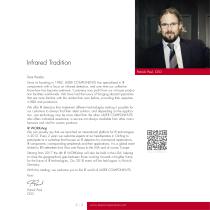
Infrared Tradition Patrick Paul, CEO Dear Reader, Since its founding in 1982, LASER COMPONENTS has specialized in IR c omponents with a focus on infrared detectors, and over time our collective know-how has become extensive. Customers now profit from our in-house production facilities world-wide. We have had the luxury of bringing aboard specialists that are more familiar with the market than ever before, providing their expertise in R&D and production. We offer IR detectors that implement different technologies making it possible for our customers to always find their ideal solution; and depending...
Open the catalog to page 3
In-House Manufacturing LASER COMPONENTS Detector Group Founded in 2004 Located in Tempe, Arizona, USA The LASER COMPONENTS Detector Group with its CEO ragan rubisic D G started with the production of Avalanche Photodiodes in 2004, and with his experience in xInGaAs materials our PIN photodiodes were subsequently developed. Our latest technologies were launched in 2015, with Detector Group opening a development division and production plant for PbS and PbSe detectors. LASER COMPONENTS has now become the technology leader in PbS/PbSe manufacturing; developing new detectors and inventive fabrication...
Open the catalog to page 6
Questions to Dragan Grubisic, CEO Q: What has been your first experience with infrared? A: I started working with Ge, InGaAs and InAs single element etectors d in 1983. Q: Has there been somebody like an infrared guide to you? A: Processing of infrared detectors has been and still is a kind of “black magic” so I mostly worked on my own developing fabrication and passivation processes for those infrared detectors with initial support by a Senior Chemist at Judson Infrared Inc. and later on by an infrared expert who was one of the first engineers working at Santa Barbara Research Centre. Q: What...
Open the catalog to page 7
In-House Manufacturing LASER COMPONENTS Pyro Group Founded in 2014 Located in Stuart, Florida, USA In 2014 the LASER COMPONENTS group expanded its infrared etector d activities and acquired the majority ownership of a U.S. based think tank and manufacturer lead by Alan Doctor, a well-known pioneer in the field of IR, who was the first CEO of LASER COMPONENTS Pyro Group for more than 3 years. LASER COMPONENTS Pyro Group is now lead by our new CEO Lance Feldman, who has been manufacturing pyroelectric detectors for over more than a decade. The LASER COMPONENTS Pyro Group facility was moved in 2015,...
Open the catalog to page 8
Questions to Lance Feldman, CEO Q: What has been your first experience with infrared? A: My first experience with Infrared occurred while I was still in Middle School, when motion sensors moved from Ultrasound to Infrared; the dramatic reduction of false positives, reduction in cost, giving rise to the commercialization of burglar alarms. I was fascinated with the technology and the reduction of these false positives utilizing Infrared. Q: Has there been somebody like an infrared guide to you? A: In 2008 I was approached by Alan Doctor who is well known in the IR community. He taught me the science...
Open the catalog to page 9
In-House Manufacturing LASER COMPONENTS GmbH Founded in 1982 Located in Olching, Germany The LASER COMPONENTS GmbH is the headquarter of the whole LASER COMPONENTS Group, and is where our optoelectronic department is located. More than 10 engineers work on inter-divisional products and technologies in the Munich suburb. For our IR products a product family for testing and lab applications is currently being developed, dubbed the "CUBE". As well as CUBE's, we can now also offer our miniature FTIR Reference laser module. Housed in our popular CUBE format the InGaAs, Pyroelectric, PbS, and PbSe...
Open the catalog to page 10
Questions to Dr. Lars Mechold, CTO Q: What has been your first experience with infrared? A: During my PhD I used to work in the field of high resolution spectro scopy in molecular plasmas. Q: Has there been somebody like an infrared guide to you? A: Yes, my former supervisor Prof. Röpcke at the Leibniz Institute for Plasma Science and Technology. He introduced me to a new field and its fabulous possibilities. Q: What has changed in the infrared over the years? A: Lead-salt lasers disappeared and QCL arised. There are new laser sources available. Fortunately more and more applications find themselves...
Open the catalog to page 11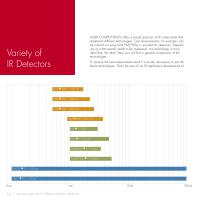
LASER COMPONENTS offers a broad spectrum of IR components that implement different technologies. Gas measurements, for example, can be carried out using both PbS/PbSe or pyroelectric detectors. Depending on what exactly needs to be measured, one technology is more ideal than the other. Here you will find a general comparison of the technologies. To receive the best measurement result it is mostly neccessary to test different technologies. That’s the aim of our IR application development kit.
Open the catalog to page 12
Detectivity D* The Detectivity D* describes the quality of a detector with the following definition: D* represents the signal-to-noise ratio for a certain electrical frequency and bandwidth if 1 Watt of radiation power reaches a detector surface of 1 cm2. The higher the D* value is, the better the detector is. NEP describes the noise equivalent power. D* [cm √Hz W-1] = √active detector surface NEP Cooled PbSe Fig 2: D* vs speed for different detector materials 12 – 13
Open the catalog to page 13
Application Driving Innovation At LASER COMPONENTS, we understand that it is not the component manufacturers who drive worldwide innovation, but rather those who use our products. Therefore, we make sure to keep our finger on the pulse of new technologies, whether via. one of our annual international IR WORKshop events; where we bring together academics and industrial innovators from all fields around the world together, to share their combined knowledge at our HQ in Munich or at Arizona State University in the USA. We are also a manufacturer that is dedicated to working with customers to produce...
Open the catalog to page 14All LASER COMPONENTS catalogs and technical brochures
 FIBER OPTICS
112 Pages
 Components made for 3D LiDAR
8 Pages
 FLEXPOINT® Laser Modules
12 Pages
 Laser Optics
88 Pages
 APD Modules: A-Cube Series
8 Pages
 Company Profile and Products
48 Pages
 Laser Safety Eyewear
29 Pages


