
- Catalogs
- Larson Davis
- CAL250, Precision Acoustic Calibrator

CAL250, Precision Acoustic Calibrator

CAL250, Precision Acoustic Calibrator
- Output Level: 114 dB
- Output Frequency: 251.2 Hz
- Microphone Compatibility: 1” standard, with adaptors for 1/2”, 1/4”, 3/8”, and 1/8” microphones
- Compliance: IEC 60942-1:2003, ANSI S1.40-2006, IEC 61010-1:2001, EU directive 2004/108/EC, IEC 61326-1:2005
- Environmental Conditions: Operates between -10 ºC to +50 ºC, with a humidity range of 10% to 90% RH
- Power Supply: 9 V battery, operating range 6.7 V to 10 V
- Dimensions: Length 124 mm, Diameter 44.5 mm
- Weight: 249 g
Catalog excerpts
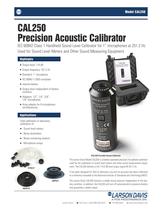
CAL250 Precision Acoustic Calibrator IEC 60942 Class 1 Handheld Sound Level Calibrator for 1” microphones at 251.2 Hz Used for Sound Level Meters and Other Sound Measuring Equipment Highlights I Internal battery Output level independent of battery condition Adaptors: 1/2”, 1/4”, 3/8”, 1/8” microphones Array adaptor for 8 microphones simultaneously Applications Field calibration or laboratory calibration of: I Sound level meters Noise dosimeters Noise monitoring stations Microphone arrays CAL250 Portable Sound Calibrator The Larson Davis Model CAL250 is a battery operated precision microphone calibrator used for the calibration of sound level meters and other sound measurement equipment. The CAL250 delivers a full 114.0 dB level output signal @ 251.2 Hz. It has been designed for field or laboratory use and its accuracy has been calibrated to a reference traceable to the National Institute of Standards and Technology (NIST). ADP021 ADP019 The Larson Davis CAL250 features a stable sound pressure independent of the battery condition. In addition, the CAL250 will turn off automatically to preserve battery and guarantee a stable output. Larson Davis
Open the catalog to page 1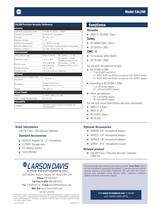
CAL250 Precision Acoustic Calibratorµ Acoustic Calibration sound pressure level Equivalent free-field level Harmonic distortion Stability after pressing On Minimum stabilizing time 10 seconds after coupling microphone and calibrator Reference conditions Static pressure range Temperature range SPL variation < ± 0.3 dB SPL variation < ± 0.4 dB Frequency variation < ± 2 Hz SPL variation < ± 0.4 dB Frequency variation < ± 2 Hz Storage temperature Storage humidity Effective volume of calibrator and microphone Battery Voltage Operating Range 6.7 V to 10 V Traceable to National Institute of Standards...
Open the catalog to page 2All Larson Davis catalogs and technical brochures
 831C Sound Advisor
16 Pages
 Spartan 730 Dosimter
2 Pages
 AEC206
2 Pages
 BAS001
2 Pages
 831-LOWN
2 Pages
 SOUNDEXPERT LXT
8 Pages
 SOUNDADVISOR™
16 Pages
 Preamplifier Power Supply
2 Pages
 Model PRM2103
2 Pages
 BAS006 Impulsive Source
2 Pages
 BAS004 Tapping Machine
2 Pages
 Firearms Acoustic Analysis
2 Pages
 EPS2116
2 Pages
 Advanced sound level meter
24 Pages
 Model 831
2 Pages
 NoiseTutor
4 Pages
 BAS003 Directional Source
2 Pages
 Reference Sound Source
2 Pages
 BAS002 Amplifier
2 Pages
 HVManager Software
2 Pages
 Audiometer Calibration
4 Pages
 NoiseTutor 2012
4 Pages
 Model 831, FFT Option
2 Pages
 Environmental Shroud
2 Pages
 System 824
4 Pages
 SoundTrack LxT® N/Forcer
2 Pages
 Sound Level Meters Model 831
2 Pages


Archived catalogs
 Vibration Meter Model HVM100
2 Pages

- Portable calibrator
- Precision calibration equipment
- Measurement monitoring module
- Continuous monitoring module
- Environmental monitoring system
- Laboratory calibration equipment
- Vibration analyzer
- Tapping machine
- Digital sound level meter
- Portable vibration meter
- Class 2 sound level meter
- Power monitoring module
- Portable monitoring system
- Basic sound level meter
- Integrating sound level meter
- Digital vibrometer