
- Catalogs
- Lakeland Industries
- Buyers Guide

Buyers Guide

Buyers Guide
This document provides an overview of Lakeland's CE certified protective clothing, designed for protection against chemicals, flames, heat, and arc flash. It details various standards and tests related to chemical protection, infectious agent protection, anti-static properties, radiant heat, and arc flash protection.
Lakeland Industries Inc. is a leading manufacturer of disposable protective clothing, known for high-quality products and a global presence, supplying to industrial, medical, and emergency response personnel in over 40 countries.
All products are certified to the latest CE standards, including Type 5 & 6 protective coveralls, chemical suits, Cool Suits®, Pyrolon™ for flame retardancy, ALM® aluminised clothing for heat protection, and ARC® clothing for arc flash and fire protection.
- Chemical Protection: Type 3 & 4 standards, chemical permeation tests, and selection guides.
- Infectious Agent Protection: EN 14126 standard for biological hazards.
- Anti-static Properties: EN 1149 standard for anti-static clothing.
- Heat and Flame Protection: EN 11612 standard for radiant heat protection and arc flash protection.
ChemMax® 3: Features superior multi-layer barrier films, enhanced comfort, and safety features like cushioned knee pads and a three-piece hood.
SafeGard™ GP: Entry-level protective coverall with high breathability and comfort, designed to prevent particle penetration.
Detailed tables compare the physical properties and chemical resistance of Lakeland products against competitors, highlighting areas where Lakeland products excel.
Lakeland offers a comprehensive range of protective clothing solutions, ensuring high standards of safety and comfort for workers in hazardous environments. Detailed product information and guides are available.
- EN 14605: Protection against sprays of hazardous liquids (Type 3) and jet sprays (Type 1).
- EN 943-1&2: Protection against hazardous vapors and gases.
- EN ISO 14116: Flame and heat protection.
- EN 11612: General protective clothing standards.
- Type 1 Garments: Gas-tight suits like Interceptor® Plus for protection against gases and vapors.
- Type 3 & 4 Garments: ChemMax® and PyrolonTM series for protection against strong jet sprays and shower sprays.
- Type 5 & 6 Garments: SafeGardTM for protection against dust and light aerosol sprays.
- Chemical Properties: Consider the chemical's toxicity, carcinogenicity, and the effect of temperature on permeation rates.
- Task and Environment: Factors such as mobility, visibility, and environmental conditions should influence garment choice.
- Comfort and Safety: Options like Cool Suits provide comfort without compromising safety.
- Use permeation tests to compare fabric safety but note they do not indicate safe use duration.
- Calculate maximum safe use time considering permeation rates, temperature, and chemical toxicity.
- Consult Lakeland’s ‘Guide to Chemical Suit Selection’ for detailed chemical permeation and physical properties comparison.
- Garments like ChemMax® 1 EB and ChemMax® 3 offer enhanced features such as taped seams for improved protection.
- PyrolonTM garments meet both chemical and flame resistance standards, suitable for wearing over thermal protective garments.
Selecting the right protective garment involves understanding the chemical hazards, task requirements, and environmental conditions. Lakeland provides a comprehensive range of garments to meet various protection needs, ensuring safety and comfort for users.
- ChemMAX® Suits: Available in different types and designed for encapsulating protection with features like stitched and taped seams, rear entry, attached boots, and a hood with a face visor.
- Interceptor® Plus: A gas-tight, Type 1a chemical protective coverall designed for use with self-contained breathing apparatus (SCBA).
- The suits are certified to various EN standards, including EN 943, EN 14116, and EN 14605.
- Permeation tests and physical property tests ensure the suits meet safety standards.
- Push-Lock® Glove Connection System: Provides a secure and reusable method to attach gloves to the suit sleeves.
- Cool Vest®: Designed to be worn under chemical suits, it uses phase change material to maintain a cooling temperature.
- Understanding the differences between Type 3 and Type 4 suits is crucial for choosing the most suitable protection level.
- Use the PermaSURE® app for accessing safe-wear times for over 4000 chemicals.
Various protective garments are detailed, including coveralls, smocks, gowns, aprons, sleeves, encapsulating suits, overboots, and jackets. Specific features include double front zip fastening, cushioned kneepads, thumb loops, and anti-slip soles.
Garments are generously cut according to the Super-B style for maximum freedom. A size chart is provided for sizes SM to 3X.
The document discusses the importance of understanding chemical permeation and permeation test data.
Calculates safe-use times for ChemMax® 3, ChemMax® 4 Plus, and Interceptor® Plus coveralls against over 4,000 chemicals.
Type 5 and 6 garments provide protection against hazardous dry particles and reduced/light liquid sprays and splashes.
Lakeland garments offer superior protection, comfort, and breathability compared to alternatives. The document encourages the use of PermaSURE® for accurate assessment of safe-use times.
The document outlines the specifications for different types of protective coveralls, including SafeGardTM and MicroMax® NS.
The selection process involves assessing the type of hazard and considering factors like particle size, environmental conditions, and task-specific requirements.
The coveralls are certified to various EN standards, including EN ISO 14116 for flame and heat protection, EN 11612, and EN 14126 for infectious agents.
For optimal protection and comfort, the document recommends using breathable options like SafeGardTM.
- SafeGardTM: Offers high breathability and comfort with SMMS fabric.
- MicroMax® NS: Provides superior liquid resistance with a microporous film laminate.
- PyrolonTM: Meets chemical and flame resistance standards.
The document highlights the importance of considering the 'bellows effect' and ensuring air permeability to prevent dust penetration.
The garments are made from microporous film laminate fabric with stitched and taped seams, offering enhanced Type 4 protection.
The document lists various physical properties of the garments, such as abrasion resistance, flex cracking, trapezoidal tear, tensile strength, puncture resistance, anti-static properties, and seam strength.
The document emphasizes the importance of garments certified to EN 14126 for protection against bacteria, biological contaminants, and infectious agents.
Proper donning and doffing of protective suits are crucial, especially in infectious agent protection.
The document includes a flow chart to guide users in selecting the best garment for specific tasks.
The document provides comprehensive guidance on selecting and using protective garments for various hazardous environments.
The document provides guidance on the selection and use of protective garments, emphasizing the user's responsibility to ensure suitability for specific applications.
The document outlines different types of protection, including hazardous chemical protection, gas and vapor protection, liquid chemical protection, and protection against dust, radiation, and heat.
Cool Suits® are designed for breathable protection, combining high breathability fabrics with high-protection fabrics for Types 4, 5, and 6 protection.
Several variations of Cool Suits® are available, each offering different levels of protection and comfort.
The document explains the concept of anti-static clothing, designed to prevent static electricity build-up that could ignite explosive atmospheres.
Anti-static clothing is designed to reduce the probability of static discharge, which can cause incendiary sparks.
Protective clothing must meet requirements measured in either Part 1 (Surface Resistance) or Part 3 (Charge Decay).
This suit combines flame retardant properties with chemical protection.
Anti-static properties are achieved by reducing fabric resistance, allowing charges to dissipate safely.
To ensure anti-static effectiveness, garments should maintain contact with the wearer’s skin.
Anti-static properties in disposable coveralls are complex, and risk minimization is key.
EN ISO 14116 and EN 11612 are standards for flame retardant garments.
This testing method assesses the effectiveness of heat protective workwear by simulating flash fires.
PyrolonTM Plus 2 and PyrolonTM XT are flame retardant, breathable coveralls designed to be worn over thermal protective garments.
These garments are tested for abrasion resistance, flex cracking, tear strength, tensile strength, puncture resistance, and seam strength.
PyrolonTM CRFR and CBFR provide chemical protection (Type 3 & 4) and meet flame resistance standards.
Lakeland's 'Super-B' style includes ergonomic design features such as cushioned knee-pads, double zips, storm flaps, and a three-piece hood.
Permeation and penetration data are provided for various chemicals.
Proper garment design is crucial for ensuring comfort and protection.
1. Pointed Oval Hood: Designed for a better fit.
2. Two-piece Crotch Gusset: Reduces stress at seams, enhancing durability and movement.
3. Inset Sleeves: Allows greater freedom of movement compared to traditional 'bat-wing' sleeves.
Purpose: Protects against radiant heat in high-temperature environments like industrial ovens.
Design: Utilizes Gentex 'Dual Mirror®' 100% aluminum to reflect up to 95% of radiant heat.
1. ALM® 300: Entry-level suit for essential high-temperature applications.
2. ALM® 500: Triple-layer suit with moisture and thermal barriers for superior protection.
3. ALM® 700: Designed for areas with moisture or steam, offering the highest protection level.
1. Convective Heat: Class B1 to B3, based on time to temperature rise.
2. Radiant Heat: Class C1 to C4, with ALM® 700 exceeding Class 4 standards.
3. Contact Heat: Class F1 to F3, indicating time to temperature rise.
4. Molten Metal Splash: Classes D1/E1 to D3/E3, based on mass of metal required to damage fabric.
Purpose: Sets minimum performance levels for garments against heat and flames.
The document provides detailed information on protective garments designed for arc flash and radiant heat protection.
The document outlines various classes of protection based on the duration of heat exposure.
The document explains arc flash, its hazards, and the process of selecting protective garments.
The document describes the features of specific garments, such as the Arc® 43 and Arc® X.
The document lists various EN standards and test results for flame, heat, and arc thermal protective performance.
The document advises on the importance of visual inspection before use and provides recommendations for donning and doffing procedures.
A buddy system is recommended for donning and doffing protective suits.
Most Lakeland garments are designed for single use. However, undamaged and uncontaminated garments may be reused.
ALM® suits rely on their aluminised surface for heat reflection and must be kept clean.
Interceptor® Plus suits are pressure tested for leak-tightness.
Suits are vacuum-packed to reduce costs. They should be stored dry, away from light, and at temperatures above -15°C.
Training on suit use and maintenance is available. Suits have a shelf life of 10 years if stored properly.
Uncontaminated garments can be disposed of as standard waste. Contaminated garments require special disposal.
Choosing the right garment involves considering the task, hazard, and environment.
Lakeland offers a wide range of protective clothing options and has a global presence.
Catalog excerpts

Protect Your People Understanding chemical protection Type 3 & 4 standards - page 8 Understanding chemical permeation and the standard permeation test - pages 14 & 15 Understanding infectious agent protection and EN 14126 - page 21 Understanding anti-static and the EN 1149 standard - page 28 • Understanding radiant heat in the EN 11612 standard - page 38 • Understanding Arc Flash heat protection - page 39 Also includes new protective clothing selection flow chart - centre pages Buyers Guide to the complete range of Lakeland CE certified clothing for protection against Chemicals, Flames, Heat and
Open the catalog to page 1
Protect Your People Lakeland CE Certified Protective Clothing Range Other Product Guides and Datasheets Available This catalogue provides an overview of the full range of CE certified protective clothing manufactured by Lakeland Industries Inc. The Guide to Selection of Chemical Suits A guide to the key factors for consideration in selecting the best chemical suit for the job to maximise protection and comfort whilst minimising cost. Lakeland is the original manufacturer of disposable protective clothing; its predecessor being the first to produce garments using polymer fibrebased nonwovens....
Open the catalog to page 2
Protect Your People Contents Section Introduction Pages Additional Information Product Pages Types 3 & 4 Chemical Suits page 5 - 12 A range of clothing for protection against hazardous liquid, vapour and gaseous chemicals. A range of clothing for protection against hazardous dusts and light liquid sprays and splashes. Types 5 & 6 A range of clothing for protection Cool Suits against hazardous page 26-28 liquid, vapour and gaseous chemicals. MicroMax® NS Cool Suit Encapsulating Suits Interceptor® Plus MicroMax® TS Cool Suit ChemMax® 1 Cool Suit ChemMax® 3 Cool Suit PyrolonTM CRFR Cool Suit A range...
Open the catalog to page 3
Protect Your People Introduction: Clothing For Protection Against Hazardous Chemicals Type 4 EN 14605 cover chemical protective clothing Type 4 Garments: ChemMax® 1 EB (page 5) MicroMax® TS Cool Suit (page 26) ChemMax® Cool Suits (page 27) PyrolonTM CRFR Cool Suit (page 28) Type 3 & 4 Garments: ChemMax® 1 and 2 (page 6) ChemMax® 3 and 4 (page 7) PyrolonTM CRFR and CBFR Type 1 Garments: Interceptor® Plus (page 10-11) protection against sprays of hazardous liquids protection against jet sprays of hazardous liquids protection against hazardous vapours and gases Note: Type 2 has been removed in the...
Open the catalog to page 4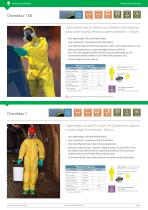
ChemMax® 1EB Chemical Protection Lightweight Type 4 chemical suit ideal for tank cleaning, spray cleaning and infectious agent protection - 87gsm. • Very lightweight, soft and flexible fabric. • Low noise level - improved comfort and safety. • Cost effective Type 4 chemical protection. (Type 3 with additional tape on flap) • Infectious Agent Barrier - passes at highest classes in all four EN 14126 bio-hazard tests (this version was used extensively by UK Government health workers in 2015 West African Ebola Crisis). • Thumb loops to secure sleeves. Physical Properties Lightweight coverall for...
Open the catalog to page 5
ChemMax® 2 Chemical Protection Propriatory established chemical barrier film laminated to spunbond PP substrate -135gsm. • Extremely soft and flexible compared to coveralls offering similar protection level. • White with grey seams for easy identification and high visibility. • Low noise level - improved comfort and safety. • Low price compared to other coveralls offering similar protection. • Permeation testing achieves similar or better result on 66% of 100 chemicals tested compared to more expensive competitors. • Cushioned double-layer knee pads for increased comfort and safety. ChemMax®...
Open the catalog to page 6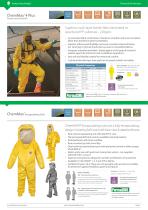
ChemMax® 4 Plus sHHBred aSURPSj Chemical Protection Superior multi-layer barrier films laminated to spunbond PP substrate - 220gsm. • Co-extrusion fabric construction. Results in smoother and more consistent fabric than bonded or glued competitors. • Superior softness and flexibility and more consistent chemical barrier (no 'pinching' or thinner bond points as seen in competitor fabrics). • European manufactured fabric. Tested against a full range of chemical warfare agents for anti-terror and civil defence operations. • Very soft and flexible material for enhanced comfort. • Cushioned double-layer...
Open the catalog to page 7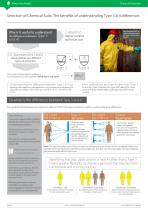
Chemical Protection Protect Your People Selection of Chemical Suits: The benefits of understanding Type 3 & 4 differences Why is it useful to understand the differences between Type Approximately 80% of real world applications are Type 4 rather than Type 3! Higher comfort and lower cost CE Standard EN 14605 clearly defines two different types of protection These types of spray hazard are different. Yet most garments on the market are BOTH Type 3 and Type 4. Why? Most applications are Type 4 rather than Type 3. Understanding the difference between Type 3 & 4 and deciding which applies to your...
Open the catalog to page 8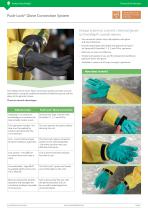
Chemical Protection Push-Lock® Glove Connection System Unique system to connect chemical gloves to ChemMax® coverall sleeves. • Two concentric plastic rings clip together with glove and sleeve between. • Provides liquid-tight seal tested and approved to Type 3 Jet Spray with ChemMax® 1,2, 3 and 4 Plus garments. • Multi-use so more cost effective. • Simpler and quicker to use and fit compared to traditional taping of sleeve and glove. • Available in cartons of 20 rings (to equip 5 garments) The Lakeland Push-Lock® Glove Connection System provides a secure alternative to using the traditional method...
Open the catalog to page 9
Chemical Protection Interceptor® Plus Powered by PermaSURE® • Multi-layer film technology creates a light and flexible high barrier against a wide range of high hazard chemicals. Weight 365gsm. • Certified to EN 943-1:2015+A1:2019 Type 1a (Note: excluding clause 5.4) • Superior design featuring double-taped seams (inside & out). • Standard or wide-vision visor options; two-layer visor with unique sealing technology for high chemical barrier. • Double layer chemical glove system. • European manufactured fabric. Tested against a full range of chemical warfare agents for anti-terror and civil defence...
Open the catalog to page 10All Lakeland Industries catalogs and technical brochures
 midweight-layering.pdf
1 Page
 FR-Protective-Clothing.pdf
33 Pages
 hi-vis_catalog
23 Pages
 indusrial_heat_3
10 Pages
 700series-data-sheet.
1 Page
 300series-data-sheet
1 Page


Archived catalogs
 LAKELAND CATALOG
108 Pages
- Fabric clothing
- Polyester clothing
- Cotton clothing
- Work safety gloves
- Waterproof clothing
- Work jacket
- Chemical protection safety gloves
- Work coveralls
- Thermal protection clothing
- Work pants
- Chemical protection clothing
- Unisex coveralls
- Polyester jacket
- Construction clothing
- Cold weather clothing
- Clothing with hood
- Unisex jacket
- Fabric jacket
- Zippered jacket