
- Catalogs
- Lake Shore Cryotronics, Inc.
- Model 372 AC Resistance Bridge and Temperature Controller


Model 372 AC Resistance Bridge and Temperature Controller

Model 372 AC Resistance Bridge and Temperature Controller
The Model 372 AC Resistance Bridge and Temperature Controller is engineered for ultra-low temperature applications, particularly in dilution refrigerators operating below 100 mK. It provides advanced temperature measurement and control, including both automatic and manual temperature control and impedance measurements.
The device includes patented noise rejection technology, versatile measurement input with up to 16 channels using the optional 3726 scanner, and dedicated input for ultra-low temperature control. It also offers impedance measurement capabilities, multiple PID controllable outputs with up to 10 W heater power, a user-friendly front panel, and a 3-year warranty.
The Model 372 minimizes electronic noise through a patented balanced noise-rejecting current source and driven guard cables to reduce parasitic capacitance. Its measurement circuitry is isolated to limit electrical disturbances.
Using AC measurement with an internal lock-in amplifier, the Model 372 can extract small signals from noise, allowing for low excitation levels and minimizing energy dissipation. Excitation levels can be as low as 10 pA, maintaining accuracy over a wide resistance range.
The Model 372 supports highly accurate ultra-low temperature measurements using NTC resistive temperature devices. It allows for the storage of up to 39 calibration curves and supports up to 17 sensors with the 3726 scanner.
The 3726 scanner and preamp expand the Model 372's capabilities, allowing for up to 16 connections for 4-wire resistance measurements. Multiple Model 372 units can be used together for simultaneous measurements without interference.
The Model 372 allows for different PID settings across temperature zones to accommodate varying thermal response characteristics of dilution refrigerators.
Features include temperature thresholds for heater outputs and an "ALL OFF" button for immediate shutdown to prevent overheating.
The Model 372 offers dedicated temperature control input and multiple heater options for precise control at ultra-low temperatures. It supports stable temperature control with mechanisms to prevent unwanted spikes.
The 3708 scanner and preamp enhance the Model 372's ability to measure low-impedance devices accurately, reducing input voltage noise and supporting cable lengths up to 10 m.
The Model 372 offers Ethernet, USB, and IEEE-488.2 interfaces for remote control and data management. It supports live data viewing and firmware updates, with backward compatibility for integration with existing systems.
Key specifications include AC, four-lead differential resistance measurement with a maximum of 16 channels, resistance ranges from 2 mΩ to 63.2 MΩ, and a maximum update rate of 10 readings per second. Control input is similar but with 6 resistance ranges from 2 kΩ to 632 kΩ. Excitation is provided by a sinusoidal AC current source with frequencies from 9.8 Hz to 18.2 Hz and currents from 1 pA to 31.6 mA RMS. The device supports up to 39 user curves with cubic spline or linear interpolation for temperature conversion. Heater output is a variable DC current source with closed loop PID control, offering multiple ranges and safety features. Interfaces include IEEE-488.2, USB, and Ethernet capabilities with support for LabVIEW™ drivers. The device operates within ambient temperatures of 15 °C to 35 °C, with power requirements of 100 to 240 VAC.
Procedures include range selection (manual, voltage excitation, current excitation, and autorange modes), filter settings adjustable from 1 s to 200 s settling time, and safety features like power-up current protection, short-circuit protection, and compliance voltage limit detection. Software features include Min/Max reading capture, scanner dwell time, and curve entry via front panel or computer interface.
For optimal performance, it is recommended to use the Rox™ RX-102B-CB sensor for temperatures down to 10 mK, ensure proper isolation from chassis and heater grounds to prevent interference, and utilize the provided LabVIEW™ drivers for seamless integration with existing systems.
The document provides part numbers and descriptions for ordering various configurations of the AC resistance bridge and scanners, along with available accessories and options.
Lake Shore Cryotronics, Inc. is a leader in measurement and control solutions for materials characterization under extreme conditions, serving a global research community.
Catalog excerpts

Model 372 AC Resistance Bridge and Temperature Controller
Open the catalog to page 1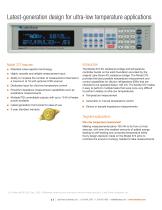
Latest-generation design for ultra-low temperature applications Lake Shore Model 372 AC Resistance Bridge & Temperature Controller Input Setup Curve Entry Remote/Local Exit Menu Output Setup Zone Settings Interface ^^^^^ Still Output Relay/Alarms _ Display Setup Still Output Relay/Alarms Instrument Setup Max/Min Reset ■ Patented noise rejection technology ■ Highly versatile and reliable measurement input ■ Ability to increase the number of measurement channels to a maximum of 16 with optional 3726 scanner ■ Dedicated input for ultra-low temperature control ■ Powerful impedance measurement capabilities...
Open the catalog to page 2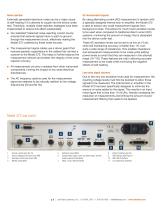
Noise rejection Externally generated electronic noise can be a major cause of self-heating if it is allowed to couple into the device under test. Thankfully, multiple noise-rejection strategies have been implemented to reduce this effect substantially: By using alternating current (AC) measurement in tandem with a specially designed internal lock-in amplifier, the Model 372 is able to extract very small measurement signals from background noise. This allows for much lower excitation levels to be used when compared to traditional direct current (DC) systems, minimizing the amount of energy that...
Open the catalog to page 3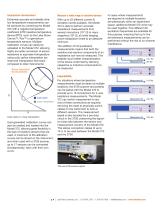
Temperature measurement Measure a wide range of resistive devices Extremely accurate and reliable ultralow temperature measurements can be achieved by combining the Model 372 with a negative temperature coefficient (NTC) resistive temperature device (RTD), such as the Lake Shore Cernox™, Rox™ or germanium temperature sensors. Multiple calibration curves can easily be uploaded to the Model 372, allowing highly accurate conversion of sensor resistance to equivalent temperature using cubic spline interpolation (an improved interpolation technique compared to older instruments). With up to 22 different...
Open the catalog to page 4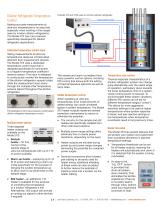
Dilution Refrigerator Temperature Control A Model 372 and 3726 used to control a dilution refrigerator Scanned temperature channels Making accurate measurements at ultra-low temperatures is no easy feat, especially when working in the ranges seen by modern dilution refrigerators. The Model 372 has many features specifically developed for dilution refrigerator applications. Dedicated temperature control input Taking measurements at ultra-low temperatures deserves uninterrupted attention from measurement devices. The Model 372 uses a dedicated temperature control input that is designed specifically...
Open the catalog to page 5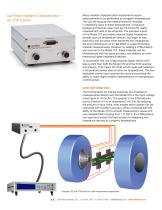
Low-Power Impedance Characterization— the 3708 Scanner Many material characterization experiments require measurements to be performed at cryogenic temperatures. This can be because the material behavior changes in interesting ways at these temperatures, or because background thermal noise must be minimized for useful measurement data to be extracted. The standard inputs of the Model 372 accurately measure higher-impedance devices such as temperature sensors, but begin to lose resolution and accuracy when extremely low impedances are encountered such as in Hall effect or superconducting material...
Open the catalog to page 6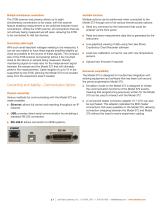
Multiple simultaneous connections Available functions The 3708 scanner and preamp allows up to eight simultaneous connections to be made, with the scanner feature enabling measurement to be switched between those connections. Unlike the 3726 scanner, all connections that are not actively being measured are left open, allowing the 3708 to be connected to Hall bar devices. Multiple actions can be performed when connected to the Model 372 through one of its various remote access options: Overcoming cable length DD Live graphical viewing of data using the Lake Shore Cryotronics Chart Recorder software...
Open the catalog to page 7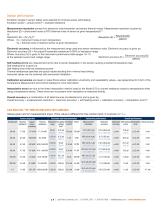
Sensor performance Excitation ranges in sensor tables were selected to minimize sensor self-heating. Excitation power = actual current2 × example resistance Measurement resolution comes from electronic instrumentation and sensor thermal noises. Measurement resolution is given by: Resolution (Ω) = ((instrument noise at RT)2+(thermal noise of sensor at given temperature)2)0.5 or Resolution(Ω) Resolution (Ω) = (Ni2+Ns2)0.5 Resolution (K) = (dR/dT) Where: Ni = instrument noise at room temperature Ns = thermal noise of resistive sensor at given temperature Electronic accuracy is influenced by the...
Open the catalog to page 8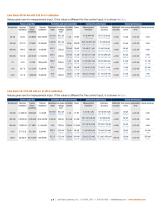
Lake Shore GR-50-AA with 0.05 to 6 K calibration Values given are for measurement input. If the value is different for the control input, it is shown in blue. Sensor properties Temperature Nominal resistance Typical sensor sensitivity Excitation and instrumentation Thermal Resistance Excitation Excitation Power resistance range voltage current limit Instrument performance Measurement resolution Electronic accuracy Overall performance Calibration Self-heating Interpolation Overall accuracy accuracy errors error Lake Shore CX-1010-SD with 0.1 to 325 K calibration Values given are for measurement...
Open the catalog to page 9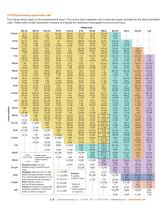
372/3726 performance specification table The values below apply to the measurement input. The control input operates over a reduced range indicated by the black-bordered cells. These cells contain bracketed numbers to indicate the resolution that applies to the control input. Voltage range Current excitation 632 mV 200 mV 63.2 mV 20 Ω 6.32 Ω 2Ω 20 µΩ 6.3 µΩ 2 µΩ 10 mW 3.2 mW 1 mW 63.2 Ω 20 Ω 6.32 Ω 63 µΩ 20 µΩ 6.3 µΩ 3.2 mW 1 mW 320 µW 200 Ω 63.2 Ω 20 Ω 200 µΩ 63 µΩ 20 µΩ 1 mW 320 µW 100 µW 632 Ω 200 Ω 63.2 Ω 630 µΩ 200 µΩ 63 µΩ 3.2E-04 100 µW 32 µW 2 kΩ 632 Ω 200 Ω 2 mΩ 630 µΩ 200 µΩ 100 µW...
Open the catalog to page 10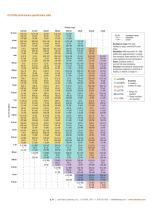
372/3708 performance specification table Current excitation resistance range resolution power Resistance range: Full scale resistance range, nominal 20% over range. Resolution: RMS noise with 18 s filter settling time (approximates 3 s analog time constant). Noise specified at ½ full scale resistance at room temperature. Power: Excitation power at one-half full s
Open the catalog to page 11All Lake Shore Cryotronics, Inc. catalogs and technical brochures
 Model 224 Temperature
6 Pages
 GaAlAs Diodes*
3 Pages
 DT-670 Silicon Diodes
5 Pages
 7600
760020 Pages
 8404
840424 Pages
 Model 625
5 Pages
 100 Series
3 Pages
 Model 218
4 Pages
 Model 211
4 Pages
 Model 370
10 Pages
 Thermocouple Wire
1 Page
 Ruthenium Oxide Sensors
4 Pages
 Germanium Sensors
4 Pages
 Cernox Sensors
4 Pages
 Rhodium Iron Sensors
3 Pages
 Platinum Sensors
3 Pages
 GaAlAs Sensors
3 Pages
 DT 670
4 Pages
 DT 400 Sensors
4 Pages
 Magnetics Catalog
64 Pages
 Temperature Catalog
232 Pages


- Resistance temperature sensor
- Measuring machine
- Digital temperature control
- Analog I/O
- Pt100 temperature transducer
- Generator
- Digital temperature controller
- Remote I/O
- Automation temperature controller
- PID temperature control
- PID temperature controller
- Modbus I/O
- Control measurement system
- Analog input module
- Configurable temperature control
- Configurable temperature controller
- Platinum resistive temperature sensor
- Thin-film temperature sensor