
- Catalogs
- Lake Shore Cryotronics, Inc.
- Model 370


Model 370

Model 370
The Model 370 AC Resistance Bridge is engineered for precise AC resistance measurements in cryogenic environments (20 mK to 1 K). It minimizes noise and self-heating errors, making it ideal for use with Lake Shore calibrated subkelvin resistance temperature sensors.
- Resistance measurement range: 2 mΩ to 2 MΩ.
- 21 excitation levels: 3.16 pA to 31.6 mA.
- Real-time sensor excitation power display.
- PID temperature control, IEEE-488, and RS-232C interfaces.
- Noise-reduction elements: patented current source and optically isolated electronics.
Utilizes 4-lead AC measurement for high accuracy with low excitation current. Phase-sensitive detection reclaims small signals from noise, operating at 13.7 Hz to reduce lead capacitance effects.
Offers current and voltage excitation modes. Current mode provides stable excitation with 21 AC current levels. Voltage mode limits excitation power to reduce self-heating in NTC sensors.
Features a patented matched impedance current source and active common mode reduction circuit. Optical isolation reduces digital noise and breaks ground loops.
Includes digital PID control with a variable DC current source for heater output, designed for low noise and stability. Can control temperature based on multiple scanned sensors, though stability may degrade with multiple sensors.
Custom scanners (Models 3716, 3716L, and 3708) expand input capability. Model 3716L is optimized for low noise, while Model 3708 offers ultra-low noise performance.
Supports IEEE-488.2 and RS-232C interfaces for automated data recording. Includes analog outputs for resistance monitoring and can be controlled manually or via computer interface.
The Model 370 AC Resistance Bridge is a comprehensive solution for precise resistance measurement in cryogenic environments, offering advanced features for noise reduction, temperature control, and flexible interfacing options.
The document details specifications and performance characteristics of the Model 370 AC Resistance Bridge and associated sensors, focusing on accuracy, sensitivity, and noise levels in cryogenic environments.
Designed for high accuracy measurements of resistances above 200 kΩ, with excitation currents from 1 pA to 30 pA. Noise figure: 33 nV/√Hz. Details resistance range, excitation voltage limits, and power requirements for GR-50-AA and RX-102A sensors.
GR-50-AA sensor recommended for high accuracy and sensitivity from 0.05 K to 1 K. RX-102A sensor offers similar specifications with different resistance and thermal resistance characteristics.
Includes tables detailing measurement resolution, electronic accuracy, calibration accuracy, self-heating errors, interpolation errors, and overall accuracy for various temperatures.
Suggests using the GR-50-AA sensor with the Model 370 for high accuracy and sensitivity. Emphasizes minimizing sensor self-heating and improving thermal resistance through permanent installation.
Extensive tables provide detailed specifications for voltage range, current excitation, resistance range, resolution, and power for different models and configurations.
Supports resistance ranges from 2 mΩ to 2 MΩ, with a reading rate of 10 readings per second. Features 24-bit A/D resolution and sinusoidal AC current source excitation with 21 current ranges.
Supports various measurement units and offers temperature conversion for resistive sensors. Includes high-resolution digital PID control for temperature stability.
Features a graphic vacuum fluorescent display with multiple reading displays. Includes IEEE-488.2 and RS-232C capabilities, supporting LabVIEW™ drivers.
Operates within an ambient temperature range of 15 °C to 35 °C. Requires a power supply of 100, 120, 220, or 240 VAC. CE marked with various accessories and options.
Provides part numbers and descriptions for different configurations and accessories, including scanners and preamps.
Catalog excerpts
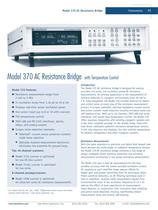
Model 370 AC Resistance Bridge Model 370 AC Resistance Bridge Resistance measurement ranges from 2 mΩ to 2 MΩ 21 excitation levels from 3.16 pA to 31.6 mA Displays real-time sensor excitation power One sensor input (up to 8 or 16 with scanner) PID temperature control IEEE-488 and RS-232C interfaces, alarms, relays, and analog outputs Unique noise-reduction elements: Patented* current source preserves common mode noise rejection Optically isolated measurement electronics eliminates the potential for ground loops Model 3716 scanner is optimized for low DC bias current Model 3716L scanner is optimized for low noise 8-channel preamp/scanner: Model 3708 scanner is optimized for ultra-low noise AC resistance measurements * .S. Patent #6,501,255, Dec., 2002, “Differential current source with active U common mode reduction,” Lake Shore Cryotronics, Inc. Lake Shore Cryotronics, Inc. 77 with Temperature Control Resistance Measurement With the same attention to precision and detail that helped Lake Shore become the world leader in subkelvin temperature sensors, the Model 370 AC resistance bridge combines a full range of design strategies which optimize resolution and minimize measurement uncertainty in low power resistance measurement. Two 16-channel scanners: www.lakeshore.com Instruments Introduction The Model 370 AC resistance bridge is designed for precise, accurate, low noise, low excitation power AC resistance measurements. Its primary application is the measurement of resistive materials in cryogenic environments from 20 mK to 1 K. Fully integrated, the Model 370 includes features to reduce and control noise at every step of the resistance measurement process. A unique, patented, matched impedance current source and active common mode reduction circuitry minimize noise and self-heating errors. With up to 16 channels, IEEE‑488 and serial interfaces, and closed loop temperature control, the Model 370 offers seamless integration with existing cryogenic systems and is the most complete package on the market today. Used with Lake Shore calibrated subkelvin resistance temperature sensors, it not only measures and displays, but also controls temperature for dilution refrigerators and other cryogenic systems. Model 370 Features The Model 370 uses 4-lead AC measurement for the best possible accuracy with the lowest possible excitation current. AC coupling at each amplifier stage reduces offsets for higher gain and greater sensitivity than DC techniques allow. Phase sensitive detection, an AC filtering technique used in lock-in amplifiers, reclaims small measurement signals from environmental noise. A low excitation frequency of 13.7 Hz reduces the effect of lead capacitance on measurement. These features, in conjunction with innovative lead shielding and active noise reduction circuitry, significantly reduce measurement noise and resistor self-heating. (614) 891-2244 fax: (614) 818-1600 e-mail: [email protected]
Open the catalog to page 1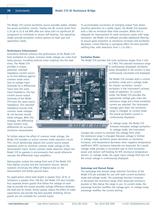
78 Instruments Model 370 AC Resistance Bridge The Model 370 current excitation source provides stable, reliable, low power excitation current. Twenty-one AC current levels from 3.16 pA to 31.6 mA RMS offer low noise with no significant DC component to contribute to sensor self-heating. Two operating modes provide excitation control options to meet user and application needs. Performance Enhancement Innovative features enhance the performance of the Model 370 from excitation to output. Common mode voltage can come from many sources, including external noise coupling into the lead wires. The Model...
Open the catalog to page 2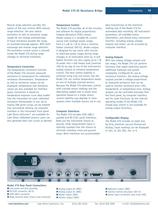
Model 370 AC Resistance Bridge Manual range selection provides the option of full user control. With manual range selection, the user selects excitation as well as resistance range; ranges do not change automatically. If input resistance exceeds the range, an overload message appears. With both autorange and manual range selection, the excitation current source is shorted inside the Model 370 during range changes to minimize transients. Temperature Conversion The temperature conversion function of the Model 370 converts measured resistance to temperature for calibrated resistance thermometers....
Open the catalog to page 3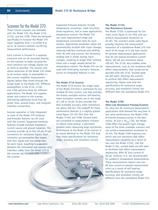
80 Model 370 AC Resistance Bridge Instruments Scanners for the Model 370 Three custom scanners are available with the Model 370, the Model 3716, 3716L, and the 3708. These are designed specifically to increase the Model 370 input capability from 1 to either 8 or up to 16 resistors without sacrificing measurement performance. Each scanner is housed in a separate enclosure and can be mounted directly on the cryostat so leads carrying the most sensitive low voltage signals are as short as possible. The scanner also allows extension of the Model 370 shield to all resistor leads. A preamplifier in...
Open the catalog to page 4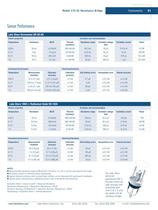
Model 370 AC Resistance Bridge Instruments 81 Sensor Performance Lake Shore Germanium GR-50-AA Sensor properties Excitation and instrumentation Temperature Resistance dR/dT Thermal resistance 0.05 K 35 kΩ -3.6 MΩ/K 200 mK/nW 0.1 K 2 kΩ -72 kΩ/K 20 mK/nW 0.3 K 164 Ω -964 Ω/K 4 mK/nW 1K 34 Ω -31 Ω/K 0.1 mK/nW Instrument performance Temperature Resistance range Excitation voltage limit Excitation current Power 63.2 kΩ 20 µV 0.316 nA 3.5 fW 6.32 kΩ 63 µV 10 nA 232 fW 200 kΩ 63 µV 316 nA 16.4 pW 63 kΩ 200 µV 1 µA 33.5 pW Calibration accuracy Self-heating errors Interpolation error Overall accuracy...
Open the catalog to page 5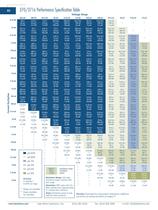
370/3716 Performance Specification Table 82 Voltage Range 31.6 mA 10 mA 3.16 mA 1.0 mA 316 µA 100 µA 31.6 µA 10 µA 3.16 µA Current Excitation 1.0 µA 316 nA 100 nA 31.6 nA 10 nA 3.16 nA 1.0 nA 316 pA 100 pA 31.6 pA 10 pA 3.16 pA 1.0 pA 632 mV 200 mV 63.2 mV 20 mV 6.32 mV 2.0 mV 632 µV 200 µV 63.2 µV 20 µV 6.32 µV 2.0 µV 20 Ω 20 µΩ 10 mW 6.32 Ω 6.0 µΩ 3.2 mW 2.0 Ω 2.0 µΩ 1.0 mW 632 mΩ 1.3 µΩ 320 µW 200 mΩ 400 nΩ 100 µW 63.2 mΩ 130 nΩ 32 µW 20 mΩ 100 nΩ 10 µW 6.32 mΩ 100 nΩ 3.2 µW 2.0 mΩ 100 nΩ 1.0 µW * * * 63.2 Ω 60 µΩ 3.2 mW 20 Ω 20 µΩ 1.0 mW 6.32 Ω 6.0 µΩ 320 µW 2.0 Ω 4.0 µΩ 100 µW 632 mΩ 1.3...
Open the catalog to page 6All Lake Shore Cryotronics, Inc. catalogs and technical brochures
 Model 224 Temperature
6 Pages
 GaAlAs Diodes*
3 Pages
 DT-670 Silicon Diodes
5 Pages
 7600
760020 Pages
 8404
840424 Pages
 Model 625
5 Pages
 100 Series
3 Pages
 Model 218
4 Pages
 Model 211
4 Pages
 Thermocouple Wire
1 Page
 Ruthenium Oxide Sensors
4 Pages
 Germanium Sensors
4 Pages
 Cernox Sensors
4 Pages
 Rhodium Iron Sensors
3 Pages
 Platinum Sensors
3 Pages
 GaAlAs Sensors
3 Pages
 DT 670
4 Pages
 DT 400 Sensors
4 Pages
 Magnetics Catalog
64 Pages
 Temperature Catalog
232 Pages


- Measuring machine
- Digital temperature control
- Analog I/O
- Pt100 temperature transducer
- Temperature controller
- Generator
- Digital temperature controller
- Remote I/O
- Automation temperature controller
- PID temperature controller
- Modbus I/O
- Control measurement system
- Analog input module
- Configurable temperature control
- Configurable temperature controller
- Platinum resistive temperature sensor
- Thin-film temperature sensor